

Key Insights into Mixed Methods Research
- Comprehensive Understanding: Mixed methods research excels at providing a holistic view by integrating the broad generalizability of quantitative data with the rich, contextual depth of qualitative insights.
- Enhanced Validity and Credibility: Through triangulation—cross-checking findings from diverse data sources—mixed methods strengthen the validity and reliability of research conclusions, offering more confident evidence.
- Significant Resource Demands: The inherent complexity of designing, executing, and integrating both quantitative and qualitative data makes mixed methods research notably more time-consuming, costly, and demanding in terms of expertise.
Mixed methods research (MMR) stands as a powerful paradigm in the research landscape, intentionally combining qualitative and quantitative approaches within a single study. This integration aims to harness the unique strengths of each methodology, thereby mitigating their individual limitations and providing a more profound understanding of complex phenomena. By weaving together numerical data that reveals patterns and general trends with descriptive data that uncovers underlying reasons and contextual nuances, MMR offers a richer, more robust, and ultimately more credible evidence base than either approach could achieve in isolation.
The Unparalleled Strengths of a Mixed Methods Approach
The decision to employ a mixed methods approach is often driven by the desire to answer research questions that demand a multifaceted understanding. This methodology offers several distinct advantages that elevate the quality and applicability of research findings.
Balancing Breadth and Depth
One of the foremost strengths of MMR lies in its capacity to offer a comprehensive understanding by balancing the limitations of qualitative and quantitative data. Quantitative data, with its emphasis on large sample sizes and statistical analysis, provides breadth, identifying trends, patterns, and generalizable findings. Conversely, qualitative data delves into the specifics, offering rich, contextual, and in-depth insights into the "why" and "how" behind observed phenomena. When combined, these approaches provide a complete picture, moving beyond superficial correlations to reveal underlying mechanisms and subjective experiences.
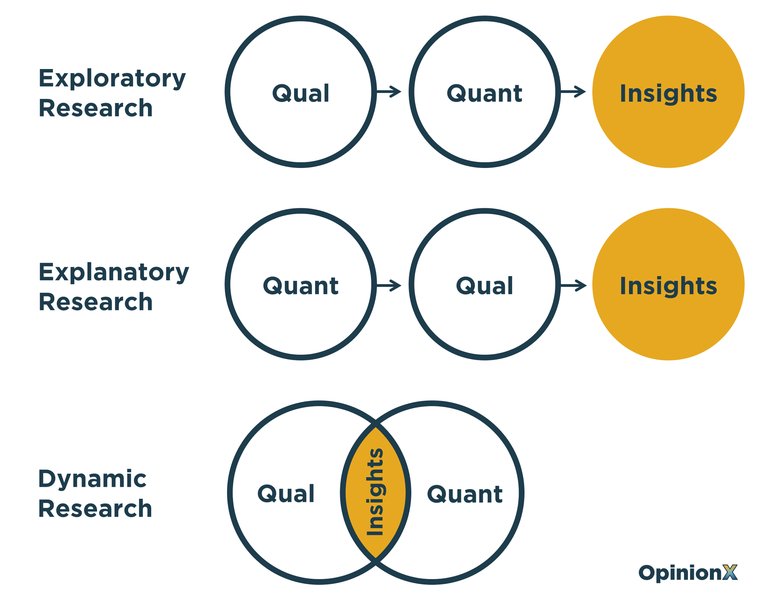
An illustration depicting various types of mixed methods research designs, showcasing their integrated nature.
Triangulation and Validation
A critical advantage of MMR is the ability to triangulate findings. Triangulation involves cross-checking results obtained from different data sources or methodologies. When qualitative and quantitative findings converge, it significantly enhances the validity, reliability, and credibility of the research conclusions. This convergence provides stronger, more confident evidence and reinforces the interpretation of results, making them more persuasive and less susceptible to methodological biases inherent in single-method studies.
Complementarity and Richer Evidence
The complementary nature of qualitative and quantitative data leads to richer and more robust evidence. Qualitative insights can provide the necessary context to interpret quantitative findings, while quantitative data can validate or generalize themes identified qualitatively. This synergy allows for a deeper exploration of complex research questions, offering an enhanced interpretation and applicability, particularly in fields such as health and social sciences where multifaceted problems are common.
Addressing Complex Questions
MMR offers significant flexibility in research design, making it exceptionally well-suited for addressing complex, real-world questions that demand exploration from multiple angles. It allows researchers to investigate both "what" happened (quantitatively) and "why" or "how" it happened (qualitatively). This adaptability enables the integration of inductive (exploratory) and deductive (confirmatory) reasoning, leading to the generation of innovative insights that might remain elusive with a standalone approach.
Instrument Development and Theory Building
Qualitative insights can play a crucial role in informing the development of quantitative measurement instruments, ensuring that surveys and scales are culturally appropriate and capture relevant constructs. Conversely, quantitative findings can help refine qualitative interpretations and contribute to theory building, allowing researchers to move from specific observations to broader theoretical generalizations. This iterative process strengthens both the conceptual foundation and practical utility of the research.
When to Employ a Mixed Methods Approach
The decision to utilize mixed methods should be driven by the research question itself. It is most appropriate when:
- The research question is complex and cannot be adequately answered by either qualitative or quantitative methods alone.
- There is a need to validate quantitative findings with in-depth qualitative explanations, or vice-versa.
- Researchers aim to develop new instruments or theories that require both exploratory qualitative work and confirmatory quantitative testing.
- The study seeks to achieve broader applicability and inform policy or program design more effectively than single-method studies.
This mindmap illustrates the core strengths and weaknesses of mixed methods research, categorizing the advantages and disadvantages for a clearer understanding.
Comparative Analysis of Methodologies
To further contextualize the strengths and weaknesses of mixed methods, it's useful to compare it with purely qualitative and quantitative approaches. The following table summarizes key aspects where MMR distinguishes itself.
| Aspect | Mixed Methods Research | Quantitative Research | Qualitative Research |
|---|---|---|---|
| Primary Goal | Comprehensive understanding, triangulation, complementarity | Generalizability, hypothesis testing, statistical analysis | In-depth understanding, exploration of meaning, context |
| Data Types | Numerical and textual/visual | Numerical (e.g., statistics, surveys) | Textual/visual (e.g., interviews, observations) |
| Depth of Understanding | High (combines both) | Moderate (focus on patterns, less on 'why') | Very high (rich, contextual insights) |
| Generalizability | Moderate to High (can generalize and contextualize) | High (large samples, statistical inference) | Low (small samples, context-specific) |
| Complexity | Very High (design, integration, analysis) | Moderate (statistical expertise) | Moderate (thematic analysis expertise) |
| Resource Demands | Very High (time, cost, expertise) | Moderate (large-scale data collection) | Moderate (time for in-depth data collection/analysis) |
| Credibility/Validity | Enhanced (via triangulation) | Good (statistical rigor) | Good (rich description, trustworthiness) |
A comparative overview of research methodologies, highlighting the distinct characteristics of mixed methods versus standalone approaches.
Understanding Mixed Methods Research: A Visual Guide
To further illustrate the concept of mixed methods research, consider this insightful video from John Creswell, a leading figure in mixed methods methodology. This video provides a foundational understanding of what mixed methods research entails and why it has gained significant traction in various academic disciplines.
A fundamental overview of mixed methods research by Dr. John Creswell, explaining its core tenets and significance in modern research.
Dr. Creswell's explanation highlights how mixed methods approaches are not merely about conducting qualitative and quantitative studies side-by-side but involve a deliberate integration of both paradigms to achieve a more profound understanding. He often emphasizes the pragmatic philosophical stance that underpins mixed methods, where the choice of methods is dictated by the research question and the most effective way to answer it, rather than adherence to a single methodological dogma. This approach allows researchers to leverage the exploratory power of qualitative data to generate hypotheses or inform instrument design, which can then be tested or validated using quantitative methods. Conversely, quantitative findings can identify areas that require deeper, contextual exploration through qualitative inquiry. This cyclical and integrated nature is what truly sets mixed methods apart, enabling researchers to explore complex phenomena from multiple vantage points and derive insights that are both generalizable and deeply contextualized.
Frequently Asked Questions
What is the primary advantage of a mixed methods approach?
What are the main challenges when conducting mixed methods research?
When is mixed methods research most appropriate?
Does mixed methods research increase the credibility of findings?
Is special expertise required for mixed methods research?
Conclusion
In conclusion, mixed methods research offers a powerful and increasingly popular pathway to understanding complex phenomena by synergistically combining qualitative and quantitative approaches. Its strengths lie in providing comprehensive insights, enhancing the validity of findings through triangulation, and offering unmatched flexibility in tackling intricate research questions. However, these benefits come with notable challenges, including increased design and execution complexity, significant resource demands, and the intricate task of integrating diverse data and philosophical perspectives. Researchers considering a mixed methods approach must weigh these advantages against the practical and intellectual demands, ensuring that the chosen methodology truly serves the depth and breadth required by their research objectives.
Recommended Further Exploration
- How to design a mixed methods study effectively?
- What are the best practices for integrating qualitative and quantitative data?
- Explore the philosophical underpinnings of mixed methods research.
- Can you provide examples of successful mixed methods studies in healthcare?