

Key Insights into the Möbius Strip
- Single Continuous Surface: Unlike typical objects, a Möbius strip possesses only one side, meaning you can trace its entire surface without lifting your finger or crossing an edge.
- Formation with a Half-Twist: It is created by taking a rectangular strip, giving one end a 180-degree half-twist, and then joining the ends together to form a loop.
- Non-Orientable Topology: This fascinating object is a fundamental concept in topology, demonstrating non-orientability, where the notions of "inside" and "outside" or "left" and "right" cannot be consistently defined.
The Möbius strip, often a subject of intrigue and wonder, is a simple yet profoundly significant mathematical object. It challenges our intuitive understanding of surfaces by possessing properties that seem paradoxical at first glance. This captivating strip is more than just a mathematical curiosity; it's a testament to the unexpected behaviors that emerge from simple alterations in construction.
The Essence of the Möbius Strip: A Topological Marvel
At its core, a Möbius strip is a surface with remarkable properties: it has only one side and one edge. This contrasts sharply with everyday objects like a sheet of paper, which clearly has two distinct sides and four edges. The creation of a Möbius strip is deceptively simple, yet the implications of its structure are far-reaching within mathematics and beyond.
How to Construct a Möbius Strip
The process of forming a Möbius strip is straightforward, making it an excellent hands-on demonstration of a complex mathematical concept:
- Start with a rectangular strip of material, typically paper.
- Hold one end of the strip steady.
- Give the other end a half-twist, meaning a 180-degree rotation.
- Join the two ends together to form a loop.
This simple act transforms a two-sided, two-edged strip into a single-sided, single-edged topological marvel.
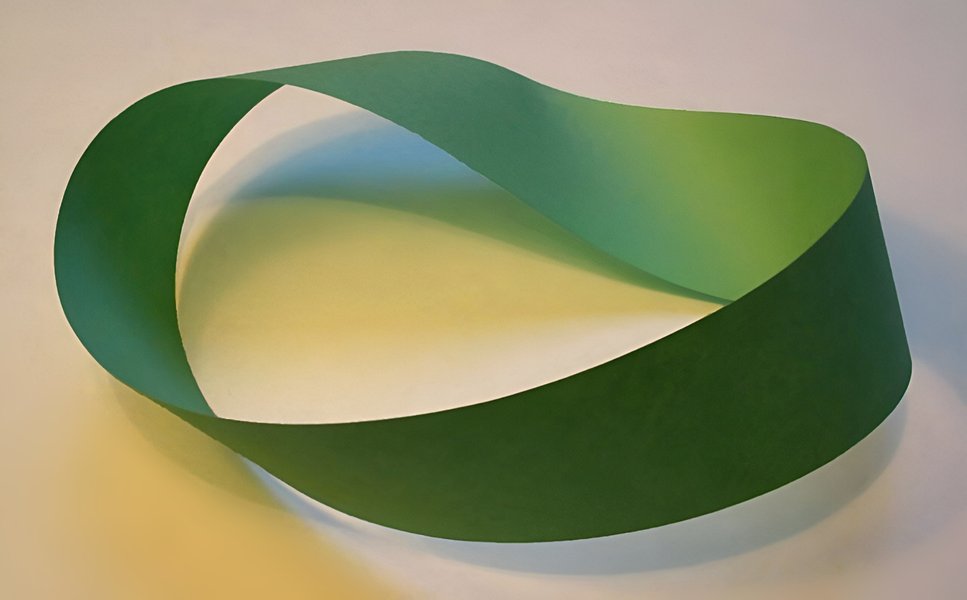
A visual representation of a Möbius Strip, highlighting its characteristic twist.
The Unifying Surface: What Does One Side Mean?
The concept of "one side" can be fully appreciated by performing a simple experiment: if you draw a line along the center of a Möbius strip, without lifting your pen, you will find yourself back at your starting point after traversing what would ordinarily be considered both "sides" of a regular strip. This demonstrates that there is no distinct "other side" to switch to; the entire surface is continuously connected.
Similarly, if you were to trace its edge, you would also traverse the entire boundary of the strip without encountering a break, reinforcing its single-edge property.
Non-Orientability Explained
A key characteristic of the Möbius strip is its non-orientability. In simpler terms, this means that you cannot consistently define an "inside" or "outside," or a "left" or "right" on its surface. Imagine an arrow pointing in a specific direction on the strip. If you move this arrow along the surface, it's possible to return to the starting point with the arrow now pointing in the opposite direction, even though it never flipped over an edge. This property has profound implications in fields like physics and advanced mathematics.
A mindmap illustrating the core concepts and characteristics of the Möbius Strip.
The Surprising Effects of Cutting a Möbius Strip
One of the most fascinating demonstrations of the Möbius strip's unique topology involves cutting it. Unlike a standard loop, where cutting along the centerline would produce two separate, smaller loops, the Möbius strip behaves unexpectedly:
- Cutting along the centerline: If you cut a Möbius strip along its centerline, instead of getting two separate rings, you will end up with a single, longer strip with two full twists. This resulting strip is twice the length of the original Möbius strip and is not itself a Möbius strip, but rather a two-sided ring.
- Cutting parallel to the edge: If you cut a Möbius strip parallel to its edge (about one-third of the way from the edge), you will produce two interlocking loops: one smaller Möbius strip and one longer, two-sided strip.
Applications and Cultural Impact
Beyond its theoretical importance, the Möbius strip has found its way into practical applications and has significantly influenced art and culture, demonstrating its versatility and enduring appeal.
Engineering and Technology
The unique single-sided nature of the Möbius strip makes it ideal for certain mechanical applications where even wear is desired. For example:
- Conveyor Belts: Möbius strip-shaped conveyor belts can last longer because the entire surface experiences friction and wear evenly, effectively doubling their lifespan compared to traditional two-sided belts.
- Typewriter Ribbons and Recording Tapes: Similar to conveyor belts, the design allows for more uniform wear and extended use.
- Novel Electronic and Optical Devices: Researchers are exploring how its unique topology can be leveraged in areas such as molecular electronics, where Möbius-shaped molecules exhibit interesting electronic properties, and in optics for creating specific light paths.
Art, Architecture, and Popular Culture
The visually striking and conceptually intriguing nature of the Möbius strip has made it a popular motif in various creative fields:
- Art: M. C. Escher, a renowned graphic artist, famously incorporated the Möbius strip into his works, most notably in "Möbius Strip II (Red Ants)," where ants endlessly traverse the single surface. Numerous sculptures and architectural designs around the world also draw inspiration from its continuous form.
- Literature and Philosophy: Its paradoxical nature has been used as a metaphor for infinity, cycles, and interconnectedness in literature, philosophy, and even speculative fiction.
- Music: The concept has even been applied to music theory, representing certain aspects of musical structures.

An arch rock formation resembling the elegant twist of a Möbius strip.
Comparative Analysis: Möbius Strip vs. Other Surfaces
To further understand the unique properties of the Möbius strip, it's helpful to compare it to more familiar surfaces and other topological curiosities.
Comparing Surface Properties
The following table highlights how the Möbius strip's properties differ from a standard loop or cylinder, emphasizing its distinct topological characteristics.
| Property | Möbius Strip | Standard Loop/Cylinder |
|---|---|---|
| Number of Sides | One | Two (inside and outside) |
| Number of Edges | One | Two |
| Orientability | Non-orientable | Orientable |
| Behavior when cut along centerline | Forms a single, longer loop with twists | Forms two separate loops |
| Ability to consistently define "left/right" or "inside/outside" | No | Yes |
Video: Diving Deeper into Möbius Strip Experiments
To further illustrate the remarkable properties of the Möbius strip, here's a video demonstrating its various cutting experiments and explaining its cool characteristics. This video provides a hands-on perspective that complements the theoretical explanations, making the abstract concept tangible.
A video exploring the fascinating properties and various experiments that can be performed with a Möbius strip, including cutting it in surprising ways.
Frequently Asked Questions
What is the primary defining characteristic of a Möbius strip?
How is a Möbius strip typically constructed?
What does it mean for a surface to be "non-orientable," and how does the Möbius strip demonstrate this?
Are there any practical applications for the Möbius strip?
Who discovered the Möbius strip?
Conclusion
The Möbius strip stands as a simple yet profound example of topological ingenuity. Its paradoxical nature, characterized by having only one side and one edge, challenges our everyday perception of space and geometry. From its elegant construction through a single half-twist to its surprising behavior when cut, the Möbius strip provides an accessible entry point into the complex and fascinating world of topology. Its influence extends beyond pure mathematics, inspiring applications in engineering and captivating artists and thinkers across various disciplines. The enduring allure of the Möbius strip lies in its ability to reveal how fundamental alterations can lead to remarkably distinct and thought-provoking properties in familiar forms.
Recommended Further Exploration
- How to make a Möbius strip and demonstrate its properties
- What are the mathematical implications of non-orientable surfaces
- M.C. Escher and the Möbius strip in art
- Advanced topological concepts inspired by the Möbius strip