

Möbius transformations, also known as fractional linear transformations, are foundational concepts in complex analysis that profoundly link algebra and geometry. These unique functions operate on the extended complex plane, a conceptual space that integrates the standard complex numbers with a single point representing infinity. This powerful framework allows for a seamless and comprehensive understanding of transformations that might otherwise present singularities or undefined behaviors.
Key Insights into Möbius Transformations and the Extended Complex Plane
- Fundamental Definition: A Möbius transformation is represented by the form \(f(z) = \frac{az + b}{cz + d}\), where \(a, b, c, d\) are complex numbers and the determinant \(ad - bc \neq 0\). This condition ensures the transformation is well-defined and invertible.
- Geometric Preservation: One of their most striking properties is their ability to map "generalized circles" (which include both circles and straight lines) to other generalized circles. They are also conformal, meaning they preserve the angles between intersecting curves.
- The Role of the Extended Complex Plane: The concept of the extended complex plane, often visualized as the Riemann sphere, is crucial. It provides a natural domain for Möbius transformations, resolving issues with points where the denominator might otherwise be zero and allowing for a one-to-one mapping across the entire space, including infinity.
Understanding Möbius Transformations: A Detailed Exploration
Möbius transformations are more than just algebraic formulas; they are powerful geometric operators with far-reaching implications across various scientific and engineering disciplines. Their ability to elegantly handle the concept of infinity is a testament to their mathematical sophistication.
The Algebraic Form and Its Significance
The defining equation for a Möbius transformation is:
\[ f(z) = \frac{az + b}{cz + d} \]Here, \(a, b, c, d\) are complex coefficients. The crucial condition \(ad - bc \neq 0\) guarantees that the transformation is not degenerate (i.e., it doesn't collapse the entire plane to a single point). This condition ensures the transformation has an inverse, making it a bijective mapping.
Matrix Representation and Group Structure
Interestingly, Möbius transformations can be represented by 2x2 matrices:
\[ M = \begin{pmatrix} a & b \ c & d \end{pmatrix} \]The composition of two Möbius transformations corresponds directly to the multiplication of their respective matrices. This matrix representation reveals that the set of all Möbius transformations forms a group under composition, often denoted as PSL(2, ℂ), a projective special linear group over the complex numbers. This group structure highlights their fundamental role in mathematical symmetries.
Decomposition into Basic Transformations
Any Möbius transformation can be understood as a sequence of simpler, more intuitive transformations:
- Translation: \(f(z) = z + b\)
- Scaling/Rotation (Homothety): \(f(z) = az\)
- Inversion: \(f(z) = 1/z\)
By combining these fundamental operations, the complex behavior of any Möbius transformation can be deconstructed and analyzed. For example, the transformation \(f(z) = \frac{az + b}{cz + d}\) can be rewritten as \(f(z) = \frac{a}{c} + \frac{bc - ad}{c(cz + d)}\) (assuming \(c \neq 0\)). This form reveals a composition of operations: translation, scaling, inversion, scaling again, and finally another translation.
The Extended Complex Plane: Embracing Infinity
The concept of the extended complex plane, denoted as \(\mathbb{C}_\infty\) or \(\mathbb{C}^*\), is paramount for Möbius transformations. It transforms the standard complex plane by adding a single "point at infinity."
Conceptual representation of how the complex plane can be extended to include infinity.
The Riemann Sphere: A Geometric Visualization
The most intuitive way to visualize the extended complex plane is through the Riemann sphere. This is a sphere tangent to the complex plane at the origin. Points on the complex plane can be mapped to points on the sphere via stereographic projection. The point at infinity in the complex plane corresponds to the north pole of the Riemann sphere. This geometric model provides a consistent way to handle infinity, turning complex analysis problems into geometric problems on a sphere.
On the Riemann sphere, generalized circles (lines and circles in the complex plane) appear as circles on the sphere. Möbius transformations are precisely the conformal bijections (angle-preserving transformations) of this sphere to itself. This elegant equivalence allows for a unified understanding of their behavior.
Properties and Behavior of Möbius Transformations
The unique characteristics of Möbius transformations make them invaluable tools in various mathematical and applied contexts.
This mindmap outlines the essential properties that define Möbius transformations, from their ability to map generalized circles to their underlying group structure and their generation from simpler transformations.
Mapping of Generalized Circles
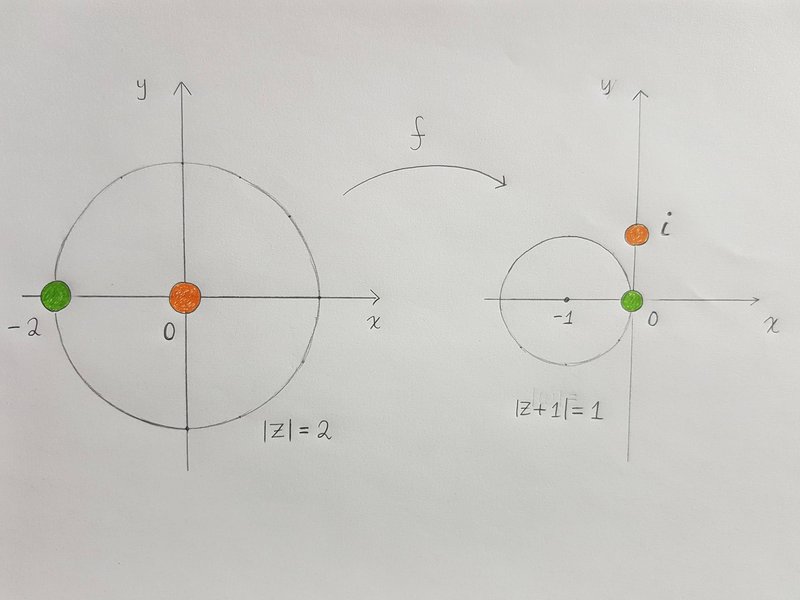
Perhaps the most celebrated property of Möbius transformations is their action on "generalized circles." In complex analysis, a generalized circle refers to either a Euclidean circle or a straight line. Möbius transformations invariably map generalized circles to other generalized circles. This is a powerful geometric result, simplified by considering lines as circles passing through the point at infinity on the Riemann sphere.
Conformality
Möbius transformations are conformal mappings. This means they preserve the angles between intersecting curves locally. While they may distort shapes and sizes, the angles between curves remain unchanged. This property is crucial in fields like fluid dynamics and cartography.
Fixed Points
A fixed point of a Möbius transformation \(f(z)\) is a point \(z_0\) such that \(f(z_0) = z_0\). Solving the equation \(z = \frac{az + b}{cz + d}\) typically leads to a quadratic equation, meaning a Möbius transformation can have one or two fixed points. These fixed points provide critical information about the transformation's dynamics.
Uniqueness
A Möbius transformation is uniquely determined by its action on any three distinct points in the extended complex plane. If you know where three points map to, you can uniquely determine the coefficients \(a, b, c, d\) (up to a scalar multiple) of the transformation.
Applications Across Disciplines
The mathematical elegance and robust properties of Möbius transformations make them indispensable in numerous fields.
Electrical Engineering
In electrical engineering, Möbius transformations are critical in the analysis of digital filters and the design of microwave circuits. The Smith chart, a graphical aid used in radio frequency (RF) engineering, is a direct application of a specific Möbius transformation that maps the right half of the complex plane (representing positive resistances) to the unit disk.
Computer Graphics and Visualization
Möbius transformations find use in computer graphics, particularly in spherical video processing, virtual reality, and panoramic image stitching. They allow for seamless zooming, rotating, and transformations of 360-degree content, leveraging the properties of the Riemann sphere to manipulate visual information without distortion at the "edges."
The video "Möbius Transformations Revealed [HD]" by Douglas Arnold and Jonathan Rogness beautifully visualizes the dynamic and geometric actions of Möbius transformations. It provides an intuitive understanding of how these transformations manipulate the complex plane and the Riemann sphere, showcasing their angle-preserving and circle-mapping properties through compelling animations. This visual aid is invaluable for grasping the abstract concepts discussed.
Complex Analysis and Geometry
Beyond their practical applications, Möbius transformations are fundamental to theoretical complex analysis and non-Euclidean geometries, especially hyperbolic geometry. They form the group of isometries of the hyperbolic plane, meaning they preserve distances in this non-Euclidean space.
Linear Algebra
The Cayley transform, a specific Möbius transformation, maps skew-symmetric matrices to orthogonal matrices. This demonstrates a fascinating link between complex analysis and linear algebra, highlighting their utility in studying matrix properties and transformations.
The Interplay of Concepts: A Summary Table
To further consolidate the relationship between Möbius transformations and the extended complex plane, the following table summarizes their key attributes and their combined impact.
| Concept | Definition/Description | Role in Möbius Transformations | Key Property/Result |
|---|---|---|---|
| Möbius Transformation | \(f(z) = \frac{az + b}{cz + d}\) with \(ad - bc \neq 0\). | The transformation itself, a conformal bijection. | Maps generalized circles to generalized circles; preserves angles. |
| Extended Complex Plane | \(\mathbb{C} \cup \{\infty\}\), the complex plane augmented with a single point at infinity. | The natural domain and codomain for all Möbius transformations. | Resolves singularities; makes transformations well-defined everywhere. |
| Riemann Sphere | A geometric model of the extended complex plane via stereographic projection. | Visualizes Möbius transformations as rotations/symmetries on the sphere. | Generalized circles become circles on the sphere; infinity is the North Pole. |
| Conformality | Preservation of angles between intersecting curves. | A fundamental property of all Möbius transformations. | Essential for applications like mapping and fluid dynamics. |
| Generalized Circles | Euclidean circles or straight lines in the complex plane. | The objects that Möbius transformations map to each other. | Simplifies geometric understanding and proofs. |
| Group Structure | Möbius transformations form a group under composition. | Implies closure, associativity, identity, and inverses. | Allows for algebraic manipulation and classification of transformations. |
FAQ: Deep Diving into Möbius Transformations
What is the significance of the condition \(ad - bc \neq 0\)?
How does a Möbius transformation handle the point at infinity?
- If \(c \neq 0\), the point \(z = -d/c\) is mapped to infinity (\(\infty\)), because the denominator becomes zero. Conversely, the point at infinity (\(\infty\)) is mapped to \(a/c\).
- If \(c = 0\), the transformation simplifies to \(f(z) = \frac{az+b}{d}\), which is a linear transformation. In this case, \(d \neq 0\) (because \(ad - bc \neq 0\) becomes \(ad \neq 0\)). The point at infinity (\(\infty\)) is mapped to itself.
Are all conformal mappings Möbius transformations?
What is the practical difference between a line and a circle in the context of Möbius transformations?
Can Möbius transformations be used in 3D?
Conclusion
Möbius transformations, operating on the extended complex plane (the Riemann sphere), represent a pinnacle of elegance in complex analysis. Their ability to map generalized circles to generalized circles, preserve angles, and seamlessly incorporate the concept of infinity makes them powerful tools for both theoretical mathematics and diverse applied fields. From the intricate dynamics of electrical circuits to the visual manipulations in computer graphics, these transformations provide a consistent and insightful framework for understanding complex phenomena. Their fundamental nature, derived from simple geometric operations and reinforced by a robust group structure, ensures their continued relevance and utility in a wide array of scientific and engineering challenges.
Recommended Further Exploration
- Geometric interpretation of complex analysis and Riemann sphere
- Applications of conformal mapping in engineering
- Möbius transformations in hyperbolic geometry
- Matrix representation and group theory of fractional linear transformations