
Unlocking Molecular Interactions: A Deep Dive into Docking and Modeling
Exploring computational tools that predict how molecules bind and proteins fold, revolutionizing drug discovery and structural biology.
In the realms of computational biology, structural biology, and drug discovery, understanding how molecules interact and how proteins assume their functional shapes is paramount. Two powerful computational techniques stand out: Molecular Docking and Homology Modeling. While distinct in their primary goals, they often work in concert to provide invaluable insights that accelerate scientific research and the development of new therapies. This guide offers a detailed exploration of both methods, outlining their processes, significance, and diverse applications.
Key Insights at a Glance
- Predictive Power: Molecular docking predicts how a small molecule (ligand) binds to a target (receptor), estimating binding pose and affinity, crucial for drug design.
- Structural Scaffolding: Homology modeling predicts the 3D structure of a protein based on its amino acid sequence and known structures of related proteins, essential when experimental structures are unavailable.
- Synergistic Workflow: These techniques are complementary; homology modeling can generate the protein structure needed as input for molecular docking studies, bridging the gap between sequence and interaction analysis.
Molecular Docking: Simulating the Molecular Handshake
Predicting How Molecules Fit Together
Molecular docking is a computational method designed to predict the preferred orientation and binding affinity of one molecule (the ligand, often a small drug candidate) when it interacts with another (the receptor, typically a protein or nucleic acid). Its core purpose is to simulate the molecular recognition process, figuring out how a 'key' (ligand) fits into a 'lock' (receptor's binding site). However, acknowledging the flexibility of both molecules, the 'hand-in-glove' analogy, where both components can adjust their shapes upon binding (induced fit), is often more accurate. This technique is a cornerstone of structure-based drug design (SBDD).
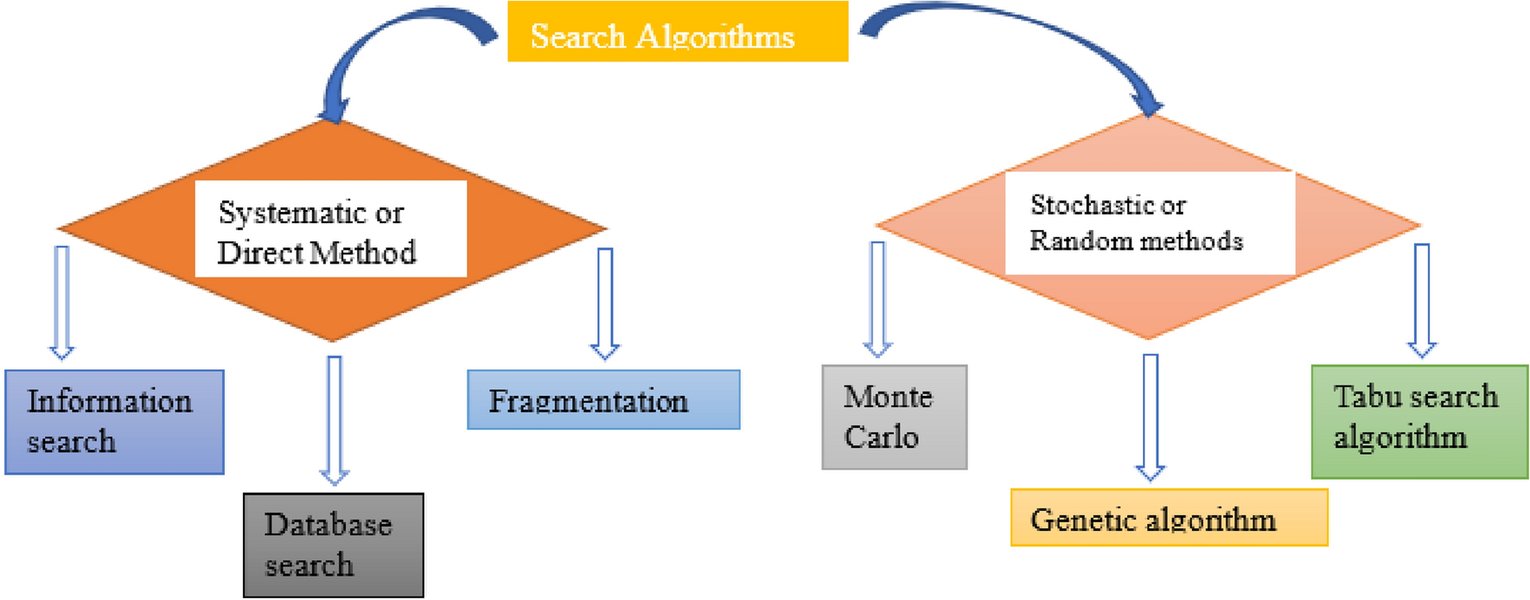
Schematic overview of the molecular docking process.
The Step-by-Step Docking Process
While specific implementations vary across software, the typical molecular docking workflow involves these fundamental steps:
- Receptor Preparation: Obtain the 3D structure of the receptor (protein). This can be sourced from experimental databases like the Protein Data Bank (PDB) or predicted using methods like homology modeling. Preparation involves cleaning the structure (e.g., removing water molecules, co-factors unless relevant), adding hydrogen atoms, and assigning atomic charges.
- Ligand Preparation: Obtain or generate the 3D structure of the ligand(s). Structures can come from databases (e.g., ZINC, PubChem) or be drawn using molecular editors. Preparation includes geometry optimization, assigning charges, and defining rotatable bonds. For virtual screening, ligand libraries might be filtered based on drug-like properties (e.g., Lipinski's rule of five).
- Binding Site Identification & Grid Generation: Define the region on the receptor where the ligand is expected to bind (the active site or a known binding pocket). Often, a grid is generated within this site to guide the docking algorithm.
- Docking Simulation (Search Algorithm): Employ algorithms (e.g., genetic algorithms, Monte Carlo simulations, systematic searches) to explore possible binding poses. This involves translating and rotating the ligand within the binding site and sampling its conformational flexibility, as well as potentially receptor flexibility (flexible docking).
- Scoring and Ranking: Evaluate each generated pose using a scoring function. Scoring functions estimate the binding free energy or a related score based on factors like van der Waals interactions, electrostatic forces, hydrogen bonds, desolvation energy, and entropic effects. Poses are ranked, with the lowest energy (or highest score, depending on the function) typically considered the most favorable prediction.
- Analysis and Validation: Analyze the top-ranked poses. Visualize the predicted interactions (e.g., hydrogen bonds, hydrophobic contacts) between the ligand and receptor residues. If available, compare computational predictions with experimental data (e.g., known binding modes, structure-activity relationships) for validation. Further refinement using techniques like molecular dynamics simulation may be performed.
Why Molecular Docking Matters: Key Applications
Molecular docking is indispensable in modern molecular sciences, offering significant advantages:
- Drug Discovery & Design: Its primary application. Used for:
- Virtual Screening: Rapidly screening vast libraries of chemical compounds computationally to identify potential 'hits' likely to bind to a therapeutic target.
- Hit-to-Lead Optimization: Guiding the chemical modification of promising hit compounds to improve their binding affinity, selectivity, and pharmacokinetic properties.
- Understanding Mechanisms: Elucidating how drugs, metabolites, or signaling molecules interact with their biological targets at an atomic level, providing insights into their mechanism of action.
- Binding Site Prediction: Identifying potential binding pockets on a protein surface, even when the natural ligand is unknown.
- Biomolecular Interaction Studies: Investigating interactions not just between proteins and small molecules, but also protein-protein and protein-nucleic acid interactions.
- Natural Product Research: Evaluating the potential biological targets of compounds isolated from natural sources.
Introduction to Molecular Docking and Protein-Ligand Interactions.
This video provides a foundational overview of molecular docking, explaining the concepts of protein-ligand interactions that form the basis of this computational technique. It visually introduces the goals and general principles involved in simulating how a ligand might fit into a protein's binding site, which is central to understanding the docking process described above.
Homology Modeling: Building Proteins from Blueprints
Predicting Protein Structures Using Known Templates
Homology modeling, also known as comparative modeling, is a computational technique used to predict the three-dimensional (3D) structure of a target protein based on its amino acid sequence and the experimentally determined structure of a related homologous protein (the template). It operates on the principle that proteins sharing significant sequence similarity likely adopt similar overall folds. This method is extremely valuable when experimental structure determination (via X-ray crystallography, NMR spectroscopy, or cryo-EM) is challenging or infeasible for a protein of interest.
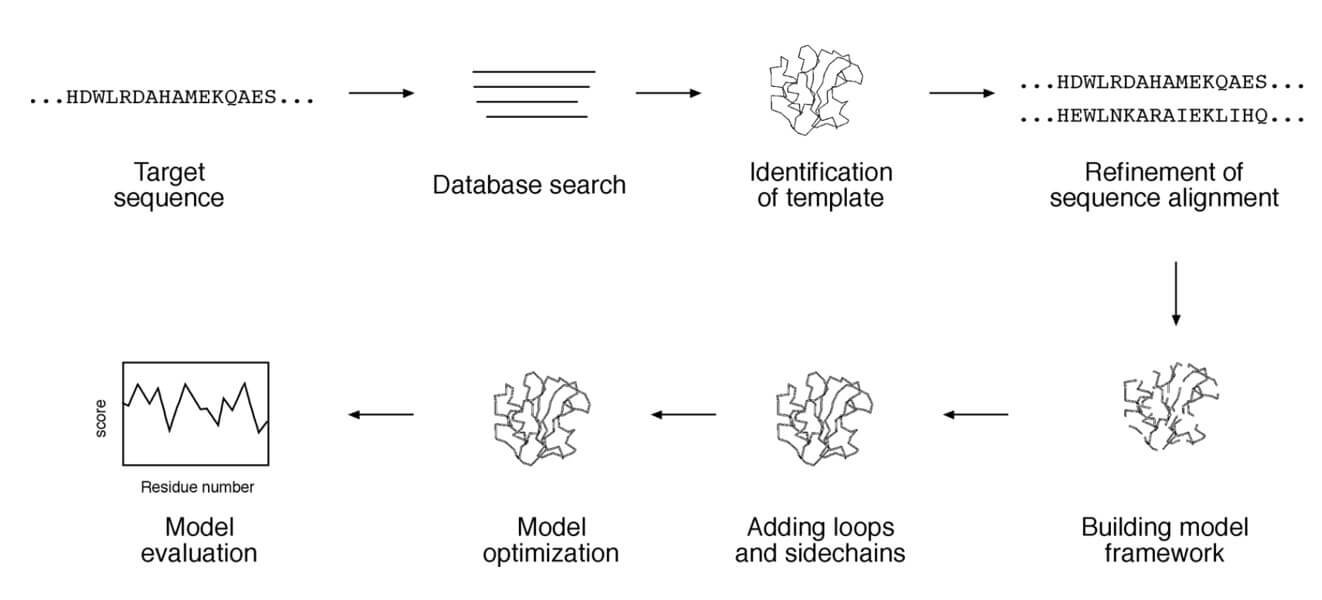
The sequential steps typically involved in homology modeling.
The Step-by-Step Modeling Process
Constructing a reliable protein model through homology modeling involves several critical stages:
- Template Identification and Selection: Search sequence databases (like the PDB) using the target protein's amino acid sequence to find proteins with known 3D structures that exhibit significant sequence similarity. Tools like BLAST or HHpred are commonly used. The quality of the model heavily depends on the sequence identity between the target and template(s); generally, >30% identity is needed for a reasonable model, with >50% often yielding good quality models. The resolution and quality of the template structure(s) are also crucial factors.
- Sequence Alignment: Align the target sequence with the template sequence(s). This step is critical as it establishes the correspondence between residues in the target and the template, dictating which template coordinates will be used for each part of the target model. Accurate alignment is especially important in regions of lower similarity and around insertions or deletions (indels).
- Model Building: Construct the 3D model of the target protein.
- Backbone Generation: Copy the coordinates of the aligned residues from the template(s) to the target protein's backbone.
- Loop Modeling: Regions where the target sequence has insertions or deletions relative to the template (loops) require special modeling, often using database fragment searches or ab initio methods.
- Side-Chain Placement: Build and optimize the conformations of the amino acid side chains onto the constructed backbone, considering rotamer libraries and steric constraints.
- Model Refinement: Optimize the initial model to correct structural inaccuracies, unfavorable bond lengths/angles, steric clashes, and improve overall stereochemical quality. This often involves energy minimization or short molecular dynamics simulations.
- Model Validation and Assessment: Evaluate the quality and reliability of the generated 3D model using various tools and metrics. This includes checking stereochemical parameters (e.g., Ramachandran plots to assess backbone dihedral angles), evaluating packing quality, and comparing the model's energy profile to known structures (e.g., using tools like ProSA-web or Verify3D).
Why Homology Modeling Matters: Key Applications
Homology modeling provides crucial structural information with wide-ranging applications:
- Providing Structural Insights: Generates 3D models for proteins whose structures have not been solved experimentally, enabling visualization and analysis of structure-function relationships.
- Drug Discovery and Target Validation: Creates models of therapeutic targets (receptors, enzymes) that can be used as input for molecular docking studies to screen for potential drugs, especially when experimental structures are lacking.
- Functional Annotation: Helps predict protein function by identifying conserved structural motifs, potential active sites, or binding pockets based on the template's known function and structure.
- Understanding Mutations and Disease: Allows researchers to map disease-associated mutations onto the protein structure to hypothesize about their effects on protein stability, interactions, or function.
- Protein Engineering: Aids in designing mutations to alter protein properties (e.g., stability, substrate specificity) by providing a structural context for rational design efforts.
Bridging the Gap: Docking and Modeling Synergy
How These Techniques Work Together
Molecular docking and homology modeling are often used sequentially in computational drug discovery workflows. When a researcher wants to perform docking simulations to find ligands for a specific protein target, a reliable 3D structure of that protein is required. If an experimental structure is unavailable in databases like the PDB, homology modeling becomes the go-to method to generate a predicted 3D structure. This homology model can then serve as the receptor input for subsequent molecular docking calculations. While models have limitations compared to high-resolution experimental structures, they provide essential structural information that enables structure-based drug design efforts that would otherwise be impossible.
Comparative Overview
The table below summarizes the key differences and complementarity between molecular docking and homology modeling:
| Aspect | Molecular Docking | Homology Modeling |
|---|---|---|
| Primary Goal | Predict ligand binding mode & affinity | Predict protein 3D structure |
| Primary Input | Receptor 3D structure, Ligand structure(s) | Target protein sequence, Template 3D structure(s) |
| Core Process | Simulating ligand placement & scoring interactions | Building structure based on sequence alignment to template(s) |
| Key Output | Ranked binding poses, interaction scores/affinity estimates | Predicted 3D coordinates of the target protein |
| Main Application Area | Drug discovery (virtual screening, lead optimization), interaction analysis | Structural biology (structure prediction), providing inputs for docking/dynamics |
| Dependency | Requires receptor structure (experimental or modeled) | Requires homologous template structure(s) |
Visualizing Key Aspects: A Comparative Radar Chart
Comparing Docking and Modeling Across Dimensions
To better visualize the characteristics and dependencies of these two powerful techniques, the following radar chart compares them across several key dimensions. These scores represent qualitative assessments based on typical usage and inherent properties of the methods:
This chart highlights that molecular docking heavily relies on a known (or modeled) 3D structure and is central to predicting binding affinity and early drug discovery screening. Homology modeling's strength lies in predicting the protein fold itself, highly sensitive to template quality and sequence alignment, and crucial when experimental structures are unavailable, often enabling subsequent docking studies.
Conceptual Overview: Mindmap Summary
Connecting the Concepts of Docking and Modeling
The following mindmap provides a visual summary connecting the core concepts, processes, and applications of both molecular docking and homology modeling.
(Virtual Screening, Lead Opt.)"] id1_3_2["Mechanism of Action Studies"] id1_3_3["Binding Site Identification"] id1_3_4["Interaction Analysis"] id2["Homology Modeling"] id2_1["Purpose"] id2_1_1["Predict Protein 3D Structure"] id2_1_2["Use Sequence Similarity"] id2_1_3["Based on Known Templates"] id2_2["Steps"] id2_2_1["Template Identification"] id2_2_2["Sequence Alignment"] id2_2_3["Model Building
(Backbone, Loops, Side-chains)"] id2_2_4["Model Refinement"] id2_2_5["Model Validation"] id2_3["Applications"] id2_3_1["Structure Prediction (No Exp. Data)"] id2_3_2["Input for Docking/Dynamics"] id2_3_3["Functional Annotation"] id2_3_4["Mutation Impact Analysis"] id2_3_5["Protein Engineering"] id3["Relationship"] id3_1["Complementary Techniques"] id3_2["Homology Model can be input for Docking"]
This mindmap illustrates how both techniques branch from computational structural biology, detailing their individual purposes, procedural steps, and key areas of application, while also highlighting their synergistic relationship, particularly in drug discovery pipelines.
Frequently Asked Questions (FAQ)
Common Queries About Molecular Docking and Homology Modeling
What are the main limitations of molecular docking?
How accurate are homology models?
What software is commonly used for these techniques?
Can molecular docking predict if a compound will be a successful drug?
Recommended Further Exploration
Dive Deeper into Related Topics
- How do different molecular docking scoring functions compare in accuracy?
- What are advanced techniques used for loop modeling and refinement in homology modeling?
- What is the role of molecular dynamics simulations in validating docking poses and homology models?
- How is machine learning being applied to improve molecular docking and protein structure prediction?
References
Sources Used for This Analysis
Last updated May 2, 2025