

Essential Insights into Molecular Electronics
- Molecular Electronics is a paradigm shift, aiming to bypass the inherent limitations of silicon-based technology by utilizing individual molecules as active electronic components.
- Molecular Junctions are the foundational structures, acting as critical interfaces where molecules are precisely positioned between electrodes to facilitate charge transport.
- NEGF-DFT is the indispensable computational engine, merging Non-Equilibrium Green's Function theory with Density Functional Theory to accurately predict and analyze the complex quantum electron transport within these molecular junctions.
Molecular electronics represents a revolutionary field at the intersection of physics, chemistry, and materials science. It endeavors to utilize individual molecules or precisely arranged molecular assemblies as the fundamental components of electronic devices. This groundbreaking approach offers the promise of overcoming the miniaturization bottlenecks currently faced by traditional silicon-based electronics, potentially leading to devices that are smaller, faster, more energy-efficient, and capable of novel functionalities. The core idea is to harness the intrinsic electronic properties of molecules to construct wires, transistors, diodes, and memory elements at an unprecedented scale.
The vision behind molecular electronics extends beyond simply shrinking existing technologies; it seeks to unlock entirely new device capabilities by leveraging quantum mechanical phenomena inherent at the molecular level. This ambition drives intensive research into understanding and controlling charge transport through these minuscule building blocks.
Bridging the Gap Between Molecules and Macroscopic Circuits
At the heart of molecular electronics lies the concept of a molecular junction. This fundamental structure involves a single molecule, or a small cluster of molecules, precisely connected between two metallic electrodes. These electrodes provide the pathway for electrons to enter and exit the molecular component, establishing an electrical circuit at the nanoscale. Molecular junctions are the atomic-level analogs of resistors or diodes, allowing for controlled electron flow.
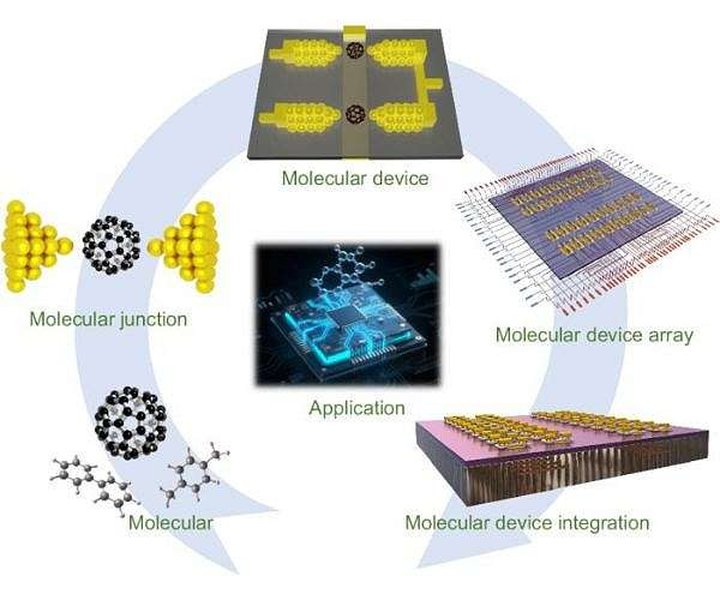
An illustration depicting a molecular junction, showcasing the concept of utilizing individual molecules as electronic components to push beyond silicon limits.
The formation and stability of these junctions are critical for the functionality of molecular devices. Various sophisticated fabrication techniques are employed, including:
- Break-junction methods: Involving the mechanical separation of electrodes to trap a molecule in the resulting gap.
- Self-assembled monolayers (SAMs): Where molecules spontaneously arrange themselves on a surface, forming a well-ordered layer.
- Scanning Tunneling Microscopy (STM) setups: Utilizing a sharp metallic tip to manipulate and connect individual molecules.
In molecular junctions, electron transport primarily occurs via quantum tunneling. Unlike classical electron flow, where electrons move through a conductor, in tunneling, electrons can pass through an energy barrier even if they do not possess sufficient energy to overcome it classically. This quantum mechanical phenomenon is central to the operation of molecular electronic devices. The specific characteristics of this transport, such as current-voltage (I-V) curves, are profoundly influenced by the molecular structure, the nature of the electrode-molecule contacts, and external factors like temperature or mechanical strain.
Factors Influencing Molecular Junction Performance
The performance of molecular junctions is a complex interplay of several factors:
- Electrode-molecule contacts: The way a molecule attaches to the electrodes significantly impacts charge injection and extraction.
- Intermolecular interactions: In assemblies of molecules, interactions between adjacent molecules can modify transport pathways.
- Vibrational effects: Molecular vibrations can couple with electron transport, leading to phenomena like vibronic coupling, which can assist or hinder electron flow.
- Conformational changes: The flexibility and stiffness of organic semiconductors within junctions can alter conductance.
- Environmental factors: Temperature, strain, and the surrounding medium can all influence the electronic properties of the molecular junction.
Researchers often employ statistical methods, such as transition voltage spectroscopy (TVS), to analyze charge transport and identify energy barriers and contact effects. Enhanced conductance can result from optimal orbital alignment or vibronic assistance, where molecular vibrations facilitate electron transfer.
Modeling Quantum Transport at the Nanoscale
To truly understand and predict the behavior of molecular electronic devices, advanced computational tools are indispensable. The Non-Equilibrium Green's Function (NEGF) combined with Density Functional Theory (DFT) stands as the leading computational framework for simulating quantum transport in molecular junctions. This powerful hybrid method merges two distinct theoretical approaches:
- Density Functional Theory (DFT): Provides an accurate description of the electronic structure of the molecule and the interfaces between the molecule and the electrodes. It calculates the ground state electronic properties, including orbital energies and wavefunctions.
- Non-Equilibrium Green's Function (NEGF) theory: Addresses the non-equilibrium conditions that exist when a voltage bias is applied across the molecular junction. It is specifically designed to describe open quantum systems, where particles can flow in and out.
The combination of NEGF and DFT allows researchers to calculate the transmission function T(E), which is a crucial quantity that describes the probability of an electron with energy E passing through the molecular junction. This transmission function is then used in the Landauer formula to predict the current (I) flowing through the junction at a given bias voltage (V):
\[ I = \frac{2e}{h} \int T(E) [f_L(E) - f_R(E)] dE \]Here, e is the elementary charge, h is Planck's constant, and \(f_L(E)\) and \(f_R(E)\) are the Fermi-Dirac distributions of the left and right electrodes, respectively. This formula allows for the theoretical prediction of current-voltage (I-V) characteristics, which are directly comparable to experimental measurements.
The NEGF-DFT Workflow and Its Insights
A typical NEGF-DFT simulation workflow involves several steps:
- Device Region Construction: Defining the molecular system, including the molecule itself and the relevant contact atoms from the electrodes.
- Electronic Structure Calculation (DFT): Computing the Hamiltonian and overlap matrices for this device region using DFT.
- Electrode Self-Energies: Determining the self-energies of the left and right electrodes, which represent their coupling to the central molecular region.
- Green's Function Formation: Constructing the retarded Green's function (\(G^r\)) for the entire system.
- Coupling Functions: Calculating the coupling functions (\(\Gamma_L\) and \(\Gamma_R\)) that describe how strongly the molecule interacts with each electrode.
- Transmission Function Derivation: Obtaining the transmission function \(T(E)\) from \(G^r\) and the coupling functions.
- Current-Voltage Integration: Integrating \(T(E)\) with the Fermi-Dirac distributions to generate the I-V curves.
NEGF-DFT is invaluable for:
- Predicting the conductance of molecular junctions.
- Revealing the impact of gating, conformational changes, and specific molecular structures on electron transport.
- Analyzing how electron-electron interactions and electron-vibration couplings can influence conductance histograms and inelastic transport features.
From Fundamental Understanding to Commercialization
Molecular electronics offers a plethora of potential applications, aiming to extend Moore's Law and introduce novel functionalities beyond current semiconductor capabilities.
This animation from the Quantum Engineering of Molecular Materials and Devices (QEMMAD) research collaboration vividly introduces molecular electronics, illustrating how individual molecules can function as fundamental electronic building blocks. It provides an excellent visual foundation for understanding the concepts discussed, from the integration of molecules into circuits to the quantum mechanical phenomena governing their behavior.
Diverse Device Implementations
The field is actively exploring the creation of various molecular-scale devices:
- Nano-transistors, diodes, and switches: Harnessing molecular properties for logic operations.
- Memory elements: Utilizing different molecular states to store information.
- Sensors: Detecting environmental changes through conductance shifts caused by molecular interactions.
- Molecular wires: Creating nanoscale interconnects for efficient charge transfer.
- Spintronics: Exploring the use of electron spin in paramagnetic molecules for quantum computing and data storage.
Recent advancements are not limited to theoretical understanding. Practical progress includes developing techniques for stable and reproducible electrode-molecule connections and exploring novel molecular materials. Supramolecular chemistry, for instance, is being leveraged to enhance current flow through designed molecular architectures.
Navigating the Path to Real-World Molecular Devices
While the potential of molecular electronics is immense, significant challenges remain on the path to widespread adoption and commercialization. These include:
- Reproducibility: Ensuring consistent device performance given the inherent variability at the nanoscale.
- Reliable Contacts: Achieving robust and stable electrical connections between molecules and electrodes.
- Quantum Fluctuations: Managing and utilizing the inherent quantum mechanical uncertainties in measurements.
- Integration: Developing scalable methods to integrate billions of molecular components into complex circuits.
- Beyond-DFT Approaches: Advancing computational methods to account for more complex electron correlation effects and many-body interactions.
The field is highly dynamic, with ongoing conferences and research initiatives highlighting its rapid evolution. The goal is not just to replace existing silicon technology but to unlock entirely new device functionalities and push the boundaries of what electronics can achieve.
An Integrated View of Molecular Electronics, Junctions, and NEGF-DFT
To provide a comprehensive overview, the following table summarizes the key aspects of molecular electronics, molecular junctions, and the NEGF-DFT computational framework.
| Concept | Description | Role in Molecular Electronics | Key Challenges/Opportunities |
|---|---|---|---|
| Molecular Electronics | Interdisciplinary field using single molecules or molecular assemblies as electronic components. Aims to overcome silicon limits. | Foundation for next-generation electronics (faster, smaller, novel functions). | Miniaturization, performance, energy efficiency, extending Moore's Law. |
| Molecular Junctions | Structures where molecules are bridged between two electrodes, facilitating electron transport. Basic building block for molecular devices. | Enables charge transport at the nanoscale; fundamental for molecular transistors, diodes, etc. | Reliable electrode-molecule contacts, reproducibility, understanding quantum transport mechanisms (tunneling, hopping, vibronic coupling). |
| NEGF-DFT | Computational method combining Non-Equilibrium Green's Function theory with Density Functional Theory. | Predicts current-voltage characteristics, transmission functions, and electronic properties in molecular junctions under bias. Essential for device design and understanding. | Accounting for many-body effects, electron-phonon coupling, correlation, scalability for complex systems, accuracy for open systems. |
This integrated perspective highlights how each component is crucial for the advancement of molecular electronics. From the fundamental idea of using molecules as circuit elements to the sophisticated theoretical tools required to model their behavior, the field is pushing the boundaries of scientific understanding and technological innovation.
Frequently Asked Questions
What is the primary goal of molecular electronics?
How are molecular junctions formed?
Why is NEGF-DFT important in molecular electronics research?
What are some potential applications of molecular electronics?
What are the main challenges in developing molecular electronic devices?
Conclusion
Molecular electronics stands as a frontier science, actively redefining the possibilities of electronic devices. By harnessing the exquisite properties of individual molecules, it offers a path to overcome the inherent limitations of silicon technology, paving the way for unprecedented miniaturization, enhanced performance, and novel functionalities. Molecular junctions serve as the critical interfaces, translating molecular characteristics into electronic signals. The sophisticated NEGF-DFT computational framework is an indispensable tool, providing the theoretical underpinnings necessary to understand, predict, and design these nanoscale marvels. While significant challenges in reproducibility, stability, and large-scale integration remain, the rapid advancements in both experimental techniques and theoretical modeling underscore the immense potential of this field to revolutionize electronics and computing in the coming decades.
Recommended Further Reading
- Advanced computational methods for quantum transport in molecular devices
- Experimental techniques for fabricating and characterizing molecular junctions
- Future trends and commercialization potential of molecular electronics
- Impact of quantum effects on electron transport in nanoscale systems