
Unlocking Value: Strategies to Monetize Your Long-Term Stock Holdings
Transforming Appreciated Assets into Tangible Returns and Financial Flexibility
For investors holding a long-term stock position, the journey from initial purchase to substantial appreciation often involves patience and conviction. Once those holdings have grown significantly in value, the question naturally shifts from "how do I grow this?" to "how can I effectively realize or utilize this wealth?" Monetizing long-term stock means converting its value into cash or other accessible forms of wealth, while ideally minimizing tax implications and managing risk. This doesn't always mean outright selling; it can involve a variety of sophisticated strategies designed to generate income, diversify, or access liquidity without fully divesting your position.
Key Highlights for Monetizing Long-Term Stock Holdings
- Capital Gains and Dividends are Primary Returns: The most direct ways to make money from stocks are through price appreciation (selling for a capital gain) and receiving regular dividend payments. Long-term holdings typically benefit from favorable tax rates on capital gains.
- Income-Generating Strategies Offer Flexibility: Beyond selling, strategies like writing covered calls or engaging in income investing can provide a steady stream of cash flow while maintaining ownership of the underlying shares.
- Tax Efficiency and Risk Management are Crucial: Thoughtful planning, including understanding holding periods, cost basis methods, and various monetization techniques, is essential to minimize tax burdens and manage the inherent risks of concentrated stock positions.
Understanding Your Long-Term Stock Holdings
A "stock holding" refers to the specific investments an individual or entity maintains within their portfolio. For long-term investors, these holdings are typically acquired with the intention of being held for more than a year, often spanning several years or even decades. The primary appeal of long-term investing lies in its potential for significant capital appreciation and, in many cases, consistent income generation through dividends. This strategy is favored for its ability to weather market volatility and leverage the power of compounding returns over time.
The Fundamentals of Making Money from Stocks
There are two fundamental ways to generate returns from stock investments:
Capital Appreciation: Selling for a Profit
This is the most common and straightforward method. When you buy a stock at one price and sell it later at a higher price, the difference is your capital gain. For long-term investors, the goal is to buy fundamentally strong companies and hold them as their market value increases. The "long stock" strategy, where you simply buy shares, is predicated on the expectation that the stock's price will rise over time. The profit is not realized until the stock is actually sold.
Dividend Income: Regular Payouts
Many companies, especially those that are mature and profitable, choose to distribute a portion of their earnings to shareholders in the form of dividends. These are regular cash payments (or sometimes additional shares) that provide a steady income stream. Dividend-paying stocks are a cornerstone of income investing, offering a way to generate passive income without selling the underlying asset. Reinvesting these dividends can also significantly boost long-term returns through compounding.
Comparison of Investment Strategy Attributes
The radar chart illustrates the strengths of different monetization strategies across various investment attributes. For instance, "Dividend Investing" excels in "Income Generation" and "Risk Management," while "Variable Prepaid Forward Contract" shines in "Tax Efficiency" and "Diversification Benefit," alongside strong "Risk Management" and "Liquidity Access." "Buy and Hold (Growth Focus)" is primarily strong in "Capital Appreciation Potential." "Covered Call Writing" offers a good balance of "Income Generation" and "Risk Management" while providing moderate "Liquidity Access." This visualization helps highlight how each strategy caters to different financial objectives and risk profiles.
Strategies for Monetizing Long-Term Stock Holdings
Monetizing long-term stock holdings involves more than just selling. It encompasses a range of strategies tailored to an investor's financial goals, risk tolerance, and tax situation. The overarching aim is to unlock the value of your appreciated assets while potentially deferring taxes, generating income, or diversifying your portfolio.
Income Generation Strategies
For investors seeking regular cash flow from their long-term stock, these strategies are particularly appealing:
Dividend Investing
As mentioned, investing in dividend-paying stocks is a direct way to generate passive income. Many large, established companies consistently pay out a portion of their profits to shareholders. This strategy is often part of an "income investing" approach, where the primary goal is to generate regular payments. You can either take the cash or reinvest the dividends to acquire more shares, further compounding your returns.
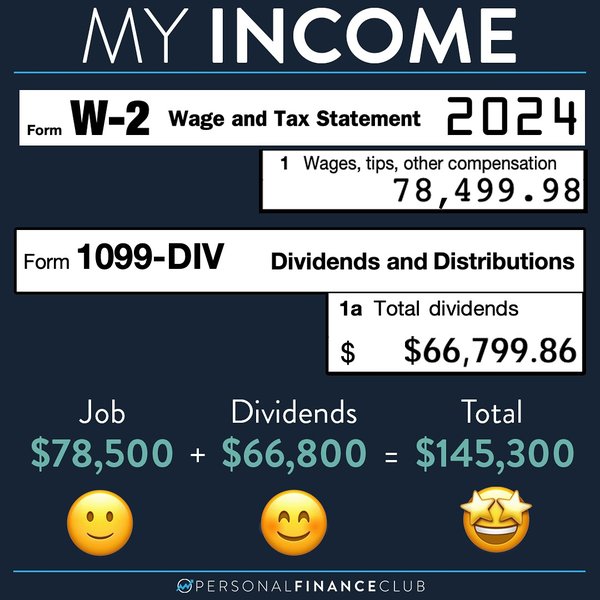
An investor's journey to replacing W2 income with dividends, illustrating the power of consistent dividend reinvestment.
Writing Covered Calls
This strategy involves selling call options on stock you already own. You collect a premium (income) for selling the option. If the stock price stays below the "strike price" of the option, you keep the premium and your shares. If the stock price rises above the strike price, your shares might be called away (sold) at the strike price, limiting your upside but still providing a profit from the sale plus the premium received. This is a popular approach for generating income and can reduce some risk of being long on the stock alone, especially if you have a neutral to slightly bullish short-term outlook on the stock.
The formula for a covered call's maximum profit is:
\[ \text{Max Profit} = (\text{Strike Price} - \text{Purchase Price of Stock}) + \text{Premium Received} \]This strategy effectively "monetizes" your stock by generating income from it without immediately selling it, though it caps potential capital gains if the stock rises significantly.
Liquidity and Diversification Strategies
When holding a highly appreciated, concentrated stock position, managing risk and accessing liquidity without triggering significant tax events becomes paramount. These strategies offer ways to achieve these goals:
Variable Prepaid Forward Contracts (VPFCs)
A VPFC allows you to receive an upfront cash prepayment from a financial institution in exchange for delivering a variable number of shares in the future. This structure allows you to monetize your stock holdings while retaining some upside exposure above a set price and deferring capital gains taxes until the contract settles. This is a complex derivative transaction, typically used for significant, concentrated holdings.
The shares delivered at settlement depend on the stock price at that time, providing a range of outcomes. It's a method to unlock liquidity and manage risk without outright selling and realizing immediate taxable gains.
Rule 10b5-1 Plans
For insiders or individuals with significant company stock holdings, a Rule 10b5-1 plan allows for the systematic sale of shares over time according to a pre-arranged schedule. This plan provides an affirmative defense against insider trading allegations and offers a structured way to monetize holdings, diversify the portfolio, and make stock transactions during blackout periods. It provides a disciplined approach to liquidating shares while adhering to regulations.
Secured Loans Against Stock Holdings
You can use your stock holdings as collateral to secure a loan. This process allows you to access liquidity (cash) while retaining ownership of the shares. This means you don't need to sell your stocks to raise funds, thus deferring capital gains taxes. It's a way to unlock the value of your portfolio for various purposes without divesting.
Learn how to protect your stock profits using a smart options strategy, offering insights into risk mitigation.
This video delves into protecting stock profits using options strategies, which is highly relevant to monetizing long-term holdings. While the video focuses on options, the core concept of protecting gains and generating income is central to effective monetization. Understanding these techniques can help investors safeguard their accumulated wealth from market downturns while still extracting value from their positions.
Charitable Remainder Trusts (CRTs) and Exchange Funds
These are more advanced tax-efficient strategies primarily used for highly appreciated, concentrated stock positions. CRTs allow you to donate appreciated stock to a trust, receive a tax deduction, and then receive income payments for a set period or for life, while avoiding immediate capital gains taxes on the donated stock. The trust then sells the stock and diversifies the assets. Exchange funds allow you to diversify a concentrated stock position into a broader portfolio without immediately selling your shares, deferring capital gains taxes.
Long-Term Profit-Taking and Management
Even with a long-term mindset, managing your profits effectively is crucial. This involves considering when and how to sell, and understanding the tax implications.
Strategic Selling and Profit Targets
While long-term investors generally aim to hold, there are times when strategic profit-taking is advisable. This could involve setting a "profit target" – a specific price point or percentage increase at which you decide to sell a portion or all of your shares. This helps to lock in gains and avoid clinging to a stock too long, only to see its value decline. It's about having an "exit strategy" in place.
Rebalancing Your Portfolio
As stocks in your portfolio appreciate, they can become a disproportionately large part of your total assets, leading to a concentrated position and increased risk. Rebalancing involves periodically selling some of your appreciated assets and reinvesting the proceeds into underperforming areas or new opportunities to maintain your desired asset allocation and diversification. This manages risk without necessarily being a full monetization.
Dollar-Cost Averaging in Reverse
While dollar-cost averaging involves investing a fixed amount regularly, a reverse strategy could involve systematically selling a fixed amount over time. This helps to smooth out the selling price and avoid trying to "time the market" perfectly on the way out, especially for very large positions.

Effective asset allocation and portfolio strategy are key to managing risk and maximizing long-term returns.
Tax Implications of Monetizing Stock Holdings
Understanding the tax consequences is paramount when monetizing stock holdings, especially for long-term investments. Capital gains taxation depends heavily on the "holding period" of your investment.
A "holding period" is the length of time an investment is held. For tax purposes, this period begins the day after acquisition and continues until the day of disposal or sale.
The distinction between short-term and long-term capital gains is critical:
Short-Term Capital Gains
If you hold a stock for one year or less, any profit from its sale is considered a short-term capital gain. These gains are taxed at your ordinary income tax rate, which can be as high as 37% depending on your income bracket.
Long-Term Capital Gains
If you hold a stock for more than one year, any profit from its sale is considered a long-term capital gain. These are taxed at lower, more favorable rates: typically 0%, 15%, or 20%, depending on your taxable income and filing status. This favorable tax treatment is a major incentive for long-term investing.
Managing Your Cost Basis
Your "cost basis" is essentially the original price you paid for an investment, plus any associated costs like commissions. When you sell stock, your capital gain (or loss) is calculated as the sale price minus your cost basis. For investors who have purchased the same stock at different times and prices, choosing a cost basis method can impact your tax liability:
| Cost Basis Method | Description | Tax Implication |
|---|---|---|
| First-In, First-Out (FIFO) | Assumes the first shares purchased are the first ones sold. | May result in higher capital gains if earlier shares have significantly appreciated. |
| Specific Identification (SpecID) | Allows you to choose which specific shares (tax lots) to sell. | Highly tax-efficient, enabling you to select shares with the highest basis (to minimize gain) or lowest basis (to maximize loss) for tax planning. |
| Average Cost (for Mutual Funds) | Averages the purchase price of all shares. Typically used for mutual funds. | Simple but offers less tax control than SpecID for individual stocks. |
Choosing the right cost basis method, especially "Specific Identification," can help you strategically manage your capital gains and losses, potentially reducing your tax burden. It's always advisable to consult with a financial advisor and tax specialist to determine the best approach for your specific situation.
Frequently Asked Questions
How do I access the money from my stock holdings?
What is the difference between short-term and long-term capital gains?
Can I generate income from my stocks without selling them?
How can I minimize taxes when monetizing appreciated stock?
What is a concentrated stock position and why is it risky?
Conclusion
Monetizing long-term stock holdings is a sophisticated process that extends far beyond simple selling. Whether your objective is to generate consistent income, access liquidity for other ventures, or strategically diversify a concentrated position, a variety of tailored approaches exist. Understanding the nuances of strategies like dividend investing, covered calls, variable prepaid forward contracts, and meticulous tax planning through cost basis management is crucial. By thoughtfully implementing these methods, investors can transform their accumulated wealth into tangible financial benefits while navigating the complexities of the market and minimizing tax burdens. Always consider consulting with a qualified financial advisor to align these strategies with your individual financial goals and risk tolerance.
Recommended Reading
- How to strategically rebalance a highly appreciated stock portfolio
- Understanding the tax benefits of long-term capital gains
- Advanced strategies for liquidating concentrated stock positions
- Comparing income investing vs. growth investing strategies