
Unveiling the Physics: What Happens When Blackbody Radiation is Treated as Monochromatic Photon Gas?
Exploring the specific thermodynamic formulae that emerge from this fascinating theoretical framework.
When we model blackbody radiation not as its usual full spectrum but as an idealized gas composed solely of photons of a single frequency (monochromatic photons), we can derive a specific set of thermodynamic formulae. This approach simplifies certain aspects while still relying on the foundational principles of quantum statistical mechanics. Let's delve into the key concepts and resulting equations.
Essential Insights: Key Takeaways
- Planck's Law Adapted: The spectral energy density for a specific frequency, derived from Planck's Law, becomes the central measure of energy, as there's no integration over a spectrum.
- Pressure-Energy Relationship: The pressure exerted by this monochromatic photon gas is directly proportional to its energy density, specifically one-third of the energy density, a characteristic of relativistic gases like photon gas.
- Zero Chemical Potential: A crucial aspect is that photons, being bosons that can be freely created and absorbed by the cavity walls, have a chemical potential of zero, simplifying statistical calculations.
Foundations: The Monochromatic Photon Gas Model
Blackbody radiation originates from an idealized object that absorbs all incident electromagnetic radiation and re-emits radiation in thermal equilibrium. Typically, this emitted radiation spans a continuous spectrum of frequencies. However, by considering it as a gas of monochromatic photons, we focus on photons of a single, fixed frequency \( \nu_0 \). These photons are massless bosons, particles that follow Bose-Einstein statistics and, in this ideal gas model, do not interact with each other but only with the walls of the cavity maintaining thermal equilibrium.
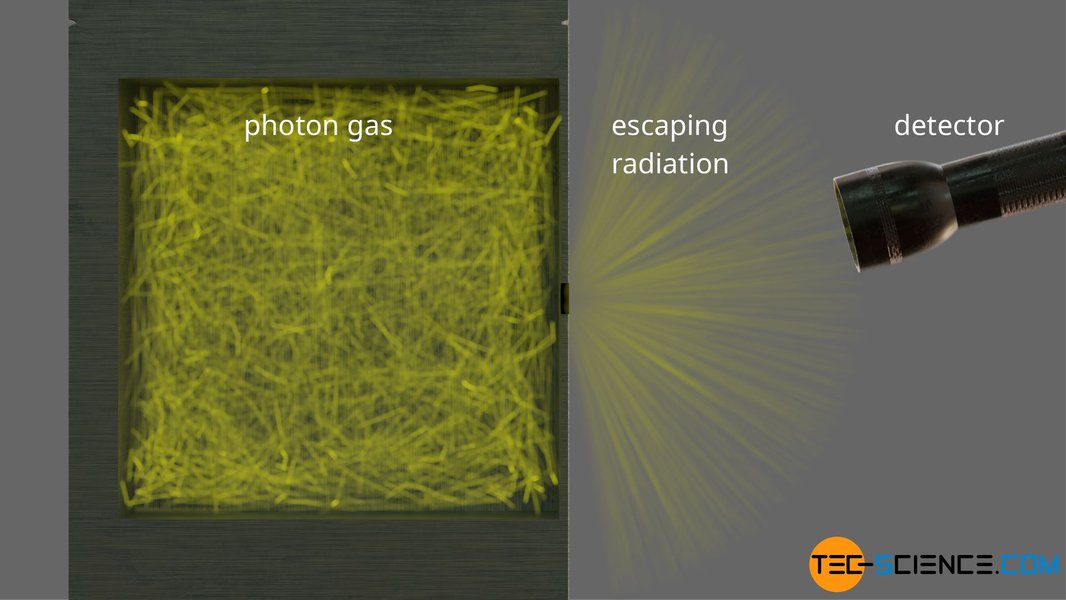
Conceptual representation of photon gas energy density related to blackbody radiation.
Key Characteristics
Single Photon Energy
The energy \(E\) of any single photon is determined by its frequency \( \nu \) (or angular frequency \( \omega = 2\pi\nu \)) or wavelength \( \lambda \): \[ E = h\nu = \hbar\omega = \frac{hc}{\lambda} \] where \(h\) is Planck's constant (\(6.626 \times 10^{-34} \text{ J·s}\)), \(\hbar = h/2\pi\) is the reduced Planck's constant, and \(c\) is the speed of light in vacuum (approximately \(3 \times 10^8 \text{ m/s}\)). For our monochromatic photon gas, all photons share the same frequency \( \nu_0 \), and thus the same energy \( E_0 = h\nu_0 \).
Chemical Potential (\(\mu\))
A defining feature of a photon gas in thermal equilibrium, including a monochromatic one within a blackbody cavity, is that its chemical potential is zero (\(\mu = 0\)). This is because photons are not conserved; they can be emitted or absorbed by the cavity walls as the system maintains equilibrium. This significantly influences the Bose-Einstein distribution function used to describe the photon states.
Resulting Thermodynamic Formulae for Monochromatic Photon Gas
By applying the principles of statistical mechanics to an ideal gas of monochromatic photons at temperature \(T\) and fixed frequency \( \nu_0 \), we obtain the following key formulae:
1. Spectral Energy Density (at \( \nu_0 \))
For general blackbody radiation, Planck's Law describes the spectral energy density \(u(\nu, T)\) per unit frequency interval. In our monochromatic case, we are interested in the energy density specifically at the single frequency \( \nu_0 \). This is given by: \[ u(\nu_0, T) = \frac{8\pi h \nu_0^3}{c^3} \frac{1}{e^{h\nu_0/(k_B T)} - 1} \] Here, \(k_B\) is Boltzmann's constant (approximately \(1.381 \times 10^{-23} \text{ J/K}\)). This formula represents the energy per unit volume attributed to photons of frequency \( \nu_0 \).
2. Total Energy Density
Since the gas is monochromatic, the total energy density \(U/V\) is simply the spectral energy density at that single frequency \( \nu_0 \). Unlike a full blackbody spectrum where one would integrate \(u(\nu, T)\) over all frequencies to get the Stefan-Boltzmann law (\(U/V = aT^4\)), for a monochromatic photon gas, the total energy density is: \[ \left(\frac{U}{V}\right)_{\text{mono}} = u(\nu_0, T) = \frac{8\pi h \nu_0^3}{c^3} \frac{1}{e^{h\nu_0/(k_B T)} - 1} \] This density is thus dependent not only on temperature \(T\) but also critically on the chosen frequency \( \nu_0 \).
3. Pressure of the Monochromatic Photon Gas
The pressure \(P\) exerted by a photon gas is related to its energy density by \(P = \frac{1}{3} (U/V)\). This relationship holds for any relativistic gas, including photons. For our monochromatic photon gas, the pressure \(P(\nu_0, T)\) exerted by photons of frequency \( \nu_0 \) is: \[ P(\nu_0, T) = \frac{1}{3} u(\nu_0, T) = \frac{1}{3} \frac{8\pi h \nu_0^3}{c^3} \frac{1}{e^{h\nu_0/(k_B T)} - 1} \] The pressure, like the energy density, is proportional to \(T^4\) only when integrated over all frequencies. For a monochromatic gas, its dependence on temperature is more complex, modulated by the exponential term and the fixed \( \nu_0 \).
4. Photon Number Density (at \( \nu_0 \))
The number of photons per unit volume with frequency \( \nu_0 \), denoted as \(n(\nu_0, T)\), can be found by dividing the energy density \(u(\nu_0, T)\) by the energy of a single photon \(h\nu_0\): \[ n(\nu_0, T) = \frac{u(\nu_0, T)}{h\nu_0} = \frac{8\pi \nu_0^2}{c^3} \frac{1}{e^{h\nu_0/(k_B T)} - 1} \] This gives the concentration of photons of the specific frequency \( \nu_0 \) at temperature \(T\).
5. Entropy Density (at \( \nu_0 \))
The entropy per unit volume \(s(\nu_0, T)\) for photons of frequency \( \nu_0 \) can also be derived using statistical mechanics for bosons with zero chemical potential: \[ s(\nu_0, T) = \frac{8 \pi k_B \nu_0^2}{c^3} \left[ \left(\frac{h\nu_0 / k_B T}{e^{h\nu_0/(k_B T)} - 1}\right) - \ln\left(1 - e^{-h\nu_0/(k_B T)} \right) \right] \] This expression reflects the disorder associated with the monochromatic photons at the given frequency and temperature.
Summary Table of Formulae
The following table summarizes the key thermodynamic quantities for an ideal gas of monochromatic photons at frequency \( \nu_0 \) and temperature \( T \):
| Quantity | Formula | Notes |
|---|---|---|
| Energy of a single photon | \(E_0 = h\nu_0\) | Fundamental energy quantum |
| Energy Density \(u(\nu_0, T)\) | \(\frac{8\pi h \nu_0^3}{c^3} \frac{1}{e^{h\nu_0/(k_B T)} - 1}\) | Energy per unit volume at frequency \( \nu_0 \) |
| Pressure \(P(\nu_0, T)\) | \(\frac{1}{3} u(\nu_0, T)\) | Pressure exerted by photons of frequency \( \nu_0 \) |
| Photon Number Density \(n(\nu_0, T)\) | \(\frac{8\pi \nu_0^2}{c^3} \frac{1}{e^{h\nu_0/(k_B T)} - 1}\) | Number of photons of frequency \( \nu_0 \) per unit volume |
| Entropy Density \(s(\nu_0, T)\) | \(\frac{8 \pi k_B \nu_0^2}{c^3} \left[ \frac{x}{e^x - 1} - \ln(1 - e^{-x}) \right]\), where \(x = \frac{h\nu_0}{k_B T}\) | Entropy per unit volume for photons of frequency \( \nu_0 \) |
| Chemical Potential \(\mu\) | \(0\) | Due to non-conservation of photon number |
Visualizing Photon Gas Properties: A Comparative Radar Chart
This radar chart offers a conceptual comparison between a monochromatic photon gas (focused on a single frequency \( \nu_0 \)) and a full-spectrum blackbody photon gas (considering all frequencies). The scores (1-10, higher is more pronounced) are illustrative, emphasizing qualitative differences rather than precise quantitative values.
The chart highlights that a monochromatic photon gas is highly specific in frequency and its pressure is tied to that single frequency. Conversely, a full-spectrum gas has more complex energy calculations (involving integration) but is directly applicable to real blackbody phenomena and exhibits the classic \(T^4\) dependence for total energy.
Conceptual Map: Monochromatic Photon Gas
This mindmap illustrates the key concepts and relationships when treating blackbody radiation as an ideal gas of monochromatic photons.
(Blackbody Radiation Focus)"] id1["Core Assumptions"] id1a["Ideal Gas Behavior"] id1b["Monochromatic Photons (single \(\nu_0\))"] id1c["Photons as Massless Bosons"] id1d["Thermal Equilibrium with Cavity"] id1e["Zero Chemical Potential (\(\mu=0\))"] id2["Key Physical Quantities"] id2a["Energy of Single Photon: \(E_0 = h\nu_0\)"] id2b["Energy Density: \(u(\nu_0, T)\)"] id2b1["Derived from Planck's Law"] id2c["Pressure: \(P(\nu_0, T) = u(\nu_0, T)/3\)"] id2d["Photon Number Density: \(n(\nu_0, T)\)"] id2e["Entropy Density: \(s(\nu_0, T)\)"] id3["Theoretical Basis"] id3a["Quantum Mechanics"] id3b["Statistical Mechanics (Bose-Einstein Stats)"] id4["Distinction from Full Spectrum"] id4a["No Integration Over Frequencies"] id4b["Properties Depend on Specific \(\nu_0\)"] id4c["Simplified but Idealized Model"]
The mindmap shows how the core assumptions lead to the derivation of specific physical quantities, all rooted in quantum and statistical mechanics, and highlights how this model differs from the full-spectrum treatment of blackbody radiation.
Delving Deeper: Photon Gas Dynamics
The video below offers a broader perspective on the statistical mechanics of a photon gas, which provides context for understanding the monochromatic case as a specific instance of these general principles. It helps in visualizing how the collective behavior of photons gives rise to macroscopic thermodynamic properties like pressure and energy density.
Mini Lesson 15: Statistical Mechanics of the Photon Gas
This video explains how blackbody radiation can be modeled as a gas of photons. By calculating the total energy of this gas, it's possible to explain several experimental observations. While the video likely discusses the full spectrum, the foundational concepts of photons behaving as a gas, their energy distribution (even if here we fix the frequency), and their role in thermal equilibrium are highly relevant to the monochromatic photon gas model. The derivation of total energy for a photon gas, often leading to the Stefan-Boltzmann law, starts from considering the contribution of photons at all frequencies; our monochromatic approach essentially isolates one such contribution.
Frequently Asked Questions (FAQ)
What does it mean to treat photons as an "ideal gas"?
Treating photons as an ideal gas means we assume they do not interact with each other, similar to how particles in a classical ideal gas are assumed to have negligible intermolecular forces. Their energy is purely kinetic (though for massless photons, it's \(E=pc\)). They interact only with the walls of the container (cavity), which act as a heat bath, allowing for emission and absorption to reach thermal equilibrium. This idealization simplifies calculations while capturing many essential quantum and thermodynamic behaviors of radiation.
Why is the chemical potential of a photon gas zero?
The chemical potential (\(\mu\)) for a system of particles is related to the change in energy when a particle is added while keeping volume and entropy constant. For photons in a blackbody cavity, their number is not conserved. Photons can be created (emitted by the walls) or destroyed (absorbed by the walls) as the system reaches thermal equilibrium. Because there is no constraint on the total number of photons (they adjust to minimize free energy), their chemical potential is zero. This is a key feature in the Bose-Einstein distribution for photons.
How does a monochromatic photon gas differ from a classical ideal gas of massive particles?
There are several key differences:
- Particle Nature: Photons are massless bosons, while classical gas particles are massive and typically follow Maxwell-Boltzmann statistics (though a quantum gas of massive bosons would follow Bose-Einstein).
- Energy Spectrum: In a classical gas, particle energies form a continuous spectrum. In a monochromatic photon gas, all photons have the exact same energy \(h\nu_0\).
- Equation of State: For a photon gas, \(P = u/3\), where \(u\) is energy density. For a non-relativistic classical ideal gas, \(P = (2/3)u_{kin}\) for monatomic gases, or more generally \(PV = Nk_BT\).
- Particle Number: Photon number is not conserved (\(\mu=0\)), whereas in a classical gas, the number of particles \(N\) is usually fixed.
- Temperature Dependence: The energy density of a full-spectrum photon gas is proportional to \(T^4\). For a monochromatic photon gas, the relationship with \(T\) is more complex (via Planck's formula at \(\nu_0\)), unlike the linear dependence \(U \propto T\) for a classical ideal gas (at constant volume, ignoring internal degrees of freedom).
Is the concept of a "monochromatic photon gas" physically realizable as true blackbody radiation?
True blackbody radiation, by definition, emits a continuous spectrum of frequencies described by Planck's law, not just a single frequency. Therefore, a strictly "monochromatic photon gas" is an idealization. However, lasers produce highly monochromatic light, and narrow-band filters can isolate specific frequencies from a broader spectrum. Studying the properties of photons at a single frequency is crucial for understanding the overall blackbody spectrum, as the full spectrum is an integration of contributions from all frequencies. So, while not a complete description of a blackbody, it's a useful theoretical construct and relevant to understanding phenomena involving specific frequencies of light.
Recommended Further Exploration
- How does Bose-Einstein statistics apply to a photon gas?
- What are the differences between radiation pressure and gas pressure in classical thermodynamics?
- Explain the derivation of Planck's law for blackbody radiation.
- What is the significance of the Stefan-Boltzmann law and how is it derived from the photon gas model?
References
Last updated May 10, 2025