
Beyond Left and Right: Can Victor Hugo's Economic Insights Reshape Political Models?
Exploring multi-axis frameworks that incorporate wealth, distribution, and societal values.
Victor Hugo, in his profound work Les Misérables, suggested that the truly fundamental questions concerning economic systems revolve around "how to generate wealth" and "how to share it out." This perspective challenges the adequacy of the traditional one-dimensional "left-right" political spectrum. Your inquiry touches upon a crucial point: could this framework, augmented by a third axis representing what a society or regime values (such as prioritizing power and stability over innovation, or vice versa), offer a more nuanced understanding? Let's delve into whether such multi-axis models have been developed and examine their advantages and disadvantages compared to the conventional left-right paradigm.
Key Insights: Moving Beyond a Single Line
- Multi-dimensional thinking: Several political and economic models have emerged that utilize two, three, or even more axes to provide a richer, more comprehensive understanding of ideologies than the simplistic left-right spectrum allows.
- Capturing complexity: Three-axis models, in particular, can incorporate dimensions like economic policy, social freedoms, and overarching societal values or priorities, aligning with the depth of Hugo's observations and your proposed extension.
- Nuance vs. simplicity: While these multi-axis models offer greater analytical depth and can better represent diverse political stances, they also introduce increased complexity in terms of visualization, understanding, and objective measurement compared to the traditional linear scale.
Victor Hugo's Economic Philosophy and the Limits of the Traditional Spectrum
Victor Hugo's focus on wealth generation and distribution provides a pragmatic and ethically grounded lens through which to assess economic systems. This contrasts sharply with the often-oversimplified traditional left-right axis. This axis historically emerged from the seating arrangements in French legislative assemblies post-revolution, primarily categorizing political positions based on attitudes towards economic equality and the extent of government intervention in the economy. The "left" typically advocates for greater intervention to achieve social welfare and equality, while the "right" generally favors free markets, individual liberty, and less government involvement.
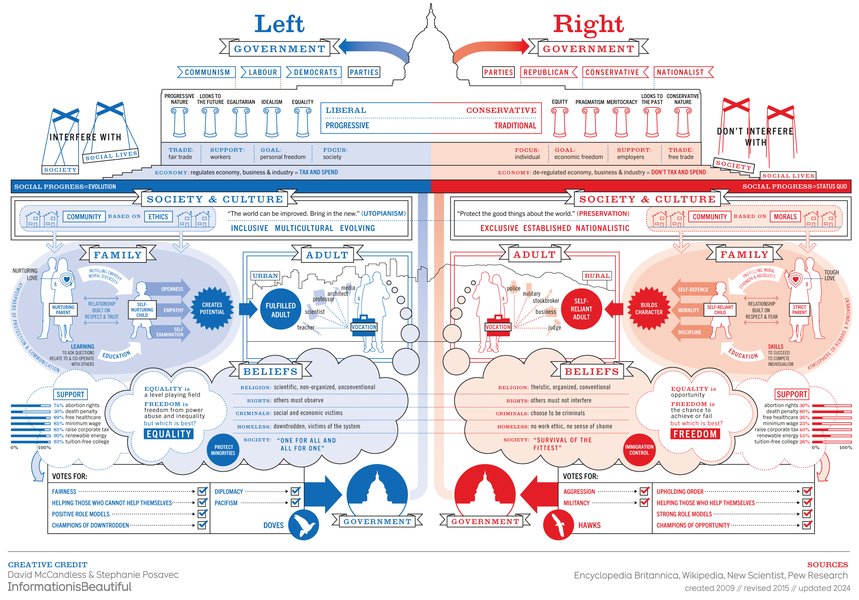
A visual representation of the traditional Left-Right political spectrum, often used in U.S. politics.
Shortcomings of the Left-Right Dichotomy
Critics argue that this single dimension is insufficient for several reasons:
- It struggles to adequately represent stances on social issues, personal freedoms, foreign policy, and environmental concerns.
- It can inaccurately place ideologies that combine elements from both "left" and "right" economic thought with varying social policies (e.g., libertarianism, certain forms of authoritarianism).
- It often fails to capture the nuanced priorities your query highlights, such as a regime's choice between fostering innovation and maintaining stability or power. For instance, a system might be economically left-leaning (emphasizing state control for wealth distribution) yet socially authoritarian, prioritizing regime stability above all else.
The Rise of Multi-Axis Political Models
To address these limitations, political scientists and theorists have developed multi-axis models. These frameworks aim to provide a more comprehensive map of political and economic ideologies by introducing additional dimensions of analysis.
Notable Examples of Multi-Axis Frameworks
While a model precisely mirroring Hugo's two questions plus a "value" axis isn't universally adopted, several existing frameworks incorporate similar multifaceted considerations, often extending to three axes:
The Nolan Chart and Its Evolution
The Nolan Chart is a foundational two-axis model that distinguishes between economic freedom and personal freedom. This creates four quadrants: Libertarians (high economic and personal freedom), Authoritarians (low on both), Left-Liberals/Communitarians (low economic, high personal freedom), and Conservatives (high economic, low personal freedom). This already offers more nuance than the single left-right line.
Three-axis variants have built upon this:
- The Friesian Institute model: Adds "positive liberty" (the capacity to act on one's free will) as a third axis to the Nolan Chart's economic and personal (negative) liberty, forming a cube. This could relate to how a society enables wealth generation and individual flourishing beyond just freedom from restraint.
- The Vosem Chart: This model proposes splitting the economic axis into "corporate economics" and "individual economics," and combines these with a "civil liberty" axis. This framework could potentially map Hugo's "wealth generation" (corporate economics) and "wealth sharing" (individual economics) alongside a values/freedom dimension (civil liberty).
The Three-Axis Political Compass
Another conceptualization involves three distinct policy areas:
- Economic Policy: Covering the spectrum from egalitarian redistribution to laissez-faire capitalism (addressing wealth generation and distribution).
- Domestic Policy / Social Stance: Ranging from authoritarian control to libertarian freedom (potentially encompassing the "what is valuable" aspect regarding social order vs. individual rights).
- Foreign Policy: Addressing international relations, interventionism vs. isolationism, etc.
This structure allows for plotting a regime that, for example, heavily regulates its economy (left on economic policy), strictly controls its populace (authoritarian on domestic policy), and pursues an aggressive foreign policy. Your "value" axis (power/stability vs. innovation) could be integrated into the domestic policy dimension or even stand as a distinct fourth axis in a more complex model.
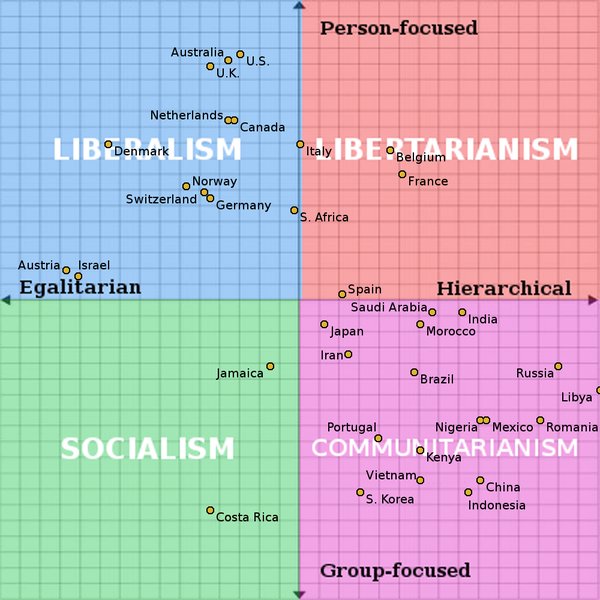
An example of a two-axis political compass, a common multi-dimensional model. Three-axis models aim to add further depth.
Conceptualizing Societal Values in Multi-Axis Models
The radar chart below offers a hypothetical visualization of how different ideological systems might be plotted using multiple axes, including dimensions that reflect Hugo's concerns and your proposed "value" axis. For instance, "Regime A" might prioritize Stability and Centralized Wealth Generation, while "Regime B" could emphasize Innovation and Equitable Wealth Distribution, with varying degrees of Personal and Economic Freedom.
This radar chart illustrates how different hypothetical ideologies might score on various societal dimensions. The axes represent key concerns including those raised by Victor Hugo (wealth generation, distribution) and the "value" dimension (stability, innovation), alongside other common political metrics. Each colored line represents a distinct ideological profile, showcasing the diversity that multi-axis models can capture beyond a simple left-right scale. For example, "Authoritarian Statism" scores high on "Societal Stability" but low on "Personal Freedom" and "Wealth Distribution Equity," while "Progressive Libertarianism" shows a different balance.
Mapping the Conceptual Landscape
The following mindmap illustrates the relationship between Victor Hugo's core economic questions, the limitations of the traditional left-right spectrum, and the development of multi-axis models, including the potential for a three-axis system incorporating societal values.
This mindmap visually connects Victor Hugo's fundamental economic questions to the limitations of the traditional left-right political spectrum. It then branches out to show how a three-axis model, incorporating societal values as a third dimension, could address these limitations. Examples of existing multi-axis models are provided, alongside a summary of the pros and cons when comparing these more complex frameworks to the simpler linear model.
Pros and Cons: Multi-Axis Models vs. Traditional Left-Right
Adopting a multi-axis framework, such as the three-axis model you envision based on Hugo's ideas, offers distinct advantages but also presents certain challenges when compared to the conventional left-right spectrum.
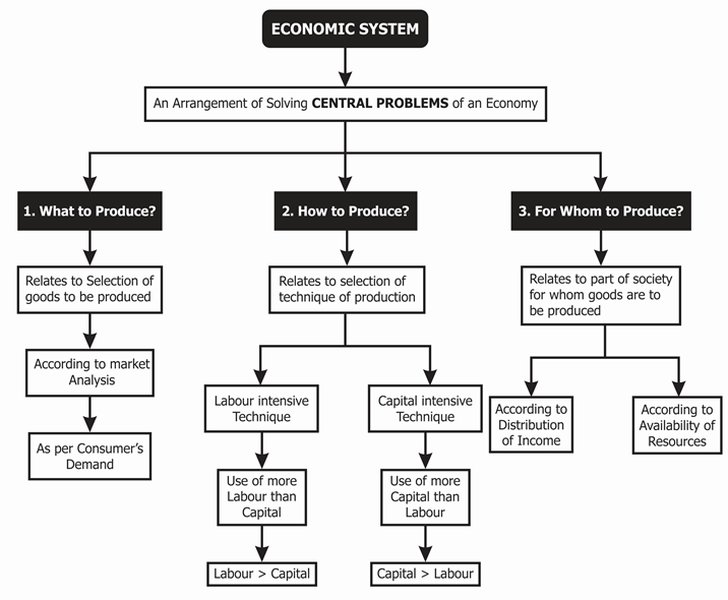
Understanding different economic systems (like Capitalism, Socialism, Mixed Economy) often requires more than a single left-right dimension.
| Aspect | Traditional Left-Right Axis | Three-Axis Model (Incorporating Wealth Generation, Distribution & Societal Values) |
|---|---|---|
| Nuance & Detail | Oversimplifies; primarily focuses on economic redistribution and government intervention. Struggles with ideologies that don't fit neatly (e.g., libertarianism, socially conservative but economically left). | Provides a much richer, more comprehensive representation. Can distinguish between economic approaches, social policies, and overarching value priorities (e.g., stability vs. innovation, individual liberty vs. collective security). |
| Representation of Diverse Ideologies | Limited. Often forces complex systems into one of two broad categories. | Better accommodates a wider range of political and economic philosophies, including those of totalitarian regimes that prioritize power, or developmental states prioritizing specific types of innovation. |
| Analytical Power | Limited for explaining complex policy trade-offs or political coalitions that cut across simple economic lines. | Potentially offers greater insight into why regimes make certain choices, how different societal goals are balanced (or not), and the internal dynamics of complex systems. Allows analysis of Hugo's wealth questions alongside value systems. |
| Simplicity & Accessibility | Very simple and intuitive, deeply entrenched in public discourse and media. Easy to grasp. | Significantly more complex to understand, visualize (often requiring 3D representation or multiple 2D charts), and communicate effectively to a general audience. |
| Objectivity & Measurement | While seemingly simple, placement on the axis can still be subjective. | Defining axes (e.g., "what is valuable," "innovation focus") can be highly subjective and culturally dependent. Quantifying a nation's or ideology's position on these axes is challenging and prone to bias. |
| Risk of Oversimplification | High risk of oversimplifying complex issues into a binary. | While more nuanced, it's still a model and can oversimplify in new ways or miss crucial interactions between the chosen axes if not carefully constructed. |
| Popular Adoption | Widely adopted and understood, forming a common language for political discussion. | Less established in popular and political discourse. Broader adoption requires significant cultural and educational shifts. |
This table summarizes the key differences, highlighting how three-axis models can capture the multifaceted nature of political and economic systems as envisioned by Hugo's questions and your addition of a value dimension, but at the cost of the simplicity and widespread understanding of the traditional left-right axis.
Frequently Asked Questions (FAQ)
What exactly is the traditional "left-right" political spectrum?
The traditional left-right political spectrum is a system of classifying political positions, ideologies, and parties. It originated during the French Revolution (1789–1799) from the seating arrangements in the French National Assembly, where supporters of the king sat to the president's right and supporters of the revolution to his left. Generally, the "left" is associated with ideas such as social equality, government intervention in the economy, and social welfare programs, while the "right" is associated with concepts like individual liberty, free markets, traditional values, and limited government.
Why is the left-right spectrum often considered "silly" or inadequate?
The left-right spectrum is criticized for oversimplifying complex political beliefs. Many argue that it fails to capture the full range of political thought because:
- It primarily focuses on economic issues and the role of government, often neglecting social issues, personal freedoms, foreign policy, environmental concerns, or cultural values.
- It struggles to place ideologies that combine elements typically associated with both left and right (e.g., libertarianism, which advocates for economic freedom often seen as right-wing, and personal freedom often seen as left-wing).
- It may not accurately reflect how individuals or groups prioritize different values, such as stability versus innovation, or security versus liberty, as highlighted in your query.
Are there any widely used multi-axis political models besides the Nolan Chart?
Yes, one of the most well-known is "The Political Compass." This model uses two axes: an economic (Left–Right) axis and a social (Authoritarian–Libertarian) axis. This creates a four-quadrant chart that can place individuals or ideologies more precisely than a single line. While it's a two-axis model, it's a significant step beyond the one-dimensional spectrum and forms a basis for some three-axis conceptualizations. Various online tests and analyses utilize this model. Other specialized multi-axis models exist in academic fields but may not have the same popular recognition.
How would Victor Hugo's questions about wealth generation and distribution fit into a three-axis model?
In a three-axis model inspired by Victor Hugo and your suggestion:
- Axis 1 (Wealth Generation): This axis could represent the methods and philosophies a society employs to create wealth. This might range from state-controlled enterprise at one end to completely free-market capitalism at the other, or from innovation-driven growth to resource-extraction economies.
- Axis 2 (Wealth Distribution): This axis would address how the generated wealth is shared. It could range from highly egalitarian systems with extensive social safety nets and redistribution mechanisms to systems with minimal redistribution and high levels of wealth concentration.
- Axis 3 (Societal Values/Priorities): This axis, as you proposed, would capture what the society or regime fundamentally values. Examples include Power/Stability vs. Innovation/Progress, Individual Freedom vs. Collective Good, or Authoritarian Control vs. Democratic Participation.
Such a model would allow for a nuanced placement of different systems. For example, a totalitarian regime might score high on prioritizing power/stability (Axis 3), have a state-controlled wealth generation model (Axis 1), and a distribution system designed to maintain elite control (Axis 2).
Recommended Further Exploration
- What are the main criticisms of the Nolan Chart and Political Compass models?
- How do different cultures define the axes in political spectrum models?
- Explore examples of political systems that defy easy categorization on the traditional left-right spectrum.
- Can quantitative data be used to objectively place countries on multi-axis political models?
References
 smarter-love.blogspot.com
Last updated May 8, 2025