
Unveiling the Product: A Deep Dive into Multiplication
Explore the fascinating world of multiplication, from its fundamental principles to practical applications and advanced computational methods.
Key Insights into Multiplication
- Multiplication as Repeated Addition: At its core, multiplication is a shorthand for repeated addition, allowing for efficient calculation of sums of identical numbers. For instance, 23.5478383 times 6768 is equivalent to adding 23.5478383 to itself 6768 times.
- Commutative Property: The order of numbers in a multiplication operation does not affect the product. Whether you multiply 23.5478383 by 6768 or 6768 by 23.5478383, the result remains the same.
- Long Multiplication for Precision: For complex numbers, especially those with decimals, long multiplication provides a systematic, step-by-step method to ensure accuracy, breaking down the problem into manageable parts.
Calculating the Product: 23.5478383 × 6768
To find the product of 23.5478383 and 6768, we perform a multiplication operation. While standard calculators can provide a quick answer, understanding the underlying process, especially for numbers with decimals, is crucial for developing a deeper mathematical intuition.
The Result of the Multiplication
Performing the multiplication of 23.5478383 by 6768 yields the following product:
\[ \text{23.5478383} \times \text{6768} = \text{159288.7495024} \]This result is obtained through a precise calculation, treating the decimal number and the whole number in a structured manner.
Understanding the Process of Multiplication
Multiplication is one of the four fundamental arithmetic operations, alongside addition, subtraction, and division. It represents the scaling of one number by another. When dealing with a whole number and a decimal, the process can be visualized as repeated addition, or more formally, as an algorithm involving place values.
Multiplication Fundamentals
Multiplication is fundamentally a process of repeated addition. For example, multiplying 3 by 4 is the same as adding 3 to itself 4 times (3 + 3 + 3 + 3 = 12) or adding 4 to itself 3 times (4 + 4 + 4 = 12). This commutative property, where \(a \times b = b \times a\), simplifies many calculations.
When multiplying a decimal number by a whole number, the principle remains the same. We effectively add the decimal number to itself as many times as indicated by the whole number. The position of the decimal point in the final product is determined by the total number of decimal places in the original numbers being multiplied. In our case, 23.5478383 has 7 decimal places, and 6768 has 0 decimal places, so the product will have 7 decimal places.
Long Multiplication Method
For more complex multiplications, especially those involving multiple digits or decimals, the long multiplication method is employed. This systematic approach breaks down the multiplication into simpler steps, ensuring accuracy. The general steps involve multiplying each digit of the multiplier by the multiplicand, aligning the partial products according to their place values, and then summing them up.
When multiplying with decimals using long multiplication, the process is similar to multiplying whole numbers. After performing the multiplication, count the total number of decimal places in the numbers being multiplied. The final product will have the same number of decimal places.
This radar chart illustrates the perceived ease and complexity of various mathematical operations and computational tools. It highlights how different methods offer varying degrees of accuracy, speed, and conceptual understanding, with manual long multiplication being conceptually demanding but highly accurate for understanding, while online calculators offer unmatched speed.
Tools for Multiplication
In today's digital age, various tools are available to assist with multiplication, ranging from basic online calculators to advanced mathematical software. These tools simplify complex calculations and reduce the potential for human error.
Online Calculators
Online calculators are widely accessible and provide instant results for various mathematical operations, including multiplication. Many websites offer specialized calculators for different purposes, such as scientific calculations, algebra problems, or even specific operations like long multiplication with step-by-step explanations.
For simple multiplication like "23.5478383 times 6768," an online calculator is the quickest way to get the answer. These calculators often handle decimal precision automatically, making them convenient for everyday use.
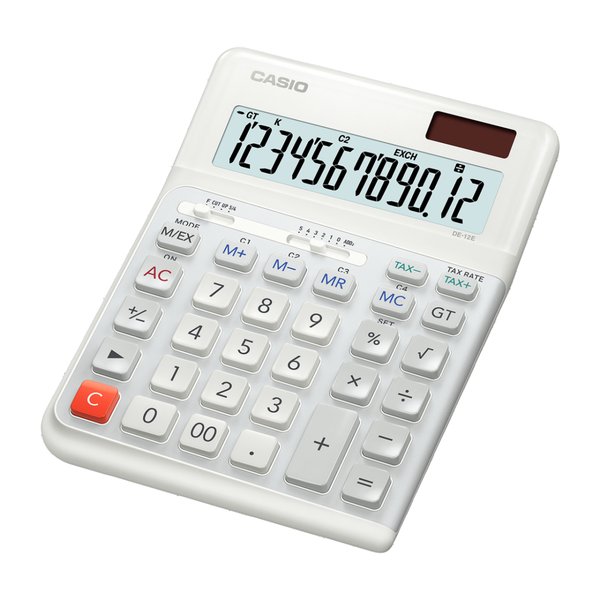
A modern desktop calculator, designed for practical and ergonomic use.
Scientific Calculators
Scientific calculators are more advanced versions of basic calculators, equipped with functions for trigonometry, logarithms, exponential operations, and more complex statistical calculations. While overkill for a simple multiplication, they demonstrate the computational power available for mathematical tasks. They are often used in academic and professional settings where precision and a wide range of functions are required.
Mathematical Software and Programming
For highly complex or repetitive calculations, mathematical software like MATLAB, Mathematica, or even programming languages like Python with libraries such as NumPy, can be used. These tools offer unparalleled precision, speed, and the ability to automate calculations for large datasets or intricate algorithms. While not necessary for a single multiplication, they represent the pinnacle of computational power for mathematical problems.
Applications of Multiplication
Multiplication is a fundamental operation with widespread applications across numerous fields, from everyday finances to advanced scientific research.
Everyday Life and Finance
In daily life, multiplication is used constantly. Calculating the total cost of multiple items, figuring out discounts, determining interest on loans, or converting currency all involve multiplication. For example, if an item costs $23.54 and you buy 6768 of them, multiplication quickly tells you the total expenditure.
Science and Engineering
In science and engineering, multiplication is integral to various calculations. From calculating force (mass × acceleration) in physics to determining chemical concentrations, or scaling designs in engineering, the operation is indispensable. The ability to quickly and accurately multiply numbers, even those with many decimal places, is critical for precise measurements and predictions.
Statistics and Data Analysis
In statistics, multiplication is used in various formulas, such as calculating weighted averages, standard deviations, and variances. When analyzing data, often values need to be scaled or combined, making multiplication a crucial step. Understanding how to perform accurate multiplication, even with precise decimal numbers, is important for robust data analysis.
Multiplication Operations and Properties
Beyond the basic calculation, understanding the properties of multiplication provides deeper insight into its behavior and usefulness in mathematics.
| Property | Description | Example |
|---|---|---|
| Commutative Property | The order of factors does not change the product. | \(a \times b = b \times a\) \(2 \times 3 = 3 \times 2 = 6\) |
| Associative Property | The grouping of factors does not change the product. | \((a \times b) \times c = a \times (b \times c)\) \((2 \times 3) \times 4 = 2 \times (3 \times 4) = 24\) |
| Distributive Property | Multiplication distributes over addition/subtraction. | \(a \times (b + c) = (a \times b) + (a \times c)\) \(2 \times (3 + 4) = (2 \times 3) + (2 \times 4) = 14\) |
| Identity Property | Multiplying any number by 1 results in the number itself. | \(a \times 1 = a\) \(5 \times 1 = 5\) |
| Zero Property | Multiplying any number by 0 results in 0. | \(a \times 0 = 0\) \(7 \times 0 = 0\) |
This table summarizes the fundamental properties that govern multiplication, illustrating how numbers behave under this operation and forming the basis for more advanced algebraic concepts.
The Role of Place Value
In multiplication, especially with multi-digit numbers or decimals, understanding place value is paramount. Each digit's position holds a specific value (ones, tens, hundreds, tenths, hundredths, etc.). When performing long multiplication, each partial product must be correctly aligned according to the place value of the multiplying digit. This alignment ensures that digits of the same place value are added together correctly in the final sum.
Frequently Asked Questions (FAQ)
What is multiplication in simple terms?
How do you multiply decimals by whole numbers?
Can I use an online calculator for any multiplication?
What is the difference between multiplicand, multiplier, and product?
Conclusion
Calculating 23.5478383 multiplied by 6768 yields 159288.7495024. This operation, while seemingly straightforward with modern tools, is built upon fundamental mathematical principles. Understanding multiplication as repeated addition, appreciating its commutative property, and recognizing the importance of place value are crucial for mathematical literacy. Whether through manual long multiplication or the swift processing of online calculators, the ability to accurately determine products remains a cornerstone of daily calculations, scientific inquiry, and technological advancement.
Recommended Further Exploration
- How to perform long multiplication with decimals step-by-step?
- What are the mathematical properties of multiplication?
- How is multiplication used in finance and everyday scenarios?
- Explore the evolution of calculation tools from abacus to modern computers.