
Unlocking Sonic Alchemy: Mastering Advanced Modulation with the Conductive Labs NDLR
Dive deep into the NDLR's powerful modulation engine to sculpt evolving soundscapes and generative masterpieces. (Knowledge cutoff: 2025-05-21)
The Conductive Labs NDLR (often affectionately called the "Noodler") is far more than a simple arpeggiator or sequencer; it's a sophisticated hub for musical ideation, particularly excelling in the realm of advanced modulation. Its architecture is designed to empower musicians to create intricate, evolving, and deeply expressive sonic textures. By understanding and leveraging its modulation capabilities, you can transform static sequences into dynamic, living compositions.
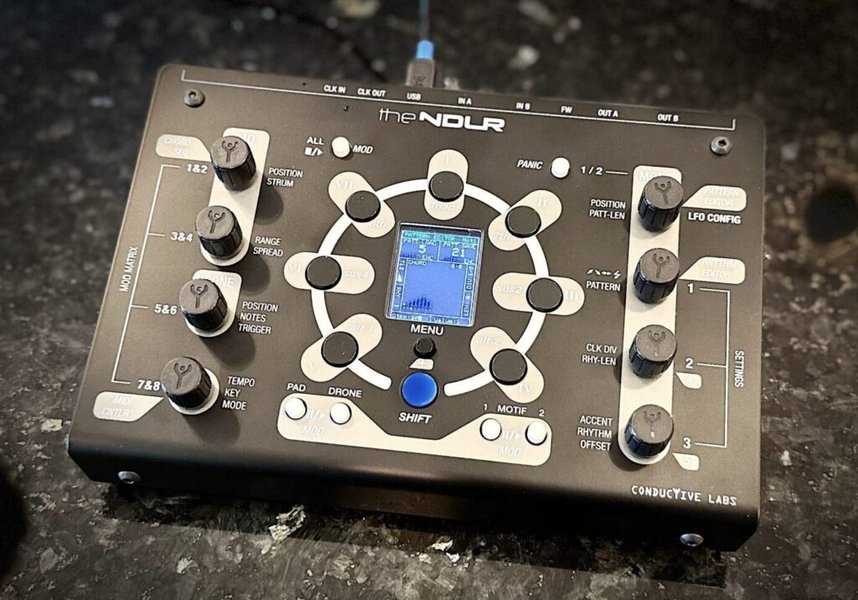
The Conductive Labs NDLR, a powerful tool for generative music and advanced modulation.
Key Modulation Insights
- The 8-Slot Modulation Matrix: At the heart of the NDLR's power lies an 8-slot modulation matrix, allowing intricate routing from numerous sources to a vast array of internal and external destinations.
- Diverse Modulation Sources: Utilize three versatile LFOs, incoming MIDI data (velocity, pitch bend, mod wheel, aftertouch), internal patterns, rhythms, and preset modulators to animate your music.
- Generative Potential Unleashed: Combine modulation with the NDLR's four independent parts (Drone, Pad, Motif 1, Motif 2) to create self-evolving musical pieces that rarely repeat.
The Engine Room: The 8-Slot Modulation Matrix
The cornerstone of the NDLR's advanced modulation capabilities is its comprehensive 8-slot modulation matrix. Think of this as a central switchboard where you can connect up to eight different modulation "inputs" (sources) to eight different "outputs" (destinations) simultaneously. Each slot in this matrix offers precise control:
- Source: What is generating the modulation signal? (e.g., an LFO, MIDI velocity).
- Destination: What parameter is being affected by the modulation? (e.g., filter cutoff on an external synth, the Pad's note spread).
- Amount: How intensely will the source affect the destination? This can often be a bipolar control, allowing for positive or negative modulation.
- Destination Value/Offset: Sets a base value for the destination parameter, which is then modified by the incoming modulation.
This matrix is incredibly flexible, allowing users to modulate nearly any parameter within the NDLR itself, as well as send MIDI CC messages to control external hardware synthesizers, effects units, or parameters within a Digital Audio Workstation (DAW). The ability to edit these routings in real-time while sequences are playing makes the NDLR a potent tool for live performance and improvisation.
Visualizing the Modulation Flow
To better understand how these components interact, consider the following mindmap illustrating the NDLR's modulation ecosystem. It shows how various sources feed into the central modulation matrix, which then directs control to a multitude of internal and external parameters, ultimately shaping the musical output.
Harnessing Powerful Modulation Sources
The NDLR provides a rich palette of sources to drive your modulations, each offering unique characteristics for shaping sound.
Low-Frequency Oscillators (LFOs)
The NDLR is equipped with three highly configurable LFOs. These are workhorses for creating cyclic, rhythmic, or slowly evolving changes.
Key LFO Features:
- Multiple Waveforms: Choose from standard shapes like sine, triangle, square, sawtooth, and random, allowing for smooth transitions, stepped changes, or chaotic variations.
- Rate Control: LFO speeds can be set in seconds for slow, sweeping changes or synchronized to the master BPM (beats per minute) for rhythmic pulsations. They can also run freely.
- Patterns as LFO Shapes: A unique feature is the ability to use the NDLR's own patterns as custom LFO waveforms, leading to highly complex and musically related modulation contours.
LFOs can be assigned to modulate virtually any parameter, from the pitch of a drone to the strum speed of a pad, or even parameters on external synthesizers via MIDI CC.
MIDI Inputs as Expressive Controllers
External MIDI controllers can inject human performance nuances directly into the modulation matrix.
Common MIDI Modulation Sources:
- Velocity: How hard a key is struck can modulate parameters like the number of notes in a chord (e.g., softer playing triggers fewer notes, harder playing triggers more), filter brightness, or effect intensity.
- Pitch Bend & Modulation Wheel: These traditional performance controls can be re-purposed to manipulate any assignable destination within the NDLR or external gear.
- Aftertouch: Pressure applied to keys after they've been struck can add another layer of expressive control.
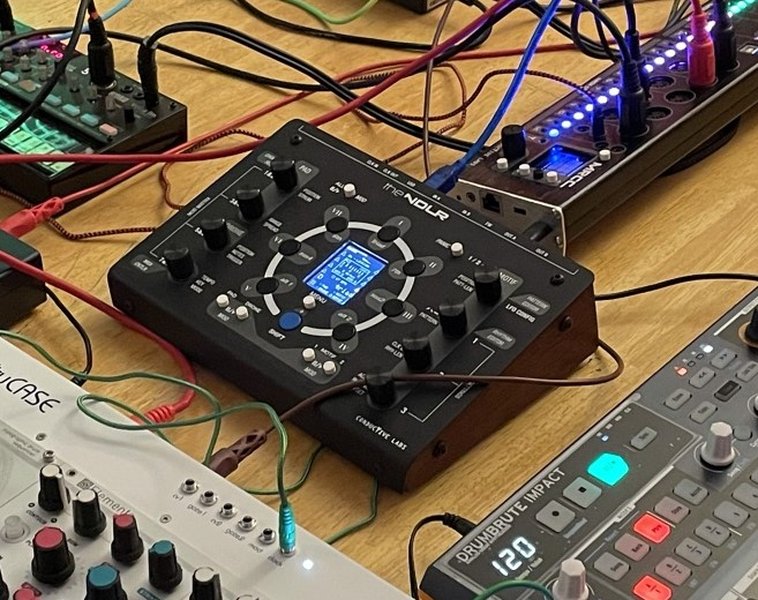
The NDLR seamlessly integrates with other MIDI gear, expanding modulation possibilities.
Patterns and Rhythms: Musical Modulators
The NDLR's Pattern editor (defining relative note sequences) and Rhythm editor (controlling velocity, ties, rests) are not just for note generation; they can also serve as sophisticated modulation sources.
Creative Uses:
- Rhythmic Modulation: Use a rhythm pattern to modulate filter cutoff, creating a pulsating rhythmic filter effect that's perfectly in sync with your sequence.
- Melodic Modulation: A pattern of notes could modulate the transposition of another part, creating intricate harmonic interplay.
- Dynamic Accents: The velocity information within a rhythm pattern can be used to modulate the accent level of a motif, adding groove and emphasis.
Preset Modulators
In addition to the customizable LFOs, the NDLR includes five preset modulators. These offer quick access to common modulation shapes and behaviors, streamlining the workflow for certain applications.
Targeting Your Modulations: Destinations Galore
The real power of modulation comes alive when you consider the vast array of parameters you can control.
Internal NDLR Parameters
Nearly every aspect of the NDLR's four musical parts (Drone, Pad, Motif 1, Motif 2) can be a modulation destination. This allows for incredibly dynamic and self-altering musical phrases.
Examples of Internal Destinations:
- Drone Part: Modulate its position, number of notes (e.g., Root-5th-8ve), or trigger behavior.
- Pad Part: Control parameters like Position (voicing), Range, Strum speed/pattern, and Spread (how wide the chord is voiced).
- Motif Parts: Modulate Pattern selection, Pattern Length, Position (transposition), Arpeggio Variation, Rhythm selection, Rhythm Length, Clock Division, Accent levels, and Note Offset.
- Global Parameters: Modulate the overall Key and Mode of the performance, or the current Chord Degree within the selected scale for dynamic harmonic progressions.
- Arpeggio Characteristics: Alter arpeggio direction, octave range, and the number of notes played.
External MIDI CC (Continuous Controller) Messages
The NDLR excels as a central modulation hub for your entire studio. It can send modulated MIDI CC messages (channels 1-127) to external hardware synthesizers, samplers, effects processors, or even parameters within your DAW.
Animating External Gear:
- Automate filter sweeps on a connected synthesizer.
- Control the decay time of a reverb unit.
- Modulate the panning of a sound in your DAW.
- Change parameters on a drum machine for evolving beats.
Impact of Modulation Sources: A Comparative View
Different modulation sources excel at influencing various aspects of music. The radar chart below offers an opinionated perspective on the relative strengths of key NDLR modulation sources across different musical characteristics. For example, LFOs are highly effective for evolving textures, while MIDI velocity input directly impacts dynamics.
This chart helps visualize how to choose the right modulation source for the desired musical effect. For instance, for highly interactive performance elements, MIDI Mod Wheel/Bend or Velocity are strong choices, while for crafting evolving textures or complex rhythms, LFOs and Patterns/Rhythms prove invaluable.
Advanced Techniques and Creative Applications
Combining these sources and destinations opens up a universe of creative possibilities.
Crafting Generative Music
The NDLR truly shines in creating generative music, where musical material is algorithmically produced with varying degrees of randomness and control. By setting up modulation routings (e.g., an LFO slowly altering chord degrees, another LFO subtly changing a motif's pattern length, and velocity input influencing pad spread), you can create ever-evolving soundscapes that feel alive and organic. The probability control within the modulation matrix adds another layer, allowing modulations to occur intermittently for less predictable results.
Dynamic Chord Progressions and Harmonies
Modulate the Chord Degree, Key, or Mode to create flowing, unexpected harmonic shifts. An LFO could gently cycle through different chords within a scale, or a pattern could trigger specific key changes at defined intervals. The NDLR’s Chord Sequencer feature, often enhanced by modulation, allows for pre-programmed or improvised harmonic journeys.
Live Editing and Improvisational Performance
The NDLR's interface is designed for hands-on control. You can tweak modulation amounts, change sources and destinations, and even turn individual modulation slots on or off per part while a sequence is running. This makes it an excellent tool for live improvisation, allowing you to react to the music and shape its evolution in real time. Each of the four parts also has independent transport controls (play/pause), further enhancing improvisational freedom.
Deep Dive into Modulation: Video Demonstration
For a practical look at how the NDLR's modulation matrix can be used to add dynamic movement to sounds, the following video offers an insightful demonstration. It showcases the process of setting up modulations and the kind of sonic results you can achieve. This specific video, "A deeper look at the NDLR modulation matrix" by SynthDad, provides a clear visual and auditory explanation of routing LFOs and other sources to various internal and external parameters.
Connectivity and Integration
The NDLR is designed to be the brain of a diverse MIDI setup. Its connectivity options are crucial for leveraging its advanced modulation capabilities across multiple devices.
- MIDI DIN: Two sets of 5-pin DIN MIDI inputs and outputs allow connection to traditional hardware synthesizers, drum machines, and other MIDI gear.
- USB MIDI: Four virtual USB MIDI ports provide flexible routing to and from a computer, enabling integration with DAWs and software instruments (VSTs).
- CV Clock In/Out: For users of modular or semi-modular synthesizers (like Korg Volcas or Eurorack systems), the CV clock input and output ensure tight synchronization, allowing NDLR's modulations to align perfectly with analog sequencers and LFOs.
Common Modulation Routings: Examples Table
To provide concrete examples, the table below outlines some common and effective modulation routings on the NDLR, showing the source, a typical destination, and the resulting musical effect.
| Modulation Source | Modulation Destination | Musical Effect / Application |
|---|---|---|
| LFO 1 (Sine Wave, Slow Rate) | Pad Part - Spread | Slowly evolving, swelling, and receding pad texture. |
| MIDI Keyboard Velocity | Motif 1 - Accent Level | Dynamic emphasis on arpeggiated notes based on playing intensity. |
| Rhythm Pattern (from Rhythm Editor) | External Synth - Filter Cutoff (via MIDI CC) | Rhythmic pulsing or gating effect on an external synth's sound. |
| LFO 2 (Random, Synced to 1/4 notes) | Motif 2 - Arpeggio Variation | Unpredictable but rhythmically timed changes to an arpeggio pattern. |
| MIDI Mod Wheel | Drone Part - Number of Notes | Interactive control over the complexity and fullness of the drone. |
| Pattern (from Pattern Editor) | NDLR - Chord Degree | Sequenced chord changes creating a specific harmonic progression. |
| LFO 3 (Square Wave, Fast Rate) | Pad Part - Strum Speed | Rapid, almost tremolo-like effect on chord strums. |
These examples are just starting points. The true power lies in experimenting with different combinations and discovering unique sonic interactions tailored to your musical vision.
Firmware Updates and Preset Management
Conductive Labs actively supports the NDLR with firmware updates, often introducing new features, refining existing ones, and expanding modulation possibilities. For instance, features like the Chord Sequencer and enhanced MIDI controller functionalities were added via firmware updates. It's always a good idea to check for the latest firmware to ensure access to all capabilities.
Crucially, the NDLR allows users to save and recall global presets. These presets store all settings, including key, tempo, part configurations, and, most importantly, all modulation matrix routings and parameters. This is invaluable for live performance, allowing for quick changes between complex setups, or for studio work, enabling you to return to and further develop intricate generative patches.
Frequently Asked Questions (FAQ)
How many modulation sources can I use at once on the NDLR?
Can I modulate parameters on my external synthesizers with the NDLR?
Are the LFOs on the NDLR syncable to MIDI clock?
Can patterns created in the NDLR be used as modulation sources?
Is it possible to save my complex modulation setups?
Recommended Further Exploration
- How can I use the NDLR for generative ambient music creation?
- What are the best ways to integrate the NDLR with a modular synthesizer setup?
- Can you explain the NDLR's chord sequencer and how it interacts with modulation?
- Tips for live performance using the Conductive Labs NDLR's modulation features.
References
Last updated May 21, 2025