
Unlocking Harmonic Horizons: The NDLR's Chord Sequencer and Modulation Synergy
Discover how this unique MIDI device empowers intricate chord progressions and dynamic soundscapes through intelligent sequencing and deep modulation.
The Conductive Labs NDLR (often pronounced "Noodler") is a sophisticated MIDI performance instrument and generative sequencer designed to simplify the creation of complex, harmonically rich musical patterns. At its heart lies a powerful chord sequencer that, when combined with its extensive modulation capabilities, offers a unique approach to composition and live performance. This exploration delves into the intricacies of the NDLR's chord sequencer and how it seamlessly interacts with modulation to bring your musical ideas to life.
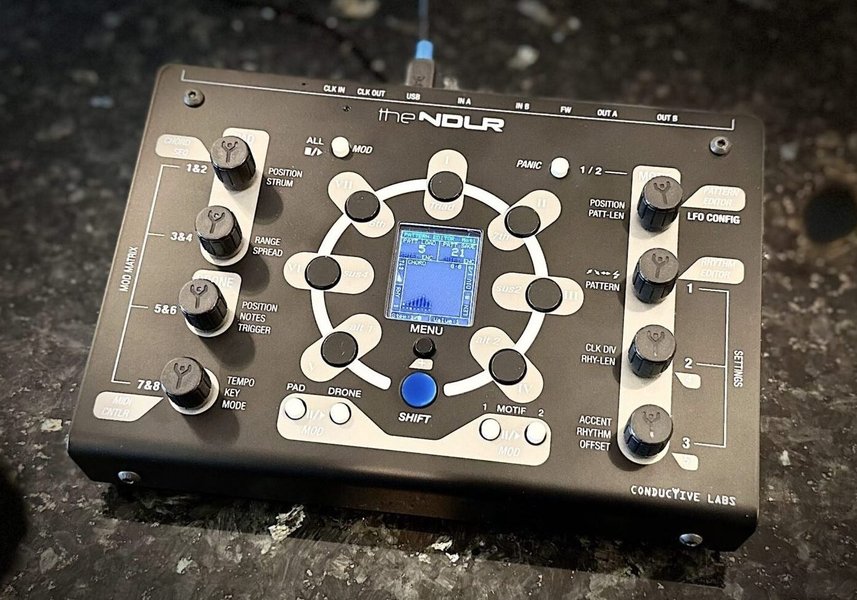
The Conductive Labs NDLR, a hub for generative MIDI sequencing and performance.
Core Insights: Sequencer & Modulation Highlights
- Harmonic Foundation: The chord sequencer allows users to program intricate chord progressions that automatically govern all four of the NDLR's MIDI parts (two Motifs, Pad, and Drone), ensuring everything stays in key and musically coherent.
- Creative Control: Instead of meticulous note-by-note programming, users define musical ideas like keys, scales, chord degrees, and types, letting the NDLR generate the corresponding notes.
- Dynamic Evolution: A comprehensive modulation matrix, featuring internal LFOs and responsiveness to external MIDI, allows for real-time animation of chord parameters and other musical elements, creating evolving and expressive performances.
The NDLR's Chord Sequencer: Crafting Progressions with Ease
The NDLR’s chord sequencer is a central feature designed to let musicians create, manipulate, and perform chord progressions in real-time while ensuring all musical output remains harmonically consistent with a chosen key and scale. It's engineered to take the complexity out of sequencing by intelligently handling note generation across its multiple parts.
Understanding the Mechanics
Building Blocks: Chord Steps
Each step within a chord sequence is defined by five crucial attributes. This detailed control allows for precise harmonic and rhythmic construction:
| Attribute | Description | Typical Values/Options |
|---|---|---|
| Duration | Specifies how long the chord step plays. | Measured in quarter notes, with resolution down to 1/8th notes (e.g., 0.125 to 31.5 quarter notes). |
| Key | Defines the musical key for that specific chord step. | Standard musical keys (e.g., C, G, F#, Ab). |
| Mode | Sets the musical mode or scale. | Major, Minor, Dorian, Mixolydian, Lydian, Phrygian, Locrian, etc. |
| Degree | Indicates the scale degree (root) of the chord within the selected key and mode. | I, II, III, IV, V, VI, VII. |
| Type | Specifies the chord quality or type. | Triads (major, minor, diminished, augmented), 7ths (maj7, min7, dom7, dim7), sus2, sus4, 6ths, altered chords. |
This table outlines the fundamental parameters you can set for each chord in your NDLR sequence, offering a blend of traditional music theory and flexible sequencing.
Structuring Your Song: Sequences and Sections
Chord sequences in the NDLR are organized methodically. Users can create up to five custom chord sequences (plus one blank default). Each sequence can be built using three distinct sections: A, B, and C. Each of these sections can contain up to six individual chord steps, as defined above. A complete "song" or extended progression is then constructed by arranging these sections in a desired order, with options for repetition to create longer forms.
Intelligent Note Generation and Harmonic Cohesion
A hallmark of the NDLR is its ability to maintain harmonic integrity. When you select a chord (either programmed in the sequencer or played live), all notes for every part—Drone, Pad, and the two Motifs (arpeggiators)—automatically adjust to fit that chord’s intervals within the overall key and scale. This ensures that arpeggios, drones, and pads always sound "in key" and harmonically coherent, even as chords transition between major, minor, or more complex types. While the texture might shift slightly due to varying intervals between chord types, the musicality is preserved. Chord types can be changed on the fly using dedicated buttons, with the new type applying to the *next* selected chord, allowing for smooth, planned transitions.
Activation and Playback Control
To play a programmed chord sequence, it must first be "Armed," typically using one of the NDLR's encoders (e.g., encoder 7). Once armed, playing any of the four NDLR parts will trigger the sequence to begin, usually on the downbeat of the next bar, often indicated by a visual cue like a blinking LED in the BPM display. Disarming or pausing the sequence doesn't instantly stop it but allows it to play out its current step or section, providing performance flexibility. The NDLR can also sync to an external MIDI clock; if no clock ticks are received, it will not advance the sequence.
Beyond Programmed Sequences: Live Chord Input
While the chord sequencer offers powerful automation, the NDLR also supports live chord input. You can use its seven dedicated chord buttons (representing scale degrees I-VII) to select chords in real-time or connect an external MIDI keyboard or sequencer. External devices can change chords by sending MIDI CC messages, typically CC26 for Chord Degree and CC27 for Chord Type.
The Dynamic Duo: Chord Sequencer Meets Modulation
The NDLR’s true power for dynamic and evolving music comes from the deep interaction between its chord sequencer and its comprehensive modulation system. This synergy allows for the animation of harmonic and rhythmic elements in ways that go far beyond static progressions.
The Modulation Matrix: An Overview
At the core of this interaction is the NDLR's 8-slot modulation matrix (sometimes referred to as an 8x8 matrix). Each slot allows you to define a modulation source, a destination, and an amount (depth) of modulation. This matrix is the brain that connects various control signals to numerous parameters within the NDLR and even to external gear.
Modulation Sources: The Drivers of Change
The NDLR provides a versatile array of internal and external modulation sources:
- Internal LFOs: Typically, three Low-Frequency Oscillators are available. These LFOs offer various waveforms (e.g., Sine, Triangle, Square, Pulse, Sample & Hold, and Patterns). Their speeds can be set in seconds (free-running) or synced to musical divisions of the master BPM (e.g., 1 to 48 beats). Some LFOs may also feature probability options, adding an element of controlled randomness.
- MIDI Controllers: Incoming MIDI messages like Velocity, Pitch Bend, Mod Wheel, and Aftertouch from an external keyboard or controller can be used as modulation sources.
- Patterns: The NDLR's 20 built-in or saved patterns, which define relative note values for the Motif parts, can also serve as rhythmic modulation sources within the matrix.
Modulating the Chord Sequencer and Its Output
The modulation matrix can directly target parameters related to the chord sequencer and the parts it controls, leading to rich, evolving textures:
- Chord Attributes: Parameters such as Chord Degree and Chord Type can often be modulation destinations. Imagine an LFO slowly sweeping the Chord Degree, causing the progression to cycle through different roots within the scale, or subtly altering the Chord Type for harmonic variation.
- Pad Voicing and Rhythm: The *Pad's position* parameter, which influences chord voicing or note selection within the pad's chord, can be modulated. Similarly, parameters like strum timing can be modulated to create rhythmic variations and evolving chord textures. Moving the top encoder in the chord sequencer interface can sometimes directly alter parameters that modulate the chord sound dynamically.
- Dynamic Animation: When the chord sequencer is active, modulation can alter its behavior mid-playback. For example, an LFO modulating the Duration attribute of chord steps could introduce rhythmic unpredictability or organic feel to the progression.
Extending Modulation to External Synthesizers
A crucial aspect of the NDLR's modulation system is its ability to send MIDI CC (Control Change) messages externally. This means that the internal LFOs or other modulation sources can be routed via the modulation matrix to control parameters on connected synthesizers. For example, a chord progression could trigger changes in an LFO rate, which in turn modulates a synth's filter cutoff, envelope decay, or effects parameters, all perfectly synchronized with the harmonic changes dictated by the NDLR's chord sequencer.
Comprehensive Control and Generative Power
Most of The NDLR's internal parameters are MIDI CC addressable, meaning they can be controlled by external MIDI CC messages. Conversely, its internal modulation matrix sending MIDI CCs externally allows for comprehensive control and animation of an entire MIDI setup. This integration of a sophisticated chord sequencer with a flexible modulation matrix positions The NDLR as a powerful tool for generative composition and live performance, enabling complex musical arrangements and dynamic sound design, even for users without traditional keyboard skills.
Visualizing NDLR's Sequencing & Modulation Capabilities
The following chart offers a conceptual look at the NDLR's strengths in areas related to its chord sequencer and modulation features. These are subjective assessments based on its described functionality, on a scale where higher values indicate greater capability.
This chart highlights the NDLR's proficiency in creating evolving musical pieces with robust control over harmony and extensive modulation possibilities, balanced with a moderate learning curve due to its depth.
Interconnected Musical Ecosystem
The NDLR creates a cohesive musical environment where the chord sequencer, modulation matrix, its internal parts, and external devices all work in concert. The mindmap below illustrates these key relationships:
(Duration, Key, Mode, Degree, Type)"] id1_2["Sequence Structure
(Sections A, B, C)"] id1_3["Global Harmonic Control"] id1_4["Live Chord Input Buttons"] id2["Modulation Matrix (8-Slot)"] id2_1["Sources"] id2_1_1["3 LFOs (Sine, Tri, Sqr, S&H, Patterns)"] id2_1_2["MIDI Input (Velocity, PB, MW, AT)"] id2_1_3["Internal Patterns"] id2_1_4["Probability Modifiers"] id2_2["Destinations"] id2_2_1["Chord Sequencer Parameters
(e.g., Degree, Type, Strum)"] id2_2_2["NDLR Part Parameters
(e.g., Pad Position, Motif Rhythms)"] id2_2_3["External MIDI CC Output"] id3["NDLR Parts (Driven by Chord Sequencer)"] id3_1["Motif 1 (Arpeggiator)"] id3_2["Motif 2 (Arpeggiator)"] id3_3["Pad (Polyphonic Chord Player)"] id3_4["Drone (Sustained Tones)"] id4["External Interaction & Control"] id4_1["MIDI Input (Clock Sync, External Chord Control)"] id4_2["MIDI Output (Notes to Synths, Modulated CCs)"]
This mindmap shows how the chord sequencer acts as the central harmonic brain, with the modulation matrix providing dynamic movement and control, all influencing the NDLR's own sound-generating parts and any connected MIDI instruments.
See It in Action: NDLR Deep Dive
For a visual demonstration and further exploration of the NDLR's capabilities, including its chord sequencer and song mode, the following video provides an in-depth review. The segment specifically discussing the Chord Sequencer and Song Mode typically starts around the 32:50 mark.
This review offers practical insights into how these features come together, showcasing the NDLR as a potent tool for generative music creation.
Frequently Asked Questions (FAQ)
What is the primary function of the NDLR's chord sequencer?
How does the NDLR ensure harmonic coherence when chords change?
Can I control external synthesizers using the NDLR's modulation and chord sequencer?
How many LFOs does the NDLR have for modulation, and what are their characteristics?
Is it possible to save and recall chord progressions on the NDLR?
Recommended Further Exploration
- What are some advanced generative music techniques using the NDLR's features?
- How can the NDLR be integrated into a hybrid studio setup with both hardware synths and DAWs?
- How does the NDLR compare to other MIDI sequencers focused on polyphony and arpeggiation?
- Can you provide a step-by-step guide to arranging a full song using the NDLR's song mode and section sequencing?
References

Last updated May 21, 2025