
Unveiling the "Anti-Intuitive" Wonders: The Science of Negative Poisson's Ratio Materials
Discover how these extraordinary materials defy conventional physics to offer unparalleled performance in engineering.

- 1.Key Insights into Auxetic Materials
- 2.The Fundamental Principle of Auxetics
- 3.Mechanisms Behind the Magic
- 4.Extraordinary Properties and Engineering Advantages
- 5.A Glimpse into Applications Across Industries
- 6.A Comparative Overview: Auxetics vs. Conventional Materials
- 7.The Future of Auxetic Materials
- 8.Comparative Properties Table
- 9.Frequently Asked Questions (FAQ)
- 10.Conclusion
- 11.Recommended Further Reading
- 12.Referenced Search Results
Imagine a material that expands when you stretch it, and contracts when you compress it. This seemingly counter-intuitive behavior is the hallmark of Negative Poisson's Ratio (NPR) materials, also known as auxetics. Unlike most conventional materials that thin out when stretched and bulge when compressed, auxetics do the exact opposite. This unique characteristic is not a trick of chemistry, but rather a marvel of structural engineering, emerging from meticulously designed internal geometries.
Key Insights into Auxetic Materials
- Unusual Deformation Behavior: Auxetic materials expand laterally when stretched longitudinally and contract laterally when compressed, offering superior impact resistance and energy absorption.
- Engineered Microstructures: Their unique properties stem from specific internal designs like re-entrant cell structures, rotating units, and chiral geometries, rather than chemical composition.
- Diverse and Growing Applications: From protective equipment and biomedical devices to aerospace components and automotive safety, auxetics are revolutionizing various industries.
The Fundamental Principle of Auxetics
The Poisson's ratio, typically denoted by \( \nu \), describes the ratio of transverse strain to axial strain when a material is subjected to a load. For most materials, stretching them along one axis causes them to contract in perpendicular directions, resulting in a positive Poisson's ratio (usually between 0 and 0.5). However, auxetic materials exhibit a negative Poisson's ratio, meaning that when stretched, they become wider, and when compressed, they become narrower. This peculiar response is due to their internal architecture, which allows for structural rearrangements that lead to this unusual expansion or contraction.
The mathematical representation of Poisson's ratio is given by:
\[ \nu = - \frac{\text{transverse strain}}{\text{axial strain}} = - \frac{\varepsilon_{\text{transverse}}}{\varepsilon_{\text{axial}}} \]For auxetic materials, \( \nu < 0 \), indicating that the transverse and axial strains have the same sign. This fundamental difference underpins their exceptional mechanical properties.
Mechanisms Behind the Magic
The ability of auxetic materials to exhibit a negative Poisson's ratio is rooted in their intricate internal structures. These are not typically found in natural materials but are rather engineered through careful design. Several key mechanisms contribute to this behavior:
Re-entrant Geometries
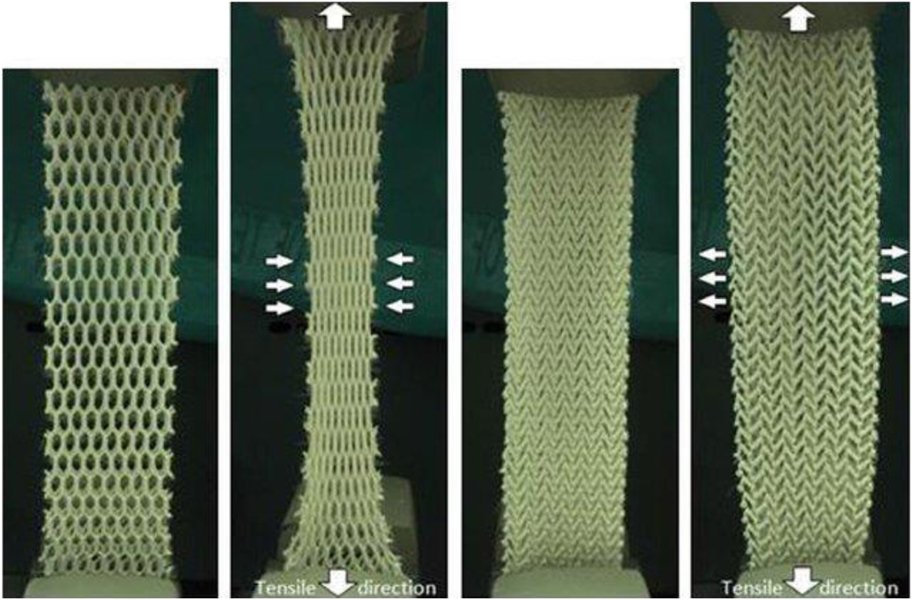
One of the most common designs for auxetic materials involves re-entrant honeycomb or foam structures. These structures feature cell walls that bend inward. When stretched, the re-entrant corners "unfold" or "hinge," causing the material to expand outwardly. This structural transformation effectively converts axial tension into lateral expansion.
Rotating Unit Lattices and Chiral Structures
Another class of auxetic designs involves interconnected rigid units that can rotate relative to each other. When an external force is applied, these units rotate, leading to an overall expansion of the material in perpendicular directions. Chiral structures, characterized by their lack of mirror symmetry, also fall into this category, leveraging rotational mechanisms to achieve auxetic behavior.
This mindmap illustrates the core concepts, mechanisms, and applications of Negative Poisson's Ratio materials, highlighting their unique properties and the engineering principles that enable them.
Knitted and Lattice Metamaterials
Modern manufacturing techniques, particularly additive manufacturing (3D printing), have opened new avenues for creating complex auxetic designs. By precisely controlling the geometry of lattices and knitted structures at micro and macro scales, engineers can achieve tailored auxetic responses. These metamaterials offer unprecedented control over mechanical properties.
Extraordinary Properties and Engineering Advantages
The negative Poisson's ratio translates into a suite of highly desirable engineering properties that are superior to those of conventional materials:
Enhanced Energy Absorption and Impact Resistance
When auxetic materials are impacted, they densify at the point of impact, effectively stiffening and distributing the load over a larger area. This localized stiffening significantly enhances their energy absorption capabilities and impact resistance, making them ideal for protective applications.
An illustration showing the application of auxetic structures in the automotive industry, particularly for enhanced safety and impact absorption.
High Shear Modulus and Indentation Resistance
The internal geometry of auxetics allows them to resist shear deformation more effectively than traditional materials. This, coupled with their densification upon indentation, leads to a higher shear modulus and superior indentation resistance. These properties are crucial for applications requiring structural integrity under complex loading conditions.
Improved Acoustic and Vibration Damping
The unique deformation mechanisms of auxetic materials also contribute to their excellent acoustic and vibration damping capabilities. By effectively dissipating energy through structural reconfigurations, they can reduce noise and vibration, making them valuable in aerospace and automotive applications.
Tunable and Multifunctional Characteristics
Advanced auxetic designs can be engineered to exhibit tunable properties, responding to external stimuli such as magnetic fields or temperature changes. This multifunctionality opens doors for "smart" materials and adaptive structures that can adjust their properties on demand, offering unprecedented control in various applications.
A Glimpse into Applications Across Industries
The remarkable properties of auxetic materials have spurred intense research and development, leading to a wide array of potential and realized applications:
Protective Equipment
The superior energy absorption and impact resistance of auxetics make them ideal for protective gear. They are being explored for use in body armor, helmets, knee pads, and athletic wear, offering enhanced safety and comfort for individuals in high-risk environments or sports.
Automotive and Aerospace
In the automotive industry, auxetics can significantly improve crashworthiness by absorbing impact energy more efficiently in components like bumpers and crumple zones. For aerospace, their lightweight nature combined with high damage tolerance makes them suitable for aircraft components, offering both weight reduction and enhanced safety.
Biomedical Devices
The ability of auxetics to conform and adapt to complex shapes is highly beneficial in biomedical applications. Flexible stents, adaptive implants, and tissue engineering scaffolds can leverage auxetic properties to mimic biological tissues more closely, improving patient outcomes and device longevity.
Other Emerging Applications
Beyond these key areas, auxetic materials are finding applications in areas such as seismic and impact dampers, adaptable seals, and even smart textiles. Their versatility ensures that new applications are continuously being discovered, pushing the boundaries of material science.
The following video provides an excellent visual demonstration and explanation of auxetic metamaterials, specifically focusing on a 3D-printed example that clearly illustrates their unique deformation behavior. It helps in understanding how these engineered structures achieve their negative Poisson's ratio through physical movement and structural design.
This video showcases an auxetic metamaterial with a negative Poisson's ratio, demonstrating its unique deformation when stretched.
A Comparative Overview: Auxetics vs. Conventional Materials
To better understand the significance of auxetic materials, it's helpful to compare their performance attributes against conventional materials. The following radar chart provides a qualitative comparison of key performance indicators.
This radar chart visually compares the performance of auxetic materials against conventional materials across several critical engineering attributes, on a scale of 1 (low) to 5 (high).
The following bar chart further illustrates the comparative advantage of auxetic materials in specific application contexts, emphasizing their utility in fields where advanced mechanical properties are critical.
This bar chart evaluates the suitability of auxetic materials versus conventional materials for various applications, on a scale of 1 (least suitable) to 10 (most suitable).
The Future of Auxetic Materials
The field of auxetic materials is rapidly evolving, driven by advancements in manufacturing techniques like additive manufacturing (3D printing). These technologies enable the creation of increasingly complex and precisely engineered auxetic structures, pushing the boundaries of what is possible. The ability to tailor material properties for specific needs makes auxetics a cornerstone for future innovations in materials science and engineering. As research continues, we can expect to see even more sophisticated designs and a broader range of applications, further solidifying their role in addressing critical engineering challenges.
Comparative Properties Table
This table summarizes the key distinctions and advantages of auxetic materials over conventional materials:
| Property | Auxetic Materials | Conventional Materials | Implication/Advantage of Auxetics |
|---|---|---|---|
| Poisson's Ratio (\( \nu \)) | Negative (e.g., -0.1 to -0.8) | Positive (e.g., 0 to 0.5) | Expands laterally when stretched, contracts when compressed, leading to unique deformation behavior. |
| Energy Absorption | High | Moderate | Better at dissipating impact energy, enhancing safety. |
| Impact Resistance | Excellent (densifies upon impact) | Good (deforms) | Superior protection against blunt force trauma and penetration. |
| Shear Modulus | High | Moderate | Increased resistance to shear deformation. |
| Indentation Resistance | Superior | Moderate | Resists localized deformation better, maintaining structural integrity. |
| Damage Tolerance | Enhanced | Typical | Can withstand damage without catastrophic failure, improving longevity. |
| Manufacturing Complexity | High (requires precise engineering) | Variable | Relies on advanced manufacturing (e.g., 3D printing) for intricate structures. |
Frequently Asked Questions (FAQ)
What is a Negative Poisson's Ratio?
Are auxetic materials found naturally?
Why are auxetic materials important?
How are auxetic materials made?
What are some common applications of auxetic materials?
Conclusion
Negative Poisson's Ratio materials, or auxetics, represent a paradigm shift in material science and engineering. Their unique ability to expand laterally when stretched and contract when compressed—a direct defiance of conventional material behavior—unlocks a realm of extraordinary properties. From superior energy absorption and impact resistance to high shear modulus and tunable responses, auxetics offer unparalleled advantages over traditional materials. The continuous advancements in fabrication techniques, particularly additive manufacturing, are propelling the development of increasingly sophisticated auxetic designs, paving the way for their integration into critical applications across diverse industries. As research progresses, these "anti-intuitive" materials are set to redefine performance, safety, and functionality in engineering.
Recommended Further Reading
- How are re-entrant structures designed for auxetic behavior?
- What are the latest advancements in 3D printing auxetic materials?
- Can auxetic materials be used in smart wearable technology?
- What are the challenges in scaling up auxetic material production?