

Key Insights into Newton's Laws
- Inertia's Enduring Influence: Newton's First Law explains why objects resist changes in their state of motion, a principle evident in car safety features like seatbelts and airbags, which mitigate the effects of sudden deceleration.
- Force, Mass, and Acceleration: The Second Law, famously expressed as \(F = ma\), quantifies how an object's acceleration is directly proportional to the applied force and inversely proportional to its mass, fundamentally shaping vehicle design and athletic performance.
- Action-Reaction Pairs: Newton's Third Law reveals that forces always occur in pairs, where every action has an equal and opposite reaction, driving propulsion in activities like walking, swimming, and rocket launches.
The Foundation of Motion: Newton's Three Laws
Sir Isaac Newton's three laws of motion, first articulated in his seminal work "Philosophiæ Naturalis Principia Mathematica" in 1687, are the bedrock of classical mechanics. These laws provide a comprehensive framework for understanding how objects move and interact under the influence of forces. They are not merely abstract scientific principles but are deeply embedded in the fabric of our daily experiences, explaining countless phenomena around us.
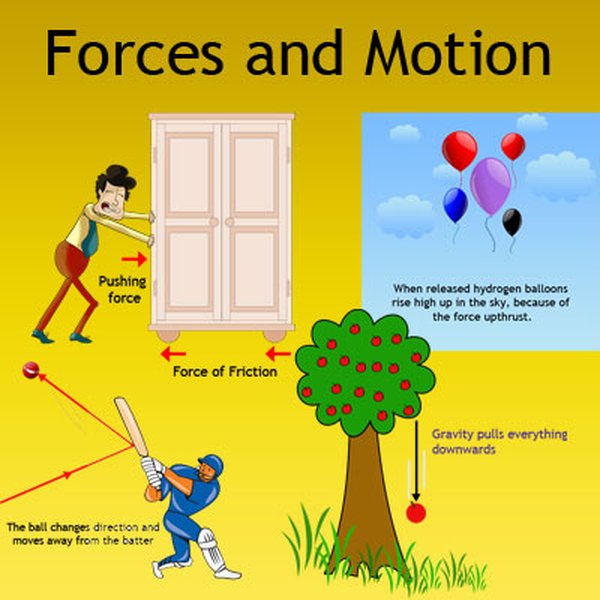
A visual representation of forces and motion, illustrating fundamental physical interactions.
Understanding Resistance to Change
Newton's First Law, often referred to as the Law of Inertia, states that an object at rest will remain at rest, and an object in motion will continue in motion with the same speed and in the same direction, unless acted upon by an external force. This intrinsic property of matter—its resistance to changes in its state of motion—is directly proportional to its mass.
Consider a book placed on a table. It stays there indefinitely unless you push it, or a gust of wind moves it. Similarly, a ball rolling across a smooth floor will continue to roll until friction or another force brings it to a stop. This law underscores the idea that a net external force is essential to initiate movement, alter speed, or change the direction of an object.
Everyday Manifestations of Inertia
- Seatbelts and Airbags: When a car suddenly brakes, your body continues to move forward at the car's original speed due to inertia. Seatbelts apply a necessary external force to decelerate you safely, while airbags deploy to cushion the impact and extend the stopping time, thereby reducing the force exerted on your body.
- The Tablecloth Trick: Magicians can swiftly pull a tablecloth from under dinnerware because the dishes, possessing inertia, tend to remain in their original state of rest. As long as the pull is quick and horizontal friction is minimized, the external force on the dishes is negligible, and they stay put.
- Spinning Fan Blades: After a fan is turned off, its blades continue to spin for a period. This continued motion is due to inertia, as there isn't an immediate external force strong enough to bring them to an instant halt.
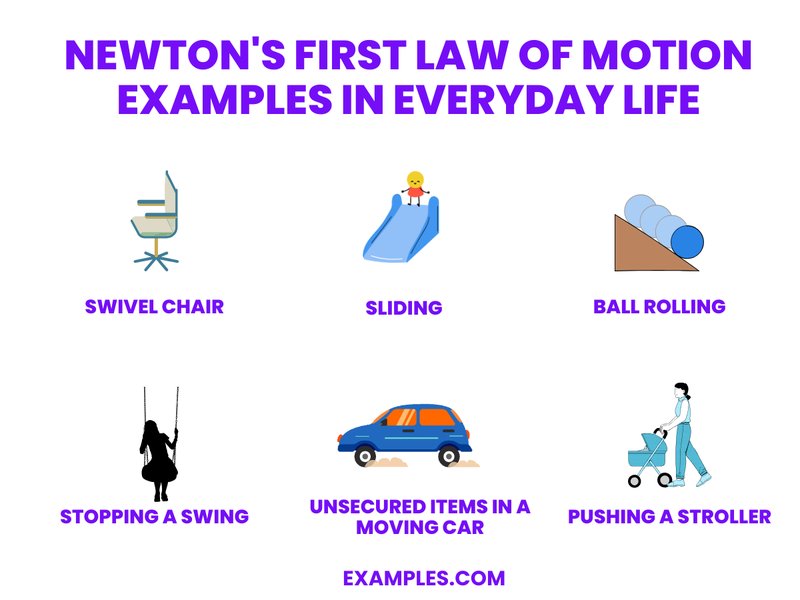
Examples of Newton's First Law in everyday scenarios, such as the continued motion of passengers in a braking vehicle.
The Quantitative Relationship of Motion
Newton's Second Law provides a quantitative definition of force, stating that the acceleration of an object is directly proportional to the net force acting on it and inversely proportional to its mass. This is famously encapsulated in the equation \(F = ma\), where \(F\) represents force, \(m\) denotes mass, and \(a\) signifies acceleration.
This law explains that a greater force will produce a greater acceleration, assuming mass remains constant. Conversely, if the same force is applied to objects of different masses, the object with less mass will experience greater acceleration. This principle is fundamental to understanding why different objects respond differently to the same push or pull.
Practical Applications of \(F = ma\)
- Pushing Objects: It requires significantly more effort (force) to push a heavy shopping cart (larger mass) to the same speed as an empty one. This directly demonstrates that a larger mass demands a greater force for equivalent acceleration.
- Sports Dynamics: In sports like baseball or golf, the force with which a player hits a ball and the ball's mass determine its acceleration and how far it travels. A powerful swing (greater force) applied to a lightweight ball results in high acceleration and distance.
- Vehicle Engineering: Automotive engineers apply Newton's Second Law to optimize vehicle performance. For racing cars, minimizing mass allows the engine's power (force) to generate maximum acceleration, enabling faster speeds and quicker lap times. Braking systems are also designed based on this law, calculating the force needed to decelerate a vehicle safely over a specific distance.

A baseball being hit, an example of Newton's Second Law in action, where force and mass determine acceleration.
The Interconnectedness of Forces
Newton's Third Law asserts that for every action, there is an equal and opposite reaction. This means that forces always occur in pairs, acting on two different objects. When one object exerts a force on a second object, the second object simultaneously exerts a force of equal magnitude and opposite direction back on the first object.
It's a common misconception that action-reaction forces cancel each other out. However, they act on different objects, thus not resulting in cancellation of motion for a single object. This law explains how interactions between objects lead to motion and change.
Everyday Examples of Action-Reaction Pairs
- Walking: When you walk, your foot pushes backward on the ground (action). In response, the ground pushes forward on your foot with an equal and opposite force (reaction), propelling you forward. This is why walking on ice is difficult; the lack of friction reduces the ground's ability to exert a strong forward reaction force.
- Rocket Propulsion: Rockets work by expelling hot gases downward at high velocity (action). The gases, in turn, exert an equal and opposite force upward on the rocket (reaction), lifting it into space.
- Swimming: A swimmer propels themselves through water by pushing water backward with their hands and feet (action). The water then pushes the swimmer forward with an equal and opposite force (reaction).
- Jumping on a Trampoline: When you push down on a trampoline (action), the trampoline pushes back up on you with an equal and opposite force (reaction), launching you into the air.
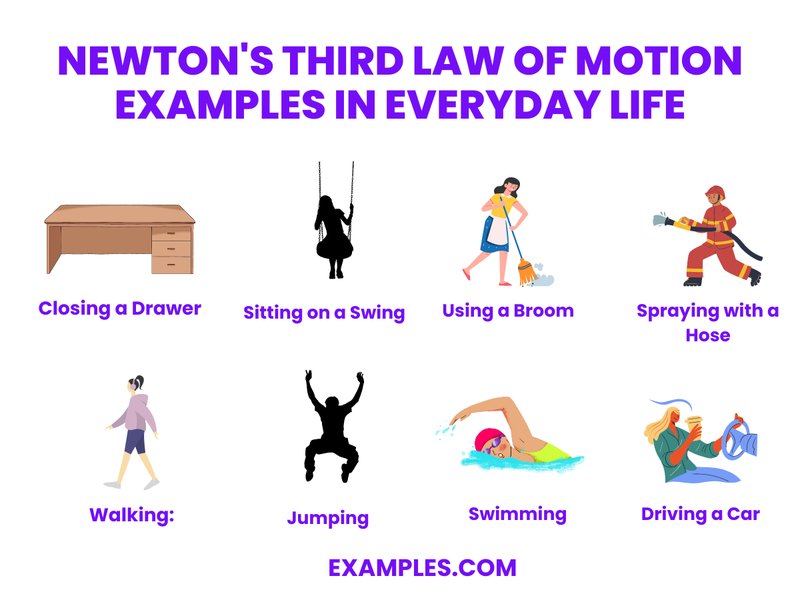
Newton's Third Law in action, depicting the equal and opposite forces between a foot and the ground while walking.
Comprehensive Summary of Newton's Laws and Their Everyday Relevance
The table below provides a concise overview of each of Newton's Laws, their fundamental principles, and a selection of real-world applications that illustrate their pervasive impact.
| Newton's Law | Core Principle | Everyday Applications |
|---|---|---|
| First Law (Inertia) | An object at rest stays at rest, and an object in motion stays in motion with constant velocity, unless acted upon by a net external force. | Seatbelts in cars, dishes remaining on a tablecloth during a quick pull, fan blades spinning after power off, objects remaining stationary unless pushed. |
| Second Law (F=ma) | The acceleration of an object is directly proportional to the net force acting on it and inversely proportional to its mass. \(F = ma\). | Pushing a shopping cart (heavier cart requires more force), hitting a baseball (force determines acceleration), rocket acceleration, braking a car, designing elevators. |
| Third Law (Action-Reaction) | For every action, there is an equal and opposite reaction. Forces always come in pairs acting on different objects. | Walking (foot pushes ground, ground pushes foot), rocket propulsion (gases push rocket), swimming (hands push water, water pushes swimmer), jumping on a trampoline, recoil from a fired gun. |
Connecting the Dots: A Mindmap of Newton's Laws
To provide a structured overview of the interconnectedness of Newton's Laws and their applications, here is a mindmap illustrating key concepts and examples.
Visual Explanation: Newton's Laws in Real Life
This video from "Newton's Laws of Motion: Real-Life Applications | Mr. SMART" provides a clear and engaging visual explanation of how Newton's three laws manifest in our daily lives, using relatable examples to make these fundamental physics principles understandable.
A video illustrating real-life applications of Newton's Laws of Motion, making abstract concepts concrete.
Frequently Asked Questions
What is the primary difference between Newton's First and Second Laws?
Can Newton's Third Law forces cancel each other out?
Are Newton's Laws applicable in all physical scenarios?
How does friction relate to Newton's Laws?
Conclusion
Newton's three laws of motion are not just historical scientific achievements; they are active principles that govern virtually every physical interaction in our world. From the simple act of walking to the complex dynamics of space travel and the design of safety systems, these laws provide an intuitive yet profound understanding of force, motion, and interaction. Their enduring relevance underscores their position as cornerstones of physics, continually informing our understanding and manipulation of the physical universe.
Recommended Further Exploration
- How do Newton's Laws apply to space exploration?
- The historical impact of Newton's Principia Mathematica
- Advanced physics concepts beyond Newton's Laws
- Newtonian mechanics in modern engineering design