
Unpacking NFL ATS Performance by Point Spread: A Deep Dive into Betting Dynamics
Understanding how NFL teams perform against the spread across various point margins for smarter betting decisions.
Key Insights into NFL ATS Performance
- Point Spread Fundamentals: The point spread is designed to level the playing field, making games more balanced for betting by setting a margin of victory or loss that a team must "cover" to win the bet, regardless of the outright game winner.
- Key Numbers and Underdog Value: Spreads of -3 and -7 are particularly significant in NFL betting due to the frequency of games decided by these margins. Historically, betting on underdogs, especially in certain spread ranges, can be more profitable, with home underdogs often showing better ATS records.
- Factors Influencing Spreads and Performance: Team performance, injuries, home-field advantage, weather conditions, and public sentiment all play crucial roles in setting and influencing point spreads, directly impacting a team's ability to cover.
In the dynamic world of NFL betting, understanding "Against the Spread" (ATS) performance is paramount for both seasoned bettors and newcomers. Unlike simply picking the winner of a game (moneyline), ATS betting involves a team covering a specific margin of victory or loss set by oddsmakers. This intricate system attempts to balance the perceived strength of two teams, making every game a more intriguing betting proposition.
Decoding the Point Spread: The Heart of NFL Betting
What is the Point Spread and How Does It Work?
The point spread is a handicapping tool used by sportsbooks to encourage balanced betting action on both sides of a game. It represents the expected margin of victory for the favored team. For instance, if the Kansas City Chiefs are favored by -7 points against the Denver Broncos, it means the Chiefs are expected to win by more than 7 points. For a bet on the Chiefs to win, they must win by 8 points or more. Conversely, if you bet on the Broncos as +7 underdogs, your bet wins if the Broncos either win outright or lose by 6 points or fewer.
This mechanism creates a "push" if the favorite wins by exactly the spread amount (e.g., the Chiefs win 27-20 when the spread is -7). To avoid pushes and guarantee a winner, sportsbooks often use half-point spreads, like -7.5 or +7.5. The odds associated with point spread bets are typically around -110 for both sides, meaning you would wager $110 to win $100. This -110 odds structure implies a break-even point of approximately 52.38% to be profitable over the long term.
The Art and Science Behind Setting Spreads
Setting the initial point spread involves a complex blend of art, science, and a bit of guesswork from experienced oddsmakers. They consider a multitude of factors, including:
- Team Performance and Recent Form: Analyzing how teams have performed in recent games, their offensive and defensive efficiencies, and overall statistical profiles.
- Injuries: The impact of key player injuries on a team's strength and depth.
- Home-Field Advantage: Historically, playing at home provides an advantage, typically valued between 2 and 3 points in the NFL.
- Matchup Analysis: How one team's strengths align or clash with another team's weaknesses.
- Public Sentiment: While not the primary factor, public betting patterns and team popularity (e.g., Dallas Cowboys or New England Patriots often drawing more bets) can influence spread adjustments.
- Weather Conditions: Extreme weather like heavy wind, rain, or snow can limit offensive play, potentially affecting totals and spreads.
Once an initial line is set, it is tested against professional bettors, and then refined based on what number will encourage roughly equal betting action on both sides. This dynamic process means spreads can fluctuate significantly from their opening lines, making line watching a critical aspect for bettors.
Understanding ATS Performance Across Different Spreads
The Significance of Key Numbers in NFL Spreads
In NFL betting, certain point spread values are known as "key numbers" because a high percentage of games conclude with a margin of victory equal to these numbers. The most prominent key numbers are 3 and 7, reflecting the common scoring plays (field goals and touchdowns). Understanding these numbers is crucial for bettors, as a spread like -2.5 is very different from -3, or +6.5 from +7.
Historically, teams favored by amounts just below a key number (e.g., -2.5 or -6.5) often see different ATS outcomes compared to those exactly on or above a key number (e.g., -3 or -7). For instance, a team favored by -2.5 needs to win by 3 points or more to cover, which aligns with a common margin of victory.
ATS Records by Point Spread Categories
Analyzing historical NFL data reveals patterns in how teams perform ATS at various point spreads. While specific percentages fluctuate year to year, general trends emerge:
- Small Favorites (-1 to -3.5): These are often closely contested games. While home favorites at -2.5 historically have a respectable ATS record, road favorites with the same line perform less favorably. This category can present opportunities if a bettor can identify undervalued teams.
- Moderate Favorites (-4 to -7): These spreads involve teams expected to win by a clear margin. Interestingly, some data suggests that teams favored by -4 or -6 have been among the more profitable favorites to bet on ATS over the long term, potentially due to public perception or mispricing around key numbers.
- Large Favorites (-7.5 and above): When a team is a large favorite, they need to win by a significant margin to cover. While strong teams often blow out lesser opponents, the inflated spreads can make it difficult for them to consistently cover. Public sentiment can lead to tighter spreads for popular teams, regardless of recent performance, making them less reliable ATS. Conversely, underdogs in these situations (e.g., +7.5 or higher) can be attractive as they only need to lose by a smaller margin or win outright.
Here's a generalized table illustrating how different spread categories might perform ATS:
| Spread Category | Favorite Example | Underdog Example | Typical Scenario | ATS Tendency (General) |
|---|---|---|---|---|
| Small Favorites | -2.5 | +2.5 | Evenly matched teams, or slight home advantage | Can be unpredictable; home favorites sometimes better cover rates. |
| Moderate Favorites | -5.5 | +5.5 | One team clearly stronger but not dominant | May offer value on specific favored teams or undervalued underdogs. |
| Large Favorites | -10.5 | +10.5 | Significant perceived mismatch | Underdogs more likely to cover by losing within the margin or winning outright. |
| "Key Number" Spreads | -3 / -7 | +3 / +7 | Games often decided by field goal or touchdown margins | High incidence of pushes; crucial to consider half-points. |
The Underdog Advantage
Many analyses suggest that betting on underdogs can be a profitable long-term strategy, particularly when they are catching a significant number of points. Teams that frequently lose straight-up can still be excellent ATS bets because they "cover the spread" by losing by fewer points than anticipated. The Washington Commanders, Houston Texans, Indianapolis Colts, and Pittsburgh Steelers have shown strong ATS records as underdogs in recent seasons.
Key Factors Influencing ATS Outcomes
Beyond the Numbers: Situational Betting Trends
While raw ATS records by point spread are valuable, a deeper understanding requires considering situational factors that impact performance:
- Home vs. Away Performance: Teams often perform differently ATS at home compared to on the road. Some teams are consistently better at covering the spread in their own stadium, while others might excel as road underdogs.
- Performance as Favorite vs. Underdog: Certain teams might be reliable favorites who consistently cover large spreads, while others might be "good bad teams" who frequently cover as underdogs.
- Division Matchups: Rivalry games within divisions can often defy standard expectations, as teams know each other well, leading to tighter, more unpredictable contests that affect spread outcomes.
- Streaks and Momentum: Teams on winning or losing streaks can see their spreads adjusted. For example, a team on a strong winning streak might see their point spreads inflate, making it harder for them to continue covering.
- Coaching and Scheme: Coaching philosophies and team schemes can also influence ATS performance, especially in how teams approach game management and play calling in close contests.
The Role of Public Betting Sentiment
Public sentiment significantly impacts NFL betting odds. When a large percentage of bets come in on one side, sportsbooks may adjust the spread to balance their liability. This can create "inflated" or "deflated" lines, where the spread might not perfectly reflect the true statistical probability but rather the market's collective opinion. Savvy bettors often look for opportunities to bet against the public when they believe the market has overreacted to a team's popularity or recent performance.
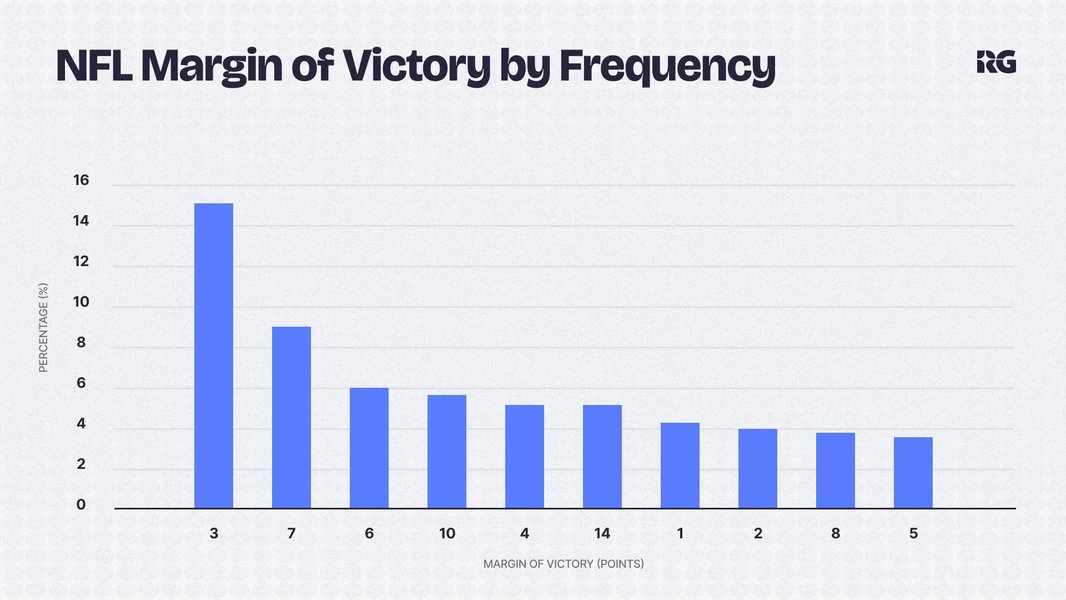
Frequency distribution of NFL margins of victory, highlighting key numbers like 3 and 7.
Forecasting ATS Performance: A Multi-faceted Approach
Leveraging Data and Analytics for Informed Bets
Modern NFL betting increasingly relies on sophisticated data analytics and statistical models. These tools process vast amounts of data, including player statistics, team efficiencies, historical matchup data, and even predictive algorithms, to generate more accurate predictions and identify valuable betting opportunities. Computer-generated picks, often based on proprietary algorithms, can provide insights into moneyline, spread, and point total selections.
While statistical models are powerful, they are not infallible. The human element, including unpredictable injuries, game-day decisions, and motivational factors, still plays a significant role. Therefore, a comprehensive approach often combines statistical analysis with qualitative assessments.
This video explains the basics of point spread betting, detailing how the spread is set based on various factors like team performance, injuries, and public sentiment. It's an excellent resource for beginners to grasp the fundamental concepts of this popular NFL betting market.
Comparative Analysis of NFL Betting Dynamics
To further illustrate the complexities of NFL betting and how various factors interplay, let's consider a radar chart comparing different aspects of team performance and their impact on ATS outcomes. This chart reflects a conceptual analysis, demonstrating how strengths and weaknesses in different areas might influence a team's ability to cover the spread.
The radar chart visually represents how various attributes contribute to a team's ATS performance. An "Elite ATS Performer" typically excels across all metrics, consistently covering spreads. An "Inconsistent ATS Performer" might have some strengths but is hampered by weaknesses, leading to fluctuating ATS results. An "Underdog ATS Specialist" may not be dominant overall but demonstrates strong defensive capabilities, solid special teams, and strategic coaching that allows them to keep games close and cover as underdogs. This chart emphasizes that ATS success is a multivariate outcome, not just a function of raw talent.
Frequently Asked Questions About NFL ATS Performance
What does "ATS" mean in NFL betting?
Why are 3 and 7 considered "key numbers" in NFL betting?
Do home teams have a better ATS record?
How important is public sentiment in setting NFL point spreads?
Conclusion: Navigating the Nuances of NFL ATS
Mastering NFL ATS performance by point spread is a journey of continuous learning and adaptation. It moves beyond simply picking winners to understanding the intricate dance between team capabilities, market dynamics, and statistical probabilities. By dissecting point spread fundamentals, recognizing the impact of key numbers, and appreciating the various factors that influence ATS outcomes—from injuries and home-field advantage to public sentiment—bettors can make more informed decisions. The goal is not just to predict who wins, but who covers the spread, demanding a deeper level of analysis that considers margin of victory and team performance relative to expectations. As the NFL season unfolds, diligent research, an understanding of trends, and an eye for value will be a bettor's most valuable assets.
Recommended Further Exploration
- How to analyze NFL moneyline vs. point spread bets?
- What is the impact of injuries on NFL betting lines?
- How to understand NFL over/under betting strategies?
- What are the most effective advanced NFL betting analytics tools?