
Restoring Your Nissan LEAF's Reverse Sound: A Comprehensive Guide for 2012 Models
Understanding the Vehicle Sound for Pedestrians (VSP) System and Reconnecting the Reverse Speaker
Key Insights into Nissan LEAF Reverse Sound
- Legal and Safety Considerations: The reverse sound in Nissan LEAFs, part of the Vehicle Sound for Pedestrians (VSP) system, is a crucial safety feature mandated in many regions to alert pedestrians and cyclists to a quiet electric vehicle's presence. Disabling it can have legal and safety implications.
- 2012 Model Year Specifics: Unlike the 2011 model, the 2012 Nissan LEAF (and newer models) notably lacks a readily accessible factory switch to disable the VSP system. This change was implemented in anticipation of evolving safety regulations.
- Reconnecting the Speaker: If your 2012 Nissan LEAF's reverse sound is absent, it is most likely due to a disconnected or faulty VSP speaker, often located under the hood near the 12V battery or in the driver's wheel well. Reconnecting it may involve accessing this speaker and ensuring proper wiring.
The Purpose of the Nissan LEAF's Reverse Sound
The Nissan LEAF, being an electric vehicle, operates with significantly less noise than traditional internal combustion engine (ICE) cars. This quiet operation, while beneficial for reducing noise pollution, can pose a safety risk to pedestrians and cyclists, especially at low speeds or when reversing. To address this, Nissan, like other automakers, implemented a Vehicle Sound for Pedestrians (VSP) system. The VSP system is designed to emit artificial sounds to alert those outside the vehicle of its presence and direction of travel. For the Nissan LEAF, this includes a specific sound for forward motion at low speeds and a distinct alert for when the vehicle is in reverse.
The reverse sound is typically an audible beep or chime, sometimes described as a "sonar-like" or "alien spaceship" noise by owners. While some drivers find it excessively loud or annoying, its primary function is safety. Regulations in many countries, including those anticipated by Nissan, require EVs and hybrids to have such warning systems. Therefore, disabling this feature, while sometimes possible through various means, carries potential legal ramifications and significantly increases the risk of an accident involving pedestrians.
Understanding Your 2012 Nissan LEAF's VSP System
The 2012 Nissan LEAF represents a transitional year for the VSP system. While the 2011 model featured a factory-built-in dash switch to temporarily deactivate the VSP system, this convenient control was removed in 2012. Nissan made this change in anticipation of forthcoming regulations from bodies like the NHTSA in the U.S., which would eventually mandate non-cancellable pedestrian warning sounds. As a result, for 2012 and newer models, there isn't an easy, owner-accessible switch to turn off the reverse sound from within the cabin.
Despite the removal of the dashboard switch, the core VSP system and its components remain in the 2012 LEAF. The external sound, including the reverse chime, is generated through speakers mounted at the front of the vehicle. If your 2012 LEAF is not making the reverse sound, it is most likely due to a disconnection or fault with the VSP speaker itself, rather than an intentional deactivation via an in-car setting.
Locating the VSP Speaker
The VSP speaker responsible for the external reverse sound is typically located under the hood. In many Nissan LEAF models, including potentially the 2012, this speaker is found:
- Right below the 12V lead-acid battery.
- In the driver's side wheel well.
- Behind the front grille or bumper area.
Accessing this speaker might require removing some components like the glove box or parts of the front bumper, depending on the specific model year and speaker placement. Some users report the VSP module itself being located behind the glove box, which sends signals to the external speaker.
This radar chart visually compares the attributes related to the reverse sound system between the 2011 Nissan LEAF (which had an in-dash switch) and the 2012+ models (which typically do not). The 2011 model scores higher on "Ease of Access" for disabling the sound but potentially lower on "Impact on Safety" if easily turned off. Conversely, the 2012+ models score lower on "Ease of Access" for modification but higher on "Regulatory Compliance" and "Impact on Safety" due to the mandated nature of the VSP. "DIY Difficulty" also reflects the increased complexity of modifications in newer models, while "Cost of Repair" indicates the potential expenses if professional intervention is required to fix or reconnect the system.
Reconnecting the Reverse Speaker in Your 2012 Nissan LEAF
If your 2012 Nissan LEAF's reverse sound is not working, the most direct approach to restore it is to investigate the VSP speaker and its connections. Often, the sound absence is due to the speaker being unplugged, damaged, or simply taped up by a previous owner to silence the chime.
Step-by-Step Guide to Reconnection (General)
While specific steps may vary slightly depending on the exact location of the VSP speaker in your 2012 model, the general process involves:
- Locate the VSP Speaker: As mentioned, this speaker is usually under the hood, near the 12V battery, or within the driver's side wheel well. You might need to remove some plastic covers or inner fender liners to gain access.
- Inspect the Wiring: Once the speaker is located, visually inspect its wiring. Look for any disconnected plugs, cut wires, or signs of damage. Sometimes, owners simply unplug the VSP speaker (part number often 28152 3na0a) to disable the sound.
- Check for Obstructions: Some owners resort to taping up the speaker to muffle or silence the sound. If present, remove any tape or sound-deadening material that might be obstructing the speaker's output.
- Reconnect/Repair: If the speaker is unplugged, carefully reconnect the electrical connector. If wires are cut, they may need to be spliced and re-insulated. Ensure all connections are secure.
- Test the Sound: After reconnecting, put the car in reverse (in a safe, open area) to check if the sound has been restored.
It's important to proceed with caution when working on automotive electrical systems. If you are uncomfortable with any of these steps, it is highly advisable to seek assistance from a qualified mechanic or a Nissan dealership.
Alternative Solutions and Considerations
While direct reconnection is ideal, other methods have been discussed by LEAF owners for managing the reverse sound, though their applicability to restoring a completely absent sound may vary:
- LeafSpy Pro: For 2013 and newer models, the LeafSpy Pro application, combined with an OBDII dongle, offers advanced diagnostic and customization options, including the ability to control some VSP settings like the reverse sound. While primarily for newer models, it's worth noting its prevalence in the LEAF community for managing these features. However, for a 2012 model with a missing sound, physical reconnection is more likely the solution than a software setting.
- Manual Switch Installation (DIY): Some 2012 LEAF owners, lamenting the removal of the 2011's dash switch, have gone to the extent of wiring in their own manual switch to control the VSP system. This involves tapping into the VSP module's wiring or the speaker's power supply. This is a more complex DIY modification and should only be attempted by those with strong electrical knowledge.
- Professional Assistance: If you're unable to locate the speaker, diagnose the issue, or successfully reconnect it, consulting a Nissan dealership or an experienced EV technician is recommended. They have the tools and expertise to properly diagnose and repair the VSP system, ensuring compliance with safety regulations.
Why the Reverse Sound is Important (Even if Annoying)
The "annoying" reverse beep serves a critical safety purpose. Electric vehicles are exceptionally quiet, making them difficult for pedestrians to hear, especially those who are visually impaired, distracted, or wearing headphones. The VSP system mitigates this risk by providing an audible warning. Disabling this sound, while providing personal convenience, can lead to increased liability in the event of an accident.
This video demonstrates a method for disconnecting the Nissan LEAF's backup chime, providing visual context to the physical location of the speaker and wiring often discussed by owners. While the video shows disconnection, it highlights the components that would need to be reconnected to restore sound.
Understanding Related Issues and Speaker Systems
It's important to distinguish the VSP system speaker from the internal audio system speakers of the Nissan LEAF. The VSP speaker is solely for external warning sounds, while the internal speakers are for music, navigation, and other in-cabin audio. If you are experiencing issues with internal sound, that would involve different troubleshooting steps related to the infotainment system or internal door speakers.
Common Speaker Locations in Nissan LEAF
For internal audio, the Nissan LEAF typically has:
- Front door speakers (often 6-1/2" or 6-3/4" aftermarket replacements fit).
- Rear door speakers (similar to front).
- Front pillar tweeters (if present, wired in parallel with door speakers).
Upgrading these speakers is a common modification for LEAF owners seeking improved audio quality, as the stock sound system, particularly without the optional Bose system, is sometimes described as lacking. However, these are distinct from the VSP external speaker.
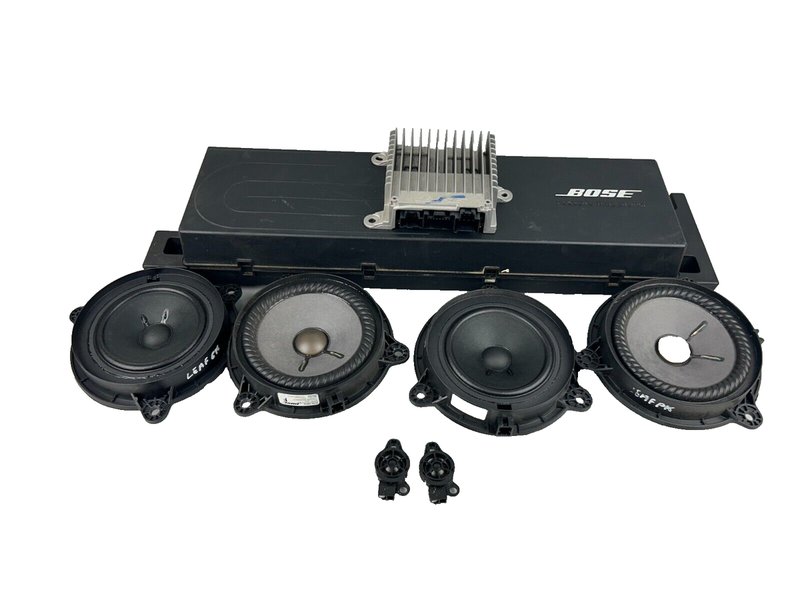
An image of a Nissan LEAF BOSE amplifier and subwoofer system, which are part of the in-cabin audio system, distinct from the external VSP speaker.
Troubleshooting VSP System Components
Beyond a simple disconnection, other issues could cause the reverse sound to be absent:
- Faulty Speaker: The VSP speaker itself could be defective.
- Wiring Damage: Beyond a simple unplugging, the wiring harness leading to the speaker could be damaged.
- VSP Module Malfunction: Less common, but the Vehicle Sound for Pedestrians (VSP) control module itself could be faulty.
A diagnostic tool might be necessary to pinpoint more complex electrical issues within the VSP system.
Summary of Nissan LEAF Reverse Sound Characteristics by Model Year
The table below provides a concise overview of how the reverse sound and VSP system have evolved across different Nissan LEAF model years, emphasizing the nuances relevant to your 2012 model.
| Model Year | VSP System Status | In-Cabin Disable Switch | Typical Reverse Sound | Common Issue Resolution | Legal/Safety Implication |
|---|---|---|---|---|---|
| 2011 | First generation VSP introduced. | Yes (physical dash switch for temporary deactivation). | Distinct chime/whirring for reverse. | Check switch position, physical connections. | User-controlled deactivation possible. |
| 2012 | VSP system standard, anticipation of regulations. | No (switch removed). | Distinct chime/whirring for reverse, often loud. | Physical VSP speaker check/reconnection, wiring inspection. | Mandated safety feature, disabling not advised. |
| 2013+ | VSP system standard, further regulatory compliance. | No (switch still removed). | Varies, generally audible chime/beep. | LeafSpy Pro for software control, physical speaker/wiring check. | Mandated safety feature, disabling not advised. |
| 2020+ | Updated pedestrian warning sounds. | No. | Can be very loud; specific "sonar-like" sound. | LeafSpy Pro, physical speaker check, professional diagnosis. | Continued legal requirement. |
Frequently Asked Questions (FAQ)
Is it legal to disable the reverse sound on my Nissan LEAF?
Where is the reverse speaker located on a 2012 Nissan LEAF?
Can I change the type of reverse sound my Nissan LEAF makes?
What is LeafSpy Pro and how does it relate to the reverse sound?
Conclusion
Restoring the reverse sound in your 2012 Nissan LEAF primarily involves investigating and reconnecting the Vehicle Sound for Pedestrians (VSP) speaker. Unlike the 2011 model, your 2012 LEAF does not feature an in-dash switch to control this sound, making a physical disconnection or component fault the most probable cause of its absence. While the loud chime can be a source of annoyance for some owners, it serves a vital safety function, alerting pedestrians and cyclists to the presence of your quiet electric vehicle. Always prioritize safety and consider the legal implications before attempting any modifications to mandatory safety systems. If you're unsure about performing the reconnection yourself, consulting a qualified Nissan technician is the safest and most reliable course of action to ensure your vehicle's safety features are fully operational.
Recommended Searches
- Where is the VSP speaker located on a 2012 Nissan LEAF?
- Troubleshooting common issues with Nissan LEAF reverse beeping.
- How to use LeafSpy Pro to adjust VSP settings in Nissan LEAF.
- What are the legal implications of disabling EV reverse sound?