

Key Insights into Normal Modes
- Decoupling Complex Dynamics: Normal modes are crucial for transforming the intricate, coupled motions of a harmonic chain into a set of independent, solvable harmonic oscillators.
- Characteristic Frequencies and Patterns: Each normal mode possesses a unique natural frequency and a distinct spatial oscillation pattern, where all particles move synchronously.
- Ubiquitous Applications: The principles of normal modes extend far beyond the theoretical harmonic chain, finding profound relevance in fields like solid-state physics, molecular vibrations, and mechanical engineering.
As a master's student in physics, delving into the normal modes of a harmonic chain in classical mechanics is an exploration of one of the most fundamental and elegant concepts in oscillatory systems. This seminar aims to provide a comprehensive understanding of what normal modes are, how they are mathematically formulated, and why their study is paramount to grasping the behavior of complex systems in the physical world.
The Essence of a Harmonic Chain
At its core, a harmonic chain is a simplified model used to understand the collective motion of interconnected particles. Imagine a linear array of masses, each connected to its nearest neighbors by springs that obey Hooke's Law. This means the restoring force exerted by each spring is directly proportional to its displacement from equilibrium. While seemingly simple, this model is a powerful analytical tool, providing the foundation for understanding more intricate systems like crystal lattices, polymers, and even wave propagation in continuous media.
The beauty of the harmonic chain lies in its ability to exhibit complex, coupled oscillations. When one mass moves, it influences its neighbors, and they, in turn, influence others, creating a cascade of interconnected movements. The challenge then becomes how to describe and predict this intricate dance of particles.
Why Study Normal Modes?
The concept of normal modes provides an elegant solution to this challenge. Instead of tracking the individual, interdependent motions of each particle, normal modes allow us to identify specific, fundamental patterns of oscillation. In these patterns, all parts of the system oscillate with the same frequency and a fixed phase relationship. Each such pattern is a "normal mode," and it oscillates independently at its own natural (resonant) frequency. This remarkable property allows us to "decouple" the complex system into a set of independent simple harmonic oscillators, making the analysis significantly more tractable.
Formulating the Dynamics: Equations of Motion
To rigorously understand normal modes, we must first establish the mathematical framework that governs the motion of the harmonic chain. Consider a one-dimensional chain of \(N\) identical masses \(m\), each connected by identical springs with a spring constant \(K\). Let \(u_n(t)\) be the displacement of the \(n\)-th mass from its equilibrium position at time \(t\).
Deriving the Coupled Equations
Applying Newton's Second Law (\(F=ma\)) to the \(n\)-th mass, and considering the forces exerted by its immediate neighbors via Hooke's Law, we arrive at the coupled differential equations of motion. For a mass \(n\) (not at the ends of the chain), the net force acting on it is due to the springs connecting it to mass \(n-1\) and mass \(n+1\):
\[ m \frac{d^2 u_n}{dt^2} = K(u_{n+1} - u_n) - K(u_n - u_{n-1}) \]Which simplifies to:
\[ m \frac{d^2 u_n}{dt^2} = K(u_{n+1} + u_{n-1} - 2u_n) \]These equations are valid for \(n = 1, \ldots, N\), with specific boundary conditions at the ends of the chain. Common boundary conditions include:
- Fixed Ends: \(u_0 = u_{N+1} = 0\) (the ends of the chain are anchored).
- Periodic Boundary Conditions: \(u_{n+N} = u_n\) (the chain forms a closed loop, like a ring).
This system of coupled second-order differential equations forms the basis for finding the normal modes.
The Normal Mode Ansatz and Dispersion Relation
To solve these coupled equations, we propose a solution in the form of a sinusoidal wave, often referred to as a "normal mode ansatz":
\[ u_n(t) = A \exp[i(qna - \omega t)] \]Here, \(A\) is the amplitude, \(q\) is the wave number, \(a\) is the lattice spacing (distance between equilibrium positions of masses), and \(\omega\) is the angular frequency. Substituting this ansatz into the equations of motion leads to the characteristic equation that relates \(\omega\) and \(q\), known as the dispersion relation:
\[ \omega^2(q) = \frac{2K}{m} [1 - \cos(qa)] = \frac{4K}{m} \sin^2\left(\frac{qa}{2}\right) \]From this, the frequency of a mode with wave number \(q\) is:
\[ \omega(q) = 2\sqrt{\frac{K}{m}} \left|\sin\left(\frac{qa}{2}\right)\right| \]This dispersion relation reveals how the frequency of oscillation depends on the spatial pattern (wave number) of the mode. For a finite chain with fixed ends, the allowed values of \(q\) are discrete, typically given by \(q = \frac{\pi r}{(N+1)a}\), where \(r = 1, \ldots, N\). For periodic boundary conditions, \(q = \frac{2\pi r}{Na}\), where \(r = 0, \ldots, N-1\).
Comparative analysis of the strengths of Normal Modes in Harmonic Chains versus general Coupled Oscillators.
Normal Coordinates and Decoupled Oscillators
One of the most profound aspects of normal mode analysis is the transformation to "normal coordinates." These are a new set of generalized coordinates that, when used, decouple the complex system of coupled oscillators into a set of independent simple harmonic oscillators. Each normal coordinate corresponds to a specific normal mode and oscillates independently at its natural frequency.
The Power of Decoupling
In terms of normal coordinates, say \(Q_q\), the equations of motion become incredibly simple:
\[ \frac{d^2 Q_q}{dt^2} + \omega^2(q) Q_q = 0 \]This is precisely the equation of motion for a simple harmonic oscillator. This means the entire complex chain behaves as a collection of independent harmonic oscillators, each corresponding to a normal mode. The total energy of the system is then simply the sum of the energies of these independent normal mode oscillators:
\[ E = \sum_q E_q = \sum_q \frac{1}{2} \left[ \left(\frac{dQ_q}{dt}\right)^2 + \omega^2(q) Q_q^2 \right] \]This diagonalization of the dynamical matrix, which leads to normal coordinates, is a cornerstone of vibrational analysis in physics and chemistry.
Visualizing Normal Modes: Patterns of Oscillation
The physical interpretation of normal modes is best understood by visualizing their characteristic patterns. For a chain with fixed ends, the spatial pattern of displacement for a given mode often takes the form of a sine wave, where the number of "half-wavelengths" corresponds to the mode number. These are essentially standing waves within the chain.
Distinctive Mode Shapes
- Fundamental Mode (\(r=1\)): All masses move in phase, resembling a single, smooth oscillation of the entire chain. This is the lowest frequency mode.
- Higher Modes (\(r > 1\)): These modes exhibit "nodes" (points of zero displacement) and "antinodes" (points of maximum displacement) along the chain. As \(r\) increases, the number of nodes increases, leading to higher frequencies and more complex patterns.
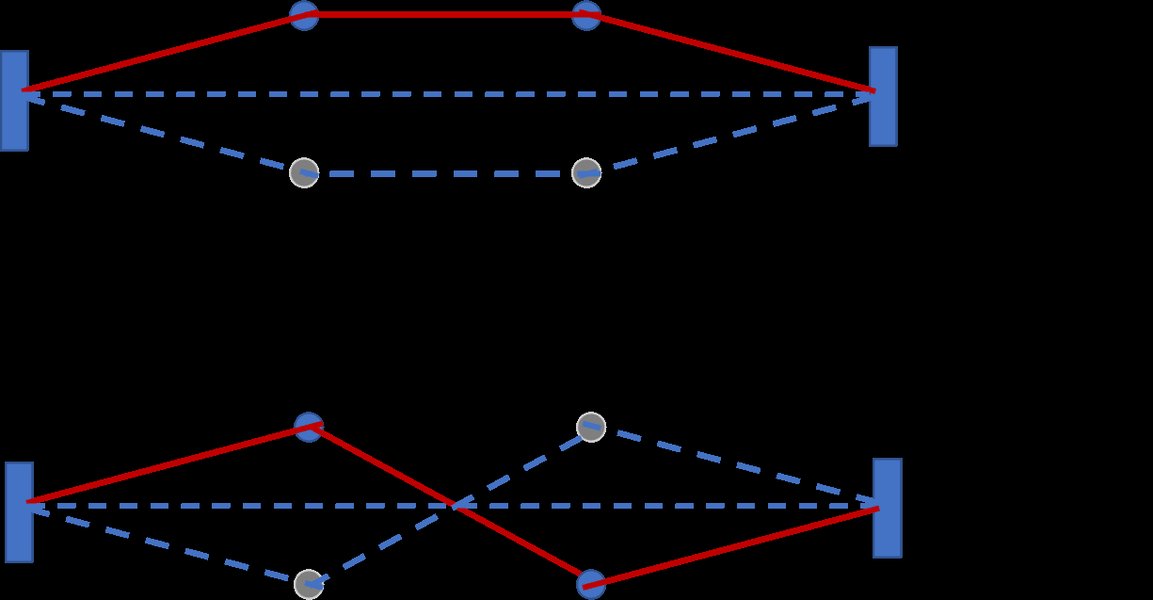
Illustrative normal modes for a two-bead string system.
These visualizations are crucial for building physical intuition. Interactive simulations, such as those available on PhET, can greatly enhance understanding by allowing manipulation of parameters and real-time observation of mode shapes.
Beyond the Monatomic Chain: Extensions and Applications
While the monatomic harmonic chain provides a powerful starting point, the principles of normal modes extend to more complex scenarios and have far-reaching applications across various branches of physics.
Diatomic Chains and Beyond
If the unit cell of the chain contains more than one atom (e.g., a diatomic chain with alternating masses), the dispersion relation becomes more complex, featuring multiple branches. Typically, these include:
- Acoustic Branch: Characterized by long wavelengths, where neighboring atoms move largely in phase. The frequency approaches zero as the wave number approaches zero, analogous to sound waves.
- Optical Branch: Characterized by shorter wavelengths, where neighboring atoms move out of phase. These modes have a finite non-zero frequency even at zero wave number, and can interact with electromagnetic radiation.
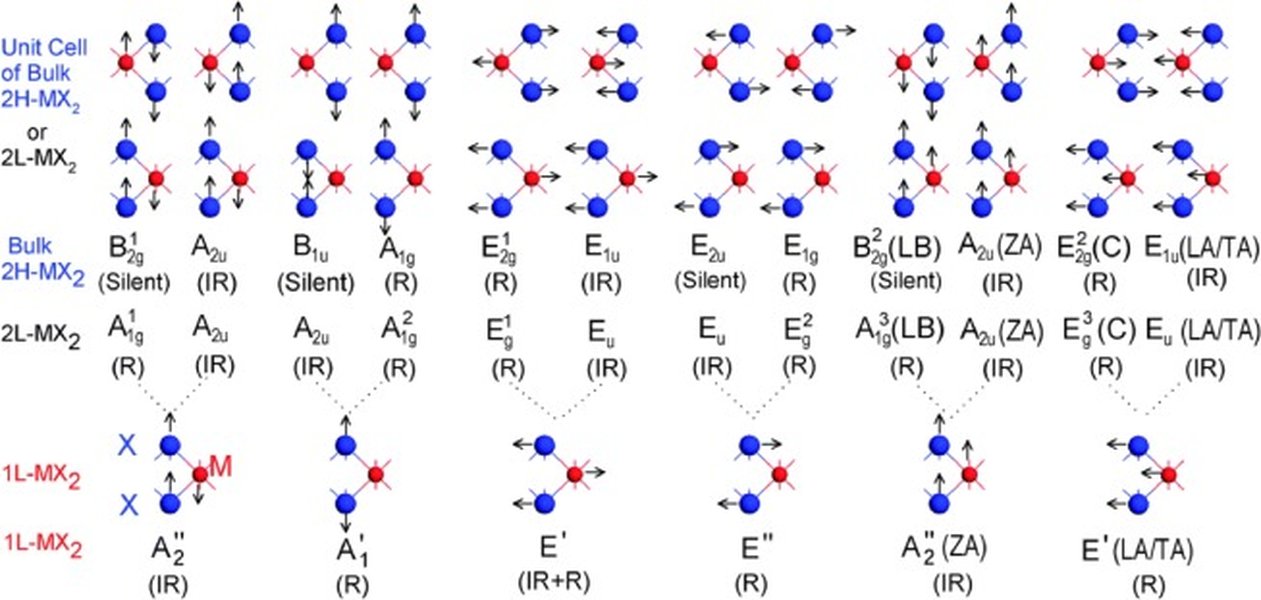
Depiction of lattice vibrations, a direct application of normal mode analysis.
Applications in Physics and Engineering
The analysis of normal modes is not just a theoretical exercise; it has profound practical implications:
- Solid-State Physics: Normal modes of crystal lattices are known as phonons, which are quantized vibrations responsible for heat conduction and specific heat capacity of solids. Understanding phonons is crucial for designing materials with desired thermal and electronic properties.
- Molecular Vibrations: Molecules can be modeled as systems of masses (atoms) connected by springs (chemical bonds). Normal mode analysis helps determine the vibrational spectra of molecules, which are unique fingerprints used in spectroscopy to identify compounds and study chemical reactions.
- Structural Engineering: Engineers use normal mode analysis to predict the resonant frequencies of structures (bridges, buildings). Ensuring that these frequencies do not coincide with common external forces (like wind or seismic activity) is critical for preventing catastrophic structural failure.
- Musical Instruments: The rich sound produced by string instruments is a superposition of the normal modes (harmonics) of the vibrating strings.
Exploring the Broader Context of Oscillators
While this seminar focuses on classical normal modes, it's important to recognize that the concept of the harmonic oscillator is a pervasive theme throughout physics, extending into quantum mechanics and beyond. Understanding the classical foundation is key to appreciating its generalizations.
Mindmap illustrating the central role of the harmonic oscillator concept in various branches of physics.
The harmonic oscillator is often called the "workhorse" of physics because many complex systems can be approximated as harmonic oscillators under small perturbations. This allows for analytical solutions and provides deep insights into the underlying physics. The Normal Modes of a Harmonic Chain are a prime example of this powerful reductionist approach.
The Importance of the Harmonic Oscillator
The ubiquity of the harmonic oscillator, whether classical or quantum, makes it an essential concept to master for any aspiring physicist. It provides a foundation for understanding almost every oscillating system, from a simple pendulum to complex molecular vibrations and even the fundamental particles in quantum field theory.
"To Master Physics, First Master the Harmonic Oscillator" - A compelling argument for the fundamental importance of this concept, even beyond the classical domain. This video explains why the simple harmonic oscillator is so critical across various fields of physics, serving as a foundational building block for understanding more complex systems, including those involving coupled oscillations and normal modes.
Summary of Key Concepts
To summarize, the study of normal modes in a harmonic chain offers a profound understanding of how complex, coupled motions can be broken down into simpler, independent oscillatory patterns. This approach is not merely an academic exercise but a powerful tool with wide-ranging applications.
| Concept | Description | Significance |
|---|---|---|
| Harmonic Chain Model | A system of masses connected by Hookean springs, representing coupled oscillators. | Provides a simplified yet powerful model for complex vibrational systems. |
| Normal Mode Definition | Collective oscillation patterns where all parts move sinusoidally with the same frequency and fixed phase. | Transforms coupled equations into independent oscillators, simplifying analysis. |
| Normal Frequencies | Characteristic frequencies at which each normal mode oscillates independently. | Determined by the system's properties (mass, spring constant, boundary conditions). |
| Normal Coordinates | Transformed coordinates that decouple the system's equations of motion. | Allows treatment of complex systems as a superposition of independent harmonic oscillators. |
| Dispersion Relation | Relationship between the frequency (\(\omega\)) and wave number (\(q\)) of the normal modes. | Encodes how the spatial pattern of oscillation affects its temporal frequency. |
| Applications | Understanding phonons in solids, molecular vibrations, structural stability, and wave phenomena. | Demonstrates the broad applicability of classical normal mode analysis across physics and engineering. |
Key concepts related to normal modes of a harmonic chain and their significance.
FAQ
What is a harmonic chain?
What are normal modes?
How do normal modes simplify complex systems?
What are "normal coordinates"?
Where are normal modes applied in real-world physics?
Conclusion
The normal modes of a harmonic chain offer a powerful lens through which to understand the complex world of coupled oscillations. By transforming a system of interconnected, interdependent motions into a collection of simple, independent oscillations, we gain profound insights into the system's intrinsic behaviors, characteristic frequencies, and spatial patterns. This classical foundation not only provides elegant solutions to mechanical problems but also serves as a critical stepping stone for understanding more advanced concepts in quantum mechanics, solid-state physics, and countless other scientific and engineering disciplines. Mastering normal mode analysis is an essential rite of passage for any physicist, illuminating the elegant order hidden within seemingly chaotic motion.
Recommended Further Exploration
- How to visualize normal modes using interactive simulations?
- The quantum mechanical treatment of harmonic oscillators and phonons.
- Applications of normal mode analysis in molecular spectroscopy.
- How do boundary conditions affect the normal modes of a chain?