
Unpacking Nozick's Experience Machine: A Challenge to Internalist Theories of Value
Exploring the philosophical implications of simulated reality on our understanding of well-being and justification.
Key Insights
- Nozick's Core Argument: Robert Nozick's Experience Machine thought experiment serves primarily as a powerful critique of ethical hedonism, asserting that pleasure alone is not the sole determinant of a valuable life.
- Challenging Internalism: The experiment implicitly challenges internalist theories of value by suggesting that certain external factors, such as genuine contact with reality and actual accomplishment, contribute to well-being in ways that purely mental states cannot replicate.
- Beyond Pleasure: Nozick's argument highlights that we desire to *do* certain things and *be* a certain kind of person, not merely to *experience* having done them or being them, implying that true value extends beyond subjective feelings.
Robert Nozick's Experience Machine, introduced in his 1974 book Anarchy, State, and Utopia, is a seminal thought experiment in philosophy. It presents a hypothetical scenario designed to challenge certain prevalent theories of well-being, particularly ethical hedonism and, by extension, internalist views on value. The core of the experiment asks a profound question: if you could live a life of perfect, indistinguishable pleasure and fulfillment within a simulated reality, would you choose it over real life, with all its inherent ups and downs?
The Experience Machine: A Philosophical Conundrum
Nozick's thought experiment invites us to imagine a machine capable of stimulating our brains to induce any desired experience. These experiences would be so vivid and realistic that they would be indistinguishable from actual life. One could imagine being a great novelist, a world leader, or experiencing perfect love and friendship, all while floating in a tank, hooked up to electrodes. The crucial stipulation is that once plugged in, you would have no memory of choosing to enter the machine, and all your experiences would feel completely real.
Nozick posited that most people would decline to plug into such a machine. This intuitive rejection, he argued, reveals that there is more to human well-being and a good life than merely experiencing pleasure or satisfying desires through internal mental states. This "more" is precisely what his argument aims to reveal and is where its challenge to internalism arises.
An individual connected to the Experience Machine, illustrating the core premise of Nozick's thought experiment.
Nozick's Reasons Not to Plug In
Nozick articulates three primary reasons why people would likely choose not to plug into the Experience Machine, each of which speaks to a value beyond mere pleasurable mental states:
- We want to do certain things, not just have the experience of doing them: We desire to actually write a great novel, make a friend, or achieve something significant in the real world. The machine only provides the *experience* of these things, not the actual doing or being. This points to a value in agency and genuine action.
- We want to be a certain kind of person: Plugging into the machine means being an indeterminate blob in a tank, rather than a courageous, intelligent, or loving individual in the real world. We value the actual traits and character we possess, not just the feeling of having them.
- Contact with a deeper reality: There is a deep-seated human desire to be connected to reality, to live in a world that is "really there." The machine offers a fabricated reality, severing this crucial link. This highlights the value of authenticity and truth in our experiences.
These reasons collectively suggest that well-being is not solely a function of internal mental states, such as pleasure or desire satisfaction, but also depends on external conditions, genuine actions, and contact with reality.
The Challenge to Internalism
To understand how Nozick's Experience Machine serves as an objection to value internalism, it's crucial to define internalism in this context. In the philosophy of value, internalism generally holds that the value of an experience or a state of affairs is entirely determined by properties that are internal to the subject's mind or consciousness. For example, ethical hedonism is a form of internalism, positing that pleasure (an internal mental state) is the sole intrinsic good. Similarly, certain desire-satisfaction theories, which argue that well-being consists of the satisfaction of one's desires, can be seen as internalist if they focus solely on the subjective experience of desire satisfaction.
Internalism vs. Externalism in Value
The debate between internalism and externalism extends across various philosophical domains, including epistemology, ethics, and the philosophy of mind. In the context of value, the distinction boils down to where the source of value lies:
| Aspect | Internalist View (Value) | Externalist View (Value) |
|---|---|---|
| Source of Value | Properties internal to the subject's mind (e.g., pleasure, subjective experience, fulfilled desires). | Properties external to the subject's mind (e.g., reality, genuine achievement, objective conditions). |
| Focus of Well-being | How things feel "from the inside." | What is actually happening, independent of subjective feeling. |
| Nozick's Objection | Challenges the sufficiency of purely internal states for a good life. | Supports the necessity of external factors for a truly valuable life. |
How the Experience Machine Undermines Internalism
Nozick's Experience Machine directly attacks the internalist position by demonstrating that people would forgo a life of guaranteed, maximal internal pleasure for a life that, while perhaps less subjectively pleasurable, is "real." This suggests that properties external to our mental states contribute to our well-being and are valued for their own sake.
- Beyond Subjective Pleasure: If hedonism were true, plugging into the machine would be the only rational choice, as it guarantees a life of maximum pleasure and minimal pain. However, the widespread intuitive rejection of the machine suggests that we value things beyond just pleasure. We value genuine experiences, authentic relationships, and actual accomplishments, which are external to our minds.
- The Importance of Reality: The desire for "actual contact with any deeper reality," as Nozick puts it, cannot be satisfied by an internal simulation. This points to an externalist notion of value, where being connected to the real world, regardless of the subjective pleasure it provides, holds intrinsic worth.
- Authenticity and Agency: Our desire to *do* rather than just *experience doing*, and to *be* a certain kind of person rather than just *feel like* one, implies that authenticity and genuine agency are crucial components of a valuable life. These are external conditions that cannot be fully replicated by purely internal states.
In essence, the Experience Machine argument pushes back against the idea that everything that matters for a good life can be reduced to what goes on inside our heads. It argues for the importance of objective facts about our lives, such as whether our achievements are real, our relationships are genuine, and our existence is rooted in an objective reality.
The Broader Implications and Debates
The Experience Machine thought experiment has had a lasting impact on philosophical discourse, inspiring debates across various fields. It serves as a powerful tool for exploring the nature of happiness, well-being, reality, and what truly makes life worth living.
Relation to "The Matrix"
The concept of the Experience Machine bears a striking resemblance to the premise of the movie The Matrix. In the film, humanity lives unknowingly in a simulated reality created by intelligent machines, while their bodies are used as a power source. The choice offered to Neo – the red pill (reality) or the blue pill (illusion) – directly mirrors the dilemma posed by Nozick. The film explores the same philosophical questions: Is a blissful illusion preferable to a harsh reality? What is the true nature of reality, and what do we lose when we are disconnected from it?
This video provides a concise overview of Nozick's Experience Machine and its implications as an objection to utilitarianism, which often aligns with hedonistic and internalist views.
Empirical Studies and Criticisms
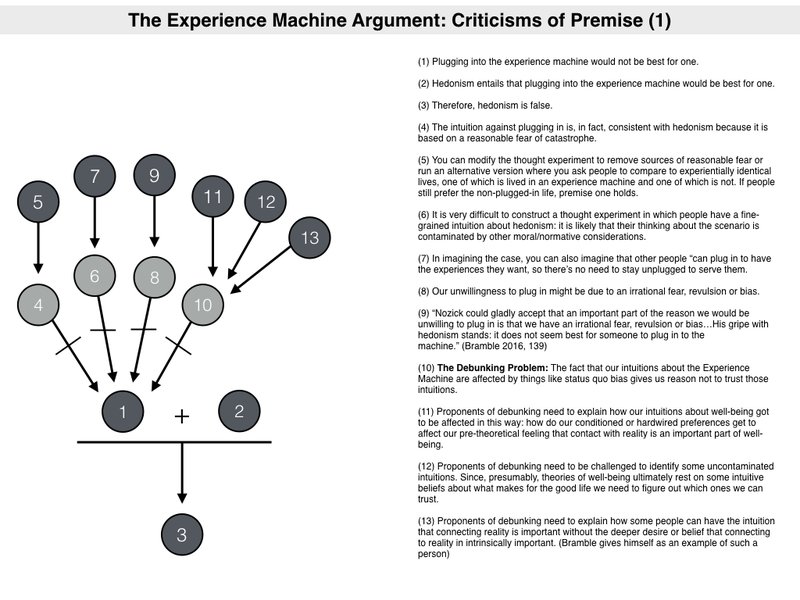
While Nozick's argument relies on intuition, some empirical studies have attempted to gauge public opinion on the Experience Machine. Some studies, like those by Weijers, suggest that a significant majority of people would indeed reject plugging in, seemingly confirming Nozick's intuition. However, other research, like that by De Brigard, has introduced variations to the scenario, suggesting that biases such as "status quo bias" (a preference for one's current state) might influence responses. For example, if people are told they have *already been* in the machine for some time, they might be averse to disconnecting, indicating a preference for the life they have experienced, real or not.
Critics also raise various objections to Nozick's argument: some argue that Nozick's machine, by definition, cannot truly simulate all aspects of reality, such as genuine meaning or objective achievement. Others contend that the concept of "realness" itself is ill-defined or that the negative connotations associated with being "plugged in" bias the responses. Despite these criticisms, the Experience Machine remains a powerful tool for examining the nuances of human well-being and the limitations of purely internalist accounts of value.
Assessing the Values at Stake
Nozick's Experience Machine highlights a range of values that extend beyond simple pleasure or desire satisfaction. This thought experiment encourages us to consider the multifaceted nature of a good life, compelling us to ponder whether "happiness" is solely an internal feeling or if it requires a connection to an objective reality and genuine engagement with the world.
The Spectrum of Well-being Theories
The Experience Machine prompts a deeper dive into different theories of well-being:
- Hedonism: The view that pleasure is the only intrinsic good and pain the only intrinsic bad. Nozick's argument directly challenges this.
- Desire-Satisfaction Theories: The idea that well-being consists of the satisfaction of one's desires. The Experience Machine complicates this by asking if the satisfaction of desires *within a simulation* is truly equivalent to their satisfaction in reality.
- Objective List Theories: These theories propose that certain things are intrinsically good for people, regardless of whether they desire them or find pleasure in them. Examples might include knowledge, friendship, achievement, and autonomy. Nozick's argument aligns more closely with objective list theories by suggesting that values like authenticity and real accomplishment are objectively good.
The Experience Machine and Human Flourishing
The thought experiment compels us to think about human flourishing not just as a state of mind, but as a holistic engagement with existence. It implies that true flourishing involves:
- Authenticity: Living a life that is genuine and true, rather than a fabricated one.
- Agency: Being the actual doer of actions and the shaper of one's own life, not merely a passive recipient of programmed experiences.
- Connection to Reality: Engaging with a world that exists independently of one's perceptions.
- Meaning and Purpose: Pursuing goals and projects that have objective significance, not just subjective pleasantness.
This radar chart illustrates the contrasting priorities between purely internalist/hedonistic views and the externalist perspective championed by Nozick's Experience Machine argument. While internalism heavily prioritizes subjective pleasure, Nozick's argument highlights the greater importance of genuine achievement, authentic relationships, a connection to reality, personal agency, and objective meaning as crucial components of a valuable life. The chart visually demonstrates how the Experience Machine seeks to expand our understanding of well-being beyond what merely feels good.
Frequently Asked Questions (FAQ)
What is ethical hedonism?
How does "The Matrix" relate to the Experience Machine?
What are some criticisms of Nozick's Experience Machine?
Does the Experience Machine completely refute hedonism?
Conclusion
Robert Nozick's Experience Machine thought experiment stands as a pivotal challenge to internalist theories of value, particularly ethical hedonism. By vividly illustrating a scenario where individuals would likely reject a life of guaranteed pleasure for the sake of reality, authenticity, and genuine accomplishment, Nozick compels us to look beyond subjective mental states when considering what constitutes a truly valuable life. His argument underscores the importance of objective facts about our existence—the actual doing of things, the kind of person we truly are, and our connection to a deeper reality—as essential components of well-being. While debates surrounding the experiment continue, its core insight remains: there is more to a good life than just feeling good.
Recommended Searches
- Explore objective list theories of well-being.
- Discover other philosophical arguments against hedonism.
- Learn about other famous thought experiments in philosophy.
- Delve into the philosophical themes of The Matrix.
Referenced Search Results
 philosophicaldisquisitions.blogspot.com
 ausomeawestin.wordpress.com