
A Comparative Analysis of Net Present Value (NPV) and Internal Rate of Return (IRR)
Essential Metrics for Capital Budgeting and Investment Decisions
When evaluating potential investments or capital projects, financial analysts and decision-makers rely on various tools to assess profitability and feasibility. Among the most widely used discounted cash flow methods are Net Present Value (NPV) and Internal Rate of Return (IRR). While both provide valuable insights, they differ in their approach and interpretation. Understanding the nuances between NPV and IRR is crucial for making informed investment decisions that maximize value.
Key Highlights
- NPV measures the absolute value: Net Present Value quantifies the net gain or loss from an investment in monetary terms, providing a direct measure of the value added to the firm.
- IRR measures the rate of return: Internal Rate of Return calculates the discount rate at which an investment's NPV equals zero, offering a percentage rate of return that can be compared to the required rate of return.
- Conflicts can arise: While often leading to similar conclusions for independent projects, NPV and IRR can provide conflicting rankings when comparing mutually exclusive projects, particularly when there are differences in scale or timing of cash flows.
Understanding Net Present Value (NPV)
Net Present Value (NPV) is a fundamental concept in finance used to evaluate the profitability of an investment or project by considering the time value of money. It represents the difference between the present value of expected future cash inflows and the present value of cash outflows over a specific period.
The Core Concept of NPV
The core idea behind NPV is that a dollar received in the future is worth less than a dollar received today due to factors like inflation, risk, and the opportunity cost of capital. By discounting future cash flows back to their present value using an appropriate discount rate (typically the cost of capital), NPV provides a clear picture of an investment's worth in today's terms.
Calculating Net Present Value
The formula for calculating NPV is as follows:
\[ \text{NPV} = \sum_{t=0}^{n} \frac{CF_t}{(1+r)^t} - \text{Initial Investment} \]Where:
- \( CF_t \) = Net cash flow at time \( t \)
- \( r \) = Discount rate (cost of capital)
- \( t \) = Time period
- \( n \) = Total number of periods
A positive NPV indicates that the project is expected to generate more value than the cost of undertaking it, making it a potentially profitable investment. Conversely, a negative NPV suggests that the project is expected to result in a net loss in present value terms.
Interpreting NPV Results
The decision rule for NPV is straightforward: accept projects with a positive NPV and reject projects with a negative NPV. When comparing multiple independent projects, those with higher positive NPVs are generally preferred as they are expected to add more value to the company.
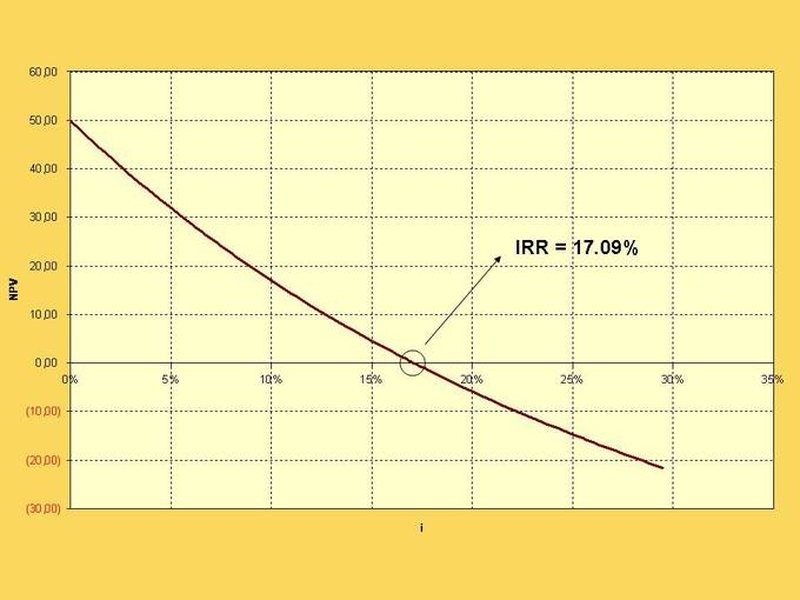
The relationship between discount rate and NPV, highlighting the IRR.
Exploring Internal Rate of Return (IRR)
Internal Rate of Return (IRR) is another widely used metric for evaluating the attractiveness of potential investments. Unlike NPV, which provides a dollar value, IRR expresses the profitability of an investment as a percentage rate.
The Essence of IRR
IRR is defined as the discount rate at which the Net Present Value (NPV) of all cash flows from a project equals zero. In simpler terms, it is the rate of return that an investment is expected to generate over its life.
Calculating Internal Rate of Return
Calculating IRR involves finding the discount rate (\( r \)) that satisfies the following equation:
\[ \text{NPV} = \sum_{t=0}^{n} \frac{CF_t}{(1+r)^t} - \text{Initial Investment} = 0 \]Solving for \( r \) in this equation often requires iterative methods or financial calculators and software, as it cannot typically be solved analytically, especially for projects with irregular cash flows.
Interpreting IRR Results
The decision rule for IRR is to accept a project if its IRR is greater than the required rate of return or hurdle rate (the minimum acceptable rate of return). If the IRR is less than the required rate of return, the project is typically rejected. IRR is particularly useful for comparing projects of different sizes, as it provides a standardized percentage measure of return.
Comparing NPV and IRR: Similarities and Differences
While both NPV and IRR are powerful tools for investment appraisal and are based on the discounted cash flow concept, they have key similarities and crucial differences that impact their application and interpretation.
Similarities Between NPV and IRR
Both methods account for the time value of money by discounting future cash flows. They are both widely used in capital budgeting to assess the financial viability of projects and investments. For independent projects with conventional cash flows (an initial outflow followed by a series of inflows), NPV and IRR often lead to the same accept/reject decision.
Key Differences and Potential Conflicts
Despite their similarities, the core difference lies in what they measure: NPV provides an absolute dollar value of the project's worth, while IRR provides a relative measure in the form of a percentage rate of return. This difference in focus can lead to conflicts when comparing mutually exclusive projects, where choosing one project precludes choosing the other.
When NPV and IRR May Conflict
Conflicts between NPV and IRR can arise in situations such as:
- Differences in Project Scale: A larger project might have a lower IRR but a higher NPV, indicating that while it is less efficient in terms of percentage return, it adds more absolute value to the firm. NPV is generally preferred in such cases as it aligns with the goal of maximizing shareholder wealth.
- Differences in Timing of Cash Flows: Projects with significantly different cash flow patterns (e.g., one with larger cash flows earlier and another with larger cash flows later) can result in conflicting rankings between NPV and IRR, especially when using different discount rates.
- Non-Conventional Cash Flows: Projects with multiple periods of cash outflows interspersed with inflows can result in multiple IRRs or no real IRR, making the IRR difficult to interpret and unreliable. NPV handles such scenarios more effectively.
A video explaining the difference between IRR and NPV in the context of real estate investment.
Advantages and Disadvantages of Each Method
Both NPV and IRR have their own strengths and weaknesses, making them more suitable for different situations and analyses.
Advantages of NPV
NPV is considered a superior method for capital budgeting because:
- It provides a direct measure of the value added to the firm in dollar terms.
- It assumes that cash flows are reinvested at the discount rate (cost of capital), which is generally a more realistic assumption than the IRR's reinvestment assumption.
- It can handle multiple discount rates and non-conventional cash flows effectively.
- It aligns with the goal of maximizing shareholder wealth.
Disadvantages of NPV
Some disadvantages of NPV include:
- It requires the determination of an appropriate discount rate, which can be challenging.
- It provides an absolute measure, which may not be as intuitive for comparing projects of different sizes as a percentage rate.
Advantages of IRR
IRR offers several advantages:
- It provides a clear percentage rate of return, which is easily understood and comparable across different investments.
- It does not require the explicit use of a discount rate in its calculation (though it is compared to the required rate of return for decision-making).
- It can be more intuitive for some decision-makers to think in terms of rates of return.
Disadvantages of IRR
The disadvantages of IRR include:
- It assumes that intermediate cash flows are reinvested at the IRR itself, which may not be a realistic assumption.
- It can lead to multiple IRRs or no real IRR for projects with non-conventional cash flows.
- It may provide misleading rankings when comparing mutually exclusive projects, especially those with different scales or cash flow timings.
NPV vs. IRR in Practice and Decision Making
In practice, both NPV and IRR are widely used in financial analysis and capital budgeting. Understanding when and how to apply each method, and recognizing their limitations, is key to effective decision-making.
Which Method is Preferred?
While both methods are valuable, NPV is generally considered theoretically superior, particularly when evaluating mutually exclusive projects. This is because NPV directly measures the expected increase in wealth and aligns with the objective of maximizing firm value. However, IRR remains popular due to its intuitive nature as a percentage rate of return.
Situational Applications
NPV is often preferred for:
- Evaluating mutually exclusive projects.
- Projects with non-conventional cash flows.
- Situations where the discount rate varies over time.
IRR can be particularly useful for:
-
Comparing independent projects.
-
Providing a quick measure of a project's profitability.
-
Situations where the appropriate discount rate is difficult to determine precisely.
Working with Both Metrics
Many financial analysts use both NPV and IRR in conjunction to gain a comprehensive understanding of a project's potential. A positive NPV indicates that a project is expected to add value, while a high IRR suggests a potentially efficient use of capital. By considering both metrics, decision-makers can make more robust investment choices.
Tabular Comparison of NPV and IRR
To further illustrate the key differences between Net Present Value and Internal Rate of Return, the following table summarizes their core characteristics:
| Feature | Net Present Value (NPV) | Internal Rate of Return (IRR) |
|---|---|---|
| What it Measures | Absolute value added to the firm (in currency) | Percentage rate of return of the investment |
| Decision Rule | Accept if NPV > 0; Reject if NPV < 0 | Accept if IRR > Required Rate of Return; Reject if IRR < Required Rate of Return |
| Reinvestment Assumption | Assumes cash flows are reinvested at the discount rate (cost of capital) | Assumes cash flows are reinvested at the IRR |
| Handles Non-Conventional Cash Flows | Handles effectively | Can result in multiple IRRs or no real IRR |
| Comparison of Mutually Exclusive Projects | Generally provides reliable rankings | Can provide misleading rankings due to scale or timing differences |
| Result Format | Currency value | Percentage rate |
Frequently Asked Questions (FAQ)
Here are some common questions regarding NPV and IRR:
Why is the time value of money important in NPV and IRR?
The time value of money is crucial because it acknowledges that money available today is worth more than the same amount in the future due to its potential earning capacity. Both NPV and IRR use discounting to account for this, ensuring that future cash flows are valued appropriately in today's terms.
Can NPV and IRR lead to different investment decisions?
Yes, particularly when evaluating mutually exclusive projects with different scales or cash flow patterns. In such cases, a project with a higher IRR might have a lower NPV, and vice versa. Financial theory generally suggests prioritizing the NPV rule as it aligns with maximizing shareholder wealth.
When should I use NPV over IRR?
NPV is generally preferred when comparing mutually exclusive projects, dealing with non-conventional cash flows, or when the discount rate is expected to change over the project's life. Its direct measure of value added makes it a more reliable indicator of a project's impact on firm value.
When might IRR be more useful than NPV?
IRR can be more intuitive for some users as it provides a rate of return. It is also useful for comparing independent projects or when the required rate of return is uncertain, as it highlights the break-even discount rate. However, its limitations with non-conventional cash flows and mutually exclusive projects should be kept in mind.
Is it possible to have multiple IRRs for a single project?
Yes, if a project has non-conventional cash flows, meaning the cash flow signs change more than once (e.g., initial outflow, some inflows, then a later outflow). This can create multiple discount rates where the NPV equals zero, making the IRR ambiguous.
References
Last updated May 16, 2025