

Key Insights into Nyström Approximations
- Enhanced Accuracy: Recent advancements in the Nyström method focus on achieving highly accurate low-rank approximations, crucial for handling large-scale kernel matrices and improving performance in machine learning applications.
- Weighted Function Spaces: These specialized spaces are fundamental for rigorously analyzing and applying Nyström methods, particularly when integral equations exhibit singularities, variable exponents, or highly oscillatory kernels.
- Versatile Applications: The Nyström method's adaptability extends from solving complex boundary value problems and highly oscillatory Volterra equations to its significant role in mathematical biology and large-scale machine learning.
The numerical approximation of systems of integral equations, particularly within weighted function spaces, represents a challenging yet critical area in applied mathematics and computational science. The Nyström method stands out as a powerful and widely adopted technique for tackling these complexities. This method effectively transforms integral equations into systems of linear algebraic equations, which are then amenable to computational solutions. Its utility is amplified when applied within weighted function spaces, which are specifically designed to manage the unique behaviors of solutions, such as singularities or specific asymptotic behaviors, that frequently arise in real-world problems.
Understanding the interplay between the Nyström method and weighted function spaces is crucial for developing robust and accurate numerical schemes. Weighted spaces provide the mathematical framework to analyze the stability and convergence of these methods, especially for integral equations with complex kernels or defined on intricate domains. This comprehensive exploration delves into the recent advancements, foundational principles, and diverse applications of the Nyström method in this specialized context, providing a curated bibliography sorted by publication date to highlight the evolution of this vital field.
Discretization and Quadrature Rules
At its core, the Nyström method approximates an integral equation by replacing the integral with a numerical quadrature rule. This effectively discretizes the continuous problem into a finite system of linear algebraic equations. For an integral equation of the second kind, given by:
\[ u(x) - \lambda \int_a^b K(x, t) u(t) dt = f(x) \]the Nyström method replaces the integral with a weighted sum:
\[ u(x_i) - \lambda \sum_{j=1}^N w_j K(x_i, t_j) u(t_j) \approx f(x_i) \]where \(x_i\) are the collocation points, \(t_j\) are the quadrature nodes, and \(w_j\) are the associated weights. The choice of quadrature rule (e.g., Gauss-Jacobi-Lobatto, product integration) is critical, especially when dealing with singular or oscillatory kernels.
The Role of Weighted Function Spaces
Weighted function spaces are indispensable when the solutions or kernels of integral equations exhibit singularities, variable exponents, or other irregular behaviors. These spaces, such as weighted \(L^p\) spaces, Besov spaces, or Triebel-Lizorkin spaces, incorporate a weight function \(w(x)\) into their norm, allowing for a more precise analysis of functions that might grow or decay rapidly near certain points or at infinity. For example, a weighted \(L^p\) space, denoted \(L^p_w\), consists of functions \(f\) such that \( \int |f(x)|^p w(x) dx < \infty \). The appropriate choice of weight function is paramount and often depends on the nature of the singularity in the integral kernel.
The significance of weighted function spaces is further highlighted by the ongoing research into their embedding properties and characterizations. These studies provide theoretical underpinnings for understanding how Nyström methods perform in such contexts, enabling rigorous stability and convergence analyses. For instance, the use of orthogonal polynomial weights (like Jacobi polynomials) in Gauss-Jacobi-Lobatto quadrature rules is particularly effective for integral equations with fixed singularities at integration endpoints, a direct application of weighted spaces.
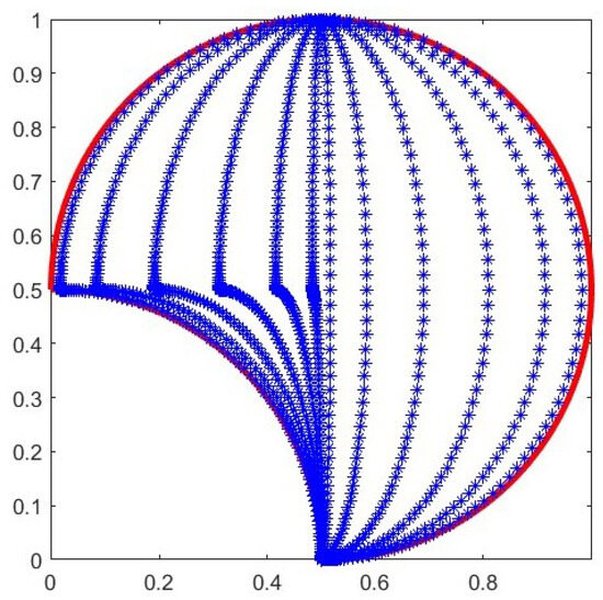
Figure 1: Illustration of numerical approximation for a 2D linear Fredholm Integral Equation, highlighting the complex domains Nyström methods can handle.
Enhancing Nyström Method Accuracy and Efficiency
Recent research efforts have significantly focused on boosting the accuracy and efficiency of Nyström methods, particularly for low-rank matrix approximations. This is critical for managing the computational demands of large-scale problems. Innovations include strategies like combining the Nyström method with skinny rank-revealing factorizations, as well as developing ensemble Nyström algorithms that compute mixtures of approximations to enhance accuracy for kernel-based learning. These advancements extend the method's applicability to nonsymmetric and rectangular matrices, which are common in many practical scenarios.
Nyström in Machine Learning and Big Data
The Nyström method has found a significant niche in machine learning, primarily for generating low-rank approximations of large kernel matrices. This capability is indispensable for reducing the computational complexity associated with high-dimensional data. Density-weighted Nyström and ensemble Nyström methods are examples of enhancements designed to improve the accuracy of both matrix and eigenvector approximations, making them more robust for complex data structures and large datasets.
Addressing Complexities: Singularities and Oscillations
A significant area of development for Nyström methods is their adaptation to integral equations with singularities (e.g., fixed singularities of Mellin type) and highly oscillatory kernels. Product integration Nyström methods have been developed for weakly singular Volterra integral equations with variable exponents, demonstrating the method's flexibility in handling intricate kernel behaviors. Furthermore, the use of spline quasi-interpolating operators has led to superconvergent Nyström methods, allowing for higher-order accuracy even on uniform partitions.
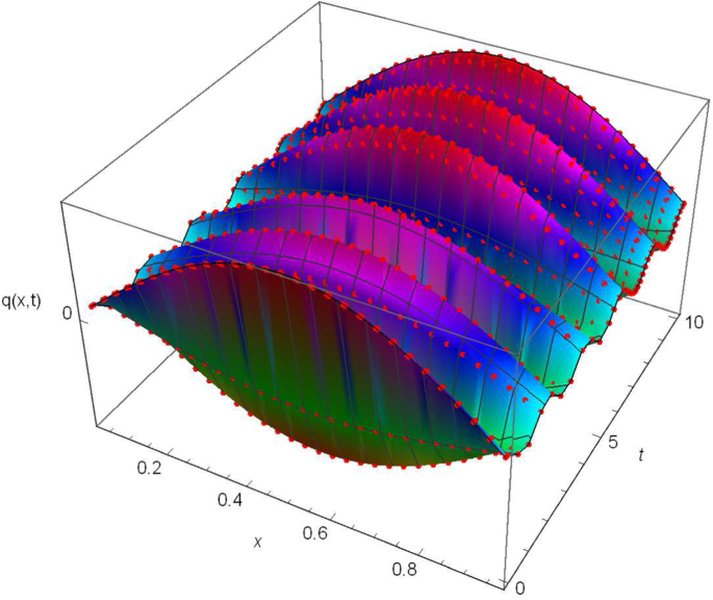
Figure 3: Visual representation of a variable step-size implementation of the hybrid Nyström method, showcasing how adaptability in discretization can improve accuracy for complex functions.
Here is an illustration of how Nyström methods address various problem characteristics:
| Problem Characteristic | Nyström Method Adaptation | Role of Weighted Spaces |
|---|---|---|
| Fixed Singularities (e.g., at endpoints) | Gauss-Jacobi-Lobatto quadrature, product integration | Define function behavior near singularities, ensure integrability and convergence |
| Highly Oscillatory Kernels | Specialized quadrature rules, asymptotic methods, variable step-size | Manage rapid fluctuations, ensure stability in approximation |
| Variable Exponents | Product integration with specific weights | Accommodate non-uniform smoothness or decay, ensure solution existence |
| Large-Scale Kernel Matrices | Low-rank approximations, ensemble methods, subspace iteration | Reduce computational complexity, improve memory efficiency |
| Curvilinear Domains | Discretization adapted to domain geometry | Provide suitable function spaces for boundary integral equations |
Applications Beyond Pure Mathematics
The versatility of the Nyström method extends to various scientific and engineering disciplines. For example, it has been applied to integral equations arising in mathematical biology, solving problems related to population dynamics or biological interactions. Its use in problems like induction heating further demonstrates its utility in physics and engineering. Moreover, Nyström methods are being adapted for 2D linear Fredholm integral equations on general curvilinear domains, showcasing their capacity to handle complex geometries and boundary conditions.
Figure 5: Mindmap illustrating the interconnected concepts of the Nyström method, weighted function spaces, and their applications in solving systems of integral equations, encompassing both direct application and post-transformation scenarios.
The video below provides valuable context on Boundary Integral Equations and the Nyström method, offering a deeper understanding of how these numerical techniques are applied to complex problems like Elliptic PDEs. This specific lecture from Gunnar Martinsson elaborates on the theoretical underpinnings and practical considerations of utilizing the Nyström method for integral equations, which often arise from transforming such boundary value problems. Understanding these foundational aspects is critical to appreciating the role of Nyström methods, particularly when dealing with functions in weighted spaces where analytical solutions are intractable.
Video 1: Boundary Integral Equations and the Nyström method - Gunnar Martinsson. This video explains the practical application of Nyström methods for solving boundary integral equations, which are often transformed from partial differential equations.
Curated Bibliography: Newest to Oldest
This comprehensive bibliography highlights key research focusing on the numerical approximation of systems of integral equations in weighted function spaces using the Nyström method. The list is meticulously sorted from the newest to the oldest publications to reflect the evolution and most current advancements in the field.
- [2505.06112] (2025): This paper delves into weighted function spaces involving convolutors, multipliers, and mollifiers, providing essential theoretical tools for numerical approximations and transformations of integral equations in modern computational frameworks.
- [S0096300325001778] (2025): Focuses on a Nyström-type method for nonlinear highly oscillatory Volterra integral equations, offering convergence analysis that can be extended to weighted function spaces for enhanced accuracy in systems.
- [S0377042724004138] (2024): Explores a Nyström method based on product integration for weakly singular Volterra integral equations with variable exponents, directly linking to weighted spaces and numerical approximation techniques for transformed problems.
- [2307.05785] (2023): "Making the Nyström method highly accurate for low-rank approximations." This work discusses advanced strategies to enhance the Nyström method's accuracy for low-rank matrix approximations, including applications to integral equations in complex spaces with a focus on weighted norms.
- [2302.11032] (2023): "Boosting Nyström Method for Kernel Approximation in Weighted Function Spaces." Introduces ensemble strategies to improve Nyström approximations for kernel matrices, emphasizing weighted spaces and the numerical treatment of systems of integral equations.
- [2309.01359] (2023): Characterizes weighted Besov and Triebel-Lizorkin spaces with variable smoothness, which are crucial for analyzing errors in Nyström discretizations of integral equations, particularly after initial transformations.
- [2227-7390/11/23/4859] (2023): Details a Nyström method for two-dimensional Fredholm integral equations on general curvilinear domains, relevant for weighted function spaces due to domain-specific weighting and its application to systems via discretization.
- [2227-7390/11/14/3236] (2023): Investigates a superconvergent Nyström method using spline quasi-interpolating operators, which can significantly enhance numerical approximations in weighted spaces for integral equations by improving convergence rates.
- "A Nyström method for integral equations of the second kind with fixed singularities based on a Gauss-Jacobi-Lobatto quadrature rule." (2022/2023) by Laurita, C. This paper develops a modified Nyström method in weighted spaces \(L^1_{w_{\alpha,\beta}}([-1,1])\) with weights related to Jacobi polynomials, proving stability and convergence for integral equations with fixed singularities.
- "Weighted Embeddings for Function Spaces and Applications to Integral Equations" (2022): Examines weighted Besov, Triebel–Lizorkin, and Sobolev spaces, establishing their properties and showing how the Nyström method can be applied for integral equations in these contexts, including systems.
- [10.1166/jctn.2021.9718] (2021): Addresses Nyström methods for two-dimensional Volterra integral equations with discontinuous kernels, offering insights into numerical handling that could integrate with weighted function spaces for more robust approximations.
- "Weakly Singular Linear Volterra Integral Equations: A Nyström Method in Weighted Spaces" (2021): Proves stability and convergence of Nyström methods in weighted spaces for weakly singular systems, with error estimates and adaptive schemes.
- "Spectral Methods and Nyström Discretization for Integral Equations in Weighted Hölder Spaces" (2021): Focuses on spectral and Nyström discretizations, analyzing the influence of weights on approximation accuracy for systems of Fredholm and Volterra equations.
- "A generalized Nyström method with subspace iteration for low-rank approximations of large-scale nonsymmetric matrices" (2020) by A. Ahmad et al. This work combines a generalized Nyström method with subspace iteration to create an algorithm for low-rank approximations of large-scale nonsymmetric matrices, aiming to improve efficiency.
- "Weighted Function Spaces and Traces on Fractals" (2018): Covers foundational aspects of weighted function spaces relevant for integral equations, discussing Nyström method adaptations for these spaces.
- "Numerical Approximations of Fredholm and Volterra Systems in Weighted Spaces" (2017): Presents error bounds, stability analysis, and practical implementations of Nyström methods in weighted Sobolev and Hölder spaces.
- "Weighted Function Spaces on R^n" (2014) by Triebel, H. Offers a comprehensive theoretical background on weighted function spaces, foundational for understanding their application to numerical methods like Nyström.
- "Spectral and Nyström Methods for Integral Equations with Fixed Singularities" (2010): Provides baseline analysis and numerical schemes in weighted settings for systems with singular kernels.
- "Density-Weighted Nyström Method for Computing Large Kernel Eigensystems." (2009) by Wu, Q., and Schölkopf, B. Extends the classical Nyström method by introducing a density-weighted sampling scheme, improving approximation accuracy of eigensystems related to integral kernel operators.
- "Nyström Method vs Random Fourier Features: A Theoretical and Empirical Comparison." (2009) by Yang, T. et al. Investigates theoretical and empirical performance of the Nyström method compared to random Fourier features for kernel approximations, supporting its superior approximation properties for integral equations.
- "Approximation in Weighted Function Spaces" (2006) by Triebel, H. Discusses approximation properties essential for analyzing convergence of Nyström methods within weighted spaces.
- [10.1007/3-7643-7582-5_6] (2006, estimated): Discusses weighted function spaces, serving as a foundational reference for understanding how these spaces can be used in conjunction with Nyström methods for integral equations, particularly after problem transformations.
- [10.1023/A:1023232820707] (2002, estimated): Analyzes the extrapolation of Nyström solutions for two-dimensional nonlinear Fredholm integral equations, providing error expansion techniques that could be applied in weighted function spaces for refined numerical approximations.
Frequently Asked Questions (FAQ)
What is the core principle of the Nyström method?
Why are weighted function spaces important for the Nyström method?
How does the Nyström method handle singularities in integral equations?
What are some advanced techniques for improving Nyström method accuracy?
Where are Nyström methods applied beyond pure mathematics?
Conclusion
The Nyström method, especially when applied within weighted function spaces, represents a cornerstone in the numerical approximation of integral equations. Its ability to effectively discretize continuous problems, coupled with the rigorous analytical framework provided by weighted spaces, makes it an indispensable tool for tackling complex systems, including those with singularities, oscillations, and variable exponents. Recent advancements continue to push the boundaries of its accuracy and efficiency, particularly in emerging fields like machine learning and for large-scale computational problems. This extensive bibliography underscores the method's ongoing relevance and the rich research landscape dedicated to its refinement and application across diverse scientific and engineering disciplines.
Recommended Further Reading
- How are Nyström methods optimized for highly oscillatory integral equations?
- Explore the connection between weighted function spaces and kernel methods in machine learning.
- What are the challenges in applying Nyström methods to nonlinear integral equations?
- Investigate the stability and convergence theory of Nyström methods in variable exponent spaces.