
Unveiling the O-RAN Architecture: A Blueprint for Future Mobile Networks
An in-depth exploration of the components, interfaces, and core principles driving the Open Radio Access Network revolution.
Key Insights into O-RAN
- Disaggregation and Openness: O-RAN fundamentally dismantles traditional, monolithic RAN structures into modular components interconnected by standardized, open interfaces, fostering a diverse multi-vendor ecosystem.
- Intelligence and Automation: The introduction of RAN Intelligent Controllers (RICs) empowers the network with AI/ML capabilities, enabling dynamic optimization, resource management, and automation in near-real-time and non-real-time.
- Virtualization and Cloudification: O-RAN heavily relies on virtualization and cloud-native principles, allowing network functions to run on general-purpose hardware and cloud platforms (O-Cloud), enhancing scalability, flexibility, and cost-efficiency.
The Dawn of a New RAN Era: Understanding O-RAN
The Open Radio Access Network (O-RAN) architecture signifies a paradigm shift in how mobile networks are designed, built, and operated. Spearheaded by the O-RAN Alliance, this initiative aims to create a more open, intelligent, virtualized, and interoperable RAN. By disaggregating hardware and software, and defining open interfaces between various network functions, O-RAN paves the way for increased vendor diversity, accelerated innovation, and enhanced network efficiency, particularly crucial for 5G and future wireless technologies.
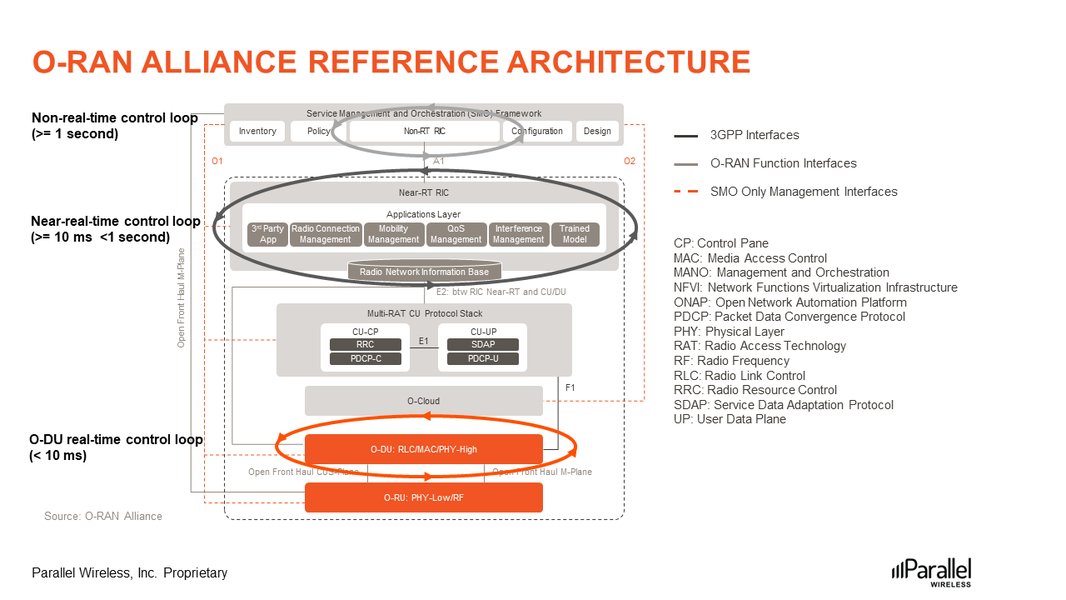
O-RAN Alliance Reference Architecture, illustrating the key components and interfaces.
Core Components of the O-RAN Architecture
The O-RAN architecture is composed of several distinct functional blocks, each with specific roles and interactions:
O-RAN Radio Unit (O-RU)
Function:
The O-RU is responsible for the radio frequency (RF) transmission and reception, along with the lower parts of the physical layer (Low-PHY) processing. This includes functions like digital-to-analog conversion, analog-to-digital conversion, RF filtering, power amplification, and elements of baseband processing like Fast Fourier Transform (FFT) / Inverse FFT (iFFT) and Physical Random Access Channel (PRACH) extraction.
Typical Realization:
Primarily a physical hardware unit, often incorporating specialized RF and digital processing components.
Typical Physical Location:
Deployed at cell sites, typically co-located with antennas on towers or rooftops to minimize RF signal loss.
Interfaces & Interactions:
Connects to the O-RAN Distributed Unit (O-DU) via the Open Fronthaul interface (based on eCPRI or O-RAN specific profiles), which carries digitized I/Q data, control, and management plane traffic.
O-RAN Distributed Unit (O-DU)
Function:
The O-DU handles real-time baseband processing, including the higher parts of the physical layer (High-PHY), Medium Access Control (MAC), and Radio Link Control (RLC) protocols. Its responsibilities include scheduling, resource allocation, and ensuring reliable data transmission over the air interface.
Typical Realization:
Can be realized as a physical unit or, increasingly, as a virtualized network function (VNF/CNF) running on Commercial Off-The-Shelf (COTS) hardware within an O-Cloud environment.
Typical Physical Location:
Can be located at the cell site (co-located with O-RU for low-latency scenarios), at an edge data center, or a more centralized location serving multiple O-RUs.
Interfaces & Interactions:
Interfaces with the O-RU via the Open Fronthaul. Connects to the O-RAN Central Unit (O-CU) via the F1 interface (as defined by 3GPP). It also interacts with the Near-Real-Time RIC via the E2 interface for real-time control and optimization. The O-DU also uses an M-Plane interface to manage the O-RU.
O-RAN Central Unit (O-CU)
Function:
The O-CU manages higher-layer protocols and non-real-time functions. It is logically split into two components:
- O-CU Control Plane (O-CU-CP): Handles Radio Resource Control (RRC) and Packet Data Convergence Protocol (PDCP) for the control plane, managing signaling and mobility.
- O-CU User Plane (O-CU-UP): Manages the PDCP for the user plane, responsible for user data traffic routing, encryption, and integrity protection.
Typical Realization:
Typically virtualized (VNF/CNF) and deployed on COTS hardware within an O-Cloud platform.
Typical Physical Location:
Usually deployed in centralized data centers or regional cloud locations, serving multiple O-DUs.
Interfaces & Interactions:
The O-CU-CP and O-CU-UP communicate via the E1 interface. The O-CU connects to the O-DU via the F1 interface. It interacts with the Near-Real-Time RIC via the E2 interface for RAN optimization. Crucially, the O-CU interfaces with the core network (e.g., 5G Core) via interfaces like NG (N2 for control plane, N3 for user plane).
The Brains of the Operation: RAN Intelligent Controllers (RICs)
RICs are central to O-RAN's vision of an intelligent and programmable RAN. They enable fine-grained control and optimization through AI/ML-driven applications.
Near-Real-Time RIC (Near-RT RIC)
Function: Enables near-real-time (typically 10ms to 1s latency) control and optimization of RAN elements (O-CU, O-DU, O-RU). It hosts specialized applications called xApps that perform tasks like traffic steering, interference management, and radio resource optimization based on data collected from RAN nodes.
Typical Realization: A software-based logical function, typically virtualized and running on an O-Cloud platform.
Typical Physical Location: Deployed at edge or regional data centers to meet low-latency requirements.
Interfaces & Interactions: Connects to O-RAN network functions (O-CU, O-DU, O-RU) via the E2 interface to collect data and send control commands. It receives policies and AI/ML model updates from the Non-RT RIC via the A1 interface.
Non-Real-Time RIC (Non-RT RIC)
Function: Provides non-real-time (greater than 1 second latency) control and optimization. It handles tasks like service and policy management, RAN analytics, and AI/ML model training and lifecycle management. It hosts applications called rApps that leverage broader network data and AI to guide the Near-RT RIC and overall RAN behavior.
Typical Realization: A software-based logical function, typically integrated within or closely coupled with the SMO framework, running on an O-Cloud platform.
Typical Physical Location: Deployed in centralized data centers.
Interfaces & Interactions: Communicates with the Near-RT RIC via the A1 interface to provide policies, enrichment information, and AI/ML model updates. It interacts with rApps via the R1 interface and with managed RAN elements via the O1 interface for higher-level management tasks.
Orchestration and Management: The SMO Framework
Function:
The Service Management and Orchestration (SMO) framework is responsible for the overall management and orchestration of the O-RAN domain. This includes Fault, Configuration, Accounting, Performance, and Security (FCAPS) management, lifecycle management of network functions, orchestration of resources (including O-Cloud), and hosting the Non-RT RIC.
Typical Realization:
A software-based platform, typically virtualized and cloud-native.
Typical Physical Location:
Deployed in centralized data centers, providing a global view and control over the O-RAN network.
Interfaces & Interactions:
Interacts with all O-RAN managed elements (Near-RT RIC, O-CU, O-DU, O-RU) via the O1 interface for management and operations. It can also interface with higher-level OSS/BSS systems and infrastructure management frameworks (via O1*).
The Foundation: O-Cloud Platform
Function:
The O-Cloud is a cloud computing platform comprising physical infrastructure (compute, storage, networking hardware, including accelerators) and software components (operating systems, virtualization/containerization layers, management and orchestration software). It provides the necessary environment to host O-RAN's virtualized network functions like the O-DU, O-CU, RICs, and SMO.
Typical Realization:
A virtualized infrastructure platform that can be geographically distributed.
Typical Physical Location:
Distributed across various locations, from edge sites (for latency-sensitive functions like O-DU) to regional and central data centers (for O-CU, RICs, SMO).
Interfaces & Interactions:
Provides an abstracted layer for VNFs/CNFs. The O-Cloud interacts with the SMO for infrastructure management and orchestration, often via the O1* interface or similar management APIs.
Navigating the Network: Key O-RAN Interfaces
Open interfaces are the cornerstone of the O-RAN architecture, enabling interoperability and a multi-vendor ecosystem. The table below summarizes some of the most critical interfaces:
| Interface | Connected Entities | Primary Purpose | Description |
|---|---|---|---|
| Open Fronthaul | O-RU ↔ O-DU | Fronthaul Data Transport | Carries I/Q data, control/user plane signaling, and synchronization information between the O-RU and O-DU. Based on eCPRI or O-RAN specific profiles. |
| F1 | O-DU ↔ O-CU | Midhaul Connection | A 3GPP-defined interface carrying control (F1-C) and user (F1-U) plane traffic between the O-DU and O-CU. |
| E1 | O-CU-CP ↔ O-CU-UP | Intra-CU Connection | A 3GPP-defined interface enabling the separation of control and user plane functions within the O-CU. |
| E2 | Near-RT RIC ↔ O-CU-CP, O-CU-UP, O-DU, (O-RU via O-DU) | Near-Real-Time Control | Enables the Near-RT RIC to collect data from and exert control over RAN functions for optimization purposes. |
| A1 | Non-RT RIC ↔ Near-RT RIC | Policy and AI/ML Management | Used by the Non-RT RIC to provide policies, AI/ML model updates, and enrichment information to the Near-RT RIC. |
| O1 | SMO ↔ O-RAN Managed Elements (Near-RT RIC, O-CU, O-DU, O-RU) | Management and Orchestration | Supports FCAPS management, software management, file management, and performance monitoring for O-RAN components. |
| R1 | Non-RT RIC ↔ rApps | rApp Services | Provides services and frameworks for rApps to interact with the Non-RT RIC. |
| M-Plane | O-DU ↔ O-RU | O-RU Management | Management plane specifically for the O-RU, facilitating configuration and operational control by the O-DU. |
Bridging Worlds: Interfaces Beyond the RAN
The O-RAN architecture is designed to integrate seamlessly with systems outside the immediate Radio Access Network boundaries:
- Core Network Interfaces: The O-CU connects to the 5G Core (5GC) or Evolved Packet Core (EPC) using standard 3GPP interfaces. For 5GC, these are the N2 interface (for control plane communication between O-CU-CP and AMF) and the N3 interface (for user plane communication between O-CU-UP and UPF).
- Operations Support Systems / Business Support Systems (OSS/BSS): The SMO framework typically interfaces with the operator's higher-level OSS/BSS via standardized or proprietary APIs. The O1 interface can be extended or mapped to facilitate this integration, enabling end-to-end service orchestration and management.
- Transport Network: While not a direct O-RAN interface, the SMO may interact with transport network controllers to manage and orchestrate the underlying fronthaul, midhaul, and backhaul transport resources.
- Infrastructure Management Frameworks: The O1* interface (or similar) allows the SMO to interact with the management systems of the O-Cloud infrastructure, enabling orchestration of the underlying physical and virtual resources.
- Analytics and AI Platforms: The Non-RT RIC may interact with external data lakes or AI/ML training platforms via the Y1 interface (for consuming RAN analytics) or other means to enhance its model training and analytical capabilities.
Decoding O-RAN: Fundamental Concepts and Design Principles
Understanding O-RAN requires grasping several core concepts that define its architecture and objectives. The following mindmap illustrates these interconnected ideas:
(RU, DU, CU)"] id1_2["Hardware/Software
Decoupling"] id2["Open Interfaces"] id2_1["Standardization
(O-RAN Alliance Specs)"] id2_2["Interoperability"] id2_3["Vendor Diversity"] id3["Intelligence & Automation"] id3_1["RAN Intelligent Controllers
(RICs)"] id3_2["AI/ML Integration"] id3_3["xApps & rApps"] id3_4["Data-driven Optimization"] id4["Virtualization & Cloudification"] id4_1["Network Function Virtualization
(NFV)"] id4_2["Cloud-Native Principles"] id4_3["O-Cloud Platform"] id4_4["Scalability & Flexibility"] id5["Multi-Vendor Ecosystem"] id5_1["Reduced Vendor Lock-in"] id5_2["Increased Innovation"] id5_3["Competitive Market"] id6["Security Considerations"] id6_1["Expanded Attack Surface"] id6_2["Zero Trust Principles"] id6_3["Secure Interfaces"]
This mindmap highlights how O-RAN's design is built upon principles like breaking down traditional base stations (Disaggregation), ensuring components from different vendors can work together (Open Interfaces), embedding AI/ML for smarter networks (Intelligence), leveraging software-defined infrastructure (Virtualization & Cloudification), and fostering a competitive environment (Multi-Vendor Ecosystem), all while addressing new Security Considerations.
The Technological Pillars of O-RAN
The O-RAN architecture is built upon several key technology enablers. The radar chart below provides an opinionated view on the relative importance and current maturity of these building blocks within the O-RAN ecosystem.
This chart illustrates that while Open Interfaces Standardization and AI/ML Integration are seen as highly impactful for O-RAN's success, their ecosystem maturity, along with areas like Cloud-Native Architecture and SDN Principles, is still evolving. Virtualization and Hardware Acceleration show moderate maturity and impact. These building blocks collectively enable the flexibility, intelligence, and openness that O-RAN promises.
Key technology building blocks include:
- Cloud Computing: The O-Cloud provides the virtualized infrastructure, leveraging technologies like CPUs, memory, storage, NICs, and hardware accelerators.
- Network Function Virtualization (NFV): Allows RAN functions to run as software on COTS hardware, decoupling them from proprietary hardware.
- Containerization and Orchestration: Technologies like Docker and Kubernetes are extensively used for packaging, deploying, and managing O-RAN's cloud-native network functions.
- Artificial Intelligence (AI) and Machine Learning (ML): Core to the RICs and their xApps/rApps, enabling intelligent automation, optimization, and predictive analytics.
- Software-Defined Networking (SDN): While not always an explicit component, SDN principles of separating control and data planes, and enabling programmability, are influential in O-RAN's design.
- Microservices Architecture: Many O-RAN functions are designed using microservices, allowing for independent development, deployment, and scaling of smaller, focused services.
- Standardization Efforts: The specifications developed by the O-RAN Alliance form the bedrock, defining interfaces, functions, and protocols to ensure interoperability.
This video provides a visual overview of the O-RAN architecture, its components, and key interfaces, complementing the technical details discussed.
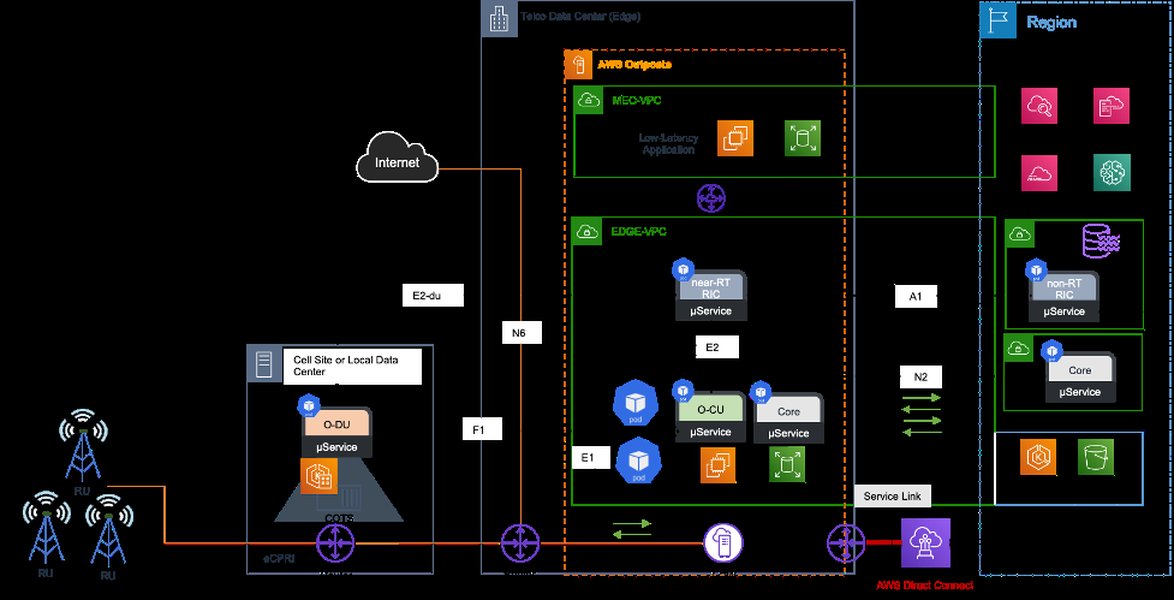
A logical representation of O-RAN architecture, highlighting the interaction between different functional blocks.
Frequently Asked Questions (FAQ)
Recommended Further Exploration
- Explore the specific use cases and benefits of deploying xApps and rApps in an O-RAN environment.
- Investigate how O-RAN addresses the challenges and enhances the capabilities of network slicing in 5G networks.
- Learn about the main security threats in O-RAN and the mitigation strategies proposed by the O-RAN Alliance.
- Compare the O-RAN architecture with traditional RAN architectures and other disaggregated approaches like Cloud-RAN (C-RAN).
References
 docs.aws.amazon.com
Last updated May 20, 2025