
Beyond the Stream: How Object-Based Media is Reshaping Your Viewing and Listening Experience
Discover the shift from fixed content to dynamic, personalized media tailored just for you.
Imagine a world where your television shows, movies, and music adapt not just to your screen size, but to your preferences, environment, and even your needs. This isn't science fiction; it's the reality being built by object-based media (OBM), object-based audio (OBA), and object-based broadcasting. These technologies represent a fundamental shift away from delivering fixed, one-size-fits-all content towards a future of dynamic, personalized, and immersive media experiences. Let's delve into what these concepts mean, trace their history, and explore what the future holds.
Key Insights into Object-Based Technologies
- Personalization Powerhouse: Object-based approaches break media into individual components (objects) like video scenes, audio tracks, or subtitles, allowing them to be reassembled dynamically for tailored user experiences, enhanced accessibility, and greater interactivity.
- Immersive Audio Revolution: Object-based audio (like Dolby Atmos or DTS:X) treats sounds as individual objects positioned in 3D space, creating incredibly realistic and immersive soundscapes that adapt to any speaker setup.
- Broadcasting's Next Wave: Object-based broadcasting leverages these principles to move beyond linear streams, enabling features like selectable camera angles, personalized audio mixes, and adaptive content delivery over IP networks.
Understanding Object-Based Media (OBM)
The Building Blocks of Future Content
At its core, Object-Based Media (OBM) is a paradigm shift in how media content is structured and delivered. Instead of a single, pre-rendered file or stream (like a traditional movie or TV show), OBM represents content as a collection of individual digital assets, known as "objects." These objects can be anything: video clips, different audio streams (dialogue, music, effects), subtitles in various languages, interactive elements, graphic overlays, or even data feeds.
Crucially, each object is accompanied by metadata. This metadata acts like an instruction manual, describing the object's characteristics, its relationship to other objects, and rules for how it should be presented. When you consume object-based content, your device (TV, smartphone, computer) acts like an assembler, using this metadata to select, arrange, and render the objects in real-time, creating a tailored experience.
Benefits of the Object-Based Approach
- Personalization: Users can potentially adjust elements like dialogue volume, choose different camera angles in sports, or select simplified audio descriptions.
- Accessibility: Content can be dynamically adapted for users with disabilities, offering features like enhanced audio descriptions, sign language overlays, or customized subtitles.
- Interactivity: OBM opens doors for interactive narratives, where viewer choices influence the story, or enhanced content like clickable information overlays.
- Adaptability: Content can automatically adjust its presentation based on the device capabilities, screen size, bandwidth, or even ambient lighting conditions.
- Efficiency: Broadcasters and creators can produce a single set of objects that can be rendered appropriately across numerous platforms and devices, rather than creating multiple versions.
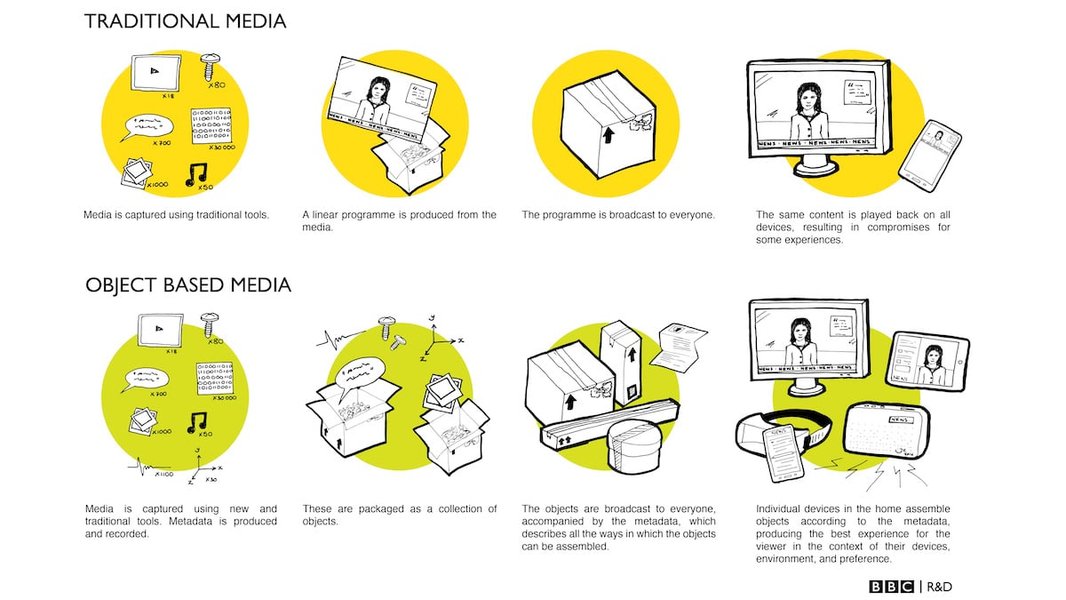
A diagram showing how individual media objects (video, audio, data) are combined to create a final user experience.
Object-Based Audio (OBA): Sound Without Boundaries
Crafting Immersive Soundscapes
Object-Based Audio (OBA) is a specific and highly successful application of OBM principles focused entirely on sound. Unlike traditional channel-based audio (stereo, 5.1, 7.1 surround sound) where sounds are mixed down into a fixed number of channels tied to specific speaker locations, OBA treats individual sounds—a voice, a footstep, a musical instrument, an explosion—as distinct "audio objects."
Each audio object carries its own sound data (typically a mono audio clip) and associated metadata. This metadata precisely describes the object's intended position in three-dimensional space, its movement over time, its size, and other acoustic properties. During playback, an OBA-capable system (like a receiver or soundbar) uses this metadata to render the sound accurately based on the listener's specific speaker configuration and environment. Whether you have a full home cinema setup with ceiling speakers or just headphones, the system adapts to deliver the most immersive and spatially accurate experience possible.
Key OBA Technologies and Advantages
- Leading Formats: Dolby Atmos, DTS:X, and MPEG-H Audio are the most prominent commercial examples of OBA systems used in cinemas, home theaters, streaming services, music, and gaming.
- True Immersion: Sounds can be placed and moved anywhere in the 3D sound field—above, below, behind, or moving around the listener—creating a significantly more realistic and engaging experience than channel-based audio.
- Format Agnostic: Content can be authored once using objects and then rendered optimally for diverse playback systems, from complex multi-speaker installations to binaural headphone experiences.
- Enhanced Personalization: OBA allows for features like boosting dialogue clarity relative to background sounds or selecting different language tracks seamlessly.
- Creative Freedom: Sound designers and mixers gain unprecedented control over the placement and movement of individual sounds, unlocking new creative possibilities.
The Journey of Object-Based Media and Broadcasting
From Lab Concepts to Emerging Standards
The concepts underpinning object-based media aren't entirely new. The journey began decades ago, evolving from theoretical research into practical applications.
Early Seeds and Research (1980s - 2000s)
Pioneering work emerged from research institutions exploring more flexible and intelligent media formats. Notably:
- MIT Media Lab: The Object-Based Media Group, active from the late 1980s to 2020 and led by V. Michael Bove, Jr., conducted foundational research into context-aware media, interactive television (like the HyperSoap project), and personalized content experiences.
- BBC R&D: Researchers like Michael Armstrong at BBC R&D began exploring object-oriented approaches in the 1990s, initially focusing on practical challenges like improving the audibility of speech on television.
Growth and Formalization (2010s)
The 2010s marked a period of significant advancement and formalization:
- Increased Usage: The term "object-based media" became more common around 2014 to describe the paradigm of assembling media from assets and metadata at consumption.
- OBA Takes Off: Commercial object-based audio systems like Dolby Atmos (launched ~2012) and DTS:X gained traction in cinemas and subsequently in home audio, demonstrating the power of the object approach for immersion.
- Broadcasting Experiments: Broadcasters, particularly the BBC, intensified research and trials into object-based broadcasting. They developed concepts and platforms like the "Render Engine," designed to assemble personalized programs "on the fly" from media objects delivered over IP networks. The UK became a strong hub for OBM research and development.
- Technological Enablers: The maturation of IP-based delivery, cloud computing, and increased processing power in consumer devices provided the necessary infrastructure to make scalable OBM feasible.
Standardization and Early Adoption (Late 2010s - Present)
Industry bodies like SMPTE and DVB began exploring frameworks and standards to accommodate object-based workflows. While widespread adoption in broadcasting is still emerging, pilot projects and trials focused on areas like enhanced sports coverage (alternative angles, personalized commentary), accessibility services, and interactive content have showcased the potential. Object-based audio, however, has seen significant consumer adoption thanks to integration in TVs, soundbars, mobile devices, and streaming services.
Visualizing OBM's Potential Impact
A Radar View of Key Attributes
Object-Based Media promises advancements across several dimensions of the media experience. The radar chart below provides a visual representation of the potential impact OBM could have in various key areas, based on current understanding and future projections. Higher scores indicate a greater anticipated influence or enhancement driven by OBM adoption.
This chart suggests OBM's strongest potential lies in enhancing personalization, accessibility, and audio immersion. While offering significant benefits in interactivity, scalability, and adaptability, the initial complexity of production workflows is also a notable factor.
Connecting the Concepts: An OBM Mindmap
Understanding the Object-Based Ecosystem
To better grasp how these different facets relate to each other, the following mindmap illustrates the core concept of Object-Based Media and its key components, applications, and related technologies.
This mindmap highlights OBM as the central idea, branching out into its definition, underlying technologies, advantages, various applications (including OBA and broadcasting), historical context, and future directions.
The Future Forecast: What's Next?
Towards Mainstream Adoption and Beyond
The future of object-based media, audio, and broadcasting appears bright, driven by technological advancements and a growing demand for more flexible and personalized content experiences.
Anticipated Trends (Next 5-10 Years)
- Mainstream Integration: OBM principles are expected to become increasingly integrated into mainstream broadcasting and streaming workflows, moving beyond niche applications and trials.
- Enhanced Personalization & Interactivity: Expect more sophisticated options for tailoring content, potentially driven by AI analyzing user preferences and context in real-time. Interactive narratives and customized advertising are likely growth areas.
- Ubiquitous OBA: Object-based audio is set to become the standard for premium audio experiences across home entertainment, mobile devices, automotive audio, and gaming.
- IP and Cloud Dominance: Production and distribution will continue to shift towards flexible, scalable IP and cloud-based infrastructures optimized for object-based workflows.
- Accessibility by Design: OBM offers powerful tools to build accessibility features into content from the ground up, potentially leading to more inclusive media experiences becoming the norm.
- Blurring Boundaries: The lines between traditional broadcasting, on-demand streaming, and interactive experiences like gaming will likely continue to blur as OBM enables more fluid and adaptive content formats.
Overcoming the Hurdles
Despite the promising outlook, challenges remain:
- Production Complexity: Developing new tools, workflows, and skills for creating and managing object-based content at scale is essential.
- Standardization & Interoperability: Ensuring different systems and devices can seamlessly interpret and render object-based content requires robust industry standards.
- Infrastructure Investment: Upgrading broadcast chains and distribution networks requires significant investment.
- Consumer Awareness: Educating consumers about the benefits and capabilities of object-based experiences is needed to drive demand.
Overall, the momentum is clearly towards a more object-oriented future for media. As the technology matures and the ecosystem develops, users can look forward to richer, more engaging, and deeply personalized ways to consume content.
Object-Based Media for Universal Access
Enhancing Accessibility Through Dynamic Content
One of the most significant promises of object-based media is its potential to revolutionize accessibility. By breaking content down into adaptable components, OBM can cater to a wide range of user needs dynamically. The video below discusses research into leveraging OBM for universal access, highlighting how different objects (like sign language interpretation, audio descriptions, or simplified text) can be selectively enabled or customized by the user or based on their profile.
Presentation discussing Universal Access for Object-Based Media Experiences from ACM MMSys 2020.
This capability moves accessibility from being a separate, often cumbersome add-on to an integrated feature of the media experience itself. Users could potentially control the prominence of dialogue, select different types of captions or descriptions, or even adjust visual elements for better clarity, making content significantly more inclusive.
Comparative Overview
OBM, OBA, and Broadcasting at a Glance
This table summarizes the key characteristics, history, current status, and future outlook for Object-Based Media, Object-Based Audio, and Object-Based Broadcasting.
| Aspect | Object-Based Media (OBM) | Object-Based Audio (OBA) | Object-Based Broadcasting |
|---|---|---|---|
| Definition | Media composed of discrete objects (video, audio, data, metadata) assembled dynamically at playback. | Audio represented as individual sound objects with spatial metadata, rendered based on playback system. | Using OBM/OBA principles to deliver personalized, interactive, and adaptive broadcast content, often over IP. |
| Brief History / Background | Conceptual roots in 1980s/90s research (MIT, BBC). Gained traction ~2010s. Focus on personalization & adaptability. | Evolved from spatial audio research. Popularized by Dolby Atmos (~2012) & DTS:X. Focus on immersion. | Concept emerged from research (late 2000s). Early demos by BBC. Enabled by IP/Cloud tech. |
| Present Status | Growing adoption in niche areas (accessibility, interactive). Experimental deployments & trials in broadcast. Standards developing. | Widely supported in cinema, home audio, streaming, gaming. Integrated into many consumer devices. Content library growing. | Pilot projects ongoing. Limited live trials (e.g., sports). Key platforms (like BBC Render Engine) developed. Standards exploration. |
| Future Outlook | Expected broader adoption across media sectors. Key enabler for personalization, accessibility, and interactive content. | Likely to become the standard for immersive audio. Continued growth in content creation tools and device support. | Potential core approach for next-gen TV & streaming. Enables highly personalized/interactive broadcast experiences. Adoption within 5-10 years anticipated. |
Frequently Asked Questions (FAQ)
What is the main difference between object-based media and traditional media?
Traditional media (like a standard TV broadcast or a regular video file) delivers content as a single, fixed package where all elements (video, audio tracks) are pre-mixed and cannot be easily separated or modified by the end-user. Object-based media, conversely, delivers content as individual components (objects) with associated instructions (metadata). The final experience is assembled dynamically by the user's device, allowing for personalization, adaptation, and interactivity that isn't possible with traditional media.
Do I need special equipment for object-based audio like Dolby Atmos?
To get the full immersive effect of object-based audio with height channels (sounds coming from above), you typically need an OBA-compatible receiver or soundbar and potentially additional height speakers (either dedicated ceiling speakers or upward-firing speakers). However, OBA formats like Dolby Atmos are designed to scale. They can provide an enhanced experience even on simpler setups, including standard surround sound systems, stereo speakers, and even headphones (using binaural rendering techniques to simulate 3D sound). Many modern TVs, soundbars, smartphones, and streaming devices support OBA decoding.
How does object-based broadcasting improve accessibility?
Object-based broadcasting allows accessibility features to be delivered as separate objects alongside the main content. This means users can choose to activate features like audio descriptions, sign language interpretation overlays, or enhanced/customized subtitles. Furthermore, the intensity or presentation of these features can often be adjusted. For example, a user could potentially increase the volume of audio descriptions relative to the main program audio, or choose a specific font size and color for subtitles, leading to a much more tailored and effective accessible experience.
Is object-based media already being used today?
Yes, although full object-based media systems are still evolving, components are widely used. Object-based audio (Dolby Atmos, DTS:X) is common in movies, streaming services (like Netflix, Disney+, Apple TV+), music streaming (Apple Music, Tidal), and video games. Object-based principles are also being used in broadcasting trials for personalized features (e.g., controlling commentary volume in sports) and enhanced accessibility options. While you might not always see it explicitly labelled as "object-based," the underlying technology enabling features like Atmos sound or certain accessibility options often relies on these principles.
Recommended Further Exploration
Dive Deeper into Related Topics
- How do Dolby Atmos and DTS:X compare in delivering immersive audio experiences?
- What are the specific applications of object-based media in virtual and augmented reality?
- Can you explain how the BBC's Render Engine enables scalable object-based broadcasting?
- What are the main challenges content creators face when producing object-based media?
References
 media.mit.edu
 object-based.media.mit.edu
Last updated May 4, 2025