
Unlocking Web Design: A Comprehensive Guide to Free and Open Educational Resources
Embark on your journey into web design with accessible, high-quality OER courses and resources.
Key Highlights of OER for Web Design
- Accessibility and Cost-Effectiveness: Open Educational Resources (OER) provide free and openly licensed teaching and learning materials, eliminating the financial barrier often associated with traditional textbooks and courses. This makes learning web design accessible to a global audience.
- Comprehensive Skill Development: OER courses cover a wide spectrum of web design fundamentals, from core languages like HTML, CSS, and JavaScript to essential design principles such as UI/UX, responsive design, and visual hierarchy. Learners can build a strong foundation and progress to more advanced topics.
- Flexibility and Adaptability: The open licensing of OER permits free use, adaptation, and sharing, allowing educators and learners to customize content to fit specific needs and learning styles. This fosters a dynamic and personalized educational experience in web design.
The world of web design is constantly evolving, making continuous learning crucial for aspiring professionals and enthusiasts alike. Fortunately, Open Educational Resources (OER) offer an unparalleled opportunity to delve into this exciting field without the traditional financial constraints. OER refers to teaching and learning materials that are in the public domain or released under an open license, permitting their free use, adaptation, and sharing. This comprehensive guide will explore the wealth of OER courses available for beginning web design, highlighting their benefits, key topics covered, and platforms where you can access them.
Understanding Open Educational Resources (OER)
What are OER and why are they important for web design education?
Open Educational Resources (OER) encompass a vast array of learning materials, including full courses, modules, textbooks, videos, assessments, and any other tools or techniques used to support access to knowledge. What distinguishes OER from other free online content is their open license, typically a Creative Commons license, which grants specific permissions for reuse, revise, remix, retain, and redistribute (often referred to as the "5Rs").
For beginning web design, OER plays a transformative role by:
- Reducing Costs: Students can save significantly on textbook and course material expenses, making web design education more equitable.
- Increasing Access: Learners from diverse socioeconomic backgrounds and geographical locations can access high-quality educational content.
- Promoting Innovation and Collaboration: The ability to adapt and remix OER encourages educators to tailor content to specific learning objectives and fosters a collaborative environment for content improvement.
- Ensuring Up-to-Date Content: In a rapidly changing field like web design, the open nature of OER allows for quicker updates and revisions, ensuring learners are exposed to the latest trends and technologies.
Many OER platforms function as digital libraries, providing curated collections of resources. For instance, OER Commons is a prominent public digital library where educators can explore, create, and collaborate on educational materials. It offers various resources, including those specifically for web design and web development.
Core Concepts in Beginning Web Design OER Courses
Building a strong foundation with essential web design principles.
Beginning web design OER courses typically cover a foundational set of skills and concepts crucial for anyone looking to create functional and aesthetically pleasing websites. These courses move beyond just learning syntax, emphasizing design principles and user experience.
Mastering the Building Blocks: HTML, CSS, and JavaScript
At the heart of every website are HTML, CSS, and JavaScript. OER courses provide extensive coverage of these core languages:
- HTML (HyperText Markup Language): This is the standard markup language for creating web pages and web applications. Beginning OER courses will teach you how to structure content using various HTML tags, understand semantic HTML for better accessibility and SEO, and create the backbone of your web pages.
- CSS (Cascading Style Sheets): CSS is used for describing the presentation of a document written in HTML. OER will guide you through styling elements, applying colors, fonts, layouts (including Flexbox and CSS Grid), and creating visually appealing designs. Many courses emphasize responsive design using CSS, ensuring websites look good on all devices.
- JavaScript: This scripting language adds interactivity and dynamic behavior to web pages. Introductory OER will cover JavaScript fundamentals, including variables, data types, functions, DOM manipulation, and basic event handling.
Principles of User Interface (UI) and User Experience (UX) Design
Beyond coding, effective web design hinges on understanding how users interact with and perceive a website. OER courses often integrate UI/UX principles:
- UI (User Interface) Design: This focuses on the visual elements users interact with, such as buttons, menus, and typography. OER will introduce concepts like color theory, visual hierarchy, and consistent design patterns.
- UX (User Experience) Design: This broader concept encompasses the overall experience a user has with a product or service. OER delves into user research, wireframing, prototyping (often using tools like Figma), and usability testing to ensure a smooth and intuitive user journey.
Many OER materials emphasize that good design is not just about aesthetics but also about usability and accessibility, ensuring websites are inclusive for all users.
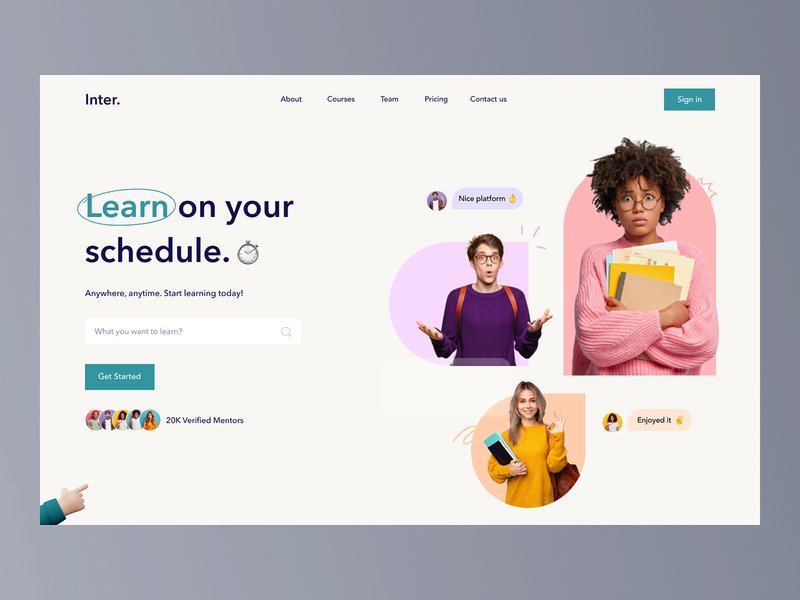
An e-learning website design showcasing effective UI/UX principles.
Responsive Web Design
With the proliferation of mobile devices, creating websites that adapt seamlessly to different screen sizes is paramount. OER courses frequently dedicate sections to responsive web design techniques, including:
- Using relative sizing units (e.g., percentages, ems, rems).
- Implementing media queries to apply different styles based on screen characteristics.
- Developing fluid grids and flexible images.
Introduction to Design Tools and Workflow
While coding is fundamental, modern web design often involves design software for wireframing and prototyping. OER may introduce learners to tools like Figma for creating visual layouts and mockups before writing code.
Where to Find High-Quality OER Web Design Courses
Navigating the landscape of open educational resources.
Several platforms and initiatives are dedicated to providing free and openly licensed educational content for web design. Here are some of the most notable:
OER Commons
OER Commons is a leading public digital library for OER. You can find a wealth of materials related to web design, web development, and computer science. Its browse and search functionalities allow you to filter by keyword (e.g., "web design," "HTML," "CSS," "JavaScript") to find relevant courses, modules, and textbooks.
LibreTexts
The LibreTexts project offers openly licensed textbooks across various subjects, including computer science, programming, databases, and web design. These are excellent resources for in-depth textual learning.
University Open Courseware and MOOCs (Audit Mode)
Many universities offer open courseware or allow auditing of their Massive Open Online Courses (MOOCs) for free. While certificates may require payment, the learning materials are often accessible. Examples include:
- Coursera: Offers a range of web design courses from universities like the University of Michigan (e.g., "Web Design for Everybody: Basics of Web Development & Coding" specialization). Many courses can be audited for free, providing access to lectures, readings, and assignments.
- edX: Similar to Coursera, edX hosts courses from top institutions. Some courses on web development or design principles might be available for free in audit mode.
- Harvard's CS50x: While a broader computer science course, CS50x includes significant components on web development basics that are highly beneficial for beginners.
Dedicated Learning Platforms with Free Tiers
Several online learning platforms offer free introductory courses or modules on web design, often as part of a larger curriculum:
- Codecademy: Provides a vast range of beginner and intermediate courses in HTML, CSS, JavaScript, and UI/UX design. Many introductory courses are free.
- freeCodeCamp: A highly popular resource offering comprehensive, free coding curricula, including front-end development (HTML, CSS, JavaScript) and responsive web design. They also offer certifications upon completion.
- Udemy: While known for paid courses, Udemy also has a selection of free web design tutorials and introductory courses, often covering specific topics like HTML, CSS, or responsive design.
- Webflow University: Offers free interactive video tutorials on web design, building with Webflow (a no-code platform), CMS, and even business strategies for freelancers. These courses are excellent for visual learners and those interested in visual development tools.
A Deep Dive into the Learning Journey
What to expect and how to maximize your OER experience.
Embarking on a web design journey using OER requires a structured approach to make the most of the abundant free resources available. It's not just about consuming content but actively engaging with it and building projects.
Typical Learning Path for a Beginner
A common progression for a beginner leveraging OER might look like this:
- HTML Fundamentals: Start with understanding the structure of web pages and basic HTML tags.
- CSS Styling: Move on to styling with CSS, including selectors, properties, and the box model.
- Responsive Design: Learn how to make your designs adapt to different screen sizes using media queries and flexible layouts.
- JavaScript Basics: Introduce interactivity with fundamental JavaScript concepts.
- UI/UX Principles: Integrate design thinking, wireframing, and prototyping into your workflow.
- Version Control (Git/GitHub): While not strictly design, learning basic Git commands is crucial for managing your code and collaborating.
- Portfolio Building: Apply learned skills by creating small projects and building a portfolio.

Engaging with OER can make web design accessible to all ages.
Key Skills and Their Importance in Web Design
The following table outlines critical skills acquired through OER web design courses and their significance in the field:
| Skill Area | Key Concepts Covered | Importance in Web Design |
|---|---|---|
| Front-End Development | HTML5, CSS3, JavaScript (ES6+), DOM Manipulation, Responsive Design | Forms the visual and interactive parts of a website; crucial for bringing designs to life. |
| UI/UX Design | Wireframing, Prototyping (Figma), User Research, Information Architecture, Usability Testing, Accessibility | Ensures the website is intuitive, user-friendly, and provides a positive experience for all visitors. |
| Graphic Design Principles | Color Theory, Typography, Visual Hierarchy, Layout, Branding | Enhances the aesthetic appeal and overall professionalism of a website. |
| Web Technologies & Tools | Browsers, Web Servers (basic understanding), Version Control (Git), Code Editors, Developer Tools | Facilitates efficient development, collaboration, and debugging. |
| Problem Solving & Logic | Algorithmic Thinking, Debugging Techniques, Critical Analysis | Essential for overcoming coding challenges and optimizing website performance. |
The Power of Interactive Learning: A Visual Perspective
OER platforms often incorporate interactive elements, which are vital for practical skill development in web design. To illustrate the multifaceted nature of web design skills acquired through OER, consider the radar chart below. It represents a hypothetical self-assessment of a learner's proficiency across various web design domains after completing a comprehensive OER curriculum. Each spoke signifies a distinct skill area, with values indicating a perceived level of mastery. This visual emphasizes that a well-rounded web designer needs to develop proficiency in both technical coding and creative design aspects.
Enriching Your Learning with Video Resources
Visual learning for practical web design application.
Beyond textual materials and interactive exercises, video tutorials are an invaluable component of learning web design, especially for beginners. They offer visual demonstrations of coding practices, design workflows, and practical applications, making complex concepts easier to grasp. Many OER initiatives and platforms curate or link to high-quality video content.
A particularly relevant video for aspiring web designers is the "Complete Web Design Course for Beginners | Free Full Course" available on YouTube. This type of resource provides a comprehensive walkthrough of the entire web design process, from foundational concepts to practical implementation. It allows learners to follow along, see code being written in real-time, and observe the immediate visual impact of design choices. Such full-length courses are excellent for establishing a strong initial understanding before diving deeper into specific areas.
"Complete Web Design Course for Beginners | Free Full Course" offers a comprehensive overview of web design fundamentals.
This video, along with many others like "Learn Web Design For Beginners - (Full Course 2025)" and "HTML & CSS for Beginners | FREE MEGA COURSE," demonstrates the practical application of HTML, CSS, and potentially JavaScript. These resources often break down the learning process into manageable segments, focusing on practical skills such as creating responsive layouts, using visual hierarchy, and implementing engaging animations. They bridge the gap between theoretical knowledge and hands-on development, which is critical for aspiring web designers.
Leveraging OER for Career Advancement
From beginner to professional: The path enabled by OER.
The skills acquired through OER web design courses can directly lead to various career paths in the digital industry. These foundational skills are highly sought after by employers looking for web developers, UI/UX designers, and front-end specialists.
- Web Developer: Focuses on the technical implementation of websites, writing code in HTML, CSS, and JavaScript.
- Web Designer: Emphasizes the visual and user experience aspects, often involving design tools like Figma and a strong understanding of aesthetics.
- User Interface (UI) Designer: Specializes in the visual and interactive elements of a product's interface.
- User Experience (UX) Designer: Focuses on the overall feeling and ease of use when interacting with a website or application.
Even if formal certifications are not offered, the practical experience gained through building projects using OER is invaluable. A strong portfolio showcasing diverse web design projects is often more impactful than a certificate for entry-level positions.
Frequently Asked Questions about OER Web Design Courses
What is the difference between web design and web development?
Are OER web design courses sufficient for a professional career?
Do I need any prior coding experience to start with OER web design courses?
What tools do I need for OER web design courses?
How can I stay updated with web design trends using OER?
Conclusion
Open Educational Resources offer an incredible gateway into the dynamic field of web design for beginners. By providing free, accessible, and adaptable content, OER democratizes learning and empowers individuals to acquire essential skills in HTML, CSS, JavaScript, UI/UX, and responsive design. The abundance of platforms, from OER Commons to free tiers on popular learning sites, ensures that anyone with an internet connection can embark on a comprehensive and practical learning journey. With dedication and a commitment to building a portfolio, OER can pave the way for a successful and fulfilling career in web design, proving that high-quality education doesn't always come with a high price tag.
Recommended Further Exploration
- Explore advanced responsive web design techniques for complex layouts.
- Discover how to build interactive web applications using modern JavaScript frameworks.
- Delve deeper into user experience (UX) research and testing methodologies.
- Learn how to create and publish your own open educational resources to contribute to the community.