

Key Insights into One-Sided Derivatives and Non-Differentiability
- One-sided derivatives define the rate of change of a function as it approaches a point from either the left or the right, crucial for analyzing function behavior at boundaries and points of abrupt change.
- A function is differentiable at a point if and only if both its left-hand and right-hand derivatives exist at that point and are equal.
- Non-differentiable points commonly arise from sharp corners (like in absolute value functions), cusps, vertical tangents, or discontinuities in the function's graph.
In calculus, the concept of a derivative quantifies the instantaneous rate of change of a function at a particular point. However, not all functions are "smooth" enough to have a well-defined derivative everywhere. This is where the powerful concepts of one-sided derivatives come into play, allowing us to meticulously examine a function's behavior as it approaches a point from a specific direction.
Understanding One-Sided Derivatives: A Directional Approach to Change
One-sided derivatives, namely the left-hand derivative and the right-hand derivative, are fundamental tools for analyzing the rate of change of a function when movement is restricted to a single direction along the argument of the function. Unlike the standard derivative, which requires a two-sided limit to exist, one-sided derivatives consider the limit as the approach to a point is made exclusively from either the left or the right.
Defining Left-Hand and Right-Hand Derivatives
Let a function \( f \) be defined on an interval \( I \) of real numbers, and let \( a \in I \). The formal definitions are as follows:
The Left-Hand Derivative
The left-hand derivative of \( f \) at \( a \), denoted as \( f'_{-}(a) \) or \( \partial_{-}f(a) \), is defined by the limit:
\[ f'_{-}(a) = \lim_{h \to 0^{-}} \frac{f(a+h) - f(a)}{h} \]This limit exists as a real number if \( a \in I \) is a limit point of \( I \cap (-\infty, a] \), meaning we are approaching \( a \) from values smaller than \( a \).
The Right-Hand Derivative
Similarly, the right-hand derivative of \( f \) at \( a \), denoted as \( f'_{+}(a) \) or \( \partial_{+}f(a) \), is defined by the limit:
\[ f'_{+}(a) = \lim_{h \to 0^{+}} \frac{f(a+h) - f(a)}{h} \]This limit exists as a real number if \( a \in I \) is a limit point of \( I \cap [a, \infty) \), meaning we are approaching \( a \) from values greater than \( a \).
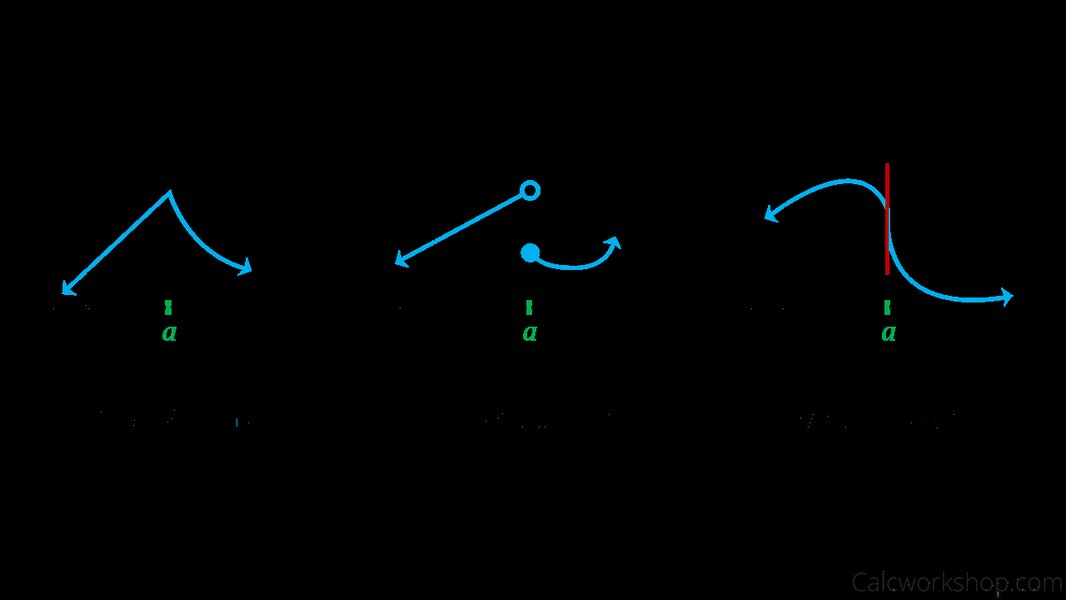
Illustration of function behavior with potential discontinuities.
Significance in Calculus
One-sided derivatives are particularly useful in several scenarios:
- Endpoints of Intervals: When a function is defined on a closed interval \( [a, b] \), the standard derivative cannot be applied at the endpoints \( a \) and \( b \) because the function is not defined on both sides. In such cases, we use the right-hand derivative at \( a \) and the left-hand derivative at \( b \).
- Piecewise Functions: For functions defined by different rules over different intervals (piecewise functions), one-sided derivatives are crucial at the points where the function's definition changes. They help determine if the function is smooth enough to have a derivative at these "junction" points.
- Conditions for Differentiability: A function \( f \) is differentiable at a point \( a \) if and only if both \( f'_{-}(a) \) and \( f'_{+}(a) \) exist and are equal. If they are not equal, or if one or both do not exist, the function is not differentiable at that point, even if it is continuous.
Delving into Non-Differentiable Points: Where Smoothness Breaks Down
A function is considered differentiable at a point if its graph has a well-defined, non-vertical tangent line at that point. When this condition is not met, the function is said to be non-differentiable. These points often reveal interesting aspects of a function's behavior.
Common Scenarios for Non-Differentiability
Several graphical characteristics and mathematical conditions lead to a function being non-differentiable at a specific point:
Sharp Corners (Kinks)
A sharp corner occurs when the left-hand and right-hand derivatives exist but are not equal. The most classic example is the absolute value function, \( f(x) = |x| \), at \( x = 0 \).
- For \( x < 0 \), \( f(x) = -x \), so \( f'(x) = -1 \). Thus, \( f'_{-}(0) = -1 \).
- For \( x > 0 \), \( f(x) = x \), so \( f'(x) = 1 \). Thus, \( f'_{+}(0) = 1 \).
Since \( f'_{-}(0) \neq f'_{+}(0) \), \( f(x) = |x| \) is not differentiable at \( x = 0 \), despite being continuous at that point.
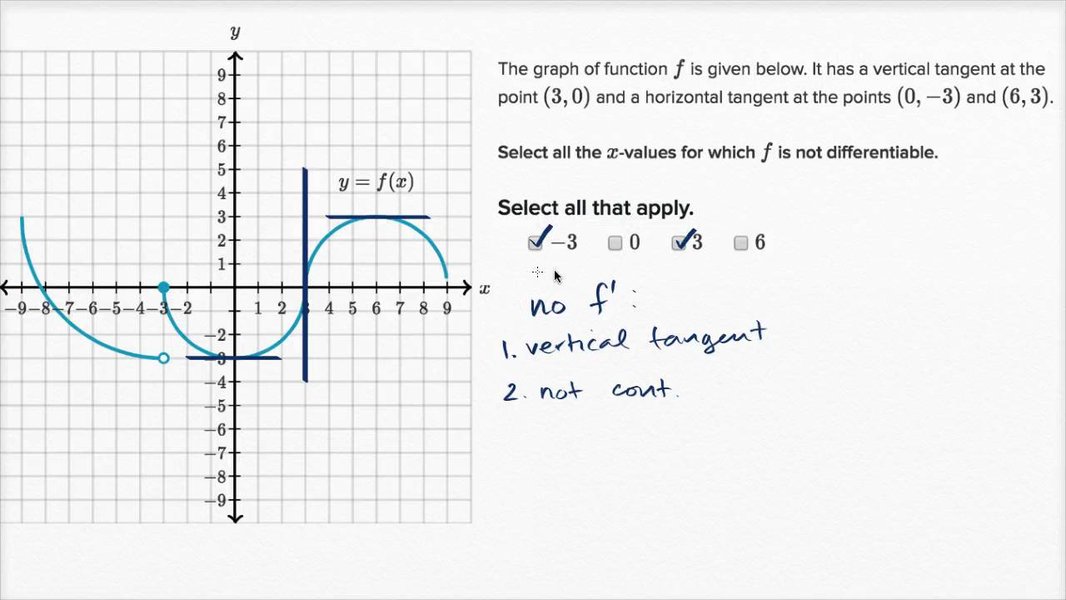
Graphical representation of a sharp corner, where differentiability fails.
Cusps
Similar to sharp corners, a cusp is a point where the tangent line changes direction abruptly, but in a way that often results in one-sided derivatives approaching positive and negative infinity, or both approaching infinity. An example is \( f(x) = x^{2/3} \) at \( x = 0 \).
At a cusp, the slopes on either side of the point approach infinity (or negative infinity), leading to a vertical tangent. While the function may be continuous, the derivative is undefined.
Vertical Tangents
If the derivative approaches infinity (or negative infinity) at a point, it indicates a vertical tangent line. In such cases, the function is not differentiable at that point because the slope is undefined. An example is \( f(x) = x^{1/3} \) at \( x = 0 \).
Here, the derivative \( f'(x) = \frac{1}{3}x^{-2/3} = \frac{1}{3x^{2/3}} \). As \( x \to 0 \), \( f'(x) \to \infty \).
Discontinuities
A fundamental theorem in calculus states that if a function is differentiable at a point, it must also be continuous at that point. The contrapositive of this statement is also true: if a function is discontinuous at a point, then it is not differentiable at that point. Types of discontinuities include:
- Jump Discontinuity: The function "jumps" from one value to another (e.g., step functions like \( f(x) = \frac{x}{|x|} \) at \( x = 0 \)).
- Removable Discontinuity: A hole in the graph that can be "filled" by redefining the function at that single point.
- Infinite Discontinuity: The function approaches infinity or negative infinity (e.g., \( f(x) = \frac{1}{x} \) at \( x = 0 \)).
In all these cases, the concept of a tangent line (and thus a derivative) is meaningless.
Oscillations (Weierstrass Function)
While less common in introductory calculus, some functions are continuous everywhere but differentiable nowhere. The most famous example is the Weierstrass function, which exhibits infinitely many oscillations, making it impossible to define a unique tangent at any point. This illustrates that continuity alone does not guarantee differentiability.
A Practical Table of Non-Differentiable Functions
This table summarizes common types of functions that exhibit non-differentiable points and the underlying reasons.
| Type of Function | Example Function | Point of Non-Differentiability | Reason for Non-Differentiability |
|---|---|---|---|
| Absolute Value Function | \( f(x) = |x| \) | \( x = 0 \) | Sharp Corner (Left and Right Derivatives Unequal) |
| Piecewise Function (Jump) | \( f(x) = \begin{cases} x & x \le 0 \ x+2 & x > 0 \end{cases} \) | \( x = 0 \) | Discontinuity (Jump) |
| Cusp Function | \( f(x) = x^{2/3} \) | \( x = 0 \) | Cusp (Vertical Tangent, one-sided limits of derivative approach infinity/negative infinity) |
| Vertical Tangent Function | \( f(x) = x^{1/3} \) | \( x = 0 \) | Vertical Tangent (Derivative approaches infinity) |
| Discontinuous (Undefined) | \( f(x) = \frac{1}{x} \) | \( x = 0 \) | Discontinuity (Function undefined at point) |
The Interplay of Continuity and Differentiability
It is crucial to understand the relationship between continuity and differentiability. As established, differentiability implies continuity. However, the converse is not true: a continuous function is not necessarily differentiable. The example of \( f(x) = |x| \) at \( x = 0 \) perfectly illustrates this point. The function is continuous (you can draw it without lifting your pen), but it has a sharp corner, making it non-differentiable.
Why Continuity is a Prerequisite
For a derivative to exist at a point, the function must be "smooth" and "connected" at that point. If there is a jump, hole, or asymptote, the concept of a tangent line becomes meaningless because the function's values do not seamlessly flow into each other. Hence, continuity is a necessary condition for differentiability.
The "Smoothness" Criterion
Differentiability requires not just continuity, but also a certain level of "smoothness." This means that as you zoom in on the graph of a differentiable function at a point, it should appear increasingly like a straight line (its tangent line). Points of non-differentiability, like corners or cusps, reveal where this "straight line" approximation breaks down, no matter how much you zoom in.
Mermaid Mindmap: Visualizing Differentiability Conditions
This mindmap summarizes the core concepts related to differentiability and its failure points, providing a structured overview of the conditions and examples.
The mindmap clearly illustrates that differentiability hinges on both continuity and the equality of one-sided derivatives. When any of these conditions are violated, we encounter points where the function is not differentiable, leading to the various forms of non-smooth behavior described.
Visualizing Differentiability Concepts
To further enhance your understanding, consider this video which provides a visual explanation of why a function may not be differentiable at certain points, particularly focusing on kinks and cusps. It complements the theoretical discussions by showing how these geometric features prevent the formation of a unique tangent line.
This video illustrates common scenarios where a function fails to be differentiable, such as at sharp corners or cusps, providing a visual intuition for these critical points.
Frequently Asked Questions About One-Sided Derivatives and Non-Differentiable Points
What is the main difference between a regular derivative and a one-sided derivative?
Can a continuous function be non-differentiable?
Why does a sharp corner make a function non-differentiable?
What is a Weierstrass function, and why is it significant?
Conclusion
One-sided derivatives provide a powerful lens through which to analyze the intricate behavior of functions, particularly at critical points where standard differentiability might fail. By examining the left-hand and right-hand rates of change, we can precisely identify and understand why functions exhibit non-differentiable characteristics such as sharp corners, cusps, vertical tangents, or discontinuities. This nuanced understanding is essential not only for theoretical calculus but also for practical applications where functions may describe real-world phenomena with abrupt changes or limits in their domains.
Recommended Further Exploration
- How to apply derivatives in real-world scenarios?
- Understanding the Mean Value Theorem and its implications?
- Exploring higher-order derivatives and their applications?
- Differentiability of multivariable functions?