
Unlocking the Blueprint of Language: A Deep Dive into Traditional Grammar
Exploring its classical roots, core principles, and enduring influence on how we understand and teach language structure.
Traditional grammar, often referred to as classical or school grammar, represents a foundational approach to understanding and analyzing language structure. It's a system deeply rooted in the linguistic traditions of ancient Greece and Rome, providing a framework that has shaped language education for centuries. This overview will explore its historical origins, core tenets, key characteristics, and its place in the broader landscape of linguistic study.
Key Highlights of Traditional Grammar
- Classical Foundations: Traditional grammar primarily draws its principles from the analysis of classical languages like Latin and Greek, emphasizing a prescriptive approach to language use.
- Structural Focus: It meticulously categorizes words into distinct parts of speech and analyzes sentences based on core components like subject and predicate, offering a structured view of language.
- Educational Cornerstone: Despite criticisms, traditional grammar remains a significant, often initial, framework for teaching language structure and rules of "correctness" in many educational settings.
What is Traditional Grammar? Unpacking the Basics
Defining the Classical Approach to Language
Traditional grammar is essentially a collection of prescriptive rules and concepts concerning the structure of language, historically taught in schools. Its primary aim is to define what is considered "correct" or "proper" usage, often based on established literary standards and the grammar of prestigious languages, most notably Latin. This approach focuses on maintaining linguistic tradition rather than describing how language is dynamically used in everyday communication by its speakers.
The core of traditional grammar involves the classification of words into parts of speech and the analysis of how these words combine to form sentences. It provides a systematic way to look at sentence components, word functions, and grammatical relationships. While its methodologies have been debated and supplemented by modern linguistic theories, its fundamental concepts continue to provide a useful starting point for grammatical understanding.
A visual representation of a traditional grammar guide, highlighting its academic nature.
The Historical Tapestry of Traditional Grammar
Tracing its Ancient Roots and Evolution
The origins of traditional grammar are deeply embedded in antiquity, with significant contributions from scholars in various ancient civilizations.
Ancient Beginnings: Greece, Rome, and India
The formal study of grammar in the Western world began with the ancient Greeks. Philosophers like Plato and Aristotle explored language, but it was scholars like Dionysius Thrax (c. 170 BC – c. 90 BC) whose work, "Art of Grammar" (Tékhnē Grammatikḗ), provided one of the first systematic descriptions of Greek grammar, identifying parts of speech and morphological categories. This Greek model was later adapted by Roman grammarians, such as Marcus Terentius Varro (116 BC – 27 BC) and Aelius Donatus (4th century AD), to describe Latin. Concurrently, in ancient India, Pāṇini's Aṣṭādhyāyī (dating back to the 4th-2nd century BCE) offered an incredibly sophisticated descriptive grammar of Sanskrit, showcasing an early, highly analytical approach to language structure, though its direct influence on Western traditional grammar was later.
The Renaissance and Codification for European Languages
During the Renaissance, there was a renewed interest in classical learning, including the grammatical works of Greece and Rome. Latin, being the language of scholarship, religion, and international communication in Europe, heavily influenced the development of grammars for vernacular European languages. Grammarians sought to codify their own languages, often using the framework of Latin grammar as a template. This period saw the formalization of grammatical rules and the popularization of traditional grammar as the standard for language study and education.
Application to English
The first English grammars, appearing in the late 16th and 17th centuries, were largely based on Latin models. Grammarians like William Bullokar and later, Bishop John Wallis (whose grammar of English was notably written in Latin), attempted to fit English into the grammatical categories and structures of Latin. This often led to the imposition of Latinate rules onto English, some of which (like the infamous proscription against split infinitives or ending sentences with prepositions) were not organic to English structure but reflected Latin grammatical norms. This prescriptive tradition solidified in the 18th century with influential grammarians like Robert Lowth and Lindley Murray, whose works became standard texts in schools for generations.
Pillars of Traditional Grammar: Key Features and Components
Traditional grammar is characterized by its focus on several core elements that provide a framework for analyzing language.
The Eight Parts of Speech
A cornerstone of traditional grammar is the classification of words into categories known as parts of speech, typically numbering eight (though some classifications may vary slightly):
- Nouns: Words that name persons, places, things, or ideas (e.g., teacher, city, book, freedom).
- Pronouns: Words that substitute for nouns (e.g., he, she, it, they, who).
- Adjectives: Words that modify or describe nouns or pronouns (e.g., happy child, green apple).
- Verbs: Words that express action or a state of being (e.g., run, think, is, seems).
- Adverbs: Words that modify verbs, adjectives, or other adverbs (e.g., runs quickly, very happy, too slowly).
- Prepositions: Words that show the relationship between a noun/pronoun and other words in the sentence (e.g., in, on, under, after).
- Conjunctions: Words that connect words, phrases, or clauses (e.g., and, but, or, because).
- Interjections: Words that express strong emotion (e.g., Oh!, Wow!, Ouch!).
These categories are defined based on a combination of a word's meaning, its form (inflections), and its syntactic function within a sentence.
Sentence Structure: Subject and Predicate
Traditional grammar typically analyzes sentences as having two main components:
- Subject: The part of the sentence that names whom or what the sentence is about. It often contains a noun or pronoun and performs the action of the verb or is described by it.
- Predicate: The part of the sentence that says something about the subject. It typically contains the verb and any objects, complements, or adverbial modifiers related to that verb.
Further analysis involves identifying phrases (groups of words without a subject-verb combination, acting as a single part of speech) and clauses (groups of words containing a subject and a verb), and understanding their roles within the larger sentence structure. Parsing, the act of breaking down a sentence into its component parts and describing their grammatical roles, is a common exercise in traditional grammar.
Morphology and Syntax
Traditional grammar pays significant attention to:
- Morphology: The study of word forms and how they are altered through inflection (e.g., verb conjugation for tense, noun declension for case or number) and derivation (e.g., forming new words using prefixes and suffixes).
- Syntax: The rules governing how words are combined to form phrases, clauses, and sentences, including word order and agreement between sentence elements (e.g., subject-verb agreement).
The Prescriptive Lens: Defining "Correctness"
Perhaps the most defining characteristic of traditional grammar is its prescriptive nature. It doesn't just describe how language is used, but rather prescribes rules for how it *should* be used to be considered "correct" or "proper." This often involves proscriptive rules as well – advising what forms or usages should be avoided. These prescriptions are frequently based on the grammar of classical languages (especially Latin) or the usage of esteemed literary figures, rather than on empirical observation of contemporary language use by the general populace. This focus on correctness extends to areas like punctuation, diction (word choice), and style.
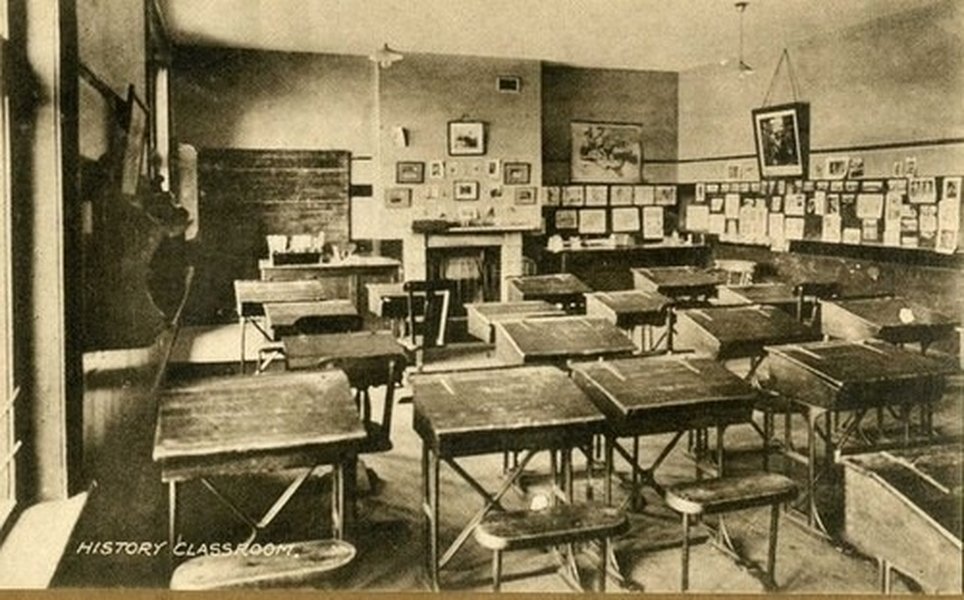
A depiction of a historical classroom, where traditional grammar was a central part of the curriculum.
Visualizing Grammatical Relationships: A Mindmap
To better understand the interconnected concepts within traditional grammar, the following mindmap illustrates its key components and influences. It shows how elements like historical roots, core focuses such as parts of speech and sentence structure, its prescriptive nature, and its role in education all contribute to the overall framework of traditional grammar.
(Dionysius Thrax)"] id1b["Ancient Rome
(Varro, Donatus)"] id1c["Ancient India
(Pāṇini - Sanskrit)"] id1d["Renaissance Revival"] id1e["Influence on English Grammar"] id2["Core Focus"] id2a["Parts of Speech
(Nouns, Verbs, Adjectives, etc.)"] id2b["Sentence Structure"] id2b1["Subject"] id2b2["Predicate"] id2b3["Phrases & Clauses"] id2c["Morphology
(Inflection, Derivation)"] id2d["Syntax
(Word Order, Agreement)"] id3["Nature"] id3a["Prescriptive
(Focus on 'correctness')"] id3b["Proscriptive
(Rules against certain usages)"] id3c["Based on Latin/Greek models"] id3d["Emphasis on written language"] id4["Educational Role"] id4a["Foundation for language learning"] id4b["Teaching 'proper' usage"] id4c["Parsing and sentence analysis"] id5["Criticisms & Limitations"] id5a["Rigidity"] id5b["Outdated for modern language"] id5c["Neglect of spoken language/variation"] id5d["Latin-centric bias"] id6["Contrast With"] id6a["Modern Linguistics
(Descriptive, scientific study)"]
This mindmap provides a visual summary, connecting the historical development of traditional grammar with its analytical components and its overall approach to language study.
Comparing Grammatical Perspectives
The following chart offers a comparative view of the emphasis placed on different linguistic aspects by Traditional Grammar versus a more Modern Descriptive Linguistic approach. This helps to highlight the distinct priorities and methodologies of each perspective. The scores (out of 10) are illustrative, representing general tendencies rather than precise quantitative measures.
As illustrated, Traditional Grammar places a high emphasis on prescriptivism, historical forms, written language, and rule rigidity. In contrast, Modern Descriptive Linguistics prioritizes describing language as it is actually used (descriptivism), focusing on its current state (synchronic focus), spoken language, and accommodating linguistic diversity and change.
Traditional Grammar in Education: Relevance and Teaching
Despite the rise of modern linguistic theories, traditional grammar continues to play a significant role in educational settings, particularly in elementary and secondary schools. It often serves as the initial introduction to grammatical concepts for language learners. Its straightforward categorization of parts of speech and basic sentence structures can provide a helpful foundation for understanding how language is organized. Teachers often use traditional grammar to explain rules of "correct" writing, punctuation, and syntax, aiming to improve clarity and precision in students' written work. The practice of sentence diagramming, a hallmark of traditional grammar instruction, is intended to help students visualize grammatical relationships.
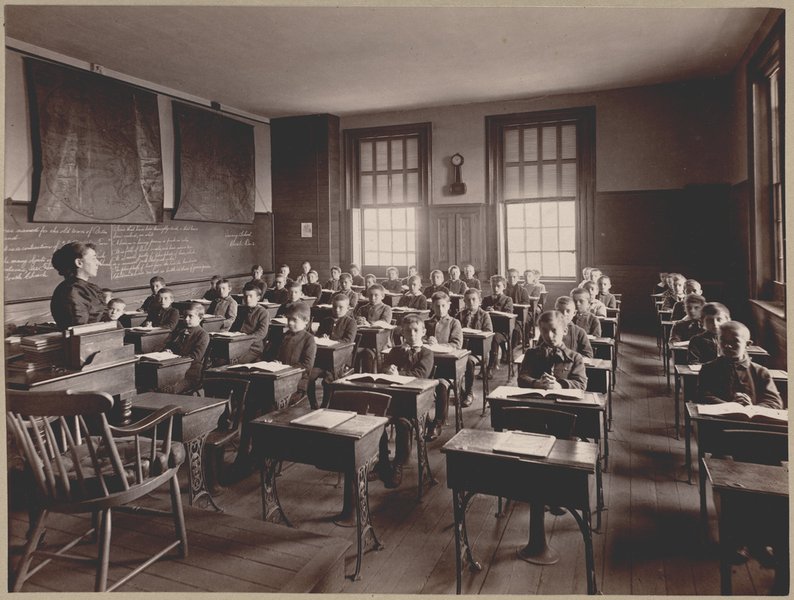
A grammar school class from the past, illustrating the long history of traditional grammar in education.
Critiques and Limitations of Traditional Grammar
Traditional grammar has faced considerable criticism, especially from proponents of modern linguistics. Key critiques include:
- Prescriptivism vs. Descriptivism: Its primary focus on prescribing "correct" usage rather than describing actual language use is seen as unscientific and often at odds with how people naturally speak and write.
- Rigidity and Outdatedness: The rules are often seen as rigid and not always reflective of contemporary language or linguistic change. Language is dynamic, but traditional grammar tends to present a static view.
- Latin-Centric Bias: Many rules in traditional English grammar were based on Latin, a language with a very different structure. This has led to the imposition of unnatural rules on English (e.g., the aforementioned split infinitive debate).
- Neglect of Important Linguistic Areas: Traditional grammar often gives less attention to crucial aspects of language like phonology (sound systems), semantics (meaning beyond word definitions), and pragmatics (language in context).
- Inadequacy for Diverse Languages: The framework, derived primarily from Indo-European languages, may not be suitable for describing the grammars of non-Indo-European languages, which can have vastly different structures.
Traditional Grammar vs. Modern Linguistics: A Comparative Glance
The differences between traditional grammar and modern linguistics are fundamental. Modern linguistics, which emerged as a more scientific and empirical field in the 20th century, generally takes a descriptive approach, seeking to understand and explain the underlying principles of language as it is actually used by speakers, encompassing all its variations and complexities. The table below highlights some key distinctions:
| Feature | Traditional Grammar | Modern Linguistics |
|---|---|---|
| Primary Approach | Prescriptive (how language *should* be used) | Descriptive (how language *is* used) |
| Focus | Rules of "correctness," often based on literary or classical standards | Systematic study of language structure, use, and acquisition; underlying cognitive principles |
| Basis | Often based on Latin and Greek grammatical models | Empirical observation of diverse languages and scientific methodology |
| Language Form Prioritized | Often prioritizes written language | Often prioritizes spoken language as primary, also studies written forms |
| Goal | To teach "proper" usage and maintain linguistic standards | To understand the nature of language, develop theories of grammar, and describe linguistic phenomena |
| View of Language Change | Often seen as corruption or decay from a "purer" form | Viewed as a natural and continuous process |
| Scope | Mainly morphology and syntax | Broader scope including phonetics, phonology, semantics, pragmatics, sociolinguistics, psycholinguistics, etc. |
This table clarifies that while traditional grammar focuses on establishing and teaching a standard, modern linguistics aims to explore the full spectrum of language as a human capacity and social phenomenon.
The Enduring Legacy and Modern Relevance
Despite its limitations and the rise of modern linguistics, traditional grammar has an enduring legacy. It provides a common vocabulary for discussing language structure (e.g., "noun," "verb," "clause") that is widely understood. For many, it serves as the first and sometimes only formal exposure to the study of grammar. Its prescriptive rules, while sometimes debated, can offer guidance for formal writing and standardized communication. The video below discusses some of the historical context and issues related to traditional grammar, offering further perspective on its role and criticisms.
This video, "What’s wrong with (traditional) grammar? | Grammar Series ...", delves into the historical origins of traditional grammar and contrasts its prescriptive approach with descriptive linguistics, providing context for its ongoing debate and relevance.
While modern linguistics offers more comprehensive and nuanced ways to understand language, the foundational concepts introduced by traditional grammar continue to be a reference point. It has shaped centuries of language education and, for better or worse, has influenced how many people perceive and use language, particularly in formal contexts.
Frequently Asked Questions (FAQ)
What are the main parts of speech in traditional grammar?
Why is traditional grammar considered prescriptive?
How does traditional grammar differ from modern linguistics?
Is traditional grammar still relevant today?
Conclusion
Traditional grammar, with its roots in classical antiquity, has provided a long-standing framework for analyzing and teaching language. Its emphasis on parts of speech, sentence structure, and prescriptive rules has shaped language education for centuries. While it faces valid criticisms for its rigidity, Latin-centric bias, and prescriptive nature, especially when compared to the descriptive and more encompassing approaches of modern linguistics, traditional grammar offers a foundational vocabulary and set of concepts for understanding language. It remains a significant, if debated, part of our linguistic heritage and continues to influence how grammar is approached in many educational contexts, providing a starting point for exploring the complexities of human language.
Recommended
- Explore the evolution of grammatical theories beyond traditional grammar.
- What are the practical applications of understanding sentence diagramming from traditional grammar?
- How did Latin grammar specifically influence the rules of English traditional grammar?
- Compare the teaching methods of traditional grammar versus modern linguistic approaches in schools.
References
 lmdresources.wordpress.com
Last updated May 22, 2025