
Oxalic Acid in Analytical Chemistry: A Comprehensive Exploration
Unveiling the Diverse Applications and Significance of Oxalic Acid in Chemical Analysis
Oxalic acid, a simple dicarboxylic acid with the chemical formula (COOH)2 or C2H2O4, holds significant importance in the field of analytical chemistry. Known systematically as ethanedioic acid, it is the simplest dicarboxylic acid, consisting of two carboxyl groups directly bonded to each other. Its unique chemical properties, such as its acidity, reducing ability, and capacity to form complexes with metal ions, make it a versatile reagent in various analytical procedures.
Key Insights into Oxalic Acid's Role in Analytical Chemistry
- Primary Standard: Oxalic acid dihydrate (\(\text{H}_2\text{C}_2\text{O}_4 \cdot 2\text{H}_2\text{O}\)) is widely used as a primary standard in acid-base titrations due to its high purity, stability, and well-defined molecular weight.
- Reducing Agent in Redox Titrations: Oxalic acid acts as a strong reducing agent, particularly in the titration of oxidizing agents like potassium permanganate (\(\text{KMnO}_4\)). This reaction is a fundamental redox titration used to determine the concentration of permanganate solutions.
- Metal Ion Analysis: Oxalic acid's ability to form insoluble oxalate salts with various metal ions makes it useful in the quantitative precipitation and determination of these metals.
Chemical Nature and Properties of Oxalic Acid
Oxalic acid is a naturally occurring organic acid found in many plants, fruits, and vegetables. It is characterized by its two carboxyl groups, which contribute to its acidic nature. It is considered a strong organic acid, with pKa1 and pKa2 values of 1.25 and 4.28, respectively. This diprotic nature allows it to donate two protons in acid-base reactions.
The chemical structure of oxalic acid is:
HO−C(=O)−C(=O)−OHIts molar mass is 90.03 g/mol for the anhydrous form and 126.07 g/mol for the dihydrate form (\(\text{H}_2\text{C}_2\text{O}_4 \cdot 2\text{H}_2\text{O}\)).
Physical Characteristics
Oxalic acid is typically a white crystalline solid with no odor. It is highly soluble in water, forming a colorless solution. The dihydrate form is commonly encountered and used in laboratory settings.
Applications in Analytical Chemistry
Oxalic acid's unique properties lend themselves to a variety of applications in analytical chemistry, primarily in titrimetric methods and metal analysis.
As a Primary Standard in Acid-Base Titrations
One of the most significant uses of oxalic acid dihydrate in analytical chemistry is as a primary standard for standardizing alkaline solutions, such as sodium hydroxide (\(\text{NaOH}\)). A primary standard is a substance of high purity and stability that can be weighed accurately to prepare a solution of precisely known concentration.
The reaction between oxalic acid and sodium hydroxide is a neutralization reaction:
\(\text{H}_2\text{C}_2\text{O}_4\text{(aq)} + 2\text{NaOH(aq)} \rightarrow \text{Na}_2\text{C}_2\text{O}_4\text{(aq)} + 2\text{H}_2\text{O(l)}\)In this reaction, one mole of oxalic acid reacts with two moles of sodium hydroxide. By accurately weighing a known mass of oxalic acid dihydrate and dissolving it in a known volume of water, a standard solution of oxalic acid can be prepared. This standard solution is then used to titrate the sodium hydroxide solution of unknown concentration. Phenolphthalein is commonly used as an indicator for this titration, changing color at the equivalence point.
The use of oxalic acid dihydrate as a primary standard is advantageous due to its non-hygroscopic nature, high molecular weight, and ease of purification and drying.
As a Reducing Agent in Redox Titrations
Oxalic acid is a strong reducing agent and is widely used in redox titrations, particularly for the determination of oxidizing agents. A classic example is the titration of potassium permanganate (\(\text{KMnO}_4\)) with oxalic acid in an acidic medium.
The balanced redox reaction is:
\(2\text{MnO}_4^-\text{(aq)} + 5\text{H}_2\text{C}_2\text{O}_4\text{(aq)} + 6\text{H}^+\text{(aq)} \rightarrow 2\text{Mn}^{2+}\text{(aq)} + 10\text{CO}_2\text{(g)} + 8\text{H}_2\text{O(l)}\)In this reaction, permanganate ions (\(\text{MnO}_4^-\)), which are purple, are reduced to manganese(II) ions (\(\text{Mn}^{2+}\)), which are colorless. Oxalic acid is oxidized to carbon dioxide (\(\text{CO}_2\)).
Potassium permanganate acts as a self-indicator in this titration. The endpoint is reached when the first permanent pale pink color appears due to a slight excess of permanganate ions. Sulfuric acid is added to provide the acidic medium necessary for the reaction and to prevent the formation of manganese dioxide.
Heating the oxalic acid solution to around 50-60°C before titration increases the reaction rate.
Video demonstrating the reaction of oxalic acid with potassium permanganate.
Quantitative Analysis of Metal Ions
Oxalic acid forms insoluble precipitates with many metal ions, such as calcium, strontium, and barium, in the form of oxalates. This property is utilized in the quantitative determination of these metal ions through precipitation methods.
For example, calcium ions (\(\text{Ca}^{2+}\)) can be precipitated as calcium oxalate (\(\text{CaC}_2\text{O}_4\)):
\(\text{Ca}^{2+}\text{(aq)} + \text{C}_2\text{O}_4^{2-}\text{(aq)} \rightarrow \text{CaC}_2\text{O}_4\text{(s)}\)The precipitated calcium oxalate can then be filtered, dried, and weighed to determine the amount of calcium in the original sample. Alternatively, the oxalate in the precipitate can be titrated with a standard solution of potassium permanganate to indirectly determine the amount of the metal ion.
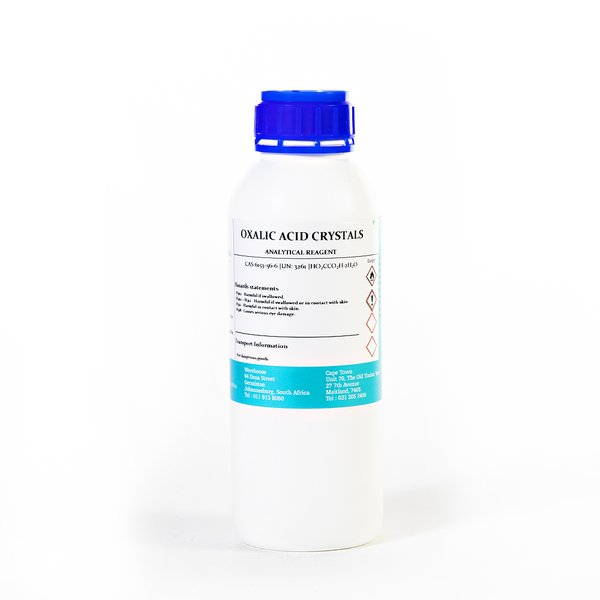
Oxalic acid crystals, a common form used in analytical chemistry.
Other Analytical Applications
Beyond titrimetry and metal precipitation, oxalic acid finds use in other analytical procedures:
Cleaning and Etching
Oxalic acid is an effective rust remover and is used for cleaning various surfaces, including metals. It can also be used for etching in certain analytical techniques.
Chromatography
Oxalic acid or oxalate salts are sometimes used as mobile phase components or complexing agents in chromatographic methods for the separation and analysis of certain compounds.
Analytical Reagent
It serves as a general analytical reagent in various tests and procedures in laboratories.
Oxalic Acid vs. Other Standards
While oxalic acid dihydrate is a valuable primary standard, other substances like potassium hydrogen phthalate (KHP) are also commonly used, particularly for standardizing bases. KHP is considered less hygroscopic than oxalic acid dihydrate, which can be an advantage in certain situations. However, oxalic acid dihydrate is often more readily available and cost-effective for general laboratory use.
For redox titrations, sodium oxalate (\(\text{Na}_2\text{C}_2\text{O}_4\)) can also be used as a primary standard for permanganate solutions. Sodium oxalate is generally considered more stable than oxalic acid dihydrate for this specific application.
Summary of Oxalic Acid's Analytical Uses
The following table summarizes the key uses of oxalic acid in analytical chemistry:
| Analytical Application | Role of Oxalic Acid | Example |
|---|---|---|
| Acid-Base Titration | Primary standard for bases | Standardization of NaOH solution |
| Redox Titration | Reducing agent | Determination of KMnO4 concentration |
| Quantitative Metal Analysis | Precipitating agent | Determination of calcium, strontium, barium |
| Cleaning and Etching | Rust removal, etching agent | Cleaning metal surfaces |
| Chromatography | Mobile phase component, complexing agent | Separation of organic acids |
| General Reagent | Analytical reagent | Various laboratory tests |
Safety Considerations
It is important to note that oxalic acid is a toxic substance and can be harmful if inhaled, ingested, or comes into contact with skin or eyes. Proper safety precautions, including wearing appropriate personal protective equipment, should always be followed when handling oxalic acid in the laboratory.
Frequently Asked Questions
What is the chemical formula of oxalic acid?
The chemical formula of anhydrous oxalic acid is (COOH)2 or C2H2O4. The dihydrate form, commonly used in analytical chemistry, is \(\text{H}_2\text{C}_2\text{O}_4 \cdot 2\text{H}_2\text{O}\).
Why is oxalic acid dihydrate used as a primary standard?
Oxalic acid dihydrate is used as a primary standard because it can be obtained in high purity, is stable, has a definite chemical composition, and a relatively high molecular weight, allowing for accurate weighing.
In which titrations is oxalic acid used as a reducing agent?
Oxalic acid is commonly used as a reducing agent in redox titrations, particularly in the standardization of oxidizing agents like potassium permanganate (\(\text{KMnO}_4\)) and cerium(IV) sulfate.
Can oxalic acid be used to determine metal ions?
Yes, oxalic acid can be used to determine certain metal ions (e.g., calcium, strontium, barium) by precipitating them as insoluble oxalate salts, which can then be quantified gravimetrically or by titration of the oxalate.
References
 tabraizullah.files.wordpress.com

Last updated April 29, 2025