
Mastering Packed Bed Column Calculations: Engineering Essentials Revealed
Uncover the critical equations, design principles, and optimization techniques to accurately size and design efficient packed bed columns for chemical processes
Key Insights for Packed Bed Column Design
- The Ergun equation serves as the foundation for pressure drop calculations across packed beds, accounting for both viscous and inertial forces that affect fluid flow through various packing materials.
- Column diameter sizing depends critically on preventing flooding, with typical designs operating at 50-75% of flooding velocity to ensure optimal mass transfer while avoiding operational inefficiencies.
- Packed bed height calculations require understanding of separation efficiency metrics such as Height Equivalent to a Theoretical Plate (HETP) or Number of Transfer Units (NTU) to achieve desired separation performance.
Understanding Packed Bed Column Fundamentals
Packed bed columns are essential equipment in chemical engineering, widely used for separation processes like distillation, absorption, and extraction, as well as reaction processes in packed bed reactors. Accurately calculating the dimensions and performance parameters of these columns is crucial for efficient and cost-effective operation.
Basic Components and Principles
A packed bed column consists of a vertical cylindrical vessel containing packing material that provides a large surface area for mass transfer between fluid phases. The design and calculation of packed bed columns involve determining several key parameters:
- Column diameter and height
- Type and size of packing material
- Pressure drop across the packed bed
- Mass transfer efficiency
- Flow rates and velocities
Effective design requires balancing these parameters to optimize separation efficiency while minimizing energy consumption and equipment costs.
Pressure Drop Calculations Using the Ergun Equation
The pressure drop across a packed bed is one of the most critical parameters in column design. The Ergun equation provides a comprehensive method for calculating pressure drop by accounting for both viscous and inertial contributions:
\[ \frac{\Delta P}{L} = 150 \frac{(1-\epsilon)^2}{\epsilon^3} \frac{\mu V_s}{D_p^2} + 1.75 \frac{(1-\epsilon)}{\epsilon^3} \frac{\rho V_s^2}{D_p} \]
Where:
- \( \Delta P \) = pressure drop (Pa)
- \( L \) = bed height (m)
- \( \epsilon \) = void fraction of the packing
- \( \mu \) = fluid viscosity (Pa·s)
- \( V_s \) = superficial velocity (m/s)
- \( D_p \) = particle diameter (m)
- \( \rho \) = fluid density (kg/m³)
Applying the Ergun Equation for Different Particle Shapes
For non-spherical particles, the Ergun equation can be modified by using an equivalent particle diameter. The sphericity factor (φ) is introduced to account for the deviation from perfect spherical shape:
\[ D_{eq} = \phi \cdot D_p \]
Where φ ranges from 0 to 1, with 1 representing a perfect sphere.
Calculating Superficial Velocity
The superficial velocity is a critical parameter in packed bed calculations and is defined as the volumetric flow rate divided by the cross-sectional area of the empty column:
\[ V_s = \frac{Q}{A} = \frac{4Q}{\pi D^2} \]
Where Q is the volumetric flow rate and D is the column diameter.
Column Diameter and Height Calculations
Determining Column Diameter
The column diameter must be sized to prevent flooding while ensuring efficient mass transfer. The calculation typically follows these steps:
- Calculate the flooding velocity using empirical correlations or flooding charts
- Select an operating velocity (typically 50-75% of flooding velocity)
- Calculate the required diameter based on the flow rates and operating velocity
The diameter can be calculated using:
\[ D = \sqrt{\frac{4Q}{\pi V_s}} \]
Calculating Packed Bed Height
The height of packing required depends on the separation efficiency needed. There are two main approaches:
HETP (Height Equivalent to a Theoretical Plate) Method
For distillation and similar processes, the packed bed height can be calculated as:
\[ H = N_{theoretical} \times HETP \]
Where Ntheoretical is the number of theoretical stages required for the desired separation and HETP is the height of packing that provides the same separation as one theoretical stage.
NTU (Number of Transfer Units) Method
For absorption and stripping processes, the height can be calculated using:
\[ H = NTU \times HTU \]
Where NTU is the number of transfer units required and HTU (Height of a Transfer Unit) is a measure of the column's mass transfer efficiency.
Packing Selection and Evaluation
The choice of packing material significantly impacts column performance. Here's a radar chart comparing the key properties of different packing types:
The radar chart illustrates the relative performance of different packing types across key metrics. Structured packing offers superior mass transfer efficiency and lower pressure drop but at a higher cost, while random packings like Raschig rings provide a more economical option with good mechanical strength.
Key Factors in Packed Bed Column Design
When designing a packed bed column, multiple factors need to be considered simultaneously. The following mindmap outlines the key considerations:
Visual Guide to Packed Bed Columns and Packing Materials
Understanding the physical components of packed bed columns and the various packing materials available is essential for proper design and calculation. The images below provide visual references:
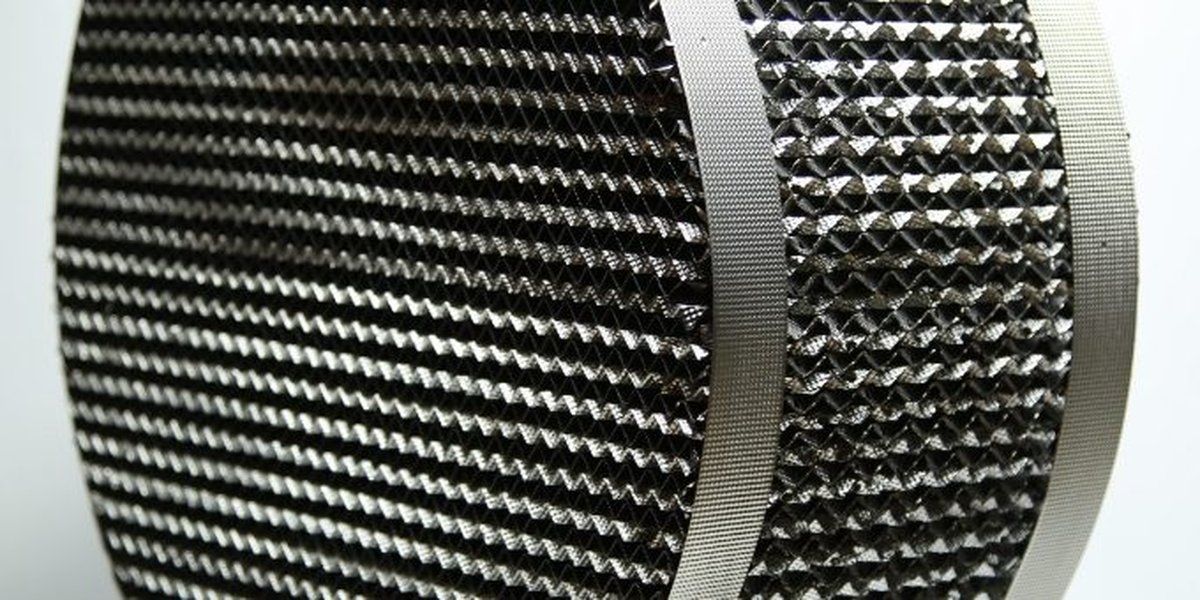
Structured packing installation in an industrial column showing the precise arrangement of metal sheets that provide high surface area with low pressure drop.
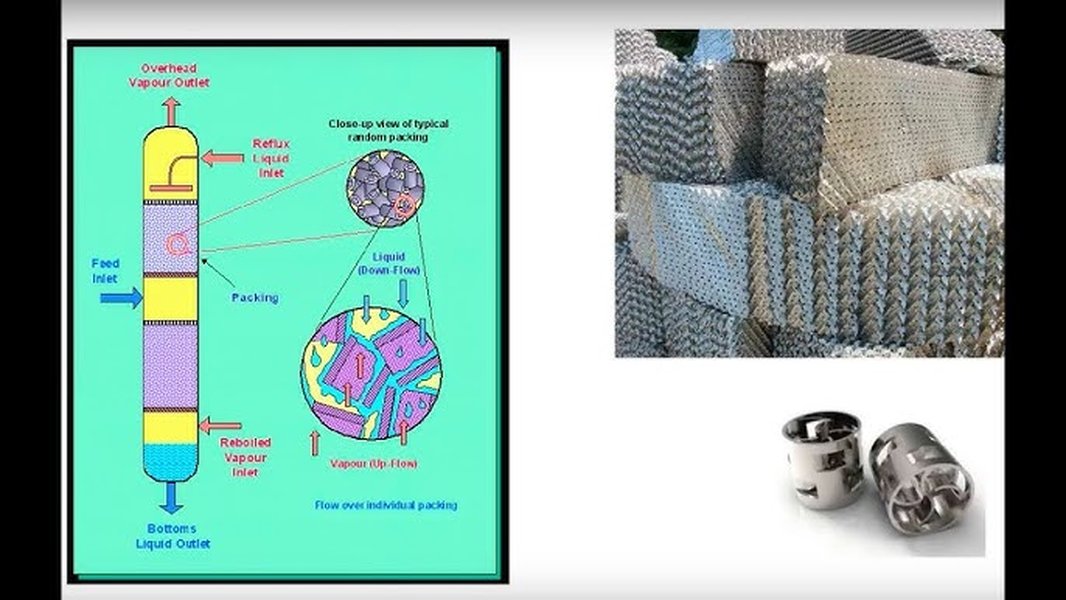
Cross-sectional view of a packed column showing the internal arrangement of random packing materials and liquid distribution system.
Key Equations for Packed Bed Column Calculations
The following table summarizes the essential equations used in packed bed column calculations:
| Parameter | Equation | Variables | Application |
|---|---|---|---|
| Pressure Drop | \[ \frac{\Delta P}{L} = 150 \frac{(1-\epsilon)^2}{\epsilon^3} \frac{\mu V_s}{D_p^2} + 1.75 \frac{(1-\epsilon)}{\epsilon^3} \frac{\rho V_s^2}{D_p} \] | ΔP = pressure drop, L = bed height, ε = void fraction, μ = viscosity, Vs = superficial velocity, Dp = particle diameter, ρ = fluid density | Applicable for all flow regimes (laminar to turbulent) |
| Column Diameter | \[ D = \sqrt{\frac{4Q}{\pi V_s}} \] | D = diameter, Q = volumetric flow rate, Vs = superficial velocity | Sizing the column based on flow rate and velocity |
| Superficial Velocity | \[ V_s = \frac{Q}{A} = \frac{Q}{\frac{\pi D^2}{4}} \] | Vs = superficial velocity, Q = volumetric flow rate, A = cross-sectional area, D = diameter | Determining flow velocity through the empty column |
| Packed Height (HETP Method) | \[ H = N_{theoretical} \times HETP \] | H = packed height, Ntheoretical = number of theoretical stages, HETP = height equivalent to a theoretical plate | Distillation and similar separation processes |
| Packed Height (NTU Method) | \[ H = NTU \times HTU \] | H = packed height, NTU = number of transfer units, HTU = height of a transfer unit | Absorption, stripping, and other mass transfer operations |
Practical Application: Design Process Demonstration
Let's examine how these calculations come together in a real-world design scenario through this detailed video explanation:
This lecture provides a comprehensive overview of packed column design principles, including the selection criteria between packed and plate columns, essential calculations, and practical design considerations that every chemical engineer should understand.
Frequently Asked Questions
References
- Pressure Drop Through a Packed Bed - Neutrium
-
Ergun Equation - ScienceDirect Topics
- Flow Through Packed Beds - University of Washington
- What Is A Random Packed Column And How To Design It - Mach Engineering
- Packed Bed Pressure Drop - CheCalc
- Essential Guide to Packed Bed Column Design - Chemical Packings
- Pressure Drop for Flow of Air Through Packed Bed
Recommended Searches
Last updated April 4, 2025