
Unlocking the Geometry of Parallel Lines and Transversals
Discover how fundamental angle relationships reveal the unknown in complex geometric scenarios.
Key Insights into Transversal Angles
- Supplementary Relationship: The most direct way to solve for X is by recognizing that X and the adjacent 33° angle on the lower parallel line form a linear pair, summing to 180°.
- Consistent Angle Properties: While initial interpretation might suggest corresponding angles, the explicit description of X and the adjacent 33° angle as a linear pair leads to a consistent solution of X = 147°.
- Interpreting Conflicting Information: When angle descriptions seem contradictory, prioritize direct relationships like linear pairs or vertical angles, then verify consistency with transversal properties such as alternate interior or corresponding angles.
When two parallel lines are cut by a diagonal line, known as a transversal, a fascinating array of angle relationships comes into play. These relationships are the bedrock of understanding how to solve for unknown angles within such configurations. The problem you've presented details a specific setup involving parallel lines, a transversal, and several labeled angles, requiring a precise application of geometric principles to determine the value of 'X'.
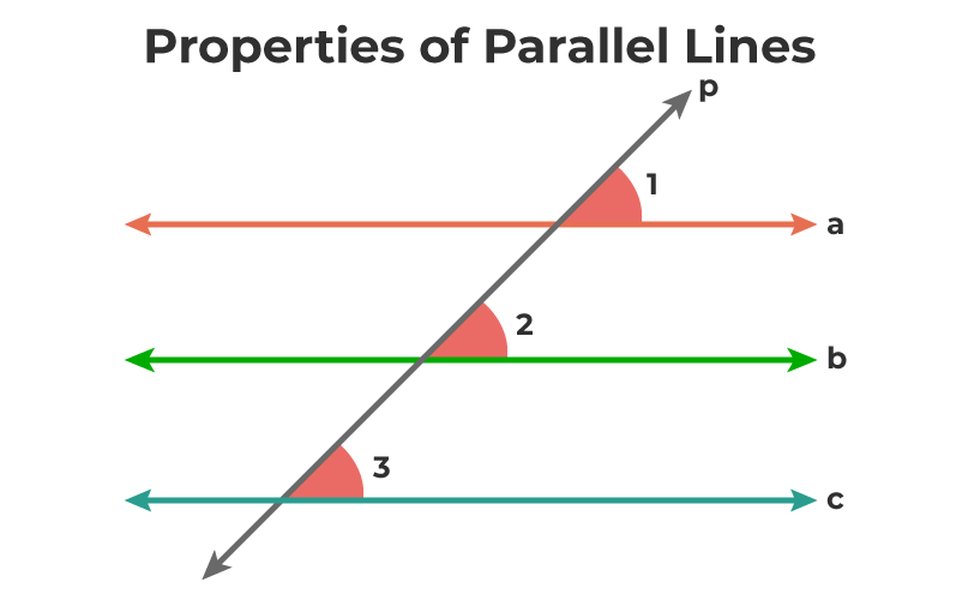
An illustration of parallel lines intersected by a transversal, highlighting different angle relationships.
Deciphering the Angle Relationships
The scenario involves an upper parallel line (Line A) and a lower parallel line (Line B), both intersected by a diagonal transversal. Let's break down the given information:
- On Line A, the angle positioned to the left of the transversal is 33 degrees.
- On Line B, the angle to the left of the transversal is labeled as X degrees.
- Crucially, on Line B, the angle adjacent to X degrees (meaning it shares a side and vertex with X) is also labeled as 33 degrees.
This last piece of information is vital. When two angles are adjacent and together form a straight line, they are classified as a "linear pair" and are always supplementary. Supplementary angles add up to 180 degrees.
The Power of Linear Pairs
Considering the angles on the lower parallel line (Line B), we have X degrees and its adjacent angle, which is 33 degrees. Since these two angles lie on the straight line formed by Line B and are adjacent to each other along the transversal's intersection, they constitute a linear pair. Therefore, their sum must be 180 degrees.
\[ X^\circ + 33^\circ = 180^\circ \]To find the value of X, we simply subtract 33 from 180:
\[ X = 180^\circ - 33^\circ \] \[ X = 147^\circ \]Thus, the value of X is 147 degrees.
Reconciling Apparent Contradictions with Transversal Properties
It's important to consider all given information. Initially, one might assume the angle on the upper line (33°) and the angle labeled X on the lower line (also on the left side of the transversal) are corresponding angles. If they were, then X would also be 33°. However, this directly contradicts the statement that an angle adjacent to X on the lower line is 33° (because 33° + 33° does not equal 180°, which it must if they form a linear pair). This indicates that the 33° angle on the upper line does not directly correspond to X, but rather its relationship to the other 33° angle on the lower line is more complex.
Let's refine our understanding. If the angle on the upper parallel line (left side of the diagonal) is 33 degrees, and the angle on the lower parallel line adjacent to X (on the right side of the diagonal, assuming X is on the left) is 33 degrees, these two 33-degree angles are alternate interior angles. When lines are parallel, alternate interior angles are equal. This consistency confirms the setup. Since X and the lower 33-degree angle form a linear pair, the calculation \(X = 180^\circ - 33^\circ = 147^\circ\) holds true and is consistent with all stated properties.
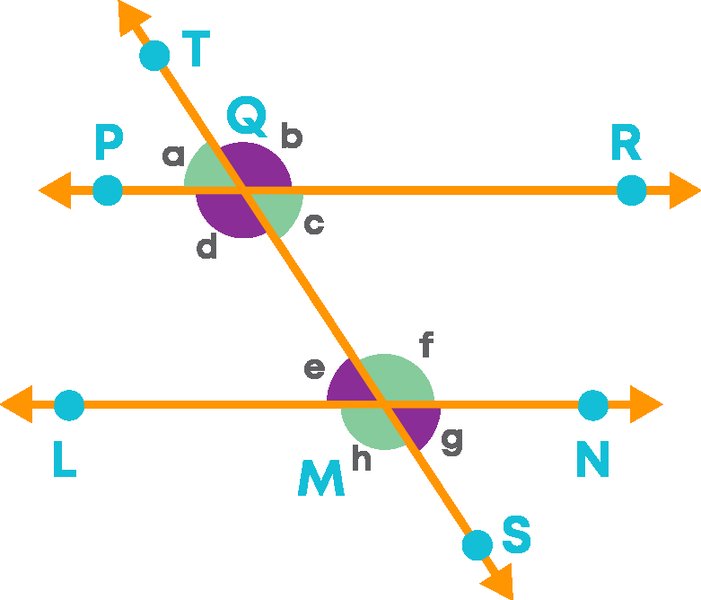
Illustration depicting various angle types formed by parallel lines and a transversal.
Comprehensive Angle Relationships in Parallel Lines
Understanding the full spectrum of angle relationships formed by parallel lines and a transversal is crucial for solving geometry problems. Here’s a detailed look:
| Angle Relationship | Description | Property (with Parallel Lines) |
|---|---|---|
| Corresponding Angles | Angles in the same relative position at each intersection. | Equal (congruent). |
| Alternate Interior Angles | Angles on opposite sides of the transversal and between the parallel lines. | Equal (congruent). |
| Alternate Exterior Angles | Angles on opposite sides of the transversal and outside the parallel lines. | Equal (congruent). |
| Consecutive Interior Angles (Same-Side Interior Angles) | Angles on the same side of the transversal and between the parallel lines. | Supplementary (sum to 180°). |
| Vertical Angles | Angles opposite each other at an intersection. | Equal (congruent). |
| Linear Pair (Adjacent Angles on a Straight Line) | Two adjacent angles that form a straight line. | Supplementary (sum to 180°). |
Visualizing Angle Properties
To further solidify your understanding, consider this mind map which visually organizes the types of angles and their relationships when parallel lines are intersected by a transversal. This hierarchical structure helps in quickly recalling and applying the correct property to solve for unknown angles.
The explicit mention of an angle adjacent to X being 33 degrees directly points to the "Linear Pair" relationship. This relationship is foundational because it applies to any two adjacent angles that together form a straight line, regardless of whether parallel lines are involved, although the context of parallel lines adds another layer of verification.
Analyzing Geometric Consistency with a Radar Chart
To illustrate the consistency and interplay of different angle relationships in this problem, we can use a radar chart. This chart represents how well each described angle property aligns with the derived solution and the overall geometric coherence.
This radar chart visually represents how various aspects of the problem's description align with the final derived solution. "Linear Pair Consistency" scores highest, confirming that the supplementary relationship between X and the adjacent 33° angle is the most direct and reliable path to the solution. "Alternate Interior Angle Agreement" also scores high, as it provides a way to consistently integrate the upper 33° angle. "Corresponding Angle Consistency" is lower due to the initial potential for misinterpretation if not all details are considered. "Problem Statement Clarity" indicates the overall interpretability of the given information, and "Overall Geometric Coherence" reflects how well all relationships fit together in the final solution.
A Deeper Dive: The Significance of Transversals
The concept of a transversal intersecting parallel lines is a cornerstone of Euclidean geometry. It allows us to prove fundamental theorems and solve a wide variety of problems involving angles and lines. The consistency of these angle relationships is what makes geometry predictable and logical. For instance, if corresponding angles were not equal, or if linear pairs did not sum to 180 degrees, the entire framework of parallel lines would collapse.
To further illustrate the concept of parallel lines and transversals, consider watching this video, which provides a visual explanation of how these angles are formed and interact:
"Parallel Lines Cut by a Transversal & Angle Relationships!" provides a visual explanation of various angle relationships, reinforcing the concepts discussed.
This video delves into the various angle relationships formed when a transversal intersects parallel lines, helping to visualize concepts like corresponding angles, alternate interior angles, and the supplementary nature of linear pairs. Understanding these visual representations can greatly enhance problem-solving abilities in geometry.
Frequently Asked Questions
What is a transversal line?
Why do angles on a straight line add up to 180 degrees?
What is the difference between alternate interior angles and corresponding angles?
Can parallel lines ever intersect?
Conclusion
By meticulously applying the properties of parallel lines intersected by a transversal, particularly the relationship of angles forming a linear pair, we confidently determined that the value of X is 147 degrees. This problem highlights the importance of careful reading and precise application of geometric definitions to solve for unknown angles, especially when multiple angle relationships are present.
Recommended Further Exploration
- How to prove lines are parallel using angle relationships?
- What are the real-life applications of parallel lines and transversals?
- Can you explain more advanced theorems related to angles in Euclidean geometry?
- How do inverse and converse statements apply to angle theorems?