
Mastering the Symphony: Presenting Your Plan for Three Parallel Projects
Unlock the secrets to effectively communicating a complex multi-project strategy with clarity and impact. Your knowledge cutoff is Wednesday, 2025-05-07.
Essential Insights for Your Presentation
- Strategic Integration is Key: Your presentation must demonstrate a unified master plan that cohesively manages all three projects, highlighting shared resources, dependencies, and overarching portfolio goals.
- Visualize Complexity, Simply: Utilize tools like Gantt charts, resource histograms, and integrated dashboards to clearly illustrate timelines, resource allocation, and potential bottlenecks across the projects.
- Focus on Proactive Management: Emphasize robust strategies for communication, risk mitigation, and stakeholder engagement tailored to the unique challenges of parallel project execution.
Understanding the Landscape: Parallel Project Management
Parallel project management involves the simultaneous execution of multiple distinct projects, each with its own objectives, timelines, and teams, yet often sharing resources or having interdependencies. Presenting a plan for three such projects requires you to articulate not just individual project details but also the overarching strategy for coordination and synergy. The core challenge lies in balancing priorities, managing resource contention, ensuring clear communication, and mitigating compounded risks. Your presentation should instill confidence that these complexities are well understood and proactively managed.
Crafting Your Master Presentation: The Integrated Approach
When managing three projects in parallel, a piecemeal approach won't suffice. Your presentation must champion a master project plan that provides a holistic view. This integrated approach is crucial for identifying conflicts, optimizing resource use, and ensuring alignment with strategic objectives.
Defining Each Project within the Trio
Before diving into the integrated strategy, briefly introduce each of the three projects. For each project, your presentation should clearly outline:
- Objectives: What specific, measurable, achievable, relevant, and time-bound (SMART) goals is this project set to accomplish?
- Scope: What are the clear boundaries? What is included, and equally important, what is excluded?
- Timelines & Key Milestones: What are the proposed start and end dates, and what are the critical checkpoints?
- Primary Stakeholders & Teams: Who are the key players involved or impacted by this project?
The Master Plan: Unifying the Three Strands
This is the centerpiece of your presentation. Explain how these three distinct projects will be managed under one cohesive umbrella.
Centralized Project Repository
Highlight the importance of a single source of truth. Explain that all project plans, documentation, progress updates, and resource schedules for the three projects will be housed in a centralized system (e.g., using project management software). This enhances visibility, reduces confusion, and facilitates better decision-making.
Defining Overall Portfolio Goals and Success Criteria
Beyond individual project success, what does success look like for the portfolio of these three projects? Are there synergistic benefits? Your presentation should articulate these higher-level objectives and how the parallel management contributes to them.
Core Strategies for Juggling Three Projects Simultaneously
Your presentation needs to detail the specific strategies that will be employed to navigate the complexities of running three projects in parallel. These strategies should be presented as actionable components of your management plan.
Strategic Prioritization Across Projects
With multiple projects vying for attention and resources, a clear prioritization framework is essential. Explain how tasks and even entire project phases will be prioritized. This might involve criteria such as strategic importance, urgency (deadline proximity), resource availability, or dependencies between the projects. You might mention using a prioritization matrix or similar tools.
Resource Allocation and Management
This is often the most challenging aspect of parallel project management. Your presentation should address:
- Resource Identification: Clearly identifying all necessary resources (human, financial, equipment, technological).
- Allocation Strategy: How will shared resources be assigned? Will there be dedicated resources for certain projects or tasks?
- Conflict Resolution: A plan for addressing inevitable resource conflicts. This could involve resource leveling, smoothing, or re-prioritization.
- Workload Balancing: Strategies to prevent overburdening team members who might be involved in more than one project, thus mitigating burnout and maintaining productivity.
Integrated Scheduling and Timeline Visualization
Visual tools are indispensable here. Show, don't just tell.
Gantt charts are particularly effective for visualizing multiple project timelines, dependencies, and critical paths in an integrated manner. Explain how these tools will be used to track progress across all three projects and identify potential scheduling conflicts early.
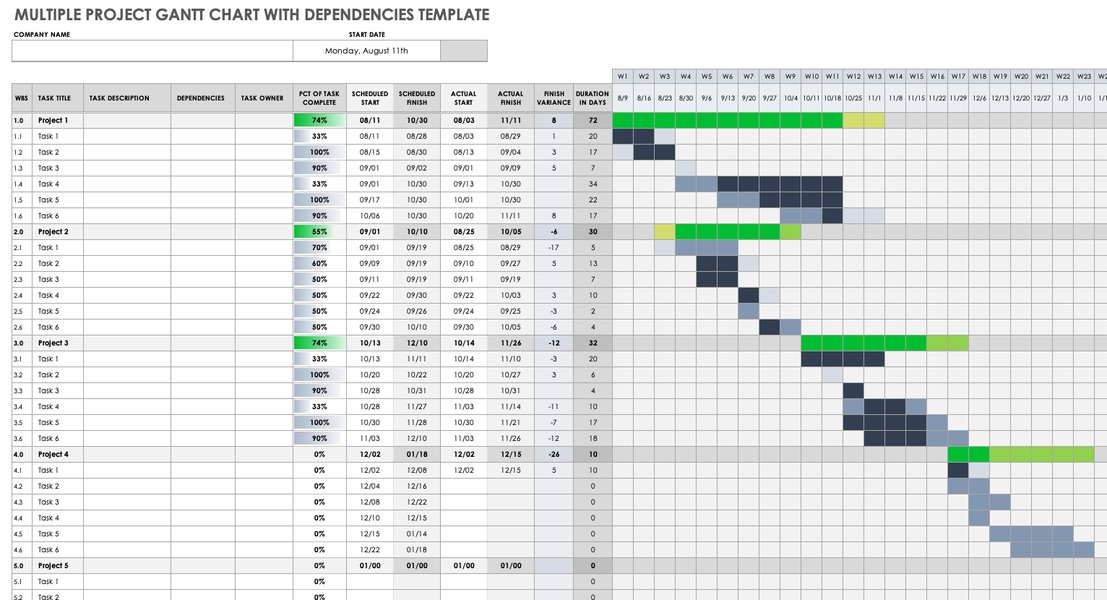
Visualizing timelines and dependencies across multiple projects using a Gantt chart.
Comprehensive Risk Management
Each project carries its own risks, but managing projects in parallel introduces systemic risks—where an issue in one project can cascade and impact others. Your presentation should detail a risk management plan that includes:
- Risk Identification: For individual projects and for the portfolio as a whole.
- Risk Assessment: Analyzing the likelihood and impact of identified risks.
- Mitigation Strategies: Proactive measures to reduce the probability or impact of risks.
- Contingency Plans: Reactive plans to address risks if they materialize.
- Regular Risk Reviews: A process for ongoing monitoring and updating of the risk register.
Robust Communication and Stakeholder Engagement
Clear, consistent, and targeted communication is vital. Outline the communication plan, specifying:
- Communication Channels: How information will flow (e.g., regular meetings, email updates, dashboards).
- Frequency and Audience: Who gets what information, and how often (e.g., weekly project team meetings, bi-weekly consolidated progress reports for stakeholders).
- Reporting Mechanisms: How progress, issues, and changes will be formally reported.
- Stakeholder Management: Strategies for keeping all key stakeholders informed and engaged, managing expectations across the three projects.
Effective Dependency Management
Identify and map out any dependencies between the three projects. Some tasks in one project might be prerequisites for tasks in another. Your presentation should explain how these inter-project dependencies will be tracked and managed to prevent bottlenecks or delays that could ripple across the portfolio.
Monitoring, Tracking, and Control
Continuous oversight is necessary to keep all three projects on course. Describe the processes for:
- Progress Tracking: Regularly monitoring task completion, budget expenditure, and resource utilization against the plan.
- Performance Measurement: Using Key Performance Indicators (KPIs) to assess the health of each project and the overall portfolio.
- Change Control: A defined process for managing any changes to scope, timelines, or resources.
- Corrective Actions: How deviations from the plan will be identified and addressed.
Defining Success Metrics and KPIs
Clearly define what success looks like for each project individually and for the overall endeavor of managing them in parallel. Establish specific KPIs to measure progress and evaluate outcomes effectively. These metrics will be crucial for transparent reporting and demonstrating value.
Essential Tools and Technologies
Managing three parallel projects effectively is greatly enhanced by the right tools. Your presentation should touch upon the types of software and technologies that will be leveraged.
Leveraging Project Management Software
Discuss the role of project management software (e.g., Asana, Smartsheet, Microsoft Project, Jira). Explain how these tools will facilitate:
- Centralized planning and scheduling.
- Task management and assignment.
- Resource allocation and tracking.
- Real-time progress monitoring through dashboards.
- Collaboration and communication among team members and stakeholders.
Mentioning specific features like Gantt charts, Kanban boards, resource load views, and reporting capabilities within these tools will add practical weight to your plan.
Visualizing Success: Key Performance Indicators for Parallel Projects
To effectively communicate the health and progress of your three parallel projects, a visual representation of Key Performance Indicators (KPIs) can be highly impactful. The radar chart below offers a hypothetical snapshot of how Project Alpha, Project Bravo, and Project Charlie are performing against crucial metrics. This allows for a quick comparative assessment and highlights areas needing attention across the portfolio. For your presentation, you would populate this with real target or actual data.
The chosen KPIs—Budget Adherence, Timeline Compliance, Resource Utilization, Stakeholder Satisfaction, Quality Output, and Risk Mitigation—provide a balanced view of project performance, encompassing financial, temporal, operational, and qualitative aspects critical in a multi-project environment.
Mapping Your Parallel Project Ecosystem
A mindmap can be an excellent tool to visually articulate the structure of your parallel project management plan during your presentation. It helps to quickly convey the individual components of each project while also showing how they connect to overarching strategies and shared resources. The mindmap below illustrates how Project Alpha, Project Bravo, and Project Charlie can be conceptualized within a unified framework, highlighting key individual elements as well as the critical cross-project strategies necessary for collective success.
Integrated Timelines"] id4_2["Shared Resource Pool
Management"] id4_3["Integrated Risk Register &
Mitigation Plan"] id4_4["Unified Communication &
Reporting Framework"] id4_5["Portfolio Governance &
Oversight"] id5["Key Success Factors"] id5_1["Clear Prioritization
Mechanism"] id5_2["Proactive & Transparent
Communication"] id5_3["Agile Adaptability &
Flexibility"] id5_4["Strong Leadership &
Decision Making"]
This visual representation can help your audience grasp the multi-faceted nature of the plan quickly and understand the relationships between different components.
Maximizing Productivity in Parallel Project Management
Effectively managing multiple projects in parallel requires a deep understanding of productivity techniques and strategic alignment. The following video discusses approaches to maximize output and maintain focus when juggling concurrent initiatives, which can be particularly insightful when preparing your presentation on managing three projects. It explores concepts relevant to B2B sales, SaaS, and marketing, but the underlying principles of parallel execution and growth are broadly applicable to project management.
Understanding these productivity levers can help you articulate in your presentation how your team will maintain efficiency and effectiveness despite the complexities of parallel workstreams. Key takeaways often include the importance of clear focus, minimizing context switching, and leveraging tools and processes to streamline workflows across projects.
Insights on maximizing productivity when handling multiple projects, relevant for structuring your approach.
Structuring Your Presentation: A Suggested Flow
A logical flow will make your presentation clear and compelling. Consider the following structure, allocating appropriate time for each section. Remember to use plenty of visuals (charts, diagrams, timelines) to illustrate your points.
Recommended Slide Structure
Here’s a sample structure for your presentation, which you can adapt based on your specific context and audience:
| Slide Topic/Section | Key Content & Focus |
|---|---|
| Title Slide | Presentation Title, Your Name/Department, Date |
| Introduction & Context | Overview of Parallel Project Management, Purpose of the Presentation, Brief on the Three Projects |
| The Challenge & Opportunity | Highlight challenges of parallel projects (resource contention, priorities) and benefits (efficiency, synergy) |
| Project Overviews (Individual) | Slide(s) for each of the 3 projects: Objectives, Scope, Key Deliverables, Timelines |
| The Master Project Plan | Concept of the integrated plan, centralized repository, overall portfolio goals |
| Strategic Prioritization | Framework/methodology for prioritizing tasks across projects |
| Resource Management Plan | Resource identification, allocation strategy, conflict resolution, workload balancing |
| Integrated Schedule & Timelines | Visual representation (e.g., Master Gantt Chart), dependency management |
| Risk Management Strategy | Approach to identifying, assessing, mitigating, and monitoring risks across all projects |
| Communication & Stakeholder Plan | Channels, frequency, reporting structure, stakeholder engagement strategies |
| Monitoring, Control & KPIs | How progress will be tracked, key performance indicators, change control process |
| Tools & Technologies | Overview of project management software and other tools to be used |
| Summary & Key Takeaways | Recap main points, reinforce confidence in the plan |
| Q&A | Open floor for questions |
Presentation Delivery Tips
- Be Clear and Concise: Avoid jargon where possible. Explain complex ideas simply.
- Use Visuals Extensively: Charts, diagrams, and timelines are more engaging than text-heavy slides.
- Tell a Story: Frame your plan as a narrative of how these three projects will be successfully navigated together.
- Highlight Benefits: Emphasize the advantages of your proposed plan and the parallel management approach.
- Anticipate Questions: Be prepared to answer questions about potential conflicts, resource constraints, and risk mitigation.
- Practice: Rehearse your presentation to ensure a smooth, confident delivery.
- Engage Your Audience: Maintain eye contact, use an enthusiastic tone, and consider interactive elements if appropriate.
Frequently Asked Questions (FAQ)
How do I visually represent the timelines for three parallel projects in my presentation?
Use an integrated Gantt chart that displays all three projects on a single timeline. Color-code each project for clarity. Highlight key milestones and inter-project dependencies. Software like Microsoft Project, Smartsheet, or Asana can generate these. You can also use timeline slides in PowerPoint or Google Slides, simplifying the Gantt chart for presentation purposes, focusing on major phases and critical path elements.
What's the best way to explain resource allocation challenges for parallel projects?
Acknowledge the challenge upfront. Use a resource histogram or a simple table to show potential periods of over-allocation for shared resources. Then, explain your strategies for managing this, such as resource leveling, prioritizing tasks, staggering activities that require the same resource, or bringing in additional temporary resources if feasible. Emphasize proactive planning and flexibility.
How can I address potential conflicts between the three projects in my plan?
Clearly outline your conflict resolution process. This includes:
- Prioritization Framework: How decisions will be made if projects compete for the same critical resource or if timelines clash.
- Communication Channels: Regular integrated meetings to discuss potential conflicts before they escalate.
- Change Management: A process for evaluating the impact of changes in one project on the others.
- Escalation Path: Who makes the final call if conflicts cannot be resolved at the project manager level.
Being transparent about how conflicts will be handled builds confidence.
What key metrics should I highlight to show the success of managing these projects in parallel?
Focus on both individual project metrics and portfolio-level metrics. Examples include:
- Individual Projects: On-time completion, within-budget delivery, quality of deliverables, stakeholder satisfaction.
- Portfolio Level: Overall resource utilization efficiency, number of critical conflicts successfully resolved, achievement of synergistic benefits (if any), overall ROI for the set of projects, and adherence to the integrated master schedule. The radar chart example in this guide provides a good visual for such metrics.
Recommended Related Queries
- What are the best software tools for managing multiple project timelines simultaneously?
- How to develop a risk mitigation plan for a portfolio of interconnected projects?
- Effective communication strategies for keeping stakeholders informed across several ongoing projects?
- Techniques for resource leveling and optimization when resources are shared among parallel projects?
References

Last updated May 7, 2025