

- Passive Voice: Focuses on the recipient or the action itself, shifting emphasis away from the doer, particularly useful when the actor is unknown, unimportant, or intentionally de-emphasized.
- Past Tenses: Define the timing of actions or states, indicating when events occurred relative to the present moment or other past events, crucial for clear chronological narration.
- Interconnected but Distinct: While passive voice describes sentence structure and past tenses convey timing, they are not mutually exclusive; a sentence can be both passive and in a past tense, offering nuanced expression.
In the vast landscape of the English language, two fundamental grammatical concepts often lead to confusion: passive voice and past tenses. Though they both deal with verbs and how actions are conveyed, they serve distinct purposes and operate on different linguistic levels. Understanding their individual functions, key characteristics, and appropriate usage is paramount for effective and precise communication. This comprehensive guide will dissect passive voice and various past tenses, illuminating their differences, explaining their necessity, identifying their trigger words, and outlining how and when to employ them effectively.
Delving into the Passive Voice: Shifting the Spotlight
The passive voice is a grammatical construction where the subject of a sentence receives the action of the verb rather than performing it. This fundamentally alters the focus of the sentence, redirecting attention from the agent (the one doing the action) to the recipient of the action or the action itself. It offers a powerful way to control emphasis and convey information strategically.
The Mechanics of Passive Construction
The structure of a passive sentence consistently involves a form of the verb "to be" followed by the past participle of the main verb. For example, in the active sentence "The pitcher threw the ball," the pitcher is the doer. In the passive equivalent, "The ball was thrown by the pitcher," "the ball" (the recipient) becomes the subject, and "was thrown" is the passive verb construction. The original doer, "the pitcher," can be included in a "by" phrase, but it is often omitted entirely, especially when the agent is unknown, irrelevant, or purposefully left unstated.

An illustration demonstrating the transformation from active to passive voice, emphasizing the change in grammatical focus.
Key Characteristics and Signals of Passive Voice
- Structure: Always employs a form of "to be" (e.g., am, is, are, was, were, be, being, been) immediately followed by the past participle of the main verb (e.g., cooked, eaten, designed).
- Focus Shift: Prioritizes the action's result or the entity experiencing the action.
- Optional Agent: The performer of the action can be introduced using the prepositional phrase "by + agent," but this is frequently omitted.
- Trigger Words: Look for "to be" forms combined with past participles.
When and Why to Embrace the Passive Voice
While active voice is generally preferred for its directness and clarity, the passive voice serves specific, important functions:
- Unknown or Unimportant Agent: When the performer of the action is unknown ("My car was stolen.") or irrelevant ("The building was constructed in 1985."), the passive voice is ideal.
- Emphasis on the Recipient or Action: If the focus should be on what happened or who/what was affected, not who did it ("Insulin was discovered in 1921.").
- Formality and Objectivity: It is prevalent in scientific writing, legal documents, news reports, and other formal contexts where objectivity and impersonality are desired ("The experiment was conducted with great care.").
- Avoiding Blame or Being Diplomatic: When discretion is needed, the passive voice can soften a statement or avoid assigning direct responsibility ("Mistakes were made.").
Consider this example to solidify understanding:
    // Active Voice (Focus on the doer)
    const activeSentence = "The committee approved the proposal.";

    // Passive Voice (Focus on the action/recipient)
    const passiveSentence = "The proposal was approved by the committee.";
    // Or, if the committee is less important:
    const concisePassive = "The proposal was approved.";
Understanding Past Tenses: Navigating the Timeline of Events
Past tenses are verb forms that specifically indicate that an action or state occurred or existed at some point before the present moment. English possesses a rich array of past tenses, each conveying subtle but important nuances about the timing, duration, and completion of past events.
The Four Pillars of Past Tenses
To accurately describe events in the past, it's essential to differentiate between the four primary past tenses:

Flashcards illustrating action verbs, foundational for grasping tense variations.
1. Simple Past Tense
- What it is: Describes actions or states that began and ended at a specific point in the past.
- Formation: For regular verbs, add "-ed" to the base form (e.g., walked, played). Irregular verbs have unique forms (e.g., went, saw).
- Key Signals: Time markers like yesterday, last week/month/year, in 2010, ago.
- Usage: To recount completed actions, sequences of past events, or past habits.
- Example: "She visited Paris last year."
2. Past Continuous (Progressive) Tense
- What it is: Describes actions that were in progress at a specific time in the past, often interrupted by another event.
- Formation: Was/were + verb-ing.
- Key Signals: Often used with while, when, as to show an ongoing action.
- Usage: To set a scene, describe background actions, or show an action that was interrupted.
- Example: "She was visiting Paris when it rained."
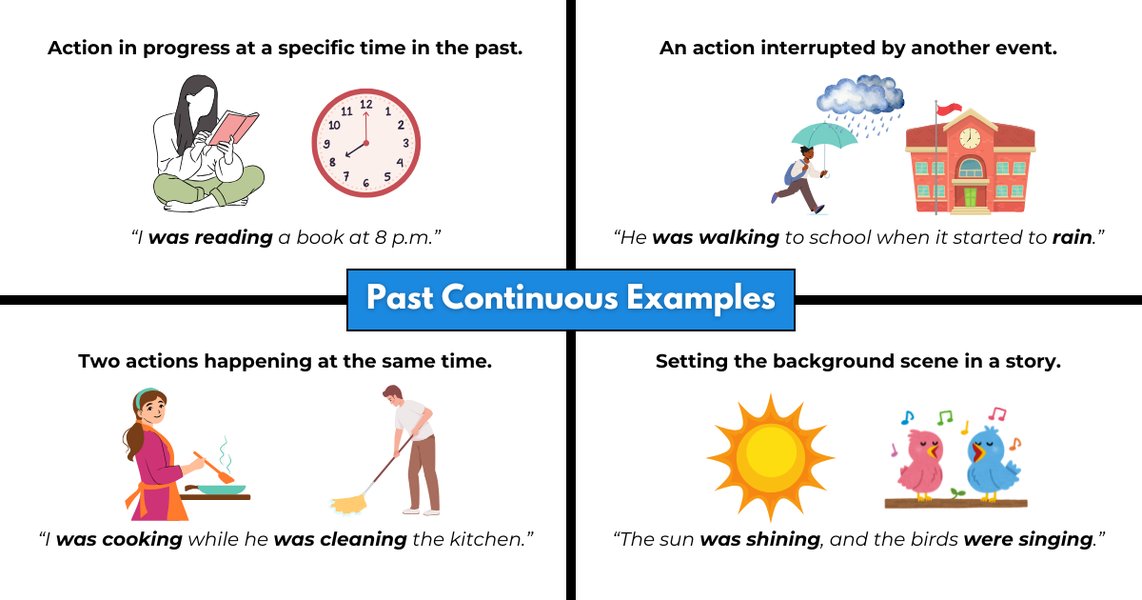
Visual examples demonstrating the usage and structure of the past continuous tense.
3. Past Perfect Tense
- What it is: Refers to an action that was completed before another action or event in the past.
- Formation: Had + past participle.
- Key Signals: Often used with by the time, before, after to establish a sequence of past events.
- Usage: To clarify the order of past events, indicating which action happened "first of the past."
- Example: "She had visited Paris before she moved to London."
4. Past Perfect Continuous Tense
- What it is: Emphasizes the duration of an action that was ongoing up to another specific point or action in the past.
- Formation: Had been + verb-ing.
- Key Signals: Often accompanied by for, since to highlight duration.
- Usage: To explain the cause of a past event or to emphasize how long an action had been occurring before another past event.
- Example: "She had been visiting Paris for weeks before the rain started."
The Interplay: Differences and Overlaps
It's crucial to understand that passive voice and past tenses are not opposing concepts; rather, they operate on different axes of grammar. Passive voice is about the structure and focus of a sentence (who is doing/receiving the action), whereas past tenses are about the timing of the action (when it happened).
A Clear Distinction
The key difference is functional: passive voice alters the grammatical roles within a sentence, shifting the subject from the performer to the receiver of the action. Past tenses, on the other hand, anchor an action in time, specifying whether it was a completed event, an ongoing process, or an event that preceded another past event. A sentence can simultaneously be in the passive voice and in any of the past tenses, such as "The house was built in 2020" (passive, simple past) or "The report had been written by then" (passive, past perfect).
To further illustrate the distinct roles, let's look at a comparative table:
| Feature | Passive Voice | Past Tenses |
|---|---|---|
| Primary Function | Shifts focus to the action's recipient or the action itself. | Indicates when an action or state occurred in the past. |
| Grammatical Structure | Form of "to be" + past participle. | Verb forms that reflect specific past timings (e.g., -ed, was/were + -ing, had + P.P.). |
| Emphasis | Result, object, or action; downplays or omits the agent. | Chronology, duration, or completion relative to other past events. |
| Key Question Answered | What was done/received? / What happened to something/someone? | When did it happen? / How long was it happening? / What happened before this? |
| Can Combine With | Any tense (present, past, future, perfect forms). | Both active and passive voices. |
The "Why" Behind Their Existence
Both passive voice and past tenses are indispensable for the richness and precision of English:
- Passive Voice: Provides flexibility in sentence construction, allowing writers to strategically highlight certain information, maintain objectivity, or avoid unnecessary details. Without it, conveying situations with unknown agents or emphasizing results over performers would be awkward and less effective.
- Past Tenses: Are absolutely essential for storytelling, historical accounts, and any narrative that requires sequencing events. They allow speakers and writers to create clear timelines, distinguish between simultaneous and sequential actions, and convey precise information about the duration and completion of past events. Without the nuanced past tenses, narratives would lack temporal depth and accuracy, leading to confusion.
Navigating Usage: How and When to Apply Them
Effective communication hinges not just on knowing what these grammatical tools are, but also on mastering their application.
How to Form the Passive Voice:
- Identify the object in an active sentence.
- Make this object the new subject of your passive sentence.
- Add the appropriate form of the verb "to be" (matching the original tense) followed by the past participle of the main verb.
- (Optional) If the agent is important, add "by" followed by the original subject.
Example: Active: "Someone stole my phone." → Passive: "My phone was stolen."
When to Use the Passive Voice:
- When the performer of the action is unknown, unimportant, or obvious ("The cave paintings were made in the Stone Age.").
- To emphasize the action itself or its recipient over the doer ("The vaccine is being developed rapidly.").
- In formal, scientific, or technical writing to maintain an objective tone and avoid personal pronouns ("The data were collected over a period of three months.").
- To politely or indirectly convey information ("The invoice must be paid by the 15th.").
Conversely, avoid overuse of the passive voice in general writing, especially when directness and clarity are paramount, as it can sometimes make writing sound vague or evasive.
Mastering Past Tenses for Narrative Clarity
Choosing the correct past tense depends entirely on the specific temporal relationship you wish to convey between events.
How to Choose and Use Past Tenses:
- Simple Past: For discrete actions completed at a definite time in the past. Use it for narrative sequences ("He woke up, ate breakfast, and left for work.").
- Past Continuous: For ongoing actions in the past, especially when they were interrupted or served as background to another event ("While she was reading, the phone rang.").
- Past Perfect: To show an action that happened before another past action, establishing a clear sequence ("By the time he arrived, the guests had already eaten.").
- Past Perfect Continuous: To emphasize the duration of an action that continued up to a specific point in the past ("They had been waiting for hours when the bus finally arrived.").
The ability to skillfully combine these tenses is crucial for creating rich, detailed, and chronologically accurate narratives.
This mindmap visually organizes the core concepts of passive voice and past tenses, highlighting their individual structures, functions, trigger words, and the distinctions that set them apart, while also showing how they can interact.
Understanding Passive Voice Across Tenses
It is important to remember that passive voice can be applied across different tenses, including all the past tenses. This fusion allows for highly specific and nuanced communication, combining the focus shift of the passive voice with the temporal precision of the tenses.
This video from BBC Learning English provides an excellent explanation of present and past passives, helping to clarify how the passive voice integrates with different tenses to shape meaning. It’s particularly relevant as it demonstrates the practical application of these concepts in real-world English.
Frequently Asked Questions
What is the primary difference between passive voice and past tenses?
When should I use the passive voice?
Why are there multiple past tenses?
Can active voice sentences be in a past tense?
What are some key indicators for identifying the passive voice?
Conclusion
Mastering the distinction and appropriate application of passive voice and past tenses is a hallmark of sophisticated English communication. While passive voice offers a valuable tool for controlling focus and tone, particularly in formal and objective contexts, the diverse array of past tenses provides the essential framework for constructing precise and coherent narratives. By understanding when to emphasize the action's recipient and when to meticulously detail the timing of events, speakers and writers can wield the English language with greater accuracy, impact, and nuance.
Recommended Further Exploration
- How to avoid overusing the passive voice in academic writing?
- Advanced techniques for sequencing events with past perfect and past continuous
- The role of verb tenses in literary analysis and storytelling
- Practical exercises for converting active to passive voice and vice-versa