
Unlocking the Potential of PEDOT:PSS: A Deep Dive into Conductive Polymer Applications
Exploring PEDOT:PSS: From Conductivity Enhancement to Neural Probe Fabrication
As an expert in materials science, neural probes, and neural implantation research, I will provide a detailed overview of Poly(3,4-ethylenedioxythiophene) polystyrene sulfonate (PEDOT:PSS), its conductivity properties, related materials, and thin-film deposition methods, with a focus on neural probe fabrication and skin/tissue contact applications.
Key Highlights of PEDOT:PSS in Bioelectronics
- Enhanced Conductivity: PEDOT:PSS conductivity can be significantly improved through various methods, including solvent doping and acid treatments, making it suitable for advanced electronic applications.
- Versatile Deposition Techniques: Thin films of PEDOT:PSS can be deposited using several methods, such as spin coating, inkjet printing, and spray coating, each offering unique advantages for different applications.
- Biocompatibility and Flexibility: PEDOT:PSS's inherent flexibility and potential for biocompatibility make it ideal for neural probes, skin contact electrodes, and other biomedical devices.
Understanding PEDOT:PSS: Composition, Properties, and Significance
Poly(3,4-ethylenedioxythiophene) polystyrene sulfonate (PEDOT:PSS) is a widely used conductive polymer composite known for its unique blend of properties that make it suitable for various applications, especially in organic electronics and bioelectronics. It consists of two main components:
- PEDOT (Poly(3,4-ethylenedioxythiophene)): This is the conductive component that provides electrical conductivity due to its conjugated polymer structure.
- PSS (Polystyrene Sulfonate): This acts as a counter-ion to balance the charge of PEDOT and also enhances the water solubility and processability of the composite material.
PEDOT:PSS is attractive because it is processable from aqueous solutions, making it easy to deposit thin films using various techniques. It also exhibits good environmental stability and optical transparency, which are crucial for applications such as transparent electrodes in solar cells and displays. The balance between PEDOT and PSS is critical, as excess PSS can reduce the conductivity by hindering the structural order of PEDOT.
Enhancing Electrical Conductivity of PEDOT:PSS
The electrical conductivity of PEDOT:PSS is a key factor determining its performance in electronic devices. Pristine PEDOT:PSS typically has moderate conductivity, but several methods can enhance this property:
- Solvent Doping: Adding polar solvents like dimethyl sulfoxide (DMSO), ethylene glycol (EG), or dimethylformamide (DMF) can significantly increase conductivity. These solvents help to modify the crystalline structure of PEDOT:PSS, reducing the inter-lamellar and π-π stacking distances, which facilitates better charge transport.
- Acid Treatment: Treating PEDOT:PSS films with acids such as sulfuric acid (H2SO4) or nitric acid (HNO3) can also enhance conductivity. Acid treatment promotes a more regular arrangement of PEDOT chains and reduces the insulating PSS content, leading to higher conductivity. For instance, HNO3 and CsCl sequential post-treatment can enhance the electrical conductivity of PEDOT:PSS films to over 5500 S/cm.
- Surfactants and Additives: Incorporating surfactants like Tween 80 can improve the wetting properties and reduce sheet resistance. Other additives, such as hydroquinone (HQ), can promote phase separation between PEDOT and PSS, forming contiguous conductive channels.
Alternatives and Related Conductive Materials
While PEDOT:PSS is widely used, several alternative materials and composites offer comparable or enhanced properties for specific applications:
- Graphene and Carbon Nanotubes (CNTs): These materials offer high conductivity and mechanical strength. Composites of PEDOT:PSS with graphene or CNTs can leverage the advantages of both materials.
- Metal Nanoparticles: Doping PEDOT:PSS with metal nanoparticles like silver (Ag) can enhance conductivity and improve optical properties.
- Conductive Inks: These are formulations of conductive materials in a printable form, often used in flexible electronics. Examples include silver nanoparticle inks and other polymer-based conductive inks.
Thin Film Deposition Methods for PEDOT:PSS
The method used to deposit PEDOT:PSS thin films significantly affects their properties and performance. Several techniques are available, each with its advantages and limitations.
Common Deposition Techniques
- Spin Coating: This is one of the most widely used methods for depositing thin films. It involves dispensing PEDOT:PSS solution onto a substrate, which is then rapidly rotated. The centrifugal force spreads the solution, creating a uniform thin film.
- Advantages: Simplicity, scalability, and ability to produce uniform films over large areas.
- Disadvantages: High material waste and limited control over film thickness for complex structures.
- Dip Coating: This method involves immersing a substrate into a PEDOT:PSS solution and then withdrawing it at a controlled speed. The solution coats the substrate, and as the solvent evaporates, a thin film is formed.
- Advantages: Cost-effective and simple, requiring minimal equipment.
- Disadvantages: Achieving uniform films can be challenging, and the process is sensitive to environmental conditions.
- Spray Coating: In this technique, PEDOT:PSS solution is atomized into a spray and deposited onto a substrate.
- Advantages: Suitable for large area coating and can be used on flexible substrates.
- Disadvantages: Achieving uniform films can be challenging, and the process may require optimization of spray parameters.
- Inkjet Printing: This method involves depositing PEDOT:PSS solution as tiny droplets onto a substrate in a predefined pattern.
- Advantages: Precise material deposition, minimal material waste, and ability to create complex patterns.
- Disadvantages: Requires careful ink formulation and optimization of printing parameters.
Factors Influencing Film Thickness and Uniformity
Several factors influence the thickness and uniformity of PEDOT:PSS thin films, regardless of the deposition method used:
- Solution Concentration: Higher concentrations generally lead to thicker films.
- Solution Viscosity: More viscous solutions tend to form thicker films.
- Substrate Surface Energy: Surface treatments can modify the substrate's surface energy, affecting the wetting and spreading of the PEDOT:PSS solution.
- Environmental Conditions: Temperature and humidity can affect the evaporation rate of the solvent and the final film properties.
Curing Conditions
Curing conditions, such as annealing temperature and duration, play a crucial role in determining the final properties of PEDOT:PSS films. Annealing can improve the electrical conductivity and structural integrity of the film by promoting better ordering of the PEDOT chains and removing residual solvents.
- Thermal Annealing: Heating the film to a specific temperature can enhance conductivity and remove residual water.
- Solvent Annealing: Exposing the film to solvent vapors can also improve its properties by promoting structural reorganization.
Deposition Method for Neural Probe Fabrication and Skin/Tissue Contact Applications
For neural probe fabrication and skin/tissue contact applications, the choice of deposition method is critical due to the need for precise control over film properties and biocompatibility. Considering the requirements, spin coating and inkjet printing are particularly suitable.
Spin Coating for Neural Probes
Spin coating is a reliable method for creating uniform thin films on planar substrates. For neural probes, this can be beneficial for coating the electrode sites with PEDOT:PSS to reduce impedance and improve signal quality.
- Process:
- The PEDOT:PSS solution is applied to the probe substrate.
- The substrate is spun at a controlled speed to spread the solution evenly.
- The film is then dried and annealed to improve its conductivity and stability.
- Advantages:
- High uniformity.
- Scalability for batch production.
- Considerations:
- Material waste.
- Potential need for masking to coat specific areas of the probe.
Inkjet Printing for Skin/Tissue Contact Electrodes
Inkjet printing offers precise deposition of PEDOT:PSS, making it suitable for creating patterned electrodes on flexible substrates for skin contact applications. This method allows for the creation of customized electrode designs with minimal material waste.
- Process:
- The PEDOT:PSS solution is formulated into an ink with appropriate viscosity and surface tension.
- The ink is then printed onto the substrate using an inkjet printer, creating the desired electrode pattern.
- The printed film is dried and annealed to enhance its conductivity and adhesion.
- Advantages:
- High precision and pattern flexibility.
- Minimal material waste.
- Considerations:
- Ink formulation is critical.
- Printing speed may be slower compared to spin coating.
Achieving Optimal Film Thickness and Properties
To achieve the desired film thickness and properties, several parameters need to be optimized:
- For Spin Coating:
- Spin speed.
- Solution concentration.
- Annealing temperature and duration.
- For Inkjet Printing:
-
Ink viscosity and surface tension.
-
Droplet spacing and printing speed.
-
Substrate temperature.
-
Table of PEDOT:PSS Deposition Techniques
A comparative overview of the different thin film deposition techniques for PEDOT:PSS, highlighting their key features, advantages, and disadvantages.
| Deposition Technique | Description | Advantages | Disadvantages | Suitable Applications |
|---|---|---|---|---|
| Spin Coating | Dispensing solution onto a rotating substrate | Simple, scalable, uniform films | High material waste, limited control for complex structures | General thin film deposition, neural probe coating |
| Dip Coating | Immersing substrate in solution and withdrawing | Cost-effective, simple | Difficult to achieve uniform films, sensitive to environment | Basic thin film coating |
| Spray Coating | Atomizing solution onto substrate | Large area coating, suitable for flexible substrates | Challenging to achieve uniform films | Large area electronics |
| Inkjet Printing | Depositing solution as droplets in a pattern | Precise deposition, minimal waste, complex patterns | Requires ink formulation, slower printing speed | Patterned electrodes, flexible electronics |
Visualizing PEDOT:PSS Applications in Flexible Electronics
PEDOT:PSS's unique properties make it ideal for various applications, including flexible and stretchable electronics. The images below showcase some of these applications.
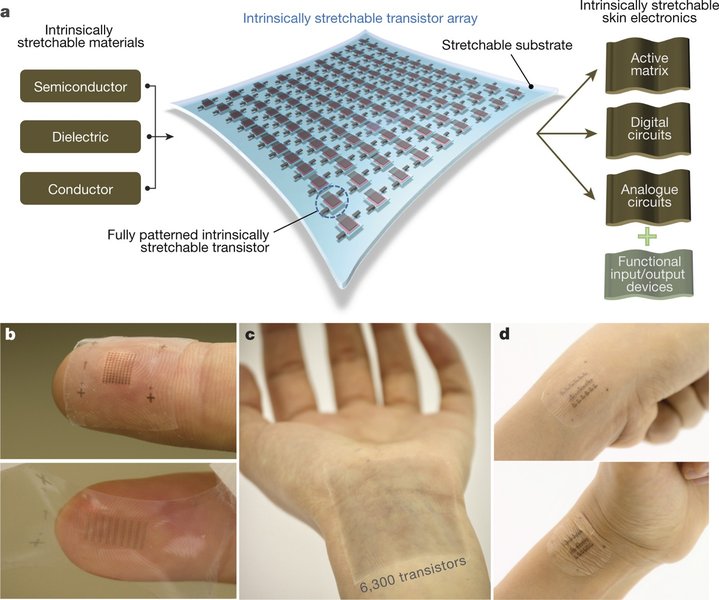
Skin electronics from scalable fabrication of an intrinsically stretchable semiconducting film.
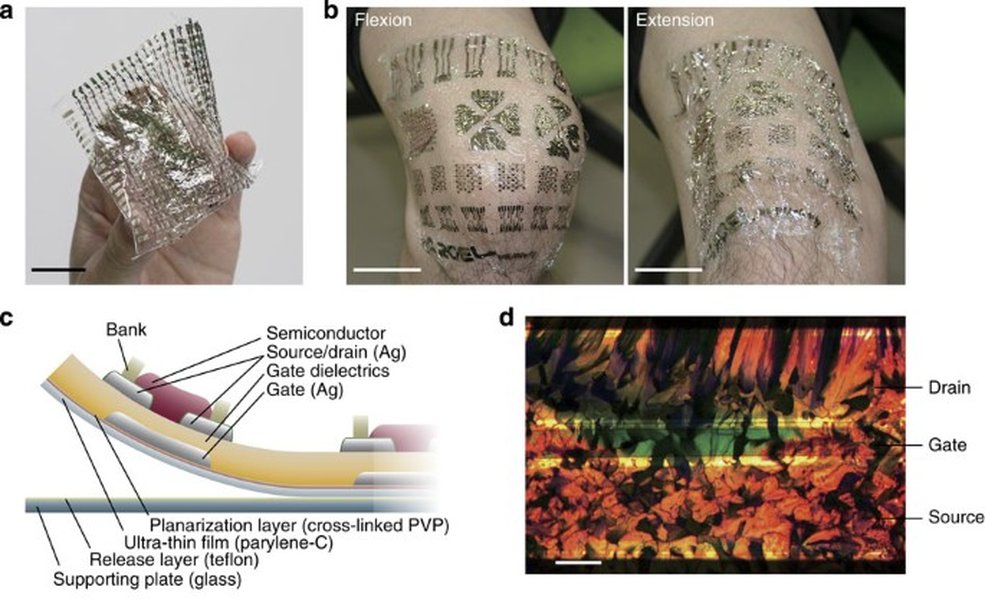
Fully-printed high-performance organic thin-film transistors and circuits.
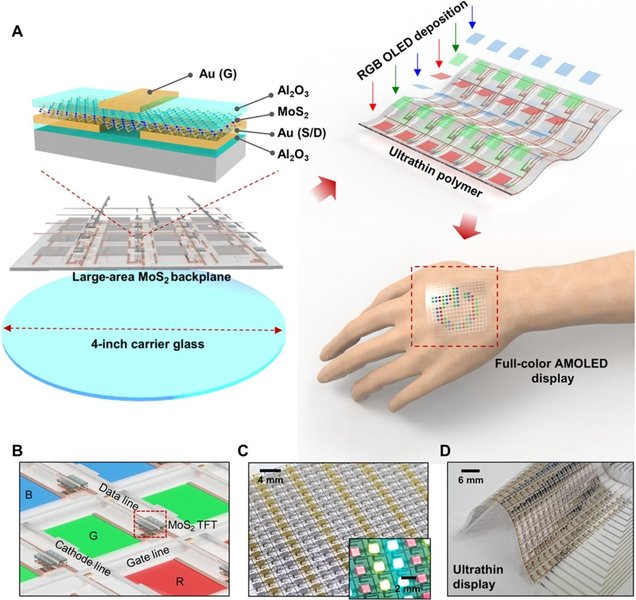
Active-matrix organic light-emitting diode display on human skin.
These images illustrate the versatility of PEDOT:PSS in creating flexible, wearable, and implantable electronic devices. Its ability to be processed into thin films and its compatibility with various substrates make it a valuable material for advancing bioelectronic technologies.
Enhancing PEDOT:PSS Properties for Thermoelectric Applications
The video below showcases techniques to enhance the thermoelectric properties of PEDOT:PSS, opening doors for energy harvesting and thermal management applications.
Video demonstrating the enhancement of thermoelectric properties of PEDOT:PSS using Tellurium (Te). This is relevant because improving thermoelectric properties expands the applications of PEDOT:PSS to include energy harvesting and thermal management.
Frequently Asked Questions (FAQ)
References
Last updated April 10, 2025