
Unlock the Secret: How to Bathe in Endless Sunlight on an Ocean World
Navigate perpetual daylight by mastering Earth's spin and leveraging polar phenomena – discover the strategy for minimum speed.
Essential Insights: Chasing the Sun
- Latitude is Key: The required speed to counteract Earth's rotation and stay in sunlight dramatically decreases as you move from the equator towards the poles.
- The Polar Advantage: The most effective way to minimize speed is to position yourself near the Arctic or Antarctic Circle during their respective summers, utilizing the "midnight sun."
- Westward Bound: To remain illuminated, you must generally travel westward, effectively racing against the Earth's eastward spin.
Understanding the Challenge: Earth's Rotation and Daylight
Imagine an Earth entirely covered by water. Your mission: to sail your boat and remain constantly bathed in sunlight, forever avoiding nightfall. The primary obstacle is the Earth's rotation. Our planet spins from West to East, completing one full rotation approximately every 24 hours. This rotation makes the sun appear to travel westward across the sky.
To stay perpetually in the sunlit portion of the Earth, you must counteract this eastward rotation. This means you need to navigate your boat westward at a speed that matches the speed of the sunrise/sunset line moving across the planet's surface at your specific latitude.
The Speed Equation: Why Latitude Matters
The Earth is a sphere (or more accurately, an oblate spheroid), meaning the linear speed of a point on its surface due to rotation varies significantly with latitude. The speed is fastest at the equator and decreases as you move towards the poles.
The required westward speed (\(v\)) to stay with the sun at a given latitude (\(\lambda\)) can be approximated by the formula:
\[ v \approx v_{eq} \times \cos(\lambda) \]Where:
- \(v_{eq}\) is the rotational speed at the equator (approximately 1670 km/h or 1037 mph).
- \(\lambda\) is the latitude in degrees.
- \(\cos(\lambda)\) is the cosine of the latitude.
This relationship dictates the core challenge and the key to minimizing your speed:
- Equator (0° Latitude): Here, \(\cos(0^\circ) = 1\). You would need to travel westward at the Earth's full rotational speed, roughly 1670 km/h (1037 mph). This speed is far beyond the capabilities of any conventional boat.
- Mid-Latitudes (e.g., 45° Latitude): At 45°, \(\cos(45^\circ) \approx 0.707\). The required speed drops to approximately 1180 km/h (733 mph) – still incredibly fast and impractical for sea travel.
- High Latitudes (e.g., 60° Latitude): At 60°, \(\cos(60^\circ) = 0.5\). The speed needed is halved compared to the equator, about 835 km/h (519 mph). While lower, this remains well beyond realistic boat speeds.
- Near the Poles (e.g., 80° Latitude): At 80°, \(\cos(80^\circ) \approx 0.174\). The required speed is significantly reduced to about 290 km/h (180 mph). This is approaching the realm of very high-speed watercraft but is still extremely challenging to maintain perpetually.
Speed Requirements vs. Latitude Table
The following table summarizes the approximate westward speed needed to stay in perpetual sunlight at various latitudes and comments on the feasibility for a boat.
| Latitude | Approx. Rotational Speed (km/h) | Required Westward Speed (km/h) | Feasibility by Conventional Boat |
|---|---|---|---|
| Equator (0°) | 1670 | ~1670 | Impossible |
| 30° N/S | 1446 | ~1446 | Impossible |
| 45° N/S | 1180 | ~1180 | Impossible |
| 60° N/S | 835 | ~835 | Impossible |
| Arctic/Antarctic Circle (~66.5° N/S) | 665 | ~665 | Extremely Difficult / Impossible |
| 80° N/S | 290 | ~290 | Very High Speed Required |
| Near Poles (>85° N/S) | < 145 | < ~145 | Challenging, but lower speeds needed |
| Within Midnight Sun Zone (Seasonal) | Variable | Potentially 0 km/h | Most Feasible Strategy |
This clearly illustrates that attempting to "chase the sun" at lower or mid-latitudes requires speeds unattainable by boats.
Leveraging Polar Phenomena: The Midnight Sun
Sailing under extended daylight conditions, reminiscent of the Arctic summer.
The Earth's axial tilt (around 23.5 degrees) is the key to the most viable strategy. Because of this tilt, regions within the Arctic Circle (north of ~66.5° N) and Antarctic Circle (south of ~66.5° S) experience periods during their respective summers where the sun does not set for 24 hours or longer. This phenomenon is known as the "midnight sun."
During the peak of the summer solstice in each hemisphere (around June 21st in the North, December 21st in the South), the zone of perpetual daylight extends furthest from the pole. By positioning yourself within this zone, you can remain in continuous sunlight without needing to move at high speeds to counteract Earth's rotation. In fact, near the poles during the height of summer, you might only need minimal speed adjustments or could potentially stay relatively stationary for days or weeks while remaining in sunlight.
The Optimal Strategy: Embrace the Poles
Given the impracticality of matching Earth's rotational speed at lower latitudes, the best strategy to minimize your maximum speed involves:
- Target High Latitudes: Travel towards either the Arctic or Antarctic Circle.
- Time Your Arrival: Plan to be within the polar circle during its summer season (roughly May-August in the Arctic, November-February in the Antarctic). The closer to the summer solstice, the larger the area experiencing the midnight sun.
- Position within the Midnight Sun Zone: Once inside the region experiencing 24-hour daylight, you can drastically reduce your speed. Your primary goal shifts from actively chasing the sun westward to simply remaining within the latitudinal band where the sun doesn't set.
- Minimal Movement: Depending on your exact latitude and the specific date relative to the solstice, you may only need very slow movement or occasional adjustments to stay within the perpetual daylight zone as it subtly shifts with the Earth's orbit. Your speed requirement could drop close to zero.
- Seasonal Migration: To maintain perpetual sunlight year-round, you would need to migrate between the Arctic and Antarctic regions, timing your presence in each polar region to coincide with its summer and the midnight sun phenomenon. This involves long trans-oceanic voyages between hemispheres twice a year.
Visualizing the Strategy
This mindmap illustrates the core components of the optimal strategy for minimizing speed while staying in perpetual sunlight.
Navigating Outside Polar Summers
If you find yourself outside the polar regions or during seasons without the midnight sun, maintaining perpetual daylight becomes exponentially harder. You would need to travel westward along a line of latitude at the speeds calculated earlier (e.g., 835 km/h at 60° latitude). Even at very high latitudes (like 80°), the required speed (290 km/h) is substantial and likely unsustainable for long periods with a boat.
Comparing Strategy Viability
This chart compares different approaches based on key factors influencing their success and feasibility. Higher scores indicate better performance or lower difficulty for that factor. The "Polar Summer Stay" clearly emerges as the most viable option for minimizing speed.
The chart highlights that while chasing the sun offers theoretical year-round feasibility (score 9), it fails drastically on required speed and vessel capability. The Polar Summer Stay excels in minimizing speed and matching boat capabilities but has limited seasonal feasibility (score 3), necessitating migration between poles for year-round sunlight.
Practical Considerations
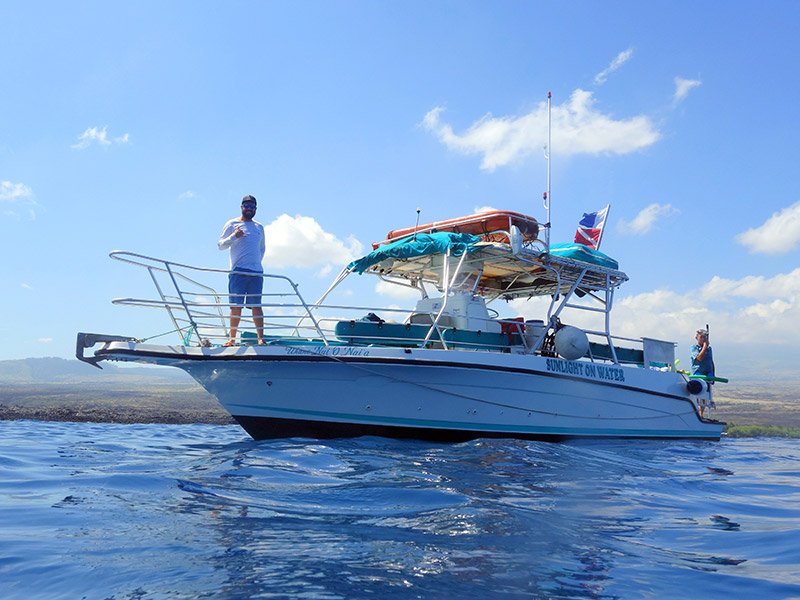
A vessel equipped for potentially challenging ocean voyages.
Even the "optimal" polar strategy presents significant practical hurdles on an all-ocean Earth:
- Vessel Capability: While the speed requirement is minimized, the boat must still be capable of long-distance travel, potentially across vast oceans to migrate between polar regions seasonally. It must also handle potentially harsh polar weather and sea conditions.
- Navigation: Precise navigation is crucial, especially when relying on staying within the dynamic boundaries of the midnight sun zone.
- Weather & Ice: Polar regions are known for severe storms and, even in summer, potential sea ice which could pose significant hazards or block paths.
- Supplies & Maintenance: A perpetual journey requires self-sufficiency or incredibly meticulous planning for resupply, which is complicated on a purely oceanic world.
- Psychological Effects: Constant daylight can disrupt human circadian rhythms and have psychological impacts over long durations.
Sailing Under Eternal Daylight: An Alaskan Perspective
While our scenario is hypothetical, adventures in places like Alaska offer a glimpse into sailing under the midnight sun. This video showcases the unique experience of navigating waters where daylight persists around the clock during the summer months, similar to the conditions you would seek in the polar strategy.
Observing real-world sailing in these conditions highlights both the beauty and the navigational considerations involved in environments with continuous daylight, reinforcing the feasibility of the polar approach for minimizing speed compared to high-speed equatorial chases.
Frequently Asked Questions
Why do I need to travel westward?
The Earth spins eastward. To stay in the same position relative to the sun (i.e., in daylight), you must move westward at a speed that cancels out the Earth's rotational speed at your latitude. Think of it like walking backward on an eastward-moving escalator to stay in the same place relative to the building.
Why are the poles the best place to minimize speed?
Two reasons: First, the linear speed of Earth's rotation decreases significantly as you approach the poles. The circumference of a line of latitude gets smaller, so you cover less distance per hour. Second, due to Earth's axial tilt, areas inside the polar circles experience the "midnight sun" during summer, where the sun doesn't set for 24 hours or more. During this time, you can stay in sunlight with minimal or potentially zero speed relative to the water.
How do seasons affect this strategy?
Seasons are critical. The midnight sun only occurs during the summer in each polar region (roughly May-August in the Arctic, November-February in the Antarctic). During the polar winter, these regions experience perpetual darkness (polar night). Therefore, to stay in sunlight perpetually using the low-speed polar strategy, you would need to migrate between the Arctic and Antarctic regions, arriving in each during its respective summer.
Is this perpetual sunlight journey actually possible with a boat?
Chasing the sun at lower latitudes requires speeds (hundreds to over 1000 km/h) that are impossible for any conventional boat. The *only* theoretically feasible strategy using realistic boat speeds is to utilize the midnight sun phenomenon in polar regions during their summers. This minimizes the required speed significantly, potentially close to zero. However, the journey would still be incredibly challenging due to the need for inter-hemispheric travel, harsh polar conditions, navigation, and self-sufficiency on an all-ocean world.
References
- Is it possible to sail around the world in constant sunlight? - Quora
- 10 Places to Experience Perpetual Daylight - MapQuest Travel
- The Midnight Sun - Visit Norway
- Is it possible to stay in perpetual darkness by traveling? (Inverse problem with similar speed logic) - Reddit
- Embrace the Enchanting Midnight Sun - Cruise Norway
- Sit in Shade (Real-time sun data concept) - Sit in Shade
Recommended Further Exploration
Last updated April 17, 2025