
Unveiling Phobos' Shadow: Just How Dark is Mars' Inner Moon?
Delving into the remarkably low reflectivity of Phobos, a key indicator of its mysterious origins and surface composition.
Phobos, the larger and innermost of Mars' two natural satellites, is an object of intense scientific interest, not least for its exceptionally dark surface. Its albedo, a measure of how much light it reflects, is among the lowest in the Solar System, offering crucial clues about its composition, history, and its relationship with Mars. Understanding Phobos' albedo is key to deciphering whether it is a captured asteroid or a remnant from Mars' formation.
Key Insights into Phobos' Reflectivity
Essential Takeaways
- Extremely Low Reflectivity: Phobos reflects only about 7.1% of the sunlight that strikes its surface, making it one of the darkest objects in our solar system.
- Carbonaceous Composition: Its low albedo is primarily attributed to a surface rich in carbonaceous materials, similar to C-type or D-type asteroids, suggesting a primitive composition.
- Surface Variations: While generally dark, Phobos exhibits localized variations in reflectivity, with features like crater rims and the floor of the large Stickney crater showing slightly different photometric properties.
Phobos' Albedo: A Closer Look at the Numbers
Quantifying the Darkness
Albedo is a dimensionless quantity that indicates how well a surface reflects solar energy. A value of 0 means a perfectly black surface that absorbs all incident light, while a value of 1 represents a perfectly white surface that reflects all incident light. Phobos' albedo consistently measures at the lower end of this scale.
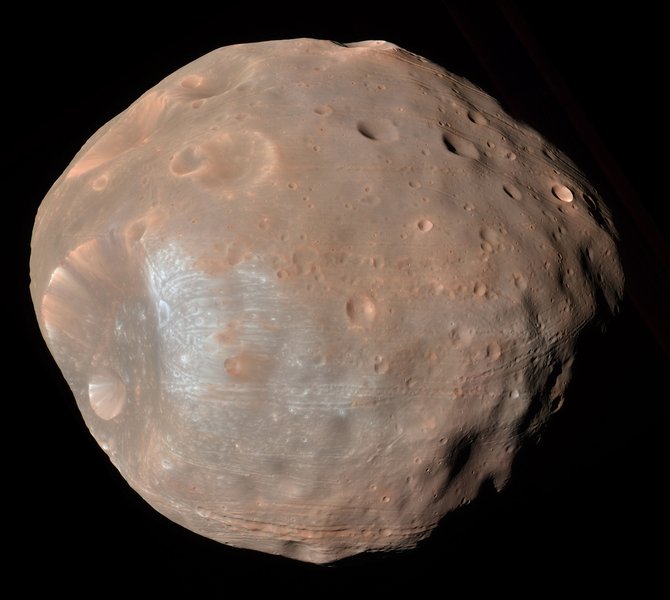
A color view of Phobos captured by NASA's Mars Reconnaissance Orbiter, showcasing its heavily cratered and dark surface.
Geometric Albedo
The geometric albedo is the ratio of a body's brightness at a zero-degree phase angle (when the observer is directly between the sun and the object) to that of an idealized flat, fully reflecting, diffusely scattering disk of the same cross-sectional area. For Phobos, the generally accepted geometric albedo is approximately 0.071. This means it reflects about 7.1% of the incident sunlight. Specific measurements include:
- Data from the Mars Express High Resolution Stereo Camera (HRSC) indicate a geometric albedo of about 6.8% (0.068) in the green filter.
- Earlier data from Viking lander cameras suggested a geometric albedo of 0.05 ± 0.01.
- In the ultraviolet spectrum, at around 200 nanometers, the albedo drops to as low as 1% (0.01).
Single-Scattering Albedo (SSA)
The single-scattering albedo refers to the probability that a photon interacting with a single particle in the regolith will be scattered rather than absorbed. Mars Express HRSC data suggest an SSA value of about 7.2% (0.072) in the green filter. This value is higher than that found for many primitive asteroids and cometary nuclei but is close to the values for the dwarf planet Ceres.
Radar Albedo
Radar albedo measures the reflectivity of a surface to radar waves. Observations have yielded varying results:
- Radar detection at 8510-MHz (3.5-cm wavelength) determined a radar albedo of 0.093 ± 0.035.
- Arecibo 2380 MHz radar data provided an OC (circularly polarized) radar albedo of 0.021 ± 0.006.
These radar signatures are more akin to those of large, C-class main-belt asteroids rather than small, Earth-approaching objects.
Why is Phobos So Dark?
Unpacking the Compositional Clues
The remarkably low albedo of Phobos is a direct consequence of its surface composition and physical properties. Several factors contribute to its dark appearance:
Carbon-Rich Surface
The prevailing theory is that Phobos' surface is composed of materials similar to carbonaceous chondrite meteorites. These meteorites are rich in dark carbon compounds, including organic molecules, which are excellent absorbers of light. This composition aligns Phobos with C-type and D-type asteroids, known for their low albedos. The presence of such primitive materials suggests Phobos might be a captured asteroid that originated in the outer asteroid belt or beyond.
Regolith Properties
Phobos is covered by a layer of fine dust and rocky debris known as regolith. This regolith is described as very dark gray and is likely the result of eons of micrometeoroid impacts. The pulverised nature of the surface, combined with its composition, contributes to its light-absorbing properties. Its low mean density (approximately 1.857 to 1.9 g/cm³) and high porosity suggest a loosely packed, "rubble-pile" structure, which can also influence how light scatters and is absorbed.
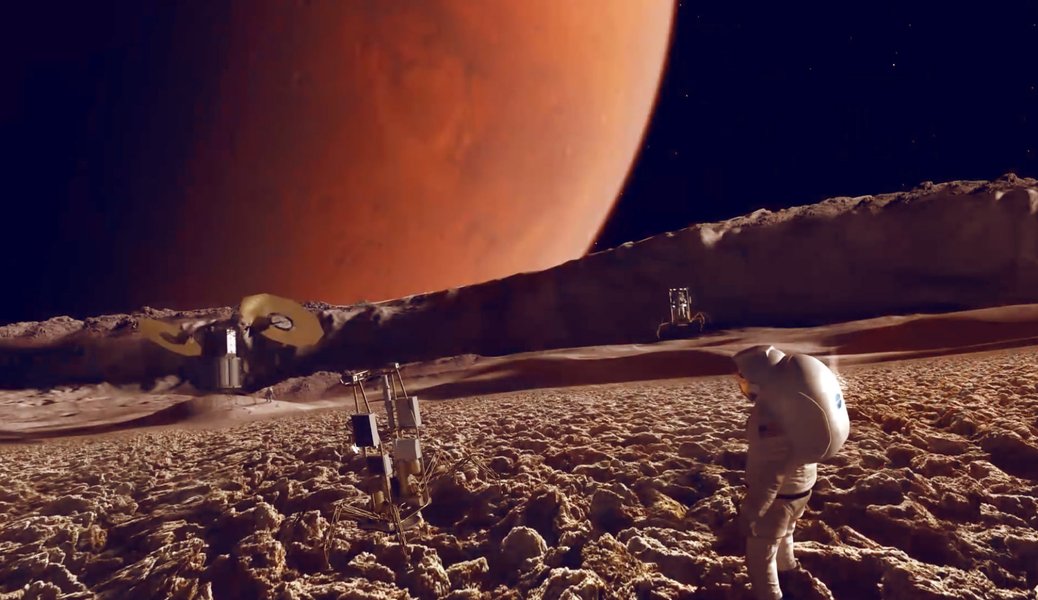
Artist's impression of Phobos, highlighting its irregular shape and cratered terrain, which contribute to its complex light-scattering properties.
Space Weathering
Continuous exposure to the harsh space environment, including solar wind bombardment and micrometeoroid impacts, can alter the optical properties of surface materials, often leading to a darkening effect known as space weathering. This process likely plays a role in maintaining Phobos' low albedo.
Albedo Variations Across Phobos' Surface
A Non-Uniform Reflectivity
While Phobos is dark overall, its albedo is not perfectly uniform. Photometric studies have revealed spatial heterogeneity in its surface properties:
- Stickney Crater: The floor of Stickney, Phobos' largest crater, has been observed to darken more rapidly with increasing phase angle (the angle between the Sun, Phobos, and the observer) than the rest of the moon's surface.
- Bright Crater Rims and Grooves: Some small, fresh craters exhibit brighter rims. Similarly, the enigmatic grooves that crisscross Phobos' surface can show variations in photometric behavior. These areas are considered among the most heterogeneous on Phobos in terms of regolith properties.
- Spectral Units: Spectroscopic data indicate the presence of at least two distinct types of materials across Phobos' surface, contributing to local albedo differences. Missions like Mars Express and the Mars Reconnaissance Orbiter have provided detailed maps of these material distributions.
These variations suggest that Phobos' regolith is influenced by discrete impact events and is not as extensively mixed horizontally as the regolith on Mars' other moon, Deimos.
Comparing Phobos: A Dark Object in the Solar System
Reflectivity in Context
To appreciate Phobos' darkness, it's useful to compare its albedo to other celestial bodies:
| Celestial Body | Approximate Geometric Albedo | Notes |
|---|---|---|
| Phobos | 0.071 (7.1%) | Very dark, similar to carbonaceous asteroids. |
| Earth's Moon | 0.12 (12%) | Significantly more reflective than Phobos. |
| Deimos (Mars' other moon) | ~0.07 (7%) | Similar to Phobos, but can be slightly brighter in some measurements. |
| Ceres (Dwarf Planet) | 0.09 (9%) | Also a dark, carbonaceous body, but slightly more reflective than Phobos. |
| Enceladus (Saturn's moon) | >0.9 (often cited as 0.99) | Extremely reflective due to fresh ice covering its surface. |
| Asphalt | ~0.04 (4%) | A common terrestrial material for comparison. |
This table highlights Phobos' status as one of the less reflective bodies in our solar system, akin to dark, primitive asteroids.
Phobos' Reflectivity Profile
Visualizing Albedo Characteristics
The following chart provides a visual comparison of different aspects related to Phobos' albedo, offering a qualitative assessment of its reflective properties. The scores are relative and for illustrative purposes, emphasizing its darkness and carbonaceous nature compared to a more reflective body like Earth's Moon.
This chart illustrates that Phobos scores low on albedo and brightness but high on carbonaceous signature and similarity to C-type asteroids, contrasting with the Earth's Moon.
Factors Influencing Phobos' Albedo: A Mindmap
Connecting the Dots
Phobos' albedo is a complex property resulting from various interconnected factors. The mindmap below illustrates these relationships, from its fundamental composition to the observable surface characteristics and the scientific implications.
This mindmap visualizes how Phobos' core composition leads to its surface properties, which in turn dictate its measured albedo values and their variations. These characteristics have significant implications for scientific understanding and future exploration.
Exploring Phobos: The Doomed Moon
A Closer Look at Mars' Inner Companion
The video below, "Phobos: The Doomed Moon of Mars," provides a fascinating overview of this enigmatic moon, touching upon its peculiar characteristics, surface features, and its eventual fate. Understanding its physical properties, including its dark surface, is crucial for comprehending its overall nature and its interactions within the Martian system.
This video delves into many aspects of Phobos, including its unusual grooves and the theories surrounding its origin. The dark, cratered surface, indicative of its low albedo, is a prominent feature discussed, highlighting the moon's ancient and battered exterior. Such visual explorations complement the numerical data on albedo by providing a tangible sense of what this low reflectivity means for Phobos' appearance and the environment explorers might one day encounter.
Frequently Asked Questions about Phobos' Albedo
What does Phobos' low albedo tell us about its origin? +
Phobos' very low albedo (around 0.071) strongly suggests a composition similar to carbonaceous C-type or D-type asteroids. These asteroids are rich in dark, carbon-based compounds and are considered some of the most primitive objects in the Solar System. This similarity supports the hypothesis that Phobos may be a captured asteroid from the outer asteroid belt or even beyond, rather than a body formed concurrently with Mars from the same material.
How does Phobos' albedo compare to Earth's Moon? +
Phobos is significantly darker than Earth's Moon. Phobos has a geometric albedo of about 0.071 (reflecting 7.1% of sunlight), while Earth's Moon has an average geometric albedo of about 0.12 (reflecting 12% of sunlight). This makes Phobos appear nearly twice as dark as our Moon.
Are there any variations in albedo across Phobos' surface? +
Yes, while Phobos is generally very dark, there are localized variations in its albedo. For example, the floor of the large Stickney crater appears to darken more rapidly with increasing phase angle compared to other areas. Additionally, the rims of some smaller, younger craters can appear relatively brighter. These variations suggest differences in regolith composition, particle size, or freshness of the exposed material.
How is Phobos' albedo measured? +
Phobos' albedo is measured using photometric techniques, which involve analyzing the amount of sunlight reflected by the moon at different wavelengths and phase angles (the angle between the Sun, Phobos, and the observer). Data for these measurements come from various spacecraft missions that have observed Phobos, including the Viking orbiters, Mars Global Surveyor, Mars Express (with its High Resolution Stereo Camera - HRSC), and the Mars Reconnaissance Orbiter. Ground-based telescopes and radar observations also contribute to understanding its reflective properties.
What are the implications of Phobos' low albedo for future missions? +
The low albedo has several implications for missions like JAXA's Martian Moons eXploration (MMX) mission. Firstly, the dark surface absorbs more solar radiation, leading to significant temperature variations between the sunlit and shadowed sides (e.g., from -4°C to -112°C). This must be considered for spacecraft and instrument design. Secondly, the albedo and its variations provide information for landing site selection and sample collection strategies, as different albedo values may correlate with different surface materials or textures. Understanding the regolith's properties, partly inferred from albedo, is crucial for designing mechanisms to interact with and collect samples from the surface.
Recommended Further Exploration
Dive Deeper into Martian Moons
- What is the composition of Phobos' surface regolith?
- How do the albedos of Phobos and Deimos compare?
- What are the leading theories about the origin of Phobos?
- How does space weathering affect the albedo of small celestial bodies like Phobos?
References
Sources for This Information
Last updated May 18, 2025