
Unveiling the Universal Currency: What Exactly IS Energy in Physics?
Delve into the fundamental concept that drives every change and motion in the cosmos, from subatomic particles to galactic clusters.
Highlights: The Essence of Energy
- The Capacity for Change: Energy is fundamentally the quantitative property that must be transferred to an object or physical system to perform work or to heat the object. It's the universe's engine for action.
- Immutable Yet Transformable: Governed by the law of conservation, energy cannot be created or destroyed, only converted from one form to another (e.g., chemical to kinetic) or transferred between systems.
- A Spectrum of Manifestations: Energy exists in diverse forms, including kinetic (motion), potential (stored), thermal (heat), chemical (bonds), electrical (charge flow), nuclear (atomic nuclei), and radiant (electromagnetic waves).
Defining Energy: The Power to Do and Change
In the realm of physics, energy is a cornerstone concept, defined as the capacity to do work or to induce change within a physical system. It's a quantitative, scalar property, meaning it has magnitude but no direction. While often elusive to direct observation, its effects—motion, heat, light, and countless transformations—are evident everywhere. Energy is not a substance itself but rather a fundamental attribute of objects and systems that allows them to interact and alter their states or the states of others. Every physical process, from the collision of subatomic particles to the explosion of a supernova, involves the transfer or transformation of energy.
This abstract yet measurable quantity underpins all physical phenomena. Whether it's the launch of a rocket, the growth of a plant, or the simple act of lifting an object, energy is the common currency. Understanding energy is crucial for comprehending the workings of the universe and for developing technologies that harness its various forms.
The Two Pillars: Kinetic and Potential Energy
At a foundational level, energy can be broadly categorized into two main types: kinetic energy, associated with motion, and potential energy, associated with position or configuration.
Kinetic Energy: The Energy of Motion
Kinetic energy (KE) is the energy an object possesses due to its motion. Any object that is moving, whether it's a planet orbiting a star, a car speeding down a highway, or an electron buzzing around an atomic nucleus, has kinetic energy. The amount of kinetic energy depends on both the mass ( \(m\) ) of the object and the square of its velocity ( \(v\) ). It is mathematically expressed as:
\[ KE = \frac{1}{2}mv^2 \]This means that an object with greater mass or, more significantly, greater velocity will possess more kinetic energy. Examples include translational kinetic energy (an object moving in a straight line), rotational kinetic energy (a spinning wheel), and vibrational kinetic energy (particles oscillating within a substance).
Potential Energy: Stored Capacity
Potential energy (PE) is the energy an object or system has stored due to its position, state, or configuration. It represents the "potential" to do work. When circumstances change, this stored energy can be converted into kinetic energy or other forms of energy.
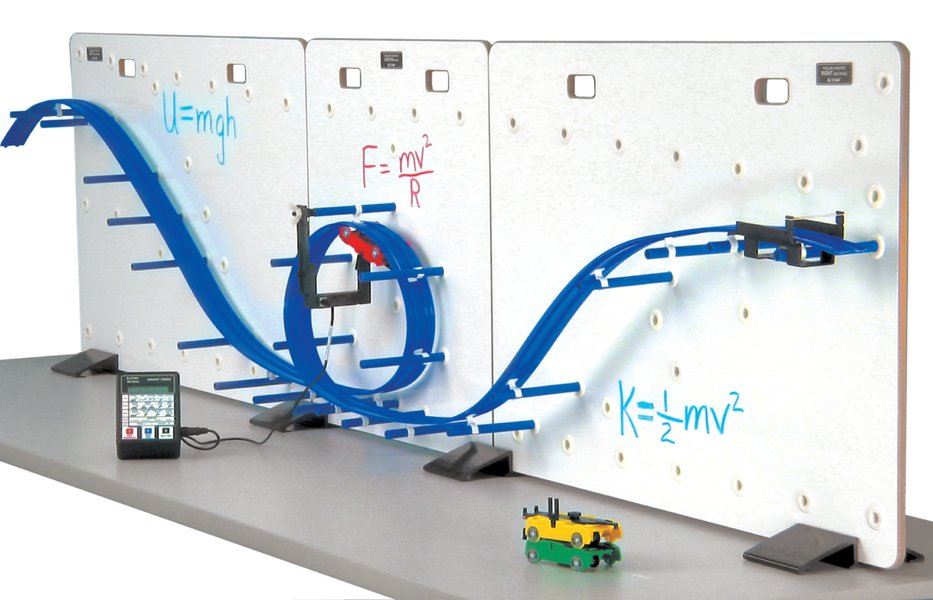
A simple pendulum illustrates the continuous conversion between gravitational potential energy (at the highest points of its swing) and kinetic energy (at the lowest point), demonstrating a basic principle of energy transformation.
Gravitational Potential Energy
This is the energy an object possesses due to its position in a gravitational field, typically relative to a reference point (like the Earth's surface). An object lifted to a height ( \(h\) ) against gravity gains gravitational potential energy. It is calculated as:
\[ PE_g = mgh \]where \(m\) is the mass, \(g\) is the acceleration due to gravity, and \(h\) is the height. A book on a high shelf or water stored behind a dam are examples of objects with gravitational potential energy.
Elastic Potential Energy
This is the energy stored in elastic materials as a result of stretching or compressing them. A stretched rubber band, a compressed spring, or a bent bow all store elastic potential energy, which is released when they return to their original shape, often converting into kinetic energy.
Chemical Potential Energy
While often categorized separately, chemical energy is fundamentally a form of potential energy stored within the bonds of atoms and molecules. This energy is released or absorbed during chemical reactions when these bonds are broken or formed. Examples include the energy in food, fuels, and batteries.
Electrical Potential Energy
This arises from the configuration of charged particles in an electric field. For example, a charged particle has electrical potential energy due to its position relative to other charged particles or an electric field. This potential energy can be converted into kinetic energy if the particle is allowed to move freely within the field.
A Spectrum of Energy Forms
Beyond the fundamental categories of kinetic and potential energy, energy manifests in a multitude of interconnected forms, each describing energy associated with specific physical phenomena.
Thermal Energy: The Vigor of Particles
Thermal energy, often referred to as internal energy, is the total kinetic and potential energy of the atoms and molecules within a substance. It's related to the random motion and vibrations of these particles. The higher the temperature of a substance, the greater the average kinetic energy of its particles, and thus, the greater its thermal energy. Heat is the term used to describe the transfer of thermal energy between systems due to a temperature difference.
Chemical Energy: Power in Bonds
As mentioned, chemical energy is potential energy stored in the chemical bonds that hold atoms together to form molecules. When chemical reactions occur, these bonds can be broken and reformed, leading to the release (exothermic reaction) or absorption (endothermic reaction) of energy. Examples abound: the combustion of wood or fossil fuels releases chemical energy as heat and light, batteries convert chemical energy into electrical energy, and living organisms convert chemical energy from food into energy for life processes.
Electrical Energy: The Flow of Charge
Electrical energy is associated with the presence and flow of electric charges, typically electrons moving through a conductor like a wire. It can also be stored in electric fields (as electrical potential energy). Electrical energy is incredibly versatile and can be easily converted into many other forms (light, heat, motion), making it a cornerstone of modern technology. It is generated from other energy forms, such as mechanical energy in generators or chemical energy in batteries.
Nuclear Energy: Power from the Atom's Core
Nuclear energy is the potent energy stored within the nucleus of an atom, held together by the strong nuclear force. This energy can be released through nuclear reactions: either fission (the splitting of a heavy nucleus into lighter nuclei) or fusion (the combining of light nuclei to form a heavier nucleus). The energy released in nuclear reactions is vastly greater than that from chemical reactions due to the much stronger forces involved.
Radiant Energy: Waves of Power
Radiant energy, also known as electromagnetic energy, is energy that travels in the form of electromagnetic waves. This spectrum includes visible light, radio waves, microwaves, infrared radiation, ultraviolet radiation, X-rays, and gamma rays. These waves carry energy through space, even through a vacuum. The energy of a photon, the quantum of the electromagnetic field, is given by \( E = hf \), where \( h \) is Planck's constant and \( f \) is the frequency of the wave. The sun is our primary source of radiant energy.
Summary of Key Energy Forms
The diverse forms of energy are fundamental to understanding physical processes. The table below summarizes some of these key forms, their descriptions, and common examples:
| Form of Energy | Description | Key Characteristics/Examples |
|---|---|---|
| Kinetic Energy | Energy of motion. | Moving car, flowing water, spinning turbine. Formula: \(KE = \frac{1}{2}mv^2\). |
| Gravitational Potential Energy | Energy stored due to an object's height in a gravitational field. | Water behind a dam, a book on a shelf. Formula: \(PE_g = mgh\). |
| Elastic Potential Energy | Energy stored in deformed elastic objects. | Stretched spring, compressed rubber ball. |
| Thermal Energy | Internal energy from the kinetic and potential energy of particles. | Hot coffee, the warmth of the sun, friction heating. |
| Chemical Energy | Potential energy stored in chemical bonds. | Food, fuels (wood, gasoline), batteries. |
| Electrical Energy | Energy from the flow or position of electric charges. | Electricity in wires, static electricity, lightning. |
| Nuclear Energy | Energy stored in the nucleus of an atom. | Nuclear power plants (fission), the sun (fusion). |
| Radiant Energy | Energy transmitted as electromagnetic waves. | Sunlight, radio waves, X-rays, microwaves. |
The Cornerstone: Conservation of Energy
One of the most profound and universally applicable principles in physics is the law of conservation of energy.
The First Law of Thermodynamics
This law states that energy cannot be created or destroyed; it can only be transformed from one form to another or transferred from one system to another. In an isolated system (one that does not exchange energy or matter with its surroundings), the total amount of energy remains constant over time. This principle is fundamental to all scientific disciplines. For a non-isolated system, the change in its internal energy (\(\Delta U\)) is equal to the heat (\(Q\)) added to the system minus the work (\(W\)) done by the system on its surroundings:
\[ \Delta U = Q - W \]This equation is a mathematical statement of the first law, accounting for energy transfers via heat and work.
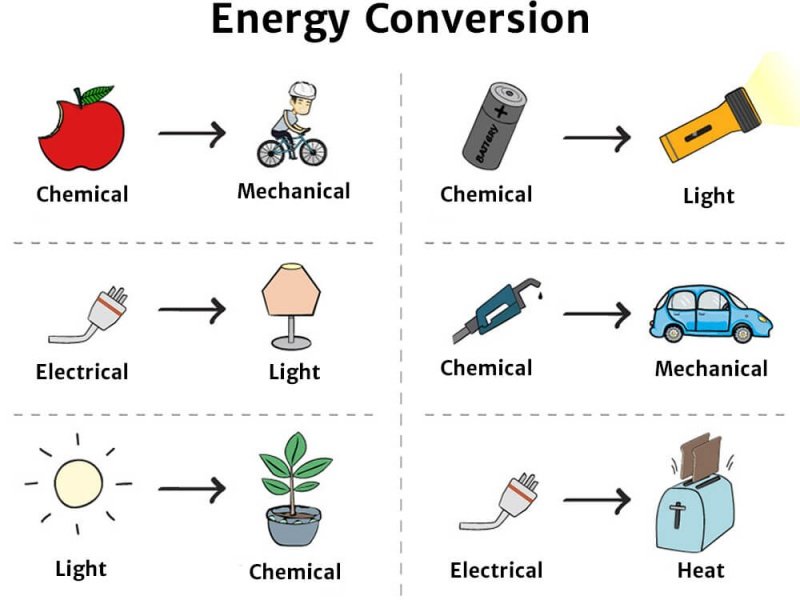
Various examples of energy transformations, such as solar to electrical, chemical to mechanical, and electrical to light, highlight the versatility and conservation of energy.
Noether's Theorem: A Deeper Connection
The conservation of energy is not just an empirical observation; it has deep theoretical roots. Emmy Noether's theorem, a landmark in mathematical physics, establishes a fundamental connection between conservation laws and continuous symmetries in physical laws. Specifically, the conservation of energy is a direct consequence of the time-translation symmetry of physical laws—the fact that the laws of physics are the same today as they were yesterday and will be tomorrow. If the underlying rules governing a system do not change with time, then its total energy must be conserved.
Historical Footprints
The modern understanding of energy conservation evolved through the 19th century. Key figures like James Prescott Joule experimentally demonstrated the mechanical equivalent of heat, showing that mechanical work and heat are interconvertible forms of energy. This work, along with contributions from scientists like Julius Robert von Mayer, Hermann von Helmholtz, and William Thomson (Lord Kelvin), helped formalize the concept of energy and its conservation, leading to the development of thermodynamics.
Energy Transformation and Transfer
While the total energy in an isolated system is conserved, its forms are constantly changing. Understanding how energy transforms and transfers is key to understanding physical processes.
Mechanisms of Transfer: Work and Heat
Energy can be transferred between systems or objects in two primary ways:
- Work: In physics, work is done when a force causes an object to be displaced. It represents a transfer of energy. For example, lifting a box involves doing work against gravity, transferring energy to the box as gravitational potential energy.
- Heat: Heat is the transfer of thermal energy between systems that are at different temperatures. Energy naturally flows from a hotter object to a cooler object until thermal equilibrium is reached.
Efficiency and the Second Law of Thermodynamics
While energy is always conserved (First Law), not all energy transformations are equally useful. The Second Law of Thermodynamics introduces the concept of entropy and has profound implications for energy conversion. It states that in any natural process, the total entropy (a measure of disorder or randomness) of an isolated system tends to increase over time. A consequence of this is that no energy transformation process can be 100% efficient in converting energy into useful work. Some energy is always inevitably "lost" or dissipated as low-grade thermal energy, typically to the surroundings, increasing the overall disorder. This is why, for example, engines get hot and no machine can run forever without an energy input.
The Third Law of Thermodynamics
The Third Law of Thermodynamics deals with the behavior of systems at absolute zero temperature (\(0 \text{ Kelvin or } -273.15^{\circ}\text{C}\)). It states that as the temperature of a system approaches absolute zero, the entropy of the system approaches a minimum or zero value. Practically, it implies that reaching absolute zero in a finite number of steps is impossible. This law sets a fundamental limit on temperature and entropy.
Visualizing Energy Form Characteristics
This radar chart provides a comparative overview of various energy forms based on qualitative characteristics such as their storability, ease of conversion, inherent energy density, direct usability for common tasks, and natural abundance. These are general assessments to illustrate the diverse nature of these energy types. The scale ranges from 1 (lowest) to 10 (highest).
Energy in the Realm of Modern Physics
The classical understanding of energy was significantly expanded and refined by the revolutions of relativity and quantum mechanics in the early 20th century.
Relativity: Mass-Energy Equivalence
Albert Einstein's theory of special relativity revealed a profound relationship between mass and energy, encapsulated in the famous equation:
\[ E = mc^2 \]where \(E\) is energy, \(m\) is mass, and \(c\) is the speed of light in a vacuum. This equation implies that mass itself is a form of energy (rest energy) and that mass and energy are interconvertible. A small amount of mass can be converted into a tremendous amount of energy, as demonstrated in nuclear reactions. Consequently, the classical laws of conservation of mass and conservation of energy were unified into a single, more fundamental law: the conservation of mass-energy. In most everyday (non-nuclear) scenarios, the conversion of mass to energy is negligible, so the separate conservation of energy remains a highly accurate approximation.
Quantum Mechanics: Energy in Packets
At the atomic and subatomic scales, quantum mechanics dictates that energy is quantized, meaning it can only exist in discrete packets or units called quanta. For example, electrons in an atom can only occupy specific energy levels; they cannot have energies in between these levels. When an electron transitions from a higher energy level to a lower one, it emits a quantum of energy, often as a photon of light. This quantization of energy is a fundamental feature of the microscopic world and has led to technologies like lasers and semiconductors. The Heisenberg Uncertainty Principle also introduces nuances, suggesting that for very short time intervals, a system's energy can fluctuate momentarily, a concept crucial in understanding virtual particles and quantum field theory.
Mapping the Interconnections of Energy Concepts
This mindmap illustrates the hierarchical and interconnected nature of energy concepts in physics, branching from the core definition to its various forms, governing principles, and its role in both classical and modern physics.
Capacity to do work
or cause change"] id2["Fundamental Principles"] id2a["Conservation of Energy
(First Law of Thermodynamics)"] id2b["Energy Transformation"] id2c["Second Law of Thermodynamics
(Entropy & Efficiency)"] id2d["Noether's Theorem
(Symmetry & Conservation)"] id2e["Third Law of Thermodynamics"] id3["Forms of Energy"] id3a["Kinetic Energy
(Motion)"] id3aa["Translational"] id3ab["Rotational"] id3ac["Vibrational"] id3b["Potential Energy
(Stored)"] id3ba["Gravitational"] id3bb["Elastic"] id3bc["Chemical (bonds)"] id3bd["Electrical (fields)"] id3c["Thermal Energy
(Particle motion)"] id3d["Electrical Energy
(Charge flow)"] id3e["Chemical Energy
(Reactions)"] id3f["Nuclear Energy
(Atomic nuclei)"] id3g["Radiant Energy
(EM Waves)"] id4["Measurement & Units"] id4a["Joule (J) - SI Unit"] id4b["Other units:
electronVolt (eV), Calorie (cal)"] id5["Energy in Modern Physics"] id5a["Mass-Energy Equivalence
\(E=mc^2\) (Relativity)"] id5b["Quantized Energy
(Quantum Mechanics)"] id6["Transfer Mechanisms"] id6a["Work
(Force acting over distance)"] id6b["Heat
(Due to temperature difference)"]
Measuring the Immeasurable: Units of Energy
Energy, being a quantitative property, requires units for its measurement. The standard unit of energy in the International System of Units (SI) is the Joule (J). One joule is defined as the amount of work done when a force of one newton displaces an object by one meter in the direction of the force. It can also be defined as the energy transferred when one watt of power is dissipated for one second.
While the joule is the standard, other units are commonly used in specific contexts:
- Electronvolt (eV): Used in atomic and particle physics, 1 eV is the kinetic energy gained by an electron when it accelerates through an electric potential difference of one volt. \(1 \text{ eV} \approx 1.602 \times 10^{-19} \text{ J}\).
- Calorie (cal): Often used for heat energy and in nutrition (as kilocalories or Calories). 1 calorie is approximately 4.184 joules (the energy needed to raise the temperature of 1 gram of water by 1 degree Celsius).
- Kilowatt-hour (kWh): Commonly used for electrical energy consumption. \(1 \text{ kWh} = 3.6 \times 10^6 \text{ J}\).
Understanding Energy: A Visual Explanation
This video from Fermilab, a leading U.S. laboratory for particle physics research, offers a clear and engaging explanation of what energy truly means in the context of physics. Dr. Don Lincoln breaks down this often-confusing term, distinguishing its familiar uses from its precise scientific definition, and touches upon its various forms and fundamental nature. It's an excellent primer for grasping why energy is such a crucial concept in understanding the universe.
Frequently Asked Questions (FAQ)
Is energy a substance or a property?
Energy is a property of objects and systems, not a substance. It is a quantitative measure of the capacity to do work or cause change. Unlike matter, energy does not have mass or occupy space in the same way a physical substance does.
Can energy ever be truly lost?
According to the law of conservation of energy (the First Law of Thermodynamics), energy cannot be created or destroyed. So, it is never truly "lost." However, during transformations, some energy is often converted into forms that are less useful for doing work, such as dispersed thermal energy (heat). This is described by the Second Law of Thermodynamics, which involves the concept of increasing entropy.
How does \(E=mc^2\) relate to everyday energy conservation?
Einstein's equation \(E=mc^2\) shows that mass and energy are equivalent. In most everyday situations (like chemical reactions or mechanical processes), the amount of mass converted to energy (or vice versa) is extremely small and negligible. Therefore, the classical law of conservation of energy (excluding mass conversion) holds as a very good approximation. Mass-energy conversion becomes significant only in nuclear reactions (like in nuclear power plants or stars) or in high-energy particle physics.
What's the difference between energy and power?
Energy is the capacity to do work. Power is the rate at which energy is transferred or transformed, or the rate at which work is done. The SI unit for energy is the Joule (J), while the SI unit for power is the Watt (W), which is equivalent to one Joule per second (J/s). For example, a 100-watt light bulb consumes 100 joules of electrical energy every second.
Why is it sometimes hard to define energy precisely in a simple way?
Energy is an abstract concept. Unlike tangible things like mass or length, we cannot directly see or hold energy. We infer its presence and quantity through its effects: the motion it causes, the heat it generates, the light it produces, or the chemical changes it drives. Its definition as "the capacity to do work" is operational but doesn't fully capture its diverse manifestations. Physicists like Richard Feynman have noted that while we know how to calculate it and understand its conservation, the fundamental "what" of energy remains somewhat elusive beyond its mathematical and operational definitions.
Recommended Further Explorations
- Explore the detailed workings of the Laws of Thermodynamics and their implications.
- Investigate the connection between energy conservation and symmetries in nature through Noether's Theorem.
- Delve into the applications of different energy forms in technology and everyday life.
- Understand the quantum mechanical view of energy and its quantization.
References
Last updated May 12, 2025