
Mastering the Court with Three: Dynamic Pickleball Formats and Strategies
Unlocking Fun and Skill Development in 3-Person Pickleball
Pickleball, a vibrant blend of tennis, badminton, and table tennis, is traditionally enjoyed by two or four players. However, if you find yourself with an enthusiastic trio, don't let the odd number deter you! Playing pickleball with three players is not only possible but also offers unique challenges and opportunities for skill development. Several engaging formats adapt the game for three participants, ensuring everyone stays active and competitive on the court. These variations often incorporate elements of both singles and doubles play, providing a dynamic experience that can sharpen individual skills and tactical thinking.
Key Highlights for 3-Person Pickleball
- Multiple Game Formats: Three-person pickleball offers distinct game formats like Cutthroat (or Australian Doubles), Pickleball Subs, and Rotating Singles, each providing a unique dynamic and strategic challenge.
- Enhanced Skill Development: Playing with three players often means more court coverage and individual responsibility, leading to improved agility, shot accuracy, and strategic positioning.
- Scoring and Rotation Adaptations: Modified scoring and serving rules are crucial for fair play and continuous engagement, ensuring all players get ample opportunity to participate and score.
Popular 3-Player Pickleball Formats
When you have three players eager to hit the pickleball court, you have several exciting options to keep everyone engaged and the game flowing. The most common and popular format is known as Cutthroat Pickleball, also referred to as Australian Doubles. However, other variations like Pickleball Subs and Rotating Singles offer alternative ways to enjoy the game with an odd number of participants.
Cutthroat Pickleball (Australian Doubles)
Cutthroat Pickleball is the most widely recognized and frequently played three-person format. In this setup, one player plays on one side of the net (the "single player" or "lone player"), while the other two players form a team on the opposite side of the net (the "doubles team"). The objective is for the single player to individually outscore the doubles team, or for the doubles team to work together to defeat the single player. It’s an excellent way to practice both singles and doubles strategies simultaneously.
Court Configuration and Gameplay
In Cutthroat, the standard pickleball court dimensions (20 feet wide by 44 feet long) are used. The single player occupies one entire side of the court, responsible for covering both the right and left service courts. The doubles team shares the opposite side, typically positioning themselves to cover the court effectively, often with one player at the kitchen line and the other slightly back, similar to traditional doubles play. The game typically proceeds with rallies following standard pickleball rules, including the two-bounce rule and the non-volley zone (kitchen) rule.
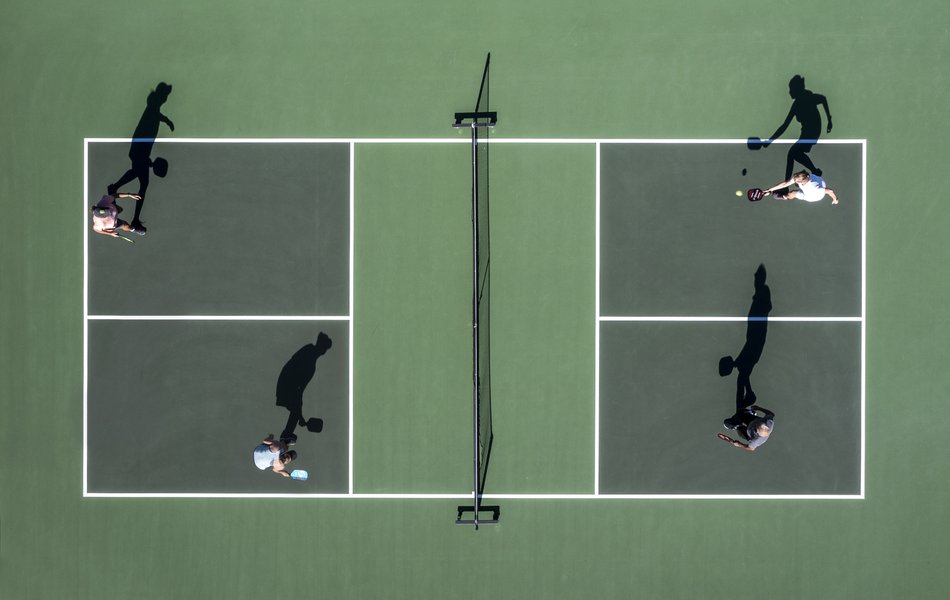
A standard pickleball court ready for action, adaptable for various 3-player formats.
Scoring in Cutthroat
Scoring in Cutthroat Pickleball can vary to ensure fairness and individual accountability. The most common method involves individual scoring, where each of the three players tracks their own points. The first player to reach 11 points, winning by at least two, is typically declared the winner. Alternatively, the single player scores points against the doubles team, with the doubles team scoring points against the single player. In some variations, only the serving player or team can score points, similar to traditional pickleball scoring. This keeps the game competitive and encourages strategic serving.
A comprehensive guide to playing Cutthroat Pickleball with three players.
This video provides a great visual demonstration of how Cutthroat Pickleball works. It highlights the dynamic nature of having one player cover an entire side against two opponents, emphasizing strategic positioning and shot selection. Understanding the flow of play from this visual aid can significantly enhance your ability to adapt to the unique challenges of Cutthroat, particularly concerning court coverage and anticipating your opponents' moves.
Rotation and Serving in Cutthroat
The rotation and serving rules are crucial for maintaining balance in Cutthroat. When playing with individual scoring, players typically take turns serving. A common rotation might involve Player A serving, then if a fault occurs, Player B serves, then Player C, and the rotation continues. In the 2v1 format, the single player serves until they commit a fault, then the serve goes to one of the doubles players. After their fault, the serve then rotates to the other doubles player, and finally back to the single player. This ensures that the serving advantage is shared fairly.
Pickleball Subs (Rotating Singles)
Pickleball Subs is another engaging three-player variation designed to keep all participants active. This format typically involves two players playing singles, with the third player "subbing in" after a predetermined condition, such as a point won by the server or a side-out. It allows for continuous play without anyone sitting out for too long, focusing on singles play but with a dynamic rotation element.
Gameplay Dynamics
In Pickleball Subs, two players engage in a singles match, while the third player waits off-court. When a specific condition is met (e.g., the server wins a point, or there's a side-out), the third player rotates in, often replacing the player who just lost the rally or the one who was serving. This keeps the intensity high and ensures that all three players get ample court time and touches on the ball. The specific rules for rotation can be customized by the players to suit their preferences.
Other 3-Player Variations
While Cutthroat and Pickleball Subs are the most common, other variations exist, or can be adapted, for three players. These often focus on drills or specific skill development:
- 2-on-1 Drills: This is an excellent practice method where two players work together against a single player. It can be used to improve defensive strategies for the single player and offensive coordination for the doubles team. It's not a full game, but a highly effective drill.
- King of the Court: This format involves one "king" player on one side, and two "challengers" on the other. The challengers try to dethrone the king by winning a set number of points or rallies. If they succeed, one of them becomes the new king. This variation is fast-paced and great for competitive spirits.
Rules and Adjustments for 3-Person Play
While the fundamental rules of pickleball remain consistent, playing with three people necessitates specific adjustments to ensure fair play, continuous engagement, and effective scoring. Understanding these modifications is key to a smooth and enjoyable 3-person pickleball experience.
Serving and Scoring Specifics
In traditional pickleball, the server announces three numbers: their team's score, the opponent's score, and the server number (1 or 2). For 3-person play, especially in formats like Cutthroat where individual scoring is common, this changes.
Individual Scoring
When tracking individual scores, each player's score is kept separately. For example, if Player A has 6 points, Player B has 7, and Player C has 2, the score might be called out as "A-6, B-7, C-2" or simply the server's score followed by the opponents' scores. The game is typically played to 11 points, winning by at least two, similar to standard pickleball. The challenge in 3-person scoring is ensuring all players remain aware of the current standings to adjust their strategy.
Serving Rotation
The serving rotation needs careful management in 3-person games. In Cutthroat, the single player serves until they fault. Then, the serve rotates to one of the doubles players, and after their fault, to the other doubles player, before returning to the single player. In other formats like Pickleball Subs, the rotation might be simpler: players serve in a predetermined sequence (e.g., Player 1, then Player 2, then Player 3) and continue to serve as long as they win points. Once they fault, the serve passes to the next player in the rotation.
Odd/Even Court Positioning
The concept of "even" and "odd" courts is vital in pickleball for proper player positioning, particularly for the server. In singles, the server serves from the right-hand court when their score is even and from the left-hand court when their score is odd. This rule generally applies to the single player in 3-person variations as well. For the doubles team in Cutthroat, traditional doubles positioning rules might apply, or they might adapt based on the flow of the game.
The "even" court is always the right side, and the "odd" court is the left side from the perspective of the serving player. This rule helps ensure fair play and consistency across different game formats.
Court Coverage and Out-of-Bounds
With only three players, court coverage becomes a critical strategic element. In Cutthroat, the single player must cover the entire court, which can be physically demanding but excellent for improving agility and court movement. The doubles team, while having the advantage of two players, must still communicate effectively to avoid collisions and ensure full court coverage without leaving gaps. Some variations might introduce specific out-of-bounds lines, such as making the centerline out of bounds on the server's side, to create unique challenges and emphasize precision.
Strategic Insights and Benefits
Playing pickleball with three players isn't just a way to fill a court; it's a fantastic opportunity to develop a more well-rounded game. The unique dynamics of these formats encourage players to refine individual skills, enhance strategic thinking, and improve court awareness.
Enhancing Individual Skills
The 2v1 aspect of formats like Cutthroat forces the single player to cover significantly more court, leading to improved agility, footwork, and stamina. This player gets extensive practice in hitting a variety of shots from different court positions, including defensive lobs, aggressive drives, and precise dinks. For the doubles team, it hones their communication and coordination, especially in covering the court and anticipating shots from a single, dynamic opponent. All players benefit from increased touches on the ball and more intense rallies.
Shot Selection and Placement
Strategic shot selection becomes paramount in 3-person pickleball. The single player needs to master placing shots effectively to make the two opponents move, exploiting gaps and forcing errors. The doubles team must work together to close down angles and anticipate the single player's moves, often focusing on depth and consistency. Practicing various shots—dinks, volleys, serves, returns, lobs, and overheads—is crucial for success in these formats.
Workout and Engagement
Three-person pickleball often results in a more intense workout compared to traditional doubles, especially for the single player in Cutthroat. The constant movement and extended rallies contribute to burning more calories and building endurance. For all players, the continuous engagement ensures that no one is sitting out for long, maximizing playtime and enjoyment. This makes it an excellent option for a focused, high-energy session.
Comparative Analysis of 3-Player Formats
To better understand the nuances of each 3-player format, let's compare them across several key attributes. This radar chart visually represents the strengths of each format, helping you choose the best option for your group.
The radar chart illustrates how different 3-person pickleball formats excel in various aspects. Cutthroat Pickleball stands out for its high strategic complexity and demanding court coverage, making it excellent for developing individual skill and tactical awareness. Pickleball Subs offers superior continuous player engagement, ensuring less downtime and more active participation for all three players. Meanwhile, 2-on-1 Drills are unparalleled for intense physical exertion and targeted individual skill development, though they might be less about a full "game" experience and more about practice. The "Ease of Scoring" metric reflects how straightforward the scoring system is to manage for each format.
Tips for a Successful 3-Person Game
Regardless of the format you choose, a few general tips can enhance your 3-person pickleball experience, making it more enjoyable and productive for all players involved.
Communication is Key
Especially for the doubles team in Cutthroat, clear communication is paramount. Call out shots, indicate who will take the ball, and strategize positioning. For the single player, communicating your intentions, even to yourself, can help maintain focus and court awareness. This also applies to managing the score and serving rotations.
Adapt and Be Flexible
Three-person pickleball is inherently about adaptation. Be flexible with rules and scoring if one format isn't working for your group. The goal is to have fun and get a good workout. Experiment with different rotation patterns or scoring methods to find what best suits your playing style and skill levels.
Focus on Drills and Skill Improvement
Even if you're playing a full game, treat 3-person pickleball as an opportunity to work on specific skills. The increased court time and varied situations allow for focused practice on dinking, volleying, serving accuracy, and defensive strategies. For instance, the single player can practice defending against multiple attackers, while the doubles team can hone their communication and court movement.
Comparison of Pickleball Formats by Player Count
Understanding how 3-person pickleball compares to traditional singles and doubles can help players appreciate its unique benefits and challenges. This table highlights key distinctions across various aspects of the game.
| Feature | Singles (2 Players) | Doubles (4 Players) | 3-Person Pickleball (Cutthroat/Australian) |
|---|---|---|---|
| Court Coverage | Extensive; one player covers entire court. | Shared; two players cover half each. | Hybrid; one player covers full court, two share other side. |
| Physical Exertion | Very High; constant movement. | Moderate; more strategic positioning. | High; especially for the single player. |
| Strategic Complexity | High; individual strategy and shot placement. | Very High; team coordination and communication. | High; combines individual and team tactics. |
| Scoring System | Server scores, two numbers (own-opponent). | Server scores, three numbers (own-opponent-server #). | Individual scoring (own-opponent-opponent) or 2v1 team scoring. |
| Player Engagement | Constant. | Consistent; less downtime. | Constant for single player, consistent for doubles team. |
| Skill Development Focus | Agility, endurance, all-court shots. | Teamwork, communication, volleying, dinking. | Hybrid; individual court coverage, team coordination, varied shot practice. |
Frequently Asked Questions
What is Cutthroat Pickleball?
How does serving work with 3 players?
Do I serve from the odd or even side in 3-person pickleball?
What are the benefits of playing pickleball with 3 players?
Conclusion
Playing pickleball with three players is not just a viable option when you're short on a fourth; it's an exciting and rewarding way to engage with the sport. Formats like Cutthroat (Australian Doubles) and Pickleball Subs offer dynamic gameplay that challenges players both physically and strategically. By adapting serving rotations, understanding modified scoring, and focusing on communication, you can ensure a fun and competitive experience for everyone on the court. These 3-person variations not only keep the game active but also provide excellent opportunities to sharpen individual skills, improve court awareness, and enjoy a more intense workout, making them a valuable addition to any pickleball enthusiast's repertoire.
Recommended Further Exploration
- Explore advanced strategies for optimizing play with an odd number of pickleball players.
- Discover effective pickleball drills specifically designed for three participants to improve skills.
- Learn about setting up a pickleball court at home and its suitability for three players.
- Deepen your understanding of fundamental pickleball scoring, including odd and even court positions.