
Unveiling Piston Dynamics: A Deep Dive into Reciprocating Engine Velocity
Explore the intricate motion of pistons and the forces that drive internal combustion engines.
Key Highlights of Piston Velocity
- Piston Velocity Varies: A piston's speed is constantly changing throughout its stroke, reaching zero at Top Dead Center (TDC) and Bottom Dead Center (BDC), and hitting maximum velocity at a point during the mid-stroke.
- Factors Influencing Velocity: Key parameters determining piston velocity include crankshaft rotational speed (RPM), crank radius, connecting rod length, and the instantaneous crank angle.
- Significance in Engine Design: Understanding piston velocity is crucial for evaluating engine stresses, G-loading on components, and optimizing performance and durability.
Reciprocating internal combustion engines are marvels of mechanical engineering, converting the linear motion of pistons into the rotational motion that powers vehicles and machinery. At the heart of this conversion lies the intricate dance between the piston, connecting rod, and crankshaft. Understanding the dynamics of this system, particularly the velocity of the piston, is paramount for engine design, performance analysis, and durability assessment.
Decoding Reciprocating Engine Mechanics
The Foundation of Piston Movement
A reciprocating engine, often referred to as a piston engine, is a heat engine that utilizes one or more pistons to transform high temperature and high pressure from combustion into a rotary motion. This process involves the repetitive up-and-down (or back-and-forth) linear movement of the piston, known as reciprocating motion. This linear motion is then converted into rotational motion by the crankshaft through a connecting rod.
The basic components involved in this kinematic chain include:
- Piston: The component that receives the force from the expanding gases during combustion and undergoes linear motion within the cylinder.
- Connecting Rod: A crucial link that connects the piston to the crankshaft. It transmits the compressive and tensile forces from the piston to the crankshaft, facilitating the conversion of linear motion to rotational motion.
- Crankshaft: The rotating shaft that converts the reciprocating motion of the pistons into useful rotary motion, which then drives the vehicle or other mechanical systems. A flywheel is often attached to the crankshaft to ensure smooth rotation and to store energy, carrying the engine through non-powered parts of its cycle.
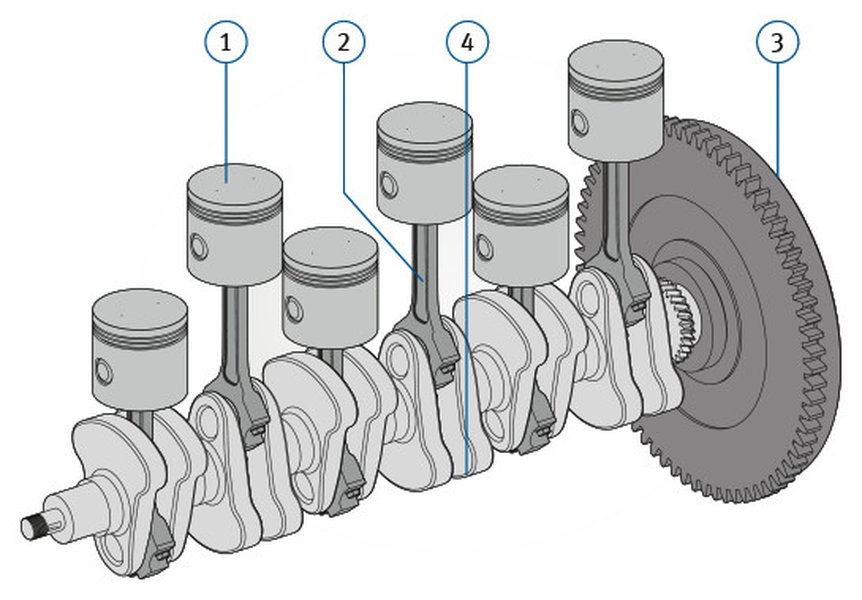
An illustration of the fundamental crank mechanism in a reciprocating engine.
The motion of the piston is not a simple harmonic motion due to the changing angle of the connecting rod throughout the crank's rotation. This angularity significantly influences the piston's instantaneous position, velocity, and acceleration.
Calculating Instantaneous Piston Velocity
Deriving the Velocity Equation
To determine the instantaneous velocity of a piston in the y-axis direction (along the cylinder bore centerline), we need to consider the geometry of the crank mechanism, which includes the crank radius, connecting rod length, and the crank angle. The equation for piston velocity, \(V_p\), can be derived as a function of these parameters.
Given the following parameters:
- Engine speed \(N = 6600 \text{ rev/min}\)
- Crank radius \(r = 41 \text{ mm}\)
- Connecting rod length \(L = 144 \text{ mm}\)
- Crankshaft angle from TDC \(\theta = 190^\circ\)
First, convert the given units to a consistent system, typically meters and seconds for velocity in m/s.
- Crank radius \(r = 41 \text{ mm} = 0.041 \text{ m}\)
- Connecting rod length \(L = 144 \text{ mm} = 0.144 \text{ m}\)
Next, convert the engine speed from revolutions per minute (RPM) to angular velocity in radians per second (\(\omega\)):
\[ \omega = N \times \frac{2\pi \text{ radians}}{\text{1 rev}} \times \frac{1 \text{ min}}{60 \text{ sec}} \] \[ \omega = 6600 \times \frac{2\pi}{60} \text{ rad/s} = 6600 \times \frac{\pi}{30} \text{ rad/s} \] \[ \omega \approx 691.15 \text{ rad/s} \]The ratio of the connecting rod length to the crank radius, often denoted as \(n\) or \(\lambda\), is also a critical parameter:
\[ \lambda = \frac{r}{L} = \frac{0.041 \text{ m}}{0.144 \text{ m}} \approx 0.2847 \]Or, often, the inverse ratio is used, \(R/S\) ratio, where \(R\) is rod length and \(S\) is stroke (2r).
\[ \text{Rod/Stroke Ratio} = \frac{L}{2r} = \frac{0.144 \text{ m}}{2 \times 0.041 \text{ m}} = \frac{0.144}{0.082} \approx 1.756 \]The instantaneous velocity of the piston, \(V_p\), can be calculated using the formula:
\[ V_p = \omega r \left( \sin\theta + \frac{\lambda \sin(2\theta)}{2\sqrt{1 - \lambda^2 \sin^2\theta}} \right) \]However, a more common and often simpler approximation for piston velocity, especially when the crank angle is far from 90 degrees, is given by:
\[ V_p = \omega r \left( \sin\theta + \frac{r}{2L} \sin(2\theta) \right) \]Let's use the second, more commonly applied formula for piston velocity, as it provides a good approximation and is widely adopted in engineering calculations.
Substitute the values into the formula:
- \(\omega = 691.15 \text{ rad/s}\)
- \(r = 0.041 \text{ m}\)
- \(\theta = 190^\circ\)
- \(L = 0.144 \text{ m}\)
First, calculate the trigonometric terms. Note that \(\sin(190^\circ)\) and \(\sin(2 \times 190^\circ) = \sin(380^\circ)\) are needed.
- \(\sin(190^\circ) \approx -0.1736\)
- \(\sin(380^\circ) = \sin(380^\circ - 360^\circ) = \sin(20^\circ) \approx 0.3420\)
Now, plug these values into the piston velocity equation:
\[ V_p = (691.15 \text{ rad/s}) \times (0.041 \text{ m}) \times \left( -0.1736 + \frac{0.041 \text{ m}}{2 \times 0.144 \text{ m}} \times 0.3420 \right) \] \[ V_p = 28.33715 \times \left( -0.1736 + \frac{0.041}{0.288} \times 0.3420 \right) \] \[ V_p = 28.33715 \times \left( -0.1736 + 0.14236 \times 0.3420 \right) \] \[ V_p = 28.33715 \times \left( -0.1736 + 0.04868 \right) \] \[ V_p = 28.33715 \times (-0.12492) \] \[ V_p \approx -3.54 \text{ m/s} \]Therefore, the velocity of the piston in the y-axis direction when the crankshaft has rotated 190° from TDC is approximately \(-3.54 \text{ m/s}\). The negative sign indicates that the piston is moving downwards at this point in its cycle.
Understanding the Significance of Piston Speed
Piston speed is a critical factor in engine performance and durability. While mean piston speed (average speed over a full rotation) provides a general indicator, instantaneous piston velocity and acceleration reveal the dynamic forces acting on engine components. High piston velocities are associated with increased friction, wear on piston rings, and significant loads on connecting rods and crankshafts. Modern engine technologies, including advanced materials and manufacturing processes for rods, bolts, and crankshafts, allow for higher operating velocities compared to older designs.
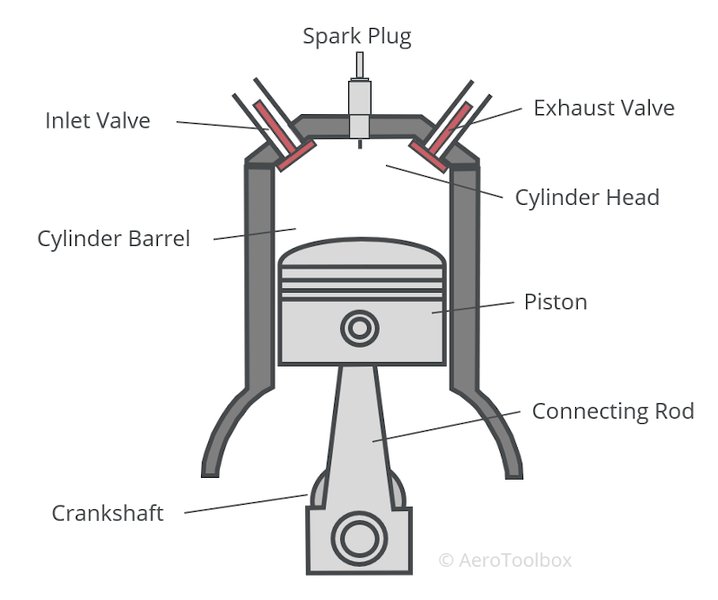
A schematic showing the piston, connecting rod, and crankshaft assembly within a cylinder.
Factors Influencing Piston Dynamics
The Interplay of Engine Components
Several interrelated factors significantly influence piston velocity and overall engine dynamics. These include:
Crank Radius and Stroke Length
The stroke length, which is twice the crank radius, directly dictates the distance the piston travels within the cylinder. A longer stroke generally leads to higher mean piston speeds for a given RPM, increasing the inertia forces on the reciprocating assembly. However, it can also contribute to better low-end torque.
Connecting Rod Length and Rod-to-Stroke Ratio
The ratio of the connecting rod length to the stroke length (\(L/2r\)) is crucial. A longer connecting rod (and thus a higher rod-to-stroke ratio) tends to reduce the side loading on the pistons, which can decrease friction and wear. It also increases the "dwell time" of the piston near Top Dead Center (TDC), allowing for more complete combustion and potentially improving efficiency. Conversely, a shorter connecting rod (lower rod-to-stroke ratio) results in greater angularity of the connecting rod, leading to higher instantaneous piston velocities and accelerations, especially around the mid-stroke, and increased side thrust on the cylinder walls.
A radar chart illustrating the relative impact of various engine parameters on piston dynamics and engine characteristics.
This chart provides a qualitative assessment of how varying these parameters might influence key engine characteristics. Higher RPM generally increases all dynamic aspects, while changes in stroke and connecting rod length have more nuanced effects on specific parameters.
Engine Speed (RPM)
Revolutions per minute (RPM) is perhaps the most direct determinant of piston speed. Higher RPMs naturally translate to higher piston velocities, leading to increased inertia forces and greater demands on the strength and durability of the reciprocating components, including pistons, connecting rods, and crankshafts. While higher RPMs can contribute to increased power output, they also elevate the risk of component failure if the engine is not designed to withstand the associated stresses.
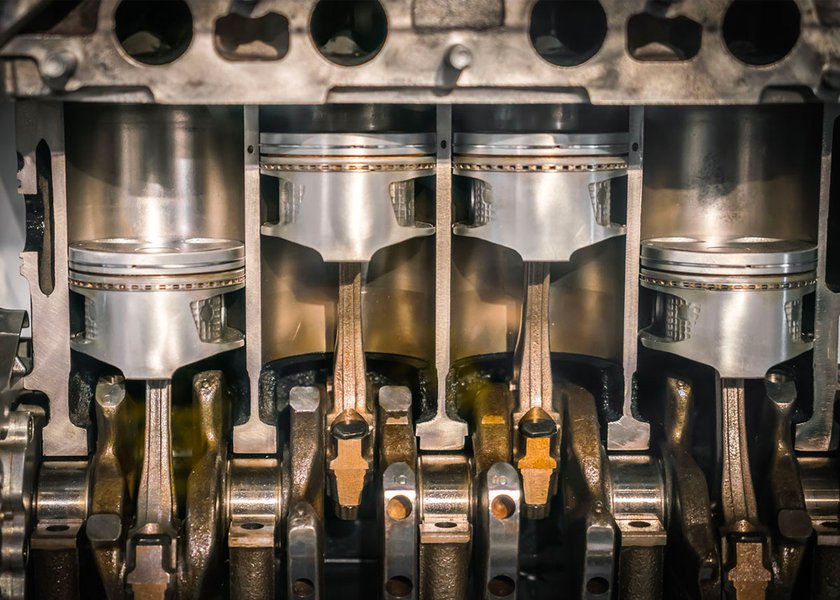
A cutaway view of an internal combustion engine, showing the intricate components.
Applications and Importance of Piston Velocity
Beyond Theoretical Calculations
Calculating piston velocity is not merely an academic exercise; it has profound practical implications in engine design and performance tuning.
Component Stress and Durability
The high velocities and rapid changes in direction experienced by the piston, connecting rod, and crankshaft generate significant inertia forces. These forces exert immense stress on the engine components. Engineers use piston velocity calculations to determine the required strength of these parts, ensuring they can withstand the G-loading and prevent fatigue or catastrophic failure. For example, high piston speeds can stretch connecting rods and resist crankshaft acceleration, potentially leading to part failure and limiting horsepower.
Engine Breathing and Volumetric Efficiency
Piston velocity also plays a role in how effectively an engine "breathes," influencing volumetric efficiency. High piston velocity promotes cylinder filling and exhaust scavenging when matched with proper intake/exhaust tract design and valve timing. This is why high-performance engines often feature shorter strokes and longer connecting rods to manage peak piston speeds while maximizing RPM and air intake.
Optimization of Engine Performance
Engine builders and designers carefully balance stroke, rod length, and RPM to optimize engine performance for specific applications. For instance, racing engines might prioritize high RPM capabilities and therefore aim for piston velocity characteristics that support rapid acceleration and high power output, even if it means higher stresses. Conversely, engines designed for durability and fuel efficiency might prioritize lower mean piston speeds to reduce wear and improve longevity.
| Parameter | Definition | Influence on Piston Velocity and Engine |
|---|---|---|
| Stroke Length (2r) | Total distance the piston travels from TDC to BDC. | Directly proportional to mean piston speed. Longer stroke increases inertia forces and can enhance low-end torque, but may limit max RPM due to high piston speeds. |
| Connecting Rod Length (L) | Distance between the center of the wrist pin and the center of the crank pin. | Affects piston side loading and dwell time at TDC/BDC. Longer rods reduce side forces and improve combustion efficiency but may require taller engine blocks. |
| Rod-to-Stroke Ratio (L/2r) | Ratio of connecting rod length to stroke length. | Higher ratios reduce piston acceleration, angularity of the rod, and side thrust. Lower ratios increase piston acceleration and side thrust, influencing engine vibrations and wear. |
| Engine Speed (RPM) | Revolutions per minute of the crankshaft. | Directly proportional to mean and instantaneous piston velocity. Higher RPM leads to higher dynamic stresses and demands on component strength. |
| Crank Angle (\(\theta\)) | Angular position of the crankshaft from TDC. | Determines the instantaneous piston position, velocity, and acceleration throughout the cycle. Piston velocity is zero at TDC (\(0^\circ\)) and BDC (\(180^\circ\)). |
Visualizing Piston Motion
The Continuous Cycle
The motion of a piston within a reciprocating engine is a continuous cycle of acceleration and deceleration. It momentarily stops at TDC and BDC, then accelerates to a maximum velocity somewhere near mid-stroke, before decelerating again. This complex motion, driven by the rotational movement of the crankshaft and the angularity of the connecting rod, is fundamental to how internal combustion engines operate.
This video provides a clear explanation and derivation of the average piston speed formula, helping to visualize how various parameters influence the piston's movement within an engine.
This video further elaborates on the concept of average piston speed and its calculation, providing a visual aid to grasp the mechanics discussed. While we calculated instantaneous velocity, the average speed helps in understanding the overall stress on the engine components over time.
Frequently Asked Questions (FAQ)
What is the difference between mean piston speed and instantaneous piston velocity?
Why does the piston velocity become zero at TDC and BDC?
How does connecting rod length affect piston motion?
What are the practical implications of high piston velocity?
Conclusion
The calculation of piston velocity is a fundamental aspect of understanding and designing reciprocating internal combustion engines. As demonstrated, for an engine operating at 6600 rev/min with a crank radius of 41 mm and a connecting rod length of 144 mm, the piston's velocity at a crankshaft angle of 190° from TDC is approximately -3.54 m/s. This value, particularly its negative sign, indicates the piston's downward motion at that specific point in its cycle. Beyond simple calculations, analyzing piston velocity and acceleration provides crucial insights into the dynamic stresses on engine components, informs material selection, and guides design choices aimed at optimizing engine performance, durability, and efficiency. The interplay between crank radius, connecting rod length, and engine speed dictates the complex kinematic and dynamic behavior of the piston assembly, highlighting the precision required in modern engine engineering.
Recommended Further Exploration
- How to calculate piston acceleration at any crank angle?
- What is the impact of rod to stroke ratio on engine performance and durability?
- What are the different forces acting on the connecting rod and crankshaft in a reciprocating engine?
- How does piston speed relate to engine volumetric efficiency and overall breathing?