
Unlocking Earth's Secrets: Porosity vs. Permeability Explained
Explore the crucial geological properties that control fluid storage and flow beneath our feet.
Porosity and permeability are two fundamental physical properties of geological materials like soil and rock. While often discussed together, they describe distinct characteristics that are vital for understanding how fluids, such as water, oil, or gas, are stored within and move through the Earth's subsurface. Grasping these concepts is essential across various scientific and engineering disciplines, including hydrogeology (groundwater studies), petroleum geology, environmental science, soil science, and civil engineering.
Key Insights at a Glance
Essential Takeaways
- Porosity Defines Storage: Porosity quantifies the total volume of empty space (pores) within a material, indicating its capacity to hold fluids.
- Permeability Governs Flow: Permeability measures the ease with which fluids can travel through interconnected pores, determining how readily a material transmits fluids.
- Distinct but Related: A material can have high porosity (lots of space) but low permeability if the pores aren't well-connected (e.g., clay), showing these properties don't always correlate directly.
Delving into Porosity: The Storage Capacity
What is Porosity?
Porosity (often denoted by 'n') is formally defined as the ratio of the volume of void spaces (pores) within a material to the total volume of that material. It's typically expressed as a percentage or a decimal fraction. These void spaces are the parts not occupied by solid particles and, under natural conditions, are usually filled with fluids like water or air.
Mathematically, it can be expressed as:
\[ \text{Porosity} (n) = \frac{\text{Volume of Voids (Pore Space)}}{\text{Total Volume}} \times 100\% \]Essentially, porosity tells us how much fluid a given volume of rock or soil can potentially hold. Materials like gravel or well-sorted sand often exhibit high porosity because their grains don't pack together perfectly, leaving substantial gaps.
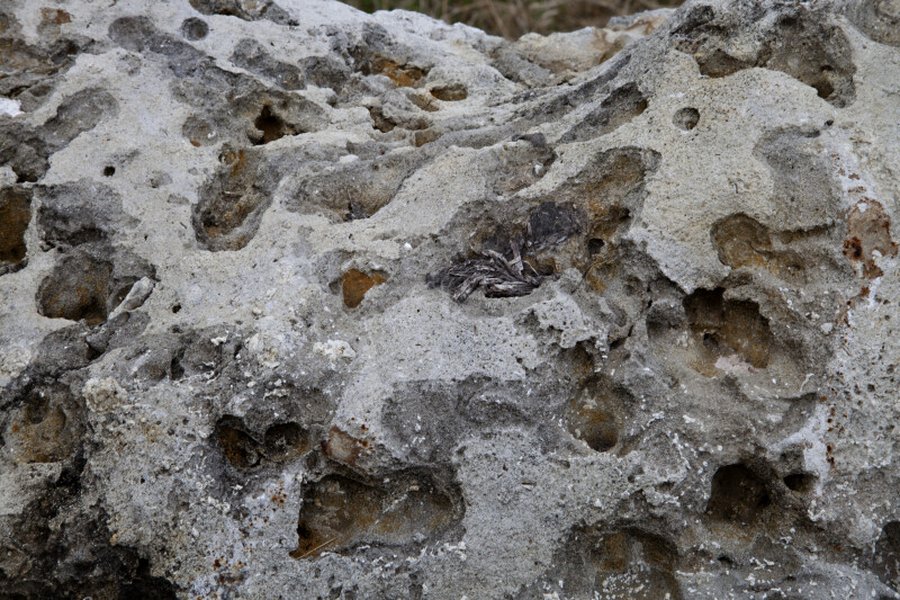
Close-up view illustrating the pores within a rock, contributing to its porosity.
Why is Porosity Important?
- Groundwater Storage: It determines the water-holding capacity of aquifers.
- Soil Health: Influences soil aeration, water retention for plants, and root penetration.
- Resource Extraction: Dictates the volume of oil or natural gas a reservoir rock can contain.
- Engineering: Affects the properties of materials used in construction and earthworks.
Factors Shaping Porosity
The porosity of a material isn't fixed; it's influenced by several interconnected factors related to its formation and subsequent history:
- Grain Size and Shape: Generally, materials with larger, more uniform, or angular grains tend to have higher porosity because they pack less efficiently, leaving larger voids. Rounded grains can pack more tightly.
- Sorting: Well-sorted materials (grains of similar size) typically have higher porosity than poorly sorted materials (a mix of sizes). In poorly sorted sediments, smaller grains fill the spaces between larger ones, reducing overall void space.
- Packing Arrangement: The way grains are arranged significantly impacts pore volume. Looser packing results in higher porosity, while tighter, more compacted packing reduces it.
- Cementation: During rock formation (diagenesis), minerals can precipitate out of groundwater and act as cement, binding grains together. This cement fills pore spaces, reducing porosity.
- Compaction and Depth: The weight of overlying sediments or rocks (overburden pressure) increases with depth. This pressure compacts the material, squeezing grains closer together and reducing pore space. Consequently, porosity generally decreases with depth.
- Fracturing and Dissolution: Processes occurring after formation, like the development of fractures or the dissolution of minerals by water, can create new void spaces (secondary porosity), increasing the overall porosity.
- Organic Matter: In soils, the presence and decomposition state of organic matter can influence porosity, sometimes increasing it by improving soil structure.

Soil structure illustrating the pore spaces vital for water retention and aeration.
Classifying Porosity: Origins and Types
Porosity can be broadly categorized based on its origin:
- Primary Porosity: This is the inherent porosity that exists when the rock or sediment initially forms.
- Intergranular Porosity: The space between individual grains in sedimentary rocks like sandstone or unconsolidated sediments like sand and gravel. This is highly dependent on grain size, shape, sorting, and packing.
- Intragranular Porosity: Pore space existing within individual grains or fossil fragments.
- Vesicular Porosity: Holes (vesicles) formed by gas bubbles trapped in volcanic rocks as they cool.
- Secondary Porosity: This type develops after the initial formation of the material due to subsequent geological processes.
- Fracture Porosity: Openings created by cracks and fractures in otherwise solid rock. This can significantly increase the effective porosity and permeability of dense rocks.
- Solution Porosity (Vuggy Porosity): Pores formed or enlarged when minerals within the rock are dissolved by circulating water, common in carbonate rocks like limestone. These can range from small pores to large caverns.
Understanding Permeability: The Flow Facilitator
What is Permeability?
Permeability (often denoted by 'k') measures the ability of a porous material to allow fluids to pass through it. It quantifies how easily fluids can flow through the interconnected network of pores. High permeability means fluids move easily (like through gravel), while low permeability means fluid movement is restricted (like through clay). It depends critically on the size, shape, and, most importantly, the interconnectedness of the pore spaces.
Permeability is often measured in units called Darcies (D) or milliDarcies (mD). While porosity relates to storage, permeability relates to transport or flow rate.
Why is Permeability Important?
- Groundwater Flow: Controls the rate at which groundwater moves through aquifers and recharges.
- Water Wells & Springs: Determines how much water can be extracted from a well or discharged by a spring.
- Oil and Gas Production: Dictates the rate at which hydrocarbons can flow from reservoir rocks to production wells.
- Contaminant Transport: Influences how quickly pollutants can spread through soil and groundwater.
- Engineering and Agriculture: Affects drainage, irrigation efficiency, and the stability of earth structures.

Permeability allows fluids, like this water droplet, to move through the soil.
Factors Governing Permeability
Permeability is sensitive to various physical characteristics of the material and the fluid flowing through it:
- Pore Size and Connectivity: This is the most critical factor. Larger, well-connected pores provide easier pathways for fluid flow, resulting in higher permeability. Even if a material has high porosity, if the pores are isolated or very small (like in clay), permeability will be low.
- Particle Size and Sorting: Similar to porosity, larger grain sizes generally lead to larger pore throats (connections between pores) and thus higher permeability. Well-sorted materials tend to be more permeable than poorly sorted ones.
- Shape and Orientation of Grains: The shape and alignment of particles can influence the tortuosity (the winding nature of flow paths) and size of pore channels.
- Fractures and Cracks: Natural fractures can dramatically increase the permeability of otherwise low-permeability rocks by providing large, direct conduits for flow.
- Compaction and Cementation: These processes reduce pore size and block connections between pores, significantly decreasing permeability. Permeability generally decreases with depth due to compaction.
- Degree of Saturation: The presence of multiple fluids (e.g., air and water, or oil and water) in the pore space can interfere with flow, reducing the effective permeability to any single fluid compared to when the material is fully saturated with just one fluid.
- Fluid Properties: The viscosity and density of the fluid affect its flow rate. More viscous fluids flow more slowly through the same material under the same pressure gradient.
- Temperature and Pressure: Changes in temperature and pressure can alter fluid viscosity and potentially affect the rock structure (e.g., swelling of clay minerals), thereby influencing permeability.
Understanding Permeability Concepts
While not strictly "types," different concepts help describe permeability in specific contexts:
- Absolute Permeability: The intrinsic permeability of a material measured when it is 100% saturated with a single fluid (like water or air). It represents the maximum flow capacity of the medium itself.
- Effective Permeability: The permeability of a material to a specific fluid when other immiscible fluids are also present in the pore space. For example, the effective permeability to oil in a reservoir containing both oil and water will be lower than the absolute permeability.
- Relative Permeability: The ratio of the effective permeability of a fluid to the absolute permeability. It's a dimensionless value between 0 and 1, indicating how the presence of other fluids hinders the flow of the fluid of interest. It's crucial in multiphase flow scenarios (e.g., oil/water/gas systems).
- Anisotropic Permeability: Permeability can differ depending on the direction of measurement, especially in layered sedimentary rocks or fractured rocks where flow is easier along layers or fractures than across them.
The Interplay: Porosity and Permeability Relationship
Connected Yet Distinct
Porosity and permeability are intimately related because fluid flow (permeability) occurs within the pore spaces (porosity). Generally, for permeability to exist, there must be porosity. However, high porosity does not automatically guarantee high permeability.
The critical factor linking them is pore connectivity. Consider these examples:
- Gravel: High porosity (large gaps between large grains) AND high permeability (gaps are well-connected).
- Sand: Good porosity (spaces between grains) AND good permeability (spaces are generally well-connected).
- Clay: Can have very high porosity (lots of tiny spaces within its structure) BUT very low permeability (pores are extremely small and poorly connected, water molecules adhere strongly to clay surfaces, restricting flow).
- Pumice (Volcanic Rock): High porosity (many vesicles) BUT low permeability if the vesicles are not interconnected.
Therefore, while porosity measures the potential storage volume, permeability measures the actual ability to transmit fluids through that volume. Both must be considered when evaluating how fluids will behave in a geological material.
Visualizing Key Factors: Porosity vs. Permeability
Relative Influence Assessment
The following chart provides a conceptual comparison of the relative importance of various factors on porosity and permeability. The scores (ranging notionally from 2 to 10, where higher means more influence) are based on general geological principles rather than specific data, illustrating tendencies. Note that the actual influence can vary greatly depending on the specific material and conditions.
This visualization highlights, for example, the paramount importance of Pore Connectivity for permeability, while factors like Packing Density might have a slightly stronger relative influence on porosity compared to permeability.
Summarizing the Concepts: A Mindmap Overview
Connecting the Dots
This mindmap provides a structured overview of porosity and permeability, linking their definitions, types, influencing factors, and their fundamental relationship. It serves as a quick reference to the core ideas discussed.
(Storage Capacity)"] P_Def["Definition: % Void Space"] P_Factors["Factors"] P_F1["Grain Size & Shape"] P_F2["Sorting"] P_F3["Packing"] P_F4["Cementation"] P_F5["Compaction/Depth"] P_F6["Fractures"] P_Types["Types"] P_T1["Primary
(Intergranular, Intragranular, Vesicular)"] P_T2["Secondary
(Fracture, Solution/Vuggy)"] P_Imp["Importance
(Storage, Soil Health, Resources)"] K["Permeability
(Flow Ability)"] K_Def["Definition: Ease of Fluid Flow"] K_Factors["Factors"] K_F1["Pore Connectivity"] K_F2["Pore Size"] K_F3["Grain Size & Sorting"] K_F4["Fractures"] K_F5["Cementation/Compaction"] K_F6["Saturation"] K_F7["Fluid Properties"] K_Concepts["Concepts"] K_C1["Absolute"] K_C2["Effective"] K_C3["Relative"] K_C4["Anisotropic"] K_Imp["Importance
(Flow Rate, Wells, Contaminants)"] Rel["Relationship"] Rel_1["Distinct but Related"] Rel_2["High Porosity != High Permeability"] Rel_3["Connectivity is Key"] Rel_4["Example: Clay (High P, Low K)"]
Factor Comparison: Porosity vs. Permeability
Side-by-Side Influence
The following table summarizes the key factors discussed and their general impact on both porosity and permeability. Understanding how these factors interact helps in predicting the behavior of fluids in different geological settings.
| Factor | Impact on Porosity | Impact on Permeability | Notes |
|---|---|---|---|
| Grain Size | Larger grains can lead to higher porosity if well-sorted. | Larger grains generally lead to significantly higher permeability (larger pore throats). | Sorting plays a crucial role alongside size. |
| Grain Sorting | Well-sorted (uniform size) generally increases porosity. | Well-sorted generally increases permeability. | Poor sorting reduces both as small grains fill voids. |
| Packing | Looser packing increases porosity. | Looser packing generally increases permeability. | Compaction leads to tighter packing. |
| Pore Connectivity | Less direct impact on total pore volume (porosity). | Critically important: Directly determines permeability. Poor connectivity = low permeability. | The key differentiator between high P and high K. |
| Cementation | Reduces porosity by filling voids. | Significantly reduces permeability by blocking pores and connections. | Common during rock formation (diagenesis). |
| Fracturing | Increases porosity (adds secondary pore volume). | Can dramatically increase permeability, especially in dense rocks. | Creates preferential flow paths. |
| Compaction / Depth | Decreases porosity due to pressure closing pores. | Decreases permeability due to reduced pore size and connectivity. | Both properties generally decrease with depth. |
| Clay Content | Can increase porosity (micropores) but often reduces effective porosity accessible to flow. | Significantly reduces permeability due to small, poorly connected pores and surface effects. | Clay minerals can also swell when wet, further reducing K. |
Visual Introduction: Porosity and Permeability Fundamentals
Understanding the Basics
This video provides a clear introduction to the fundamental concepts of porosity and permeability. It explains what each property represents and visually demonstrates how they relate to the arrangement of particles in materials like soil and rock, controlling how much fluid can be stored and how easily it can move. Understanding these basics is crucial before delving into more complex factors and applications.
Frequently Asked Questions (FAQ)
Clarifying Common Queries
1. Can a rock have high porosity but low permeability?
Absolutely. A classic example is clay or shale. These materials can have a very high percentage of void space (high porosity) due to their structure. However, the individual pores are extremely tiny and poorly interconnected. This lack of connection severely restricts the ability of fluids like water to flow through the material, resulting in very low permeability. Pumice is another example where pores (vesicles) might be abundant but isolated.
2. What's the difference between primary and secondary porosity?
Primary porosity is the pore space that exists when the rock or sediment originally forms. This includes the spaces between grains in sandstone (intergranular porosity) or the bubbles in volcanic rock (vesicular porosity). Secondary porosity develops *after* the rock has formed, due to processes like fracturing (creating cracks) or dissolution (minerals dissolving away, enlarging pores or creating new cavities like vugs). Secondary porosity can significantly alter a rock's ability to store and transmit fluids.
3. How does depth affect porosity and permeability?
Generally, both porosity and permeability tend to decrease with increasing depth below the Earth's surface. The primary reason is compaction: the weight of the overlying rock and sediment (overburden pressure) squeezes the grains closer together, reducing the volume of pore space (lower porosity) and closing off the connections between pores (lower permeability). Cementation processes can also be more prevalent at depth, further reducing both properties.
4. What are Darcy's Law and its relation to permeability?
Darcy's Law is a fundamental equation in hydrogeology and fluid dynamics that describes the flow of a fluid through a porous medium. It states that the flow rate (discharge) is proportional to the pressure gradient (how much pressure changes over distance) and the cross-sectional area of flow, and inversely proportional to the fluid's viscosity. The constant of proportionality in this relationship is the permeability (k) of the medium. Thus, permeability is the material property defined by Darcy's Law that quantifies how easily fluid flows under a given pressure gradient.
Recommended Further Exploration
Deepen Your Understanding
- How is permeability measured in the lab and field?
- What is Darcy's Law and how does it relate to groundwater flow?
- Explain effective and relative permeability in multiphase flow.
- How do porosity and permeability affect aquifer characteristics?
References
Sources Consulted
 sitesmedia.s3.amazonaws.com
Last updated April 29, 2025