
Navigating Potholes Safely
Understanding speed, tire dynamics, and safe driving practices
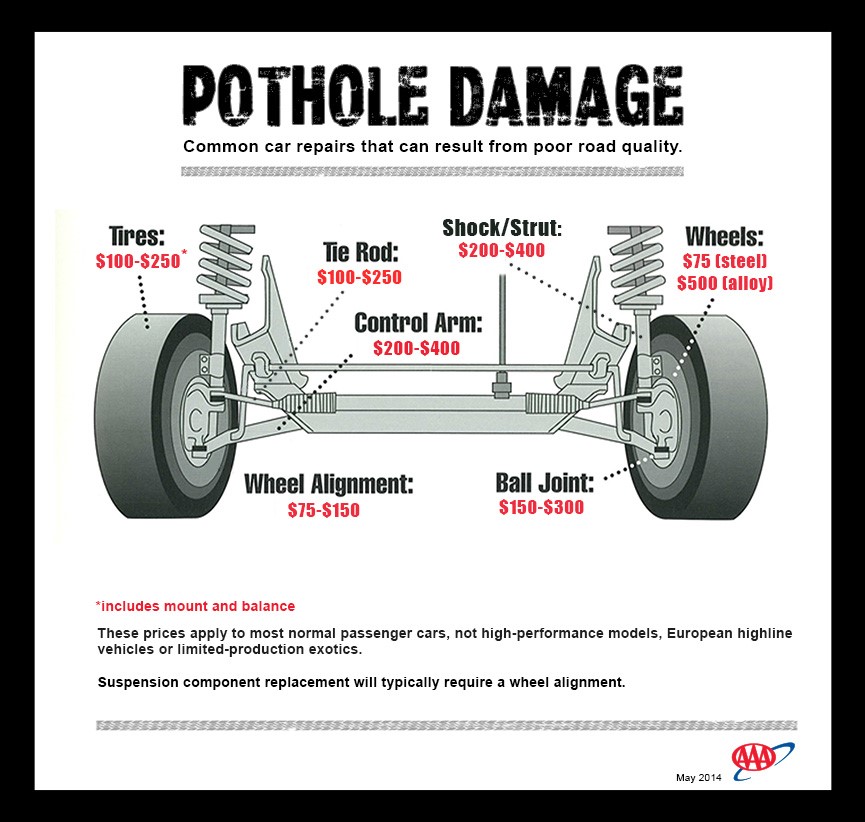
Key Highlights
- Slow Down Ahead – Reducing speed before the pothole minimizes impact forces on tires and suspension.
- Steady, Controlled Speed – Maintaining a constant speed through the pothole prevents additional compression of the tire.
- Consider Multiple Factors – Pothole characteristics, tire size and design, vehicle dynamics, and proper maintenance are all crucial.
Understanding the Impact Dynamics
When a vehicle strikes a pothole, the impact force experienced depends on several factors. Although no precise formula exists that directly relates the pothole width L and the tire size D to an optimum speed for minimal damage, experts agree on several best practices that collectively reduce the risk of tire and suspension damage. The damage a tire may incur, ranging from sidewall bulges and punctures to alignment issues, is not solely dependent on the impact speed but also on the structural design of the tire and the characteristics of the pothole.
Key Factors Influencing Impact Duration and Severity
Pothole Characteristics
The size, shape, and depth of a pothole determine how much the tire will be disturbed during impact. A deeper pothole increases the likelihood of severe deformation in the tire structure. Although the width L is a component, it is often the depth and irregularity that have a more pronounced effect on the stress experienced by the tire.
Tire Dimensions and Characteristics
Tire size D generally refers to the overall diameter, which is associated with the tire’s ability to absorb shock. Larger tires with higher sidewall profiles typically offer more cushioning than smaller, low-profile tires. However, the material properties and inflation pressure also critically influence the tire’s performance when traversing a pothole.
Vehicle Dynamics and Speed
The speed at which you approach and drive over a pothole dramatically affects the impact force. In physics, impact forces increase with speed, meaning that the kinetic energy transferred to the tire at the moment of impact becomes significantly higher at increased speeds. Even if a vehicle’s speed is well below the maximum limit (130 km/h), the abrupt interaction with a pothole can lead to substantial forces that translate into lasting damage.
General Recommendations for Driving Over Potholes
Given the lack of a specific formula based on L and D, the best strategy is to focus on practical advice established by automotive experts:
Slowing Down and Steady Driving
Reduce Speed in Advance
It is critical to lower your vehicle’s speed well before approaching a pothole. Many road safety guides recommend reducing speed to around 20-30 km/h in areas where potholes are common. This reduction ensures that the tires and the suspension system have ample time to adjust and absorb the incoming shock.
Maintain Constant Speed During Impact
Once you have slowed down and if you are unable to avoid the pothole, it is best to maintain a constant and moderate speed. Avoid braking mid-pothole because sudden deceleration can cause an uneven distribution of forces and possibly further impact the vehicle’s suspension dynamics. The goal is to allow a controlled contact with the pothole, letting the tire’s design and proper inflation manage the energy transfer.
Tire and Vehicle Considerations
Proper Inflation
Ensuring that tires are inflated to the manufacturer’s recommended pressure enhances their ability to absorb shocks. Under-inflated tires are more prone to damage because they lack the necessary rigidity to resist deformation. This is especially important when encountering uneven road surfaces, like potholes.
Suspension and Alignment
The vehicle’s suspension system plays a critical role in cushioning impacts. Regular checks and maintenance of suspension components are advisable as they directly affect how force is transmitted from the tire to the car’s chassis. Additionally, a well-aligned vehicle will respond more predictably when encountering potholes.
A Conceptual Table of Considerations
The following table summarizes the core factors and recommendations to consider when approaching and dealing with potholes:
| Factor | Impact on Tire and Vehicle | Recommendation |
|---|---|---|
| Pothole Depth | Deeper potholes cause higher impact forces | Reduce speed well before impact |
| Pothole Width (L) | Influences contact duration | Drive at a constant, controlled speed |
| Tire Size (D) and Profile | Larger tires can absorb shocks better | Match driving style to tire capabilities; ensure proper inflation |
| Vehicle Speed | Higher speeds increase kinetic energy | Aim for speeds of 20-30 km/h when encountering potholes |
| Braking | Sudden braking can exacerbate force transfer | Avoid braking at the moment of impact |
| Suspension System | Helps absorb and distribute impact forces | Ensure regular maintenance and proper alignment |
Analyzing Speed Considerations
A conceptual analysis of the speed to traverse a pothole involves considering the vehicle’s dynamics. When approaching a pothole, the goal is to limit the additional kinetic energy transferred into the tire and suspension system. Although advanced vehicular dynamics models might attempt to relate the optimal speed to pothole dimensions (such as width, L) and tire size (D), the consensus among automotive specialists is to rely on conservative, experience-based guidelines.
Physics Behind the Impact
The kinetic energy of a vehicle is given by \( \displaystyle \frac{1}{2} m v^2 \), where \( \displaystyle m \) is the mass of the vehicle and \( \displaystyle v \) is the velocity. Even a small increase in speed results in a quadratic increase in kinetic energy, which is then partially transferred to the tire when hitting a pothole. Hence, reducing the speed greatly reduces the energy that must be dissipated during the impact. This formula illustrates why driving at speeds significantly lower than 130 km/h is crucial when navigating a pothole.
Practical Speed Guidelines
Taking into account both practical driving experience and theoretical kinetic energy considerations, the widely recommended speed when approaching potholes falls between 20 km/h and 30 km/h. This range is low enough to diminish the damage potential and high enough to maintain vehicle control during the impact. In contrast, driving at high speeds—even at levels as high as 130 km/h—is far too dangerous and likely to cause severe damage if a pothole is encountered.
Maintaining Consistent Speed Over the Pothole
Beyond just slowing down, maintaining a consistent speed as you drive over the pothole is essential. Abrupt changes in speed, including sudden braking, can lead to uneven loading of the tire’s structure. Maintaining steady contact with the road surface reduces the shock experienced by the tire and the suspension system. Such measures can help ensure that any impact is absorbed in the most controlled manner possible.
Synthesis and Engineering Perspectives
While there is no single “optimum” speed guaranteed to eliminate damage, the convergence of expert recommendations from automotive literature indicates that slowing down to about 20-30 km/h while retaining steady vehicle dynamics is the best operational practice. This speed range minimizes the force transmitted to the tire and allows the vehicle's suspension system and tire structure to absorb the shock efficiently.
Why Mathematical Formulation is Elusive
The problem of determining an optimum speed based on pothole width \( L \) and tire size \( D \) involves complex dynamics including impact duration, material properties, and the transient response of the suspension system, none of which lend themselves to a simple closed-form equation. In engineering practice, simulations and empirical tests are used to predict outcomes, but for everyday drivers, it is more effective to follow the conservative speed guidelines provided.
Expert Advice Synopsis
The aggregated expert advice leads to a practical strategy:
- Reduce speed in advance. Identify potholes and slow your vehicle to within the 20-30 km/h range.
- Avoid sudden, harsh braking right before or during the pothole impact to allow for a smooth transit.
- Maintain consistent speed throughout the encounter. This consistency helps distribute the forces evenly across the tire and suspension.
- Ensure tires are properly inflated and the vehicle’s suspension is in good condition as a preventive measure against severe damage.
Additional Considerations
While the aforementioned guidelines are primarily aimed at mitigating immediate damage, there are additional considerations worth noting:
Regular Vehicle Inspections
Intermittent inspections by a professional mechanic can identify subtle damages that might not be immediately visible after hitting a pothole. Early detection of tire damage, bent rims, or misaligned suspensions allows for prompt repairs and prevents future complications.
Seasonal and Environmental Factors
Pothole frequency and severity often increase during certain seasons or after adverse weather events. In winter or during heavy rains, pay extra attention to road conditions and adjust your driving style accordingly. It may be necessary to further reduce speeds under these circumstances, even within the safe operating range.
Driver Awareness and Road Behavior
Effective safe driving also involves being aware of your surroundings and anticipating road imperfections. Enhanced driver awareness can help in identifying potholes earlier and making proactive adjustments to speed.
Summary of Optimum Conditions for Pothole Navigation
| Condition | Recommended Action | Rationale |
|---|---|---|
| Approaching a Pothole | Slow down to 20-30 km/h | Reduces kinetic energy and impact force |
| Driving Over the Pothole | Maintain a steady, controlled speed | Avoids force spikes from abrupt deceleration |
| Tire Inflation | Maintain recommended pressure | Enables optimal shock absorption |
| Vehicle Inspection | Regular checks for tire/suspension damage | Prevents accumulation of hidden damage |
| Driver Awareness | Watch for road imperfections | Enables early intervention and speed adjustment |
References
- How to Avoid Tire Sidewall Damage from Potholes? - Priority Tire
- Mastering Pothole Impact: Expert Guide to Assessing Tire Damage - Tires Easy
- Pothole Tire Damage - SimpleTire
- Avoid Pothole Damage - AAA
- Does Hitting a Pothole Damage My Tires? - Les Schwab
Recommended Searches
Last updated March 6, 2025