
Navigating the Unseen Influence: Understanding Pragmatic Transfer in Second Language Acquisition
Unpacking how native language conventions shape communication in a new linguistic landscape.
Key Insights into Pragmatic Transfer
- Definition: Pragmatic transfer is the application of an individual's native language (L1) pragmatic knowledge and conventions to a second language (L2), influencing both comprehension and production in the L2.
- Types: It primarily manifests as pragmalinguistic transfer (transfer of linguistic forms for pragmatic functions) and sociopragmatic transfer (transfer of social norms and cultural values dictating appropriate language use).
- Impact: While it can lead to positive transfer (facilitating communication), it often results in negative transfer or pragmatic failures, causing misunderstandings and communication breakdowns due to differing cultural norms.
Pragmatic transfer stands as a pivotal concept within the fields of second language acquisition (SLA) and intercultural communication. It illuminates how an individual's deep-seated understanding of their first language's (L1) social and contextual rules for communication inadvertently influences their use and interpretation of a second language (L2). Beyond merely grammar and vocabulary, pragmatics delves into the nuances of language use—how context shapes meaning, how speakers convey intentions, and how social dynamics dictate appropriate linguistic choices. When this intricate system from the L1 is carried over to the L2, it can lead to a fascinating array of communicative outcomes, ranging from seamless integration to significant cross-cultural misunderstandings.
The Essence of Pragmatic Transfer
At its core, pragmatic transfer describes the phenomenon where learners apply the communicative norms, conventions, and strategies from their native linguistic and cultural background to their interactions in a new language. This process is often unconscious but profoundly impacts how non-native speakers comprehend, produce, and learn pragmatic information in the L2. It is a critical component of a language user's overall communicative competence, affecting how verbal actions are understood and performed under various contextual and discoursal constraints.
Delving into Pragmalinguistic and Sociopragmatic Transfer
To fully grasp pragmatic transfer, it is essential to differentiate between its two primary forms:
Pragmalinguistic Transfer: The Form of Expression
Pragmalinguistic transfer pertains to the direct application of linguistic forms used to express pragmatic functions from the L1 to the L2. This involves the literal linguistic realization of an utterance. For example, a learner might directly translate a polite phrase or a specific request structure from their L1 into the L2. While the resulting utterance might be grammatically correct, its pragmatic force or appropriateness might be skewed. This can manifest in directness levels, formulaic expressions, or the use of specific lexical items that carry different pragmatic weight in the L2.
Sociopragmatic Transfer: The Social Fabric of Communication
Sociopragmatic transfer, conversely, involves the carryover of social perceptions, cultural norms, and interactional rules that underpin the interpretation and performance of linguistic actions. This type of transfer relates to what is considered appropriate to say or do in a given social context, taking into account factors such as social distance, relative power between interlocutors, and the degree of imposition of a speech act. For instance, a learner might apply their L1 cultural norms regarding directness in requests, leading to a request that is perceived as too blunt or, conversely, overly indirect and ambiguous in the L2 context.
The distinction between these two types is fundamental to understanding the multifaceted nature of pragmatic transfer and its implications for effective communication.
This radar chart illustrates the perceived impact and prevalence of different types of pragmatic transfer and related concepts. Each axis represents a specific dimension, with the inner circle indicating lower perceived influence and the outer circle representing higher influence. The chart highlights how factors like proficiency level and exposure contribute to the complexity of pragmatic transfer, showing that while some aspects are universally impactful, others vary in their manifestation.
Factors Shaping Pragmatic Transfer
The occurrence and nature of pragmatic transfer are influenced by a complex interplay of learner-internal and external factors. These variables dictate whether transfer is likely to occur, its type, and its ultimate effect on communication.
Proficiency Level: A Counterintuitive Connection
Interestingly, research suggests a nuanced relationship between L2 proficiency and pragmatic transfer. While one might assume that higher proficiency would lead to less transfer, studies indicate that more proficient L2 learners might actually exhibit more pragmatic transfer from their native language. This is because greater linguistic proficiency provides them with the means to express more subtle and complex meanings, allowing them to implement their L1 pragmatic norms more effectively within the L2 framework. A beginner, lacking the necessary linguistic tools, might be more constrained in their ability to transfer complex pragmatic patterns.
Length of Residence and Exposure: Immersion's Role
The duration an L2 learner spends immersed in the target language community significantly influences the extent and type of pragmatic transfer. Extended exposure to authentic L2 interactions and cultural norms can gradually reduce negative transfer and foster the development of target-like pragmatic behavior. Conversely, limited exposure, such as learning primarily in a formal classroom setting without significant real-world interaction, may perpetuate reliance on L1 pragmatic patterns.
Context of Acquisition: Classroom vs. Immersion
The environment in which the L2 is learned plays a crucial role. Learning in a formal classroom setting, while providing grammatical and lexical foundations, may not always offer sufficient opportunities for developing pragmatic competence, leading to a greater reliance on L1 pragmatic strategies. Naturalistic settings, such as living in the target language country, provide richer and more varied pragmatic input, which can mitigate negative transfer.
Perceived Cultural Distance and Individual Attitudes
A learner's perception of how distant their native culture's pragmatic norms are from the target culture's norms can affect transfer. If cultures are perceived as pragmatically similar, positive transfer might be more likely. Furthermore, a learner's willingness to adopt the target language's sociocultural values and their openness to new ways of interacting significantly impacts their pragmatic performance. Learners who are more acculturated may adapt more readily to L2 pragmatic norms.
The Ramifications of Pragmatic Transfer
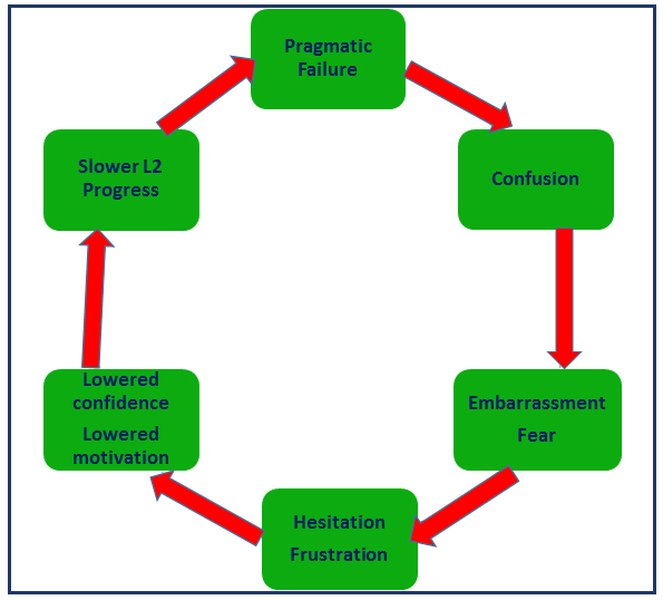
The consequences of pragmatic transfer can range from facilitating communication to creating significant barriers, often leading to what is termed "pragmatic failure."
This image depicts a student's confusion in a classroom setting, symbolizing the challenges learners face when pragmatic rules differ between languages. It underscores the importance of explicit instruction in fostering pragmatic competence.
Positive Transfer: When L1 Helps L2
Positive transfer occurs when the pragmatic rules and conventions of the L1 align with those of the L2. In such cases, the learner's L1 pragmatic knowledge can facilitate smoother and more appropriate communication in the L2, leading to effective interactions. This can be observed when speech act strategies or politeness conventions are similar across both languages, allowing the learner to transfer their existing skills successfully.
Negative Transfer (Pragmatic Failure): The Roadblock to Communication
Negative transfer, or pragmatic failure, is more commonly discussed because it arises when the pragmatic rules of the L1 conflict with those of the L2. This often leads to misunderstandings, communication breakdowns, and potentially affects the rapport between interlocutors. Pragmatic failures can manifest as:
- Misinterpretations: Learners might misinterpret indirect speech acts or subtle contextual cues based on their L1 norms.
- Inappropriate Responses: For instance, responding to compliments or apologies in ways that are culturally acceptable in their L1 but perceived as rude or odd in the L2.
- Literal Translations: Producing literal translations of L1 pragmatic formulas, which might sound unnatural or even offensive in the L2 context (e.g., a direct refusal that is considered impolite).
- Overuse or Avoidance: Using certain pragmatic forms excessively (overuse) or avoiding them altogether (avoidance) due to L1 influence.
These failures are not merely grammatical errors; they are violations of sociolinguistic rules, leading to unintended meanings or social awkwardness. For example, a Chinese learner of English might respond to a compliment with a self-deprecating comment, a common pragmatic norm in Chinese culture, which could be misinterpreted as a lack of confidence or even ungraciousness in an English-speaking context.
Research and Examples of Pragmatic Transfer
The study of pragmatic transfer is a dynamic field, often employing interdisciplinary approaches from linguistics, psychology, and sociology to understand its complexities. Empirical studies frequently focus on the realization of specific speech acts.
Speech Act Realization Studies
A common approach within interlanguage pragmatics is to examine how specific speech acts, such as requests, apologies, refusals, and compliments, are performed by L2 learners. These studies compare learners' performances with those of native speakers and L1 speakers to identify patterns of transfer. For instance, research on Chinese learners of English writing email requests and refusals has shown how L1 pragmatic patterns can lead to pragmatic failures in cross-cultural communication.
Examples in Specific Contexts
- Compliment Responses: A classic example involves non-native English speakers responding to compliments in ways that mirror L1 norms, such as deflecting or downgrading the compliment, which might not align with typical English-speaking conventions.
- Quantifier Usage: Studies on bilinguals, such as Italian learners of Slovenian, have shown negative transfer in the use of quantifiers (e.g., "many" vs. "a lot"), where L1 pragmatic knowledge influences the acquisition of subtle distinctions in the L2.
- Indirectness: The degree of directness considered appropriate in requests or statements can vary significantly across cultures. A learner might use an indirect request that is the norm in their L1, but which could be ambiguous or even misunderstood in the L2.
The Interplay of Language and Culture
Pragmatic transfer underscores the intricate connection between language, culture, and social interaction. It highlights that language acquisition is not merely about mastering grammatical rules and vocabulary but also about understanding the cultural scripts that govern how language is used in real-world contexts. Miscommunication due to pragmatic transfer is a significant concern in intercultural communication, as it can inadvertently lead to misjudgments of character, intentions, or politeness.
This mindmap visually organizes the core concepts surrounding pragmatic transfer, illustrating its definition, types, influencing factors, and impact. It shows how various elements connect to form a comprehensive understanding of this complex linguistic phenomenon.
Implications for Language Teaching and Learning
Understanding pragmatic transfer is not merely an academic exercise; it has profound implications for language education and the development of effective intercultural communication skills. For educators, awareness of how learners transfer pragmatic knowledge from their L1 is crucial for designing more effective pedagogical strategies.
This video, "Teaching Pragmatics in the EFL classroom. Why and how?", provides practical insights into integrating pragmatic instruction into language classrooms. It's relevant because it directly addresses how teachers can mitigate negative pragmatic transfer by explicitly teaching L2 pragmatic norms, a critical aspect of effective language education.
Strategies for Enhancing Pragmatic Competence
To mitigate the negative effects of pragmatic transfer and foster pragmatic competence in L2 learners, educators can employ several strategies:
- Explicit Instruction: Directly teaching target language pragmatic norms, conventions, and speech acts, rather than assuming learners will acquire them naturally.
- Cross-Cultural Comparisons: Highlighting differences and similarities between L1 and L2 pragmatic norms to raise learners' awareness of potential transfer issues.
- Role-Playing and Simulations: Providing opportunities for learners to practice pragmatic functions in realistic scenarios, allowing them to experiment with L2 pragmatic strategies in a safe environment.
- Authentic Materials: Exposing learners to authentic L2 language use in various contexts (e.g., movies, TV shows, real-life conversations) to observe native speaker pragmatic behavior.
- Feedback: Providing constructive feedback on pragmatic performance, guiding learners towards more target-like and appropriate communication.
The goal is to equip learners with the awareness and skills to navigate the subtle yet critical differences in how language is used across cultures, ultimately improving their intercultural communicative competence.
Comparative Overview of Pragmatic Transfer Facets
This table provides a concise comparison of key facets related to pragmatic transfer, highlighting their characteristics and implications. It helps to consolidate the understanding of how different elements contribute to the overall phenomenon.
| Facet | Description | Relationship to Transfer | Examples/Implications |
|---|---|---|---|
| Pragmalinguistic Transfer | Transfer of specific linguistic forms used for pragmatic functions. | Direct application of L1 linguistic structures for L2 pragmatic expression. | Literal translation of idioms, fixed expressions, or politeness formulas that sound unnatural in L2. |
| Sociopragmatic Transfer | Transfer of social norms and cultural conventions governing language use. | Application of L1 cultural understandings of appropriateness, power, and social distance to L2 interactions. | Using direct requests in an L2 culture where indirectness is preferred, or responding to compliments in a self-deprecating manner based on L1 norms. |
| Positive Transfer | When L1 pragmatic rules align with L2 rules. | Facilitates communication; L1 knowledge helps in L2. | If both L1 and L2 value indirectness in certain contexts, L1 strategy is successfully transferred. |
| Negative Transfer | When L1 pragmatic rules conflict with L2 rules. | Hindrance to communication; leads to pragmatic failures or misunderstandings. | An L1 norm of silence during conflict may be seen as uncooperative in an L2 context where direct negotiation is expected. |
| L2 Proficiency | Learner's level of mastery in the second language. | Can ironically increase pragmalinguistic transfer as learners gain more linguistic means to express L1 nuances in L2. | Highly proficient learners may still use L1-based pragmatic strategies due to having the linguistic resources to do so. |
| Context of Acquisition | The environment where L2 learning takes place (e.g., classroom vs. immersion). | Naturalistic settings often provide more exposure to authentic pragmatic use, potentially reducing negative transfer. | Learners in immersion settings may adapt more quickly to L2 pragmatic norms than those exclusively in formal classrooms. |
Frequently Asked Questions (FAQ)
What is the main difference between pragmatic transfer and general linguistic transfer?
Can pragmatic transfer ever be positive?
Why might more proficient L2 learners exhibit more pragmatic transfer?
How can pragmatic transfer be addressed in language education?
Conclusion
Pragmatic transfer is a complex and often subtle phenomenon that profoundly impacts second language acquisition and intercultural communication. It highlights that true communicative competence extends far beyond grammatical accuracy and encompasses an understanding of the cultural and social rules governing language use. By recognizing the distinction between pragmalinguistic and sociopragmatic transfer, acknowledging the factors that influence its occurrence, and appreciating its potential for both positive and negative outcomes, we can better equip language learners to navigate the intricate landscape of cross-cultural interaction. For educators and learners alike, a deep understanding of pragmatic transfer is not just an academic pursuit but a practical necessity for fostering effective, respectful, and meaningful communication across linguistic and cultural divides.
Recommended Further Reading
- Explore the comprehensive impact of pragmatic transfer on effective intercultural communication.
- Discover effective pedagogical strategies for integrating L2 pragmatics into language curricula.
- Investigate how perceived cultural distance influences the process of second language acquisition and transfer.
- Delve into specific research findings on how L2 learners perform various speech acts under L1 influence.