
Unlock Your Potential: Your Comprehensive Guide to Acing the Professional Scrum Product Owner Certification
Navigate the PSPO I exam with confidence using proven strategies, essential resources, and expert insights for 2025.
Essential Insights for PSPO Hopefuls
- Master the Scrum Guide: This foundational document is non-negotiable. Multiple readings are crucial for understanding roles, events, artifacts, and Scrum values.
- Practice Extensively: Familiarize yourself with the exam format and time pressure using mock exams and simulators. Aim consistently above the 85% passing score in practice.
- Understand Value Maximization: The core of the Product Owner role revolves around maximizing product value. Deeply understand backlog management, prioritization, and stakeholder collaboration.
Embarking on Your PSPO Journey
The Professional Scrum Product Owner (PSPO) certification, offered by Scrum.org, is a highly respected credential validating your knowledge of the Scrum framework and your ability to effectively manage products in an Agile environment. It signifies your capability to maximize the value delivered by a Scrum Team. While there are three levels (PSPO I, PSPO II, and PSPO III), this guide primarily focuses on preparing you for the foundational PSPO I assessment, the typical starting point for aspiring Product Owners.
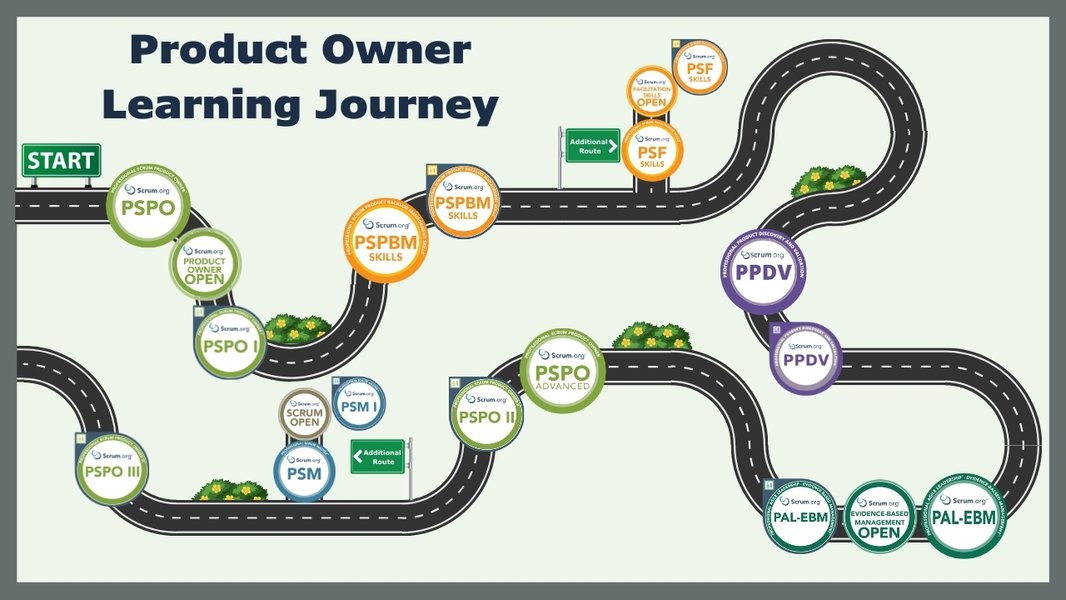
The Scrum.org learning path provides resources for Product Owners.
Understanding the PSPO I Exam Structure
Success begins with knowing what to expect. The PSPO I assessment rigorously tests your fundamental understanding:
- Format: 80 questions
- Question Types: Multiple Choice, Multiple Answer
- Time Limit: 60 minutes
- Passing Score: 85% or higher
- Language: English
- Cost: Approximately $200 USD per attempt
- Focus: Understanding and applying the Scrum framework, particularly from the Product Owner's perspective, emphasizing value delivery and agile product management.
The exam is known for its challenging time limit, demanding both accurate knowledge and quick thinking.
Core Preparation Pillars: Building Your Knowledge Base
A structured approach is key to effective preparation. Focus on these essential pillars:
Pillar 1: Master the Foundational Texts
The Scrum Guide: Your Primary Resource
The Scrum Guide is the definitive source for the Scrum framework. Read it thoroughly and repeatedly. Pay close attention to:
- The Accountabilities of the Product Owner
- The purpose and attributes of the Product Backlog
- Scrum Events (Sprint Planning, Daily Scrum, Sprint Review, Sprint Retrospective)
- Scrum Artifacts (Product Backlog, Sprint Backlog, Increment)
- The Definition of "Done"
- Scrum Values (Commitment, Focus, Openness, Respect, Courage)
Evidence-Based Management (EBM) Guide
Complement your Scrum Guide study with the EBM Guide, also from Scrum.org. It provides crucial insights into measuring value and improving outcomes, which are central to the Product Owner role. Understanding Key Value Areas (KVAs) helps in making informed decisions about product direction and backlog prioritization.
Scrum Glossary and Agile Terminology
Familiarize yourself with the official Scrum Glossary and common Agile terms. Precise understanding of terminology is often tested in the exam questions.
Pillar 2: Deep Dive into Product Owner Competencies
Beyond the framework mechanics, internalize the core responsibilities and mindset of a Professional Scrum Product Owner. Focus areas include:
- Developing and Communicating the Product Goal: Articulating a clear vision for the product.
- Product Backlog Management: Creating, ordering, and refining Product Backlog Items (PBIs) based on value, risk, and dependencies.
- Value Maximization: Continuously making choices to ensure the Development Team works on the most valuable items.
- Stakeholder Collaboration: Effectively engaging with customers, users, and other stakeholders to gather insights and manage expectations.
- Release Planning & Forecasting: Understanding how to plan releases and forecast delivery within an empirical process.
- Working with Self-Managing Teams: Understanding how the Product Owner interacts with and supports the Developers and Scrum Master.
Visualizing Product Owner Responsibilities
This mindmap outlines the key areas of focus for a Product Owner within the Scrum framework, highlighting the interconnected nature of their responsibilities in driving product value.
Pillar 3: Leverage Training Resources
Official Scrum.org Training
While not mandatory for PSPO I, attending an official Professional Scrum Product Owner course from Scrum.org is highly recommended. These 2-day courses offer interactive learning, practical exercises, experienced instructors, and often include attempts at the PSPO I assessment.
Online Courses and Supplementary Reading
Several reputable online courses can supplement your learning. Platforms like Udemy feature popular PSPO preparation courses (e.g., by Valentin Despa or Hiro Takashimya). Additionally, consider books like "The Professional Scrum Product Owner: Guide to Pass PSPO 1 Assessment" for structured study and practice questions. Scrum.org also provides a suggested reading list tailored to the PSPO competencies.
Pillar 4: Practice Makes Perfect
Mock Exams and Simulators
This is arguably one of the most critical preparation steps. Use various resources for practice tests:
- Scrum.org Open Assessments: Start with the free Product Owner Open assessment on Scrum.org to gauge your baseline understanding. Repeat until you consistently score 100%.
- Online Simulators: Utilize dedicated exam simulators (some are available as web or mobile apps) that mimic the real exam's format, question style, and time constraints.
- Course-Based Questions: Many online courses (like those on Udemy) include extensive question banks.
Aim to consistently score well above the 85% threshold (ideally 90-95%+) in practice tests under timed conditions. Analyze every incorrect answer, referring back to the Scrum Guide or EBM Guide to understand the reasoning.
Comparing Preparation Method Effectiveness
Different preparation methods contribute uniquely to readiness. This chart visualizes the perceived effectiveness of various approaches across key learning dimensions, based on common feedback. Remember, a blended approach is often most successful.
Strategic Exam Approach
Knowing the material is half the battle; navigating the exam effectively is the other half.
Time Management is Crucial
With 80 questions in 60 minutes, you have less than 45 seconds per question. Practice answering quickly but accurately. Don't get stuck on a single question; mark it for review and move on if necessary. Aim to finish practice tests with time to spare.
Read Questions Carefully
Pay close attention to keywords like "NOT," "EXCEPT," or instructions specifying the number of correct answers (for multiple-answer questions). Misreading a question is a common pitfall.
Exam Day Readiness
Avoid cramming the night before. Instead, do a light review of your notes and the Scrum Guide. Ensure you have a stable internet connection and a quiet environment for the online assessment.
Beyond the Exam: The Effective Product Owner
While the certification validates your knowledge, true success comes from applying these principles effectively in a real-world context. Focus on developing practical skills in communication, negotiation, strategic thinking, and fostering collaboration between the Scrum Team and stakeholders. The PSPO certification is a stepping stone towards becoming a proficient Product Owner who consistently delivers value.

Achieving certification demonstrates your commitment to professional product ownership.
Comparative Overview: PSPO vs. CSPO
The PSPO (Scrum.org) and the Certified Scrum Product Owner (CSPO, Scrum Alliance) are the two most recognized Product Owner certifications. While both are valuable, they have key differences:
Key Differences at a Glance
This table provides a quick comparison of the entry-level certifications from Scrum.org and Scrum Alliance.
| Feature | PSPO I (Scrum.org) | CSPO (Scrum Alliance) |
|---|---|---|
| Certification Body | Scrum.org | Scrum Alliance |
| Course Requirement | Recommended, but not mandatory to take the exam. | Mandatory attendance of a 2-day certified course. |
| Assessment | Mandatory 80-question exam (85% pass score). | Previously no mandatory exam post-course; requirements may evolve (check Scrum Alliance). Typically assessment is course-based. |
| Focus | Rigorous assessment of Scrum knowledge application. | Focus on foundational understanding through course interaction. |
| Cost (Approx.) | $200 (exam only) + optional course cost. | Higher, typically includes mandatory course fee ($1000-$2000+). |
| Renewal | Certification does not expire. | Requires renewal every 2 years (with fees and Scrum Education Units - SEUs). |
The choice between PSPO and CSPO often depends on individual learning preferences (exam-focused vs. course-focused) and budget considerations.
Video Insight: The PSPO Class
Gain a deeper understanding of what the official Professional Scrum Product Owner class entails. This video features stewards of the PSPO class discussing its objectives and structure, offering valuable context for those considering the official training route.
Frequently Asked Questions (FAQ)
Is attending the official PSPO course mandatory for the PSPO I exam?
How difficult is the PSPO I exam?
How much time should I dedicate to studying?
What are PSPO II and PSPO III?
Recommended Next Steps
- What are the detailed differences and career impacts between PSPO I and CSPO?
- Where can I find the most effective online practice exams and simulators for the PSPO I assessment?
- How does Evidence-Based Management (EBM) practically help a Product Owner maximize product value?
- What additional preparation is needed to advance from PSPO I to the PSPO II certification?
References

Last updated April 30, 2025