
Unveiling the Spectrum: Key Parameters for Representing Gender Variables Accurately
A comprehensive guide to understanding and presenting the multifaceted nature of gender in data.
Essential Insights: Navigating Gender Data Presentation
- Distinguish Core Concepts: Clearly differentiate between sex assigned at birth, gender identity, and gender expression for nuanced understanding.
- Embrace Inclusivity: Utilize comprehensive categories beyond the male/female binary to accurately reflect diverse gender identities and experiences.
- Contextualize with Care: Present gender data by considering sociocultural factors, intersectionality, and employing visualization techniques that avoid stereotypes.
Presenting gender variables effectively requires a nuanced approach that acknowledges the complexity of gender beyond a simple binary. It involves selecting appropriate parameters that capture various dimensions of gender, ensuring data is collected and represented respectfully and accurately. This guide synthesizes key considerations and parameters for presenting gender variables in research, data analysis, and visualizations.
Fundamental Parameters for Gender Variables
To comprehensively represent gender, several distinct yet interrelated parameters should be considered. These allow for a more accurate and inclusive portrayal of individuals and populations.
1. Sex Assigned at Birth
Defining the Baseline
Sex assigned at birth refers to the designation typically made at birth (e.g., male, female, or intersex) based on observable physical characteristics, including anatomy and chromosomes. While foundational, it is crucial to understand that this parameter does not equate to an individual's gender identity.
- Usage: Primarily relevant in medical contexts, epidemiological studies, and some demographic analyses where biological factors are pertinent.
- Collection: Typically involves categories like "Male," "Female," and increasingly, "Intersex" or "Assigned male/female, prefer not to specify."
2. Gender Identity
Understanding Self-Identification
Gender identity is an individual's internal, deeply felt sense of being a man, a woman, both, neither, or existing somewhere else along the gender spectrum. It may or may not correspond to the sex assigned at birth. This is a critical parameter for respecting individual autonomy and achieving accurate social data.
- Usage: Essential in social sciences, psychological research, human resources, healthcare, and any context aiming to understand individual and group experiences.
- Collection Options:
- Man
- Woman
- Non-binary (or Genderqueer, Genderfluid)
- Transgender man
- Transgender woman
- Prefer to self-describe (with an open text field)
- Prefer not to say
It's best practice to allow for multiple selections or a "select all that apply" approach if an individual identifies with more than one term.
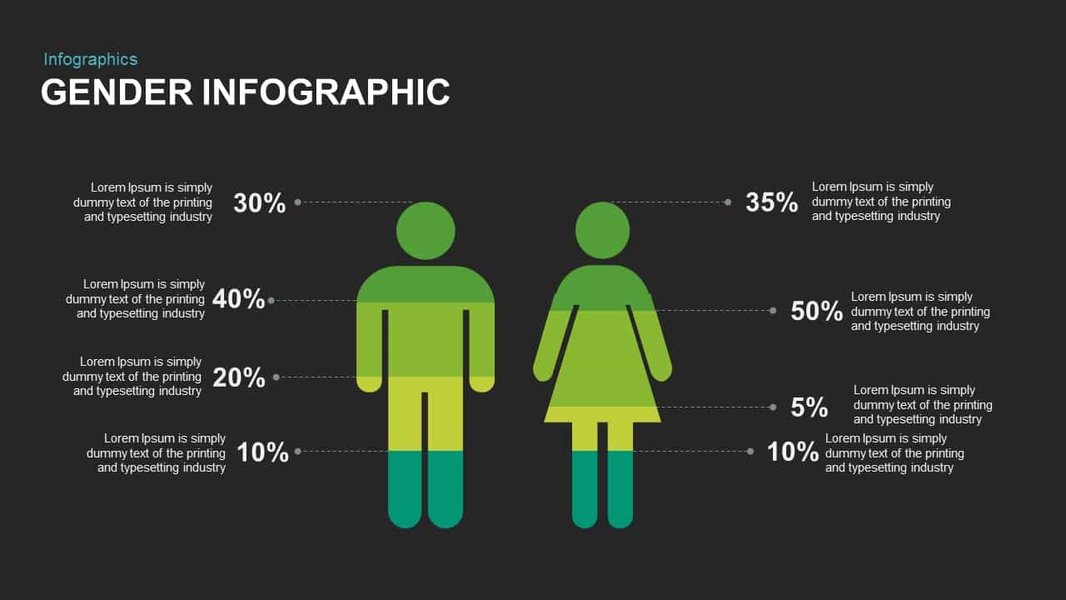
Illustrative example of how gender data can be visually represented in presentations.
3. Gender Expression
External Manifestations of Gender
Gender expression refers to how an individual publicly presents their gender. This can include behavior, clothing, hairstyle, voice, or body characteristics. Society often categorizes these expressions as masculine, feminine, androgynous, or gender-neutral. Importantly, gender expression does not necessarily align with gender identity or sex assigned at birth.
- Usage: Relevant in sociological studies, research on gender norms, bullying, discrimination, and understanding social perceptions and interactions.
- Measurement: Can be assessed through self-report, observer ratings, or qualitative descriptions. Scales might measure perceived masculinity, femininity, or androgyny.
4. Gender Roles and Sociocultural Factors (GASV)
Societal Influences and Expectations
Gender roles are socially constructed norms, behaviors, and expectations associated with a particular gender within a specific culture or society. Recognizing Gender as a Sociocultural Variable (GASV) complements Sex as a Biological Variable (SABV) by acknowledging that gender encompasses sociocultural behaviors and attitudes that interact with biological sex to influence health, well-being, and societal experiences.
- Usage: Crucial for social science research, public health, policy development, and understanding systemic inequities.
- Examples: Investigating gendered expectations in occupations, family responsibilities, or access to resources. Tools like the Stanford Gender-Related Variables for Health Research can be used.
5. Pronouns
Respectful Referencing
Pronouns are the words used to refer to someone in the third person (e.g., he/him, she/her, they/them, ze/hir). Asking for and correctly using someone's pronouns is a fundamental aspect of respectful interaction and data collection, particularly for transgender and gender-diverse individuals.
- Usage: Important in all interpersonal interactions, surveys, HR systems, and any data collection that involves personal identification to foster inclusivity.
- Collection Options: "She/Her," "He/Him," "They/Them," "Ze/Hir," "Prefer to self-describe," "Prefer not to say."
Data Collection, Coding, and Analysis
The way gender data is collected, coded, and analyzed significantly impacts the validity and inclusivity of findings.
Collecting Gender Data Inclusively
When designing surveys or data collection instruments:
- Distinguish between concepts: If necessary, ask separate questions for sex assigned at birth and current gender identity.
- Provide comprehensive options: Move beyond binary choices for gender identity. Include options like "Non-binary," "Transgender," and an open-ended "Prefer to self-describe" option.
- Offer a "Prefer not to say" option: Respect individuals' right to privacy.
- Use clear and respectful language: Avoid jargon or terms that may be outdated or offensive.
Coding Gender Variables
Gender variables are typically categorical. They can be coded numerically for statistical analysis (e.g., Male=1, Female=2, Non-binary=3) or kept as string/text variables. It's crucial to document coding schemes thoroughly. In statistical software like SPSS or SAS, ensure that variable labels and value labels are clear.
Analytical Approaches
Analytical methods should be chosen carefully to avoid reinforcing binary assumptions or masking the experiences of smaller gender groups. Consider:
- Disaggregation: Present data for all relevant gender categories, not just male/female, where sample sizes permit meaningful analysis.
- Intersectionality: Analyze gender in conjunction with other social variables like race, ethnicity, socioeconomic status, and age to understand overlapping systems of discrimination or privilege.
- Statistical Methods: Depending on the research question, methods like logistic regression, ANOVA, or non-parametric tests can be used. Ensure that analyses of transgender and gender-diverse populations accurately reflect their identities and experiences.
Visualizing Gender Data: Principles and Practices
Effective visualization of gender data is crucial for communication and understanding. The goal is to be clear, accurate, and inclusive, avoiding harmful stereotypes.
Choosing Appropriate Chart Types
- Bar charts and Pie charts: Useful for showing proportions by gender, but ensure categories are inclusive.
- Stacked bar or Area charts: Good for comparing gender distributions within subgroups or over time.
- Square area charts or Unit charts: Can be effective for displaying numbers of different magnitudes, especially when representing diverse gender self-identifications.
- Population pyramids: Traditionally used for age and sex distributions, can be adapted for broader gender categories if data allows.
- Scatter charts: Can represent categories of data (e.g., different gender identities) by color, and another variable by size or position.
Design Considerations for Inclusivity
- Color Choices: Avoid stereotypical color associations (e.g., pink for women, blue for men). Opt for neutral palettes or a diverse range of colors that are distinguishable and accessible.
- Icons and Symbols: If using icons, choose inclusive and non-binary representations, or opt for abstract shapes. Avoid reinforcing traditional gender symbols if they don't encompass all identities being presented.
- Labels and Language: Use clear, respectful, and up-to-date terminology in all chart labels, titles, and legends.
(Male, Female, Intersex)"] id1b["Gender Identity
(Man, Woman, Non-binary, Transgender, Self-describe)"] id1c["Gender Expression
(Masculine, Feminine, Androgynous, Neutral)"] id1d["Gender Roles & Sociocultural Factors (GASV)"] id1e["Pronouns
(He/Him, She/Her, They/Them, Ze/Hir, Self-describe)"] id2["Data Practices"] id2a["Inclusive Collection
(Comprehensive options, Respectful language)"] id2b["Clear Coding
(Documented schemes, Appropriate labels)"] id2c["Nuanced Analysis
(Disaggregation, Intersectionality)"] id3["Visualization Principles"] id3a["Appropriate Chart Types
(Bar, Pie, Stacked, Area, Scatter)"] id3b["Inclusive Design
(Neutral colors, Non-stereotypical icons, Clear labels)"] id4["Ethical Considerations"] id4a["Respect & Dignity"] id4b["Avoiding Bias & Stereotypes"] id4c["Confidentiality & Privacy"] id4d["Accurate Representation of Diversity"]
This mindmap illustrates the interconnected parameters and considerations involved in presenting gender variables comprehensively and ethically.
Relative Importance of Gender Parameters in Different Contexts
The relevance of specific gender parameters can vary depending on the field of study or application. The following radar chart provides an illustrative example of how different parameters might be prioritized across various domains. These are subjective estimations to highlight varying focuses.
This radar chart visualizes the estimated relevance (on a scale where higher means more relevant, min 2 to max 10) of different gender parameters across selected fields. For instance, 'Sex Assigned at Birth' holds high relevance in 'Clinical Research', while 'Gender Identity' and 'Pronouns' are highly pertinent in 'Human Resources (DEI)'.
Summary Table of Key Gender Parameters
This table summarizes the primary parameters used to present gender variables, their descriptions, and common considerations for their use.
| Parameter | Description | Key Considerations / Use Cases | Data Collection Examples |
|---|---|---|---|
| Sex Assigned at Birth | Biological sex category typically assigned at birth based on physical characteristics (e.g., male, female, intersex). | Medical records, epidemiological studies, demographic analysis where biological sex is a specific variable of interest. Distinguish from gender identity. | "Male", "Female", "Intersex", "Prefer not to say" |
| Gender Identity | An individual's internal, deeply-held sense of their gender (e.g., man, woman, non-binary, genderfluid, etc.). | Surveys, social research, HR, healthcare. Essential for understanding self-identification and lived experiences. Requires inclusive options. | "Woman", "Man", "Non-binary", "Transgender Woman", "Transgender Man", "Genderqueer", "Prefer to self-describe", "Prefer not to say" |
| Gender Expression | External manifestation of an individual's gender, often through appearance, clothing, behavior, and mannerisms. | Sociological studies, research on gender norms, discrimination, and social perception. Can be described qualitatively or using scales (e.g., masculine, feminine, androgynous). | Descriptive categories (e.g., "Predominantly masculine", "Predominantly feminine", "Androgynous", "Gender-neutral") or observational/self-report scales. |
| Gender Roles/Norms (GASV) | Socioculturally constructed expectations, behaviors, and attitudes associated with gender within a society. | Social sciences, public health, policy analysis. Analyzing the impact of societal structures and expectations on individuals and groups. | Questionnaires measuring attitudes towards gender roles, adherence to or perception of societal gender norms. |
| Pronouns | Words used to refer to someone in the third person that affirm their gender identity (e.g., she/her, he/him, they/them). | Essential for respectful communication, creating inclusive environments in workplaces, education, healthcare, and research involving TGD populations. | "She/Her", "He/Him", "They/Them", "Ze/Hir", "Other (please specify)", "Prefer not to say" |
General Introduction to Data Presentation
Understanding how to present any type of data effectively is a foundational skill. The following video offers a general introduction to methods of data presentation, which can provide a helpful backdrop before diving into the specifics of complex variables like gender.
This video provides an introduction to various methods of data presentation, covering fundamental concepts applicable across different types of data, including categorical variables like gender.
Frequently Asked Questions (FAQ)
Why is it important to distinguish sex assigned at birth from gender identity?
Sex assigned at birth and gender identity are distinct concepts. Sex assigned at birth is typically based on observable physical characteristics, while gender identity is an individual's internal sense of self. Conflating the two can lead to misgendering, inaccurate data, and a failure to understand the diverse experiences of individuals, particularly transgender and gender-diverse people. Distinguishing them allows for more precise research and respectful engagement.
How can I make my gender data collection more inclusive?
To make gender data collection more inclusive:
- Offer multiple gender identity options beyond "male" and "female," including "non-binary," "transgender," and a "prefer to self-describe" field.
- If asking about sex assigned at birth, explain why this information is needed and ensure it's relevant.
- Include an option for "prefer not to say."
- Ask for pronouns separately if relevant.
- Use clear, respectful, and current terminology. Consult with community members or experts if unsure.
- Ensure anonymity and confidentiality to encourage honest responses.
What are common mistakes to avoid when visualizing gender data?
Common mistakes include:
- Using stereotypical colors (e.g., pink for women, blue for men) or icons that reinforce binary norms.
- Only presenting data in a binary male/female format, thereby erasing non-binary and transgender individuals.
- Aggregating diverse gender identities into overly broad categories that mask important differences.
- Failing to provide context or clearly define the gender categories used.
- Creating visualizations that are difficult to interpret or inaccessible to people with visual impairments.
How does intersectionality apply to presenting gender variables?
Intersectionality recognizes that individuals often belong to multiple social categories (e.g., gender, race, class, sexual orientation, disability) simultaneously, and these identities can interact to create unique experiences of privilege or oppression. When presenting gender variables, an intersectional approach means analyzing and visualizing how gender intersects with these other factors. For example, instead of just showing data for "women," an intersectional analysis might explore the experiences of "Black women," "disabled women," or "working-class transgender women" to reveal more nuanced insights and disparities that would otherwise be hidden.
Recommended Further Exploration
- What are best practices for collecting data on non-binary gender identities in surveys?
- How can researchers ensure ethical representation of transgender and gender-diverse populations in studies?
- What is the impact of using inclusive versus non-inclusive gender options in data analysis outcomes?
- Explore examples of effective data visualizations for complex gender identity data.
References
Last updated May 8, 2025