
Unveiling the Disparities: Assaults and Disciplinary Realities in Public vs. Private Prisons
A comprehensive analysis of violence and accountability within correctional facilities across the U.S.
Key Insights into Correctional Safety and Discipline
- Private prisons often exhibit significantly higher rates of violence and assaults compared to their public counterparts, with reported figures ranging from 38% to even three to five times higher in some analyses.
- While detailed state-by-state data is often limited, available reports and studies from organizations like the Prison Policy Initiative and the Bureau of Justice Statistics underscore a trend of more frequent and punitive disciplinary actions in private facilities.
- Factors contributing to these disparities include differences in staff training, higher turnover rates in private prisons, and potentially varied institutional policies regarding misconduct reporting and enforcement.
The landscape of correctional facilities in the United States is complex, comprising both publicly funded and privately operated institutions. A crucial aspect of understanding these systems involves examining the rates of assaults and the nature of disciplinary actions taken against incarcerated individuals. While a perfectly comprehensive, state-by-state public-vs.-private prison dataset for assaults and disciplinary actions is not uniformly available due to varied reporting standards and data aggregation practices, a significant body of research and reports offers compelling insights into general trends and specific instances where data is accessible. This analysis synthesizes information from various authoritative sources to provide a clearer picture of these critical metrics.
The Core Challenge: Data Availability and Standardization
Navigating the complex landscape of correctional data reporting.
One of the primary challenges in conducting a detailed comparison of assaults and disciplinary actions between public and private prisons across all U.S. states is the lack of standardized, uniformly reported data. Federal bodies like the Bureau of Justice Statistics (BJS) and the Federal Bureau of Prisons (BOP) provide valuable national and federal-level statistics, but these often do not disaggregate data sufficiently to allow for direct state-by-state comparisons between public and private facilities. Many states may report such data internally or through annual corrections reports, but these are rarely standardized, frequently incomplete, or not easily accessible for public-private comparisons.
Why Comprehensive State-Level Data is Elusive
The inconsistent availability of data stems from several factors:
- Varying Reporting Requirements: Each state has its own set of reporting mandates for its Department of Corrections, and these often don't include a specific breakdown by prison ownership type (public vs. private).
- Private Facility Contracts: Contracts with private prison companies may not always mandate the same level of detailed public reporting on incidents and disciplinary actions as public facilities.
- Data Aggregation: Even when data is collected, it is often aggregated at a national or regional level, obscuring state-specific public vs. private distinctions.
- Focus on Specific Incidents: Some reports focus on specific types of incidents, such as sexual assaults under the Prison Rape Elimination Act (PREA), rather than providing a comprehensive overview of all assaults and disciplinary measures.
Assault Rates: A Stark Contrast Between Public and Private Facilities
Examining the incidence of violence behind bars.
Despite the challenges in obtaining universal state-level data, numerous studies and analyses consistently point to a troubling disparity in assault rates between public and private prisons. The consensus from multiple sources indicates that private correctional facilities tend to experience higher rates of violence, including both inmate-on-inmate and inmate-on-staff assaults.
Evidence of Higher Violence in Private Prisons
- A 2001 report from the U.S. Department of Justice (referenced in a Vox article) found that the rate of inmate-on-inmate violence in private prisons was 38% higher than in public prisons.
- An analysis of data from England and Wales (September 2018) revealed 156 more assaults per 1,000 prisoners in private adult prisons compared to publicly run counterparts. Specifically, private male local prisons recorded 701 assaults per 1,000 prisoners, versus 493 per 1,000 in public male local prisons.
- Broader statistics suggest that private prisons report approximately 49% more violent incidents and guard assaults than public ones, with inmate-on-inmate assaults occurring 65% more frequently in private facilities, according to the U.S. Department of Justice.
- Some reports even indicate that overall assault rates in private prisons can be between three and five times higher compared to public prisons.
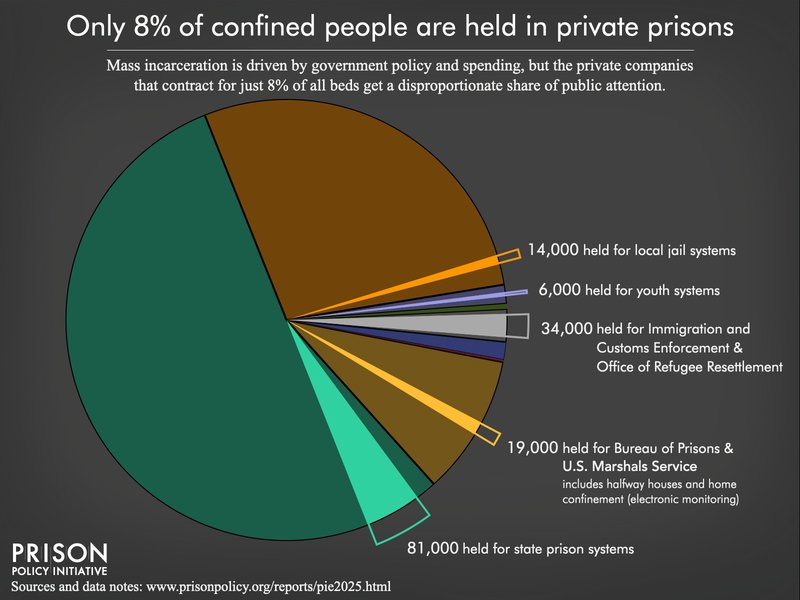
The pie chart illustrates the distribution of incarcerated populations, highlighting the proportion housed in private facilities.
Factors Contributing to Increased Violence
Several factors are often cited as contributors to the higher violence rates observed in private prisons:
- Staffing Issues: Private facilities frequently suffer from higher employee turnover rates—nearly three times that of the public sector. This can lead to less experienced staff and understaffing, compromising security.
- Training Disparities: The public sector typically requires significantly more pre-service training hours for new officers (an average of 58 more hours) than private facilities, potentially resulting in better-prepared and more effective public prison staff.
- Compensation: Lower wages for guards in private facilities may contribute to higher turnover and potentially less qualified personnel.
Disciplinary Actions: Policies, Practices, and Impact
Understanding the mechanisms of inmate accountability.
Disciplinary actions in prisons are designed to maintain order, ensure safety, and deter misconduct. These actions are governed by both federal and state laws, such as the Prison Litigation Reform Act (PLRA). However, the implementation and impact of these policies can vary significantly, especially when comparing public and private institutions.
The "Manufacture of Misconduct"
A recent report by the Prison Policy Initiative, "Bad Behavior: How prison disciplinary policies manufacture misconduct," highlights that disciplinary policies in all 50 state prison systems can be counterproductive, even leading to longer prison stays. The report, released in January 2025, argues that "unfair and unaccountable" disciplinary systems can be traumatizing and impede rehabilitation efforts. While this report provides a comprehensive overview of policies, it does not offer specific numerical data comparing disciplinary actions between public and private facilities.
Common Disciplinary Sanctions
When an incarcerated individual violates rules, "incident reports" (often called "shots") are filed. Sanctions can include:
- Solitary confinement.
- Loss of good time credits, which can extend sentences.
- Fines and fees, which can further impoverish individuals and their families.
- Forced labor.
- Loss of access to programs, services, and privileges.
In the most recent national survey of individuals in state prisons, over half (53%) reported being written up or found guilty of at least one violation in the past year, with 90% receiving some form of disciplinary action.
Disciplinary Disparities and the Role of Contraband
While specific comparative data on the *number* of disciplinary actions between public and private facilities is scarce, the higher rates of violence in private prisons suggest that more incidents requiring disciplinary responses would occur. Private prisons are also noted for implementing more punitive measures, such as fines and fees. Furthermore, stricter policies against contraband (e.g., cell phones) in private facilities can lead to harsher disciplinary actions, regardless of the severity of the offense.
Loss of Good Time
Fines & Fees
Loss of Privileges] Policy_Critique[Often 'Manufacture Misconduct' (Prison Policy Initiative 2025)] Incomplete_Data[No Universal State-by-State Breakdown] Contraband_Impact[Leads to Harsher Actions] Underlying_Factors[Contributing Elements] Staff_Turnover[Nearly 3X Higher in Private Facilities] Training_Hours[Fewer in Private Facilities (58 fewer hours)] Profit_Motive[Potential for Reduced Staffing/Training] Data_Limitations[Challenges in Reporting] Lack_of_Standardization[Across States] Focus_on_Federal[BOP/BJS Data Not State-Specific] Underreporting[Especially Sexual Assaults]
This mindmap illustrates the interconnected factors contributing to assault rates and disciplinary actions in correctional facilities, emphasizing the disparities between public and private prisons.
A Comparative Overview: Assaults and Disciplinary Trends
Synthesizing available data to illustrate key differences.
While a precise, state-by-state numerical breakdown of assaults and disciplinary actions in public versus private prisons is not consistently available across all U.S. states, the aggregated data and comparative studies offer significant insights. The following table synthesizes the most relevant findings from various sources, focusing on trends and comparative statistics where available, rather than exact state-specific counts which are often missing or inconsistent.
| Category | Public Prisons (General Trends) | Private Prisons (General Trends) | Notes / Data Sources |
|---|---|---|---|
| Overall Assault Rate | Baseline; generally lower compared to private prisons. | Significantly higher; e.g., 38% higher inmate-on-inmate violence (US DOJ 2001); 47% more violent incidents (Guardian, UK data); 3-5 times higher assault rates (Frontiers). | US Department of Justice, The Guardian (analysis of UK data), Frontiers journal articles. |
| Inmate-on-Inmate Assaults | Lower rates reported. | 65% more frequent (US DOJ). | US Department of Justice. |
| Sexual Assaults (Staff-on-Inmate) | Reported, but individuals half as likely to report victimization by another inmate than those in public state prisons (MotherJones.com, 2016). | Individuals twice as likely to report sexual abuse from guards or staff. Higher rates for female and LGBT inmates. | SurvivorLawyer.com, MotherJones.com, BJS National Prison Rape Statistics Program. Note: Sexual assault is significantly underreported across all facilities. |
| Disciplinary Actions Frequency | Over 53% of state prison inmates reported a violation in the previous year. Policies vary by state (e.g., GA, WA). | Not specifically disaggregated for private vs. public regarding overall disciplinary actions, but higher violence rates suggest more incidents. Policies may be more punitive. | Prison Policy Initiative "Bad Behavior" report (Jan 2025), general state corrections reports. |
| Staff Turnover Rate | Lower turnover rates. | Nearly 3 times higher turnover rates. | US Courts.gov, CriminalJusticePrograms.com. |
| Officer Training Hours | Average of 58 more pre-service training hours. | Fewer training hours offered. | CriminalJusticePrograms.com. |
| Recidivism Rates | Generally lower compared to private facilities, though influenced by many factors beyond ownership. | Higher recidivism rates (some sources suggest 16% higher than public prisons). | Quora (citing various sources). |
This table draws upon a variety of sources to provide a comparative, high-level view. It's important to reiterate that direct numerical comparisons for every state for both prison types are not systematically published or centrally compiled. The percentages and ratios provided reflect general trends observed in studies covering federal data or specific state/regional analyses where such comparisons have been made.
Delving Deeper: The Nuances of Prison Overcrowding and its Impact
Understanding the broader context affecting prison conditions.
The operational environment of prisons, including the prevalence of assaults and disciplinary actions, is heavily influenced by factors such as overcrowding. Overcrowding can strain resources, increase tensions, and lead to a more volatile environment for both incarcerated individuals and staff. The video below provides further context on the implications of prison populations and conditions, offering insights into the broader challenges faced by the U.S. correctional system.
"Which State has the Highest PRISON POPULATION?" This video explores the dynamics of prison populations across different states, touching upon the scale of incarceration in the U.S. and offering insights into the factors that contribute to varied prison environments. Understanding these population trends is crucial as they directly impact conditions, potentially influencing rates of violence and the effectiveness of disciplinary systems.
Performance Benchmarks: A Radar Chart Analysis
Assessing key operational and safety metrics in correctional facilities.
To further illustrate the comparative performance and operational realities between public and private prisons, a radar chart can offer a visual representation of key metrics. This chart is based on the synthesized qualitative and quantitative data discussed, providing an opinionated analysis of how these prison types generally fare across various dimensions. It reflects the overall trends suggested by the research, highlighting areas of relative strength and weakness.
This radar chart provides an illustrative comparison of public and private prisons across several key metrics. Each axis represents a different aspect of prison operation and safety, with higher values indicating better performance. The chart highlights general trends, such as public prisons tending to score higher in areas like staff training and retention, which are often correlated with better inmate and staff safety and more equitable disciplinary processes. Conversely, private prisons often show lower scores in these areas, reflecting the challenges associated with their operational models and the observed higher rates of violence.
Frequently Asked Questions
What are the primary differences between public and private prisons?
Why is it difficult to get state-by-state data on prison assaults and disciplinary actions?
Do private prisons have higher rates of violence than public prisons?
What types of disciplinary actions are common in prisons?
How does staff turnover impact prison safety and discipline?
Conclusion
The research unequivocally points to significant disparities in assault rates between public and private correctional facilities, with private prisons generally experiencing higher instances of violence. While comprehensive state-by-state data remains elusive due to varied reporting standards, the overarching trends indicate that public prisons tend to offer safer environments, often attributed to factors such as better staff training, lower turnover, and potentially more robust oversight. Disciplinary actions, though critical for maintaining order, are implemented with varying degrees of fairness and can, as some reports suggest, exacerbate misconduct rather than mitigate it. This analysis underscores the importance of continued transparency and standardized data collection to fully assess and improve conditions across all U.S. correctional systems.
Recommended Further Exploration
- Explore the long-term impact of for-profit prison models on inmate rehabilitation and reintegration into society.
- Investigate specific differences in training curricula and professional development for correctional officers in public versus private facilities.
- Delve into the specifics of the Prison Litigation Reform Act (PLRA) and its effect on inmate grievances and the enforcement of constitutional rights within correctional settings.
- Examine evidence-based strategies and policy recommendations aimed at reducing violence and improving safety across all types of correctional facilities.