
Unlocking Your Product's Journey: Mastering the Life Cycle Stages
A deep dive into the crucial phases every product navigates, from bright idea to market farewell.
Key Insights into the Product Life Cycle
- Distinct Phases: The Product Life Cycle (PLC) typically charts a product's course through several distinct stages: Development (often included), Introduction, Growth, Maturity, and Decline.
- Strategic Adaptation: Success hinges on adapting business strategies—including marketing, pricing, distribution, and product features—to the unique challenges and opportunities of each stage.
- Maximizing Value: Understanding and managing the PLC enables businesses to optimize resource allocation, maximize profitability over the product's lifespan, and make informed decisions about innovation and portfolio management.
What is the Product Life Cycle (PLC)?
The Product Life Cycle (PLC) is a fundamental concept in marketing and business strategy that describes the theoretical progression of a product through distinct phases in the market, from its initial conception and launch to its eventual withdrawal. Popularized by economist Theodore Levitt, the PLC model provides a framework for understanding how sales volume and profitability typically evolve over time. Recognizing which stage a product is in allows businesses to make proactive and strategic decisions regarding marketing efforts, investment, pricing, product development, and overall management to maximize its success and longevity.
While often depicted as a standard curve, the actual duration and trajectory of each stage can vary significantly depending on the product type, industry dynamics, technological advancements, competitive landscape, and overall economic conditions as of 2025-04-28. It serves as a vital diagnostic and planning tool rather than a rigid prediction.
The Stages of the Product Life Cycle
While various models exist, the most comprehensive understanding often includes five key stages. Let's analyze each phase:
1. Development Stage
Conception and Refinement
Although sometimes considered a pre-stage, the Development phase is critical and marks the beginning of the product's journey. It encompasses everything from initial idea generation and market research to product design, prototyping, and testing. Significant investment occurs here without any corresponding sales revenue.
- Characteristics: Zero sales, high research and development (R&D) costs, focus on feasibility and product validation, internal marketing, negative profitability.
- Business Implications: Heavy investment is required with inherent risk. Thorough market research and testing are crucial to minimize the chance of launching a product that fails to meet market needs. Decisions made here heavily influence the success of the subsequent introduction stage.
2. Introduction Stage
Market Launch and Awareness Building
This stage begins when the product is first launched and becomes available to consumers. The primary goal is to build awareness and encourage initial trial and adoption. Sales volume typically starts low and grows slowly as the market learns about the new offering.
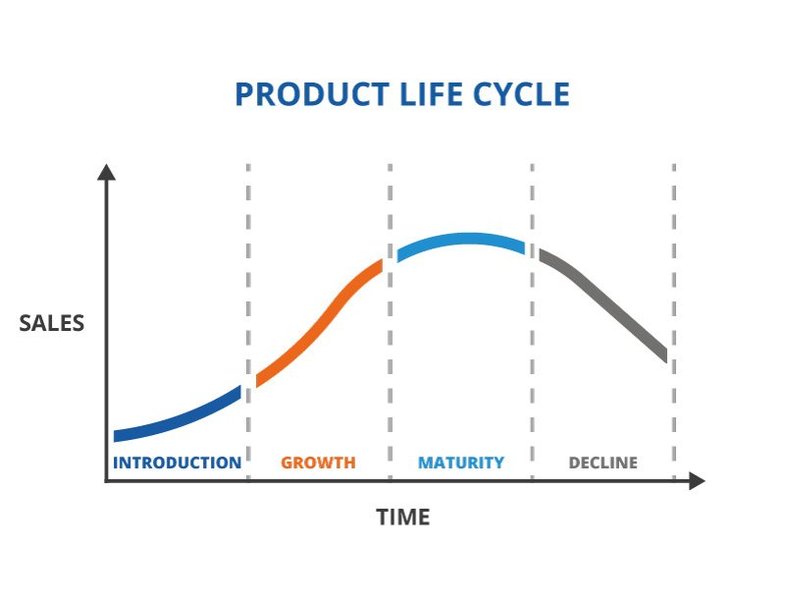
Conceptual diagram showing the typical progression through PLC stages.
- Characteristics: Low sales volume, high marketing and distribution costs per customer, often negative or minimal profits due to high initial expenses, limited competition initially.
- Marketing Focus: Creating product awareness and educating consumers, targeting innovators and early adopters, stimulating trial through promotions.
- Pricing Strategies: Companies might employ:
- Price Skimming: Setting a high initial price to recover R&D costs quickly, often targeting less price-sensitive early adopters, with plans to lower it later.
- Penetration Pricing: Setting a low initial price to rapidly gain market share and deter potential competitors.
- Business Implications: Requires significant investment in promotion. Success hinges on generating sufficient market interest. Distribution channels are established. High product failure rates are common in this phase.
3. Growth Stage
Market Acceptance and Sales Acceleration
If the introduction is successful, the product enters the Growth stage, characterized by rapidly increasing sales and growing market acceptance. Word-of-mouth referrals contribute to adoption, and the product starts generating substantial revenue.
- Characteristics: Rapidly rising sales volume, increasing profitability as production costs decrease due to economies of scale, growing competition as rivals enter the market recognizing the opportunity. * Marketing Focus: Shifting from building awareness to building brand preference and loyalty, differentiating the product from competitors, expanding distribution channels, potentially enhancing product features or quality based on feedback. * Business Implications: Focus shifts to maximizing market share. Companies invest in increasing production capacity and broadening distribution. Maintaining product quality and customer support becomes crucial. Prices may remain stable or fall slightly due to competition.
4. Maturity Stage
Peak Sales and Market Saturation
The Maturity stage is typically the longest phase in the PLC. Sales growth slows down, eventually peaks, and then plateaus as the market becomes saturated. Most potential customers have adopted the product, and competition is intense.
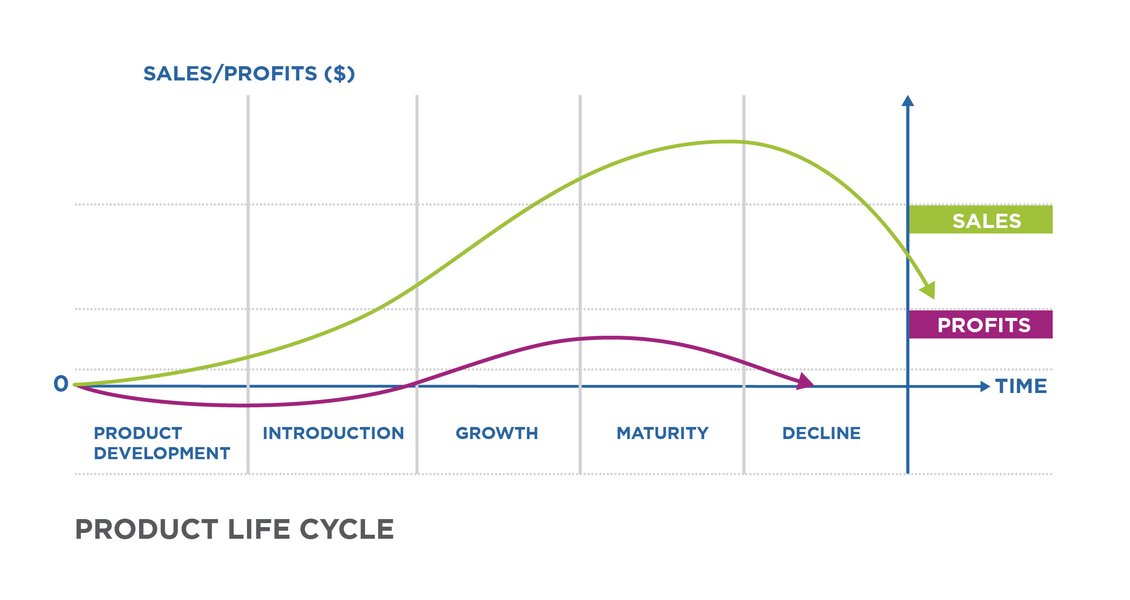
Typical sales and profit curves across the PLC stages.
- Characteristics: Sales volume peaks and stabilizes, market saturation occurs, competition is at its highest (often leading to price wars), profits stabilize or start to decline due to increased marketing costs to defend market share and potential price reductions. Production efficiency is high.
- Marketing Focus: Defending market share against competitors, emphasizing brand differentiation and features, encouraging brand switching, customer retention through loyalty programs, finding new market segments or product uses.
- Strategies to Extend Maturity:
- Market Modification: Finding new users or market segments.
- Product Modification: Improving quality, features, style, or bundling services.
- Marketing Mix Modification: Adjusting price, promotion, or distribution strategies.
- Business Implications: This is often the most profitable stage due to high volume and lower costs, but requires vigilant management to maintain share and profitability. Companies must innovate or risk entering the decline phase prematurely. Some models identify a 'Saturation' sub-stage here where growth ceases entirely.
5. Decline Stage
Falling Demand and Market Exit
Eventually, sales and profits for most products begin a sustained decline. This can be triggered by technological advancements rendering the product obsolete, shifts in consumer tastes, increased competition from superior alternatives, or market saturation.
- Characteristics: Falling sales volume and profitability, declining competition as firms exit the market, potential excess production capacity, reduced marketing support. Products in this stage with low market share and growth are sometimes termed "Poor Dogs".
- Marketing Focus: Reduced promotional spending, potentially targeting a niche market or loyal customer base. * Business Implications: Companies face critical decisions:
- Harvesting: Reducing costs (marketing, R&D, maintenance) to maximize remaining profit from loyal customers.
- Divesting/Discontinuation: Selling the product line or phasing out the product entirely to reallocate resources to more promising ventures.
- Finding a Niche: Focusing on a small, profitable segment of the market that still demands the product.
- Re-Iteration (Less Common): Sometimes, significant product changes can lead back to growth, though this often constitutes a new PLC.
Visualizing the PLC Dynamics
The dynamics of the Product Life Cycle can be visualized by comparing key metrics across its core stages. The radar chart below illustrates typical relative levels of Sales Volume, Profitability, Competition Intensity, and Marketing Investment during the Introduction, Growth, Maturity, and Decline phases. Note how marketing investment peaks early, sales and profits peak later in maturity, and competition intensifies through growth and maturity before potentially easing in decline.
(Note: This chart represents typical relative patterns; actual levels vary by product and market.)
Mapping the Product Journey
A mind map can help visualize the interconnected elements of the Product Life Cycle, showing the progression through stages and the key considerations at each point. This map outlines the typical five stages and highlights core characteristics and strategic focuses.
No Sales"] id2["2. Introduction"] id2a["Market Launch"] id2b["Build Awareness"] id2c["Low Sales
High Marketing Costs"] id2d["Target Innovators"] id2e["Pricing: Skim/Penetrate"] id3["3. Growth"] id3a["Rapid Sales Increase"] id3b["Market Acceptance"] id3c["Rising Profits"] id3d["Growing Competition"] id3e["Expand Distribution"] id3f["Differentiate Product"] id4["4. Maturity"] id4a["Sales Peak / Plateau"] id4b["Market Saturation"] id4c["Intense Competition"] id4d["Stable / Declining Profits"] id4e["Focus on Retention"] id4f["Extend Cycle (Modify)"] id5["5. Decline"] id5a["Falling Sales & Profits"] id5b["Changing Tastes / Tech"] id5c["Reduced Competition"] id5d["Options:
Harvest, Divest, Niche"]
This visualization provides a quick overview of the flow and key elements associated with navigating a product's life cycle successfully.
Strategic Implications of the PLC
Understanding the Product Life Cycle is crucial for effective strategic planning. It informs decisions across various business functions:
- Marketing Strategy Alignment: The marketing mix (Product, Price, Place, Promotion) must be adapted for each stage. For example, promotion focuses on awareness in Introduction, differentiation in Growth, and reinforcement/reminders in Maturity.
- Resource Allocation: Knowing the PLC stage helps allocate resources effectively—investing heavily in R&D and marketing early on, focusing on production efficiency in maturity, and minimizing investment in decline.
- Portfolio Management: Businesses often manage a portfolio of products at different PLC stages. This requires balancing cash flow, investing in growth products using profits from mature ones, and planning for the replacement of declining products.
- Innovation and New Product Development: The PLC highlights the finite lifespan of products, underscoring the need for continuous innovation and development of new products to sustain long-term business growth as older ones decline.
- Financial Planning: Revenue, costs, and profitability expectations change dramatically across stages, impacting budgeting, forecasting, and investment decisions.
Summary of PLC Stages and Characteristics
The following table provides a concise overview of the key characteristics and strategic focus for each primary stage of the Product Life Cycle:
| Stage | Sales Volume | Profitability | Competition | Marketing Focus | Typical Strategies |
|---|---|---|---|---|---|
| Development | None | Negative | None | Concept Validation | Research, Design, Prototyping, Testing |
| Introduction | Low & Slow | Negative / Low | Low / None | Build Awareness & Trial | Heavy Promotion, Target Innovators, Establish Distribution, Skim/Penetration Pricing |
| Growth | Rapidly Increasing | Rising Sharply | Growing | Build Market Share & Preference | Expand Distribution, Differentiate Product, Enhance Features, Penetrate Market |
| Maturity | Peak / Plateau | High / Stabilizing / Declining | Intense | Defend Market Share & Maximize Profit | Product Differentiation, Diversification, Customer Retention, Cost Efficiency, Find New Segments/Uses |
| Decline | Falling | Declining / Low / Negative | Decreasing | Reduce Expenditure & Milk the Brand | Harvesting, Divesting, Niche Focus, Phase Out Product, Cost Reduction |
Real-World Insights on the PLC
Observing how well-known products have navigated their life cycles provides valuable practical insights. Different industries and products exhibit varied PLC patterns. For instance, technology products often have much shorter cycles than staple consumer goods.
The video below discusses the Product Life Cycle using real-world examples, which can help illustrate how these theoretical stages manifest in actual market scenarios and the strategic responses companies employ.
Understanding these examples helps bridge the gap between the theoretical PLC model and its practical application in strategic business decision-making.
Frequently Asked Questions (FAQ)
Does every product follow the PLC stages exactly?
No, the PLC is a generalized model. Not all products follow this curve precisely. Some products might fail during introduction, others might have extremely long maturity stages (like classic food staples), and some might experience cycles of decline and revitalization through reinvention or finding new markets. Fads, for example, have very short life cycles with rapid growth and decline. The model provides a useful framework but should be applied flexibly.
How long does each stage of the Product Life Cycle last?
The duration of each stage varies greatly depending on factors like the product type, industry, technological change, competitive intensity, and marketing effectiveness. Technology products might move through stages in months or a few years, while industrial goods or established consumer brands might remain in maturity for decades. There's no fixed timeline.
Can the Product Life Cycle be extended?
Yes, businesses actively try to extend the profitable stages, particularly Maturity. Strategies include modifying the product (adding features, improving quality), modifying the market (finding new users, increasing usage among current customers), repositioning the brand, or adjusting the marketing mix (e.g., new advertising campaigns, price adjustments). Successful extension strategies can delay the onset of the Decline stage significantly.
What is Product Life Cycle Management (PLM)?
Product Life Cycle Management (PLM) refers to the process of managing the entire lifecycle of a product from inception, through engineering design and manufacture, to service and disposal. PLM integrates people, data, processes, and business systems and provides a product information backbone for companies and their extended enterprise. It's a more operational and often software-driven approach compared to the strategic marketing concept of PLC stages.
Recommended Further Exploration
- What are effective strategies to extend the product maturity stage?
- How does the Product Life Cycle differ for services compared to physical goods?
- Can you provide examples of products that have defied the typical Product Life Cycle?
- How has digital transformation impacted the traditional Product Life Cycle model?
References

Last updated April 28, 2025