
Unlock Market Success: Your Comprehensive Guide to Product Market Research
Navigate the complexities of understanding your customers and market to build products that truly resonate and succeed.
Product market research is the systematic investigation into your target market, customers, competitors, and industry trends. It's not just a preliminary step; it's the foundational backbone for developing, launching, and iterating on products that meet genuine needs and stand out in a crowded marketplace. By grounding your decisions in data and insights rather than assumptions, you significantly reduce risks, enhance customer satisfaction, and pave the way for sustainable business growth.
Essential Insights: Key Takeaways
- Clarity is Key: Defining precise research objectives ensures your efforts are focused and yield actionable insights for product strategy.
- Blend Your Methods: Combining qualitative (interviews, focus groups) and quantitative (surveys, analytics) research provides a holistic understanding of your market.
- Iterate and Validate: Market research isn't a one-off task; continuously test assumptions, gather feedback on prototypes (MVPs), and refine your product based on real-world data.
The Strategic Blueprint: A Step-by-Step Process
Embarking on product market research requires a structured approach. Follow these steps to gather comprehensive intelligence and make informed decisions:
Step 1: Define Your Research Compass (Objectives & Scope)
Set Clear Goals
Before diving in, articulate exactly what you need to learn. Are you validating a new product idea? Trying to understand specific customer pain points? Assessing the competitive landscape? Evaluating price sensitivity? Setting clear, measurable objectives (e.g., "Identify the top 3 unmet needs of remote workers regarding project management tools") will guide your entire research process and ensure the findings are directly applicable to your strategic decisions.
Determine the Scope
Define the boundaries of your research. Is it for an entirely new product, an enhancement to an existing one, or exploring expansion into a new market segment? Knowing the scope helps allocate resources effectively and keeps the research focused.
Step 2: Chart Your Course (Industry & Market Dynamics)
Understand the Big Picture
Begin with secondary research to grasp the broader context. Analyze industry reports, market statistics, and economic trends relevant to your product category. Look for information on market size (Total Addressable Market - TAM, Serviceable Available Market - SAM), growth potential, emerging technologies, regulatory landscapes, and potential barriers to entry. Understanding these dynamics helps position your product strategically.
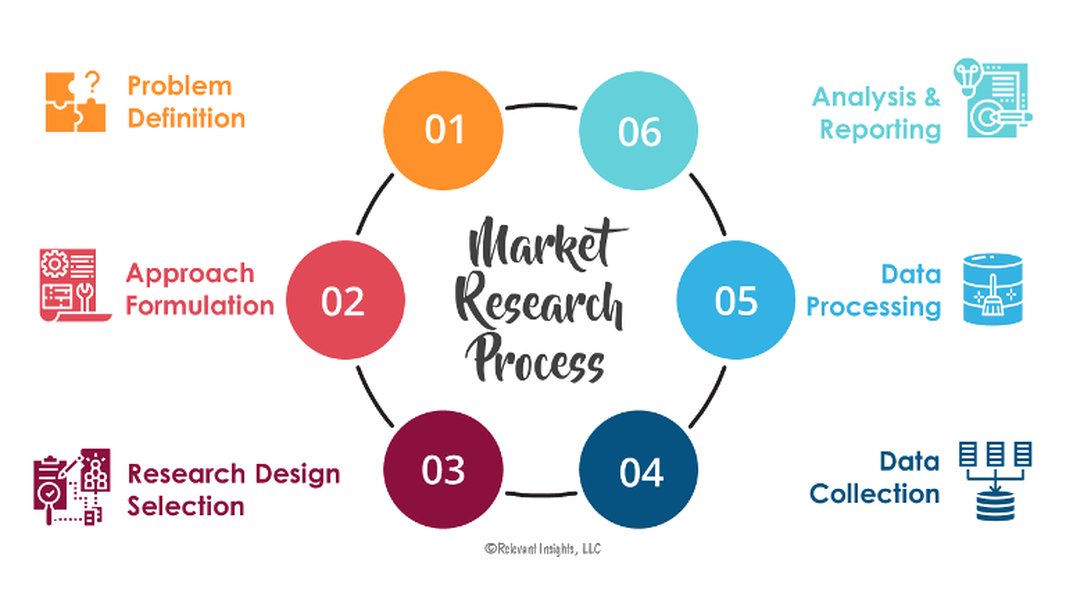
A visual overview of the typical market research process flow.
Step 3: Know Your Crew (Target Audience & Personas)
Identify Your Ideal Customers
Who are you building this product for? Define your target market by segmenting potential customers based on:
- Demographics: Age, gender, income, education, location.
- Psychographics: Values, interests, lifestyle, attitudes, personality traits.
- Behavioral: Buying habits, product usage, brand loyalty, technology adoption rate.
Develop Buyer Personas
Create detailed, semi-fictional representations of your ideal customers. These personas should encapsulate the needs, goals, motivations, challenges, and characteristics of your target segments. Personas make your target audience tangible, helping your team empathize with users and design solutions tailored to them.
Step 4: Scout the Waters (Competitor Analysis)
Identify Your Rivals
Who else is solving the problem you're addressing? Identify both direct competitors (offering similar solutions) and indirect competitors (offering different solutions to the same problem). Use tools like Crunchbase, SEMrush, or simple web searches.
Analyze Their Strategies
Examine your competitors' products, features, pricing models (including free tiers or Product-Led Growth tactics), marketing strategies, target audiences, customer reviews, and overall market positioning. A SWOT analysis (Strengths, Weaknesses, Opportunities, Threats) for key competitors can reveal market gaps and potential areas for differentiation.
Competitive Analysis Framework
Systematically compare your product concept against competitors using a structured framework. This helps pinpoint opportunities and potential threats. Consider evaluating aspects like:
| Aspect | What to Analyze | Example Data Sources |
|---|---|---|
| Product Features | Core functionality, unique selling propositions (USPs), feature gaps, user experience (UX) quality. | Competitor websites, product demos, user reviews (G2, Capterra), free trials. |
| Pricing & Model | Pricing tiers, discounts, free trial/freemium offerings, billing frequency, perceived value. | Competitor pricing pages, sales representatives, customer feedback. |
| Target Audience | Specific segments targeted, industries served, company sizes focused on. | Marketing materials, case studies, website language, social media presence. |
| Marketing & Sales | Key messaging, content strategy, advertising channels, sales approach (e.g., self-serve vs. enterprise). | Website, social media, ads, press releases, industry reports. |
| Strengths & Weaknesses | Market share, brand reputation, funding, customer support quality, known limitations. | Analyst reports, news articles, customer reviews, forums (Reddit). |
| Customer Sentiment | Overall satisfaction levels, common complaints, praised features. | Review sites, social media comments, forums. |
Step 5: Gather Intelligence (Research Methods & Data Collection)
Employ a mix of research methods to gather both broad quantitative data and deep qualitative insights.
Primary Research (Collecting New Data)
- Surveys & Questionnaires: Gather structured feedback on preferences, needs, price sensitivity, and feature importance from a larger sample. Use tools like SurveyMonkey, Google Forms, or Typeform. Keep surveys focused (5-10 questions ideal for higher completion rates).
- Interviews: Conduct one-on-one conversations (30-60 minutes) to explore customer motivations, pain points, and decision-making processes in depth. These yield rich qualitative insights.
- Focus Groups: Facilitate discussions with small groups (6-10 people) from your target audience to gather collective opinions, test concepts, and observe group dynamics.
- Observational Studies: Watch how potential customers behave in real-world settings or interact with existing solutions or prototypes. This reveals actual behavior, not just stated preferences.
- Product Testing/Prototyping: Allow users to interact with early versions (prototypes or Minimum Viable Products - MVPs) to gather feedback on usability, features, and overall appeal.
- Social Media Listening: Monitor conversations on social platforms using tools like Sprout Social or BuzzSumo to understand brand sentiment, identify trends, and uncover customer pain points related to your industry or competitors.
Secondary Research (Analyzing Existing Data)
- Industry Reports: Consult reports from market research firms (e.g., Gartner, Forrester), trade associations, and government agencies (e.g., SBA).
- Competitor Materials: Analyze websites, whitepapers, case studies, and public filings (if applicable).
- Academic Journals & Publications: Find studies related to consumer behavior, technology adoption, or specific industry trends.
- Online Data: Leverage search trends (Google Trends), online forums (Reddit), review sites (G2, Yelp), and publicly available datasets.
- Internal Data: Analyze existing customer data, sales reports, and support logs if you have an existing product or customer base.
Visualizing Research Method Effectiveness
Different research methods offer varying trade-offs. This radar chart compares common methods across key dimensions like cost, time investment, depth of insight, scalability, and objectivity. Understanding these nuances helps you select the most appropriate methods for your specific objectives and resources. Note that scores are relative estimates for comparison purposes.
Step 6: Analyze the Findings (Synthesize Insights)
Connect the Dots
Once data is collected, the crucial step is analysis. Look for patterns, trends, contradictions, and recurring themes across your different data sources (surveys, interviews, competitor research, etc.). Use data analytics tools for quantitative data and qualitative analysis techniques (like thematic analysis) for interview transcripts or open-ended survey responses.
Extract Actionable Insights
Go beyond simply summarizing data. What does it *mean* for your product? Identify key customer pain points, unmet needs, desired features, willingness to pay, and preferred channels. Synthesize these findings into actionable insights that directly address your initial research objectives.
Step 7: Test the Waters (Validation & Iteration)
Validate Your Assumptions
Use your research insights to build prototypes or an MVP. Test these early versions with your target audience. Does the product resonate? Does it effectively solve their problem? Is it usable? Gather direct feedback through usability tests, beta programs, or further interviews.
Embrace the Iterative Cycle
Product development is rarely linear. Be prepared to pivot or refine based on feedback. Use the insights from validation testing to iterate on your product design, features, pricing, and positioning. This cycle of Build-Measure-Learn minimizes risk and increases the likelihood of achieving product-market fit.
Step 8: Navigate Forward (Act on Insights & Strategy)
Inform Your Roadmap
Translate your validated insights into concrete strategic decisions. Prioritize features on your product roadmap based on customer needs and willingness to pay. Refine your marketing messaging to highlight the value propositions that resonated most during research. Adjust your pricing strategy based on perceived value and competitive positioning.
Align Your Team
Document your findings clearly and share them across relevant teams (product, marketing, sales, engineering). Ensure everyone understands the target customer, the market landscape, and the strategic direction informed by the research.
Step 9: Stay the Course (Continuous Monitoring)
Keep Your Finger on the Pulse
Markets evolve, competitors launch new features, and customer preferences change. Product market research should be an ongoing activity, not a one-time project. Establish continuous feedback loops through in-app surveys, regular customer check-ins, ongoing social media monitoring, and periodic competitive analyses.
Adapt and Evolve
Regularly revisit your understanding of the market and your customers. Be prepared to adapt your product and strategy based on new data and emerging trends to maintain relevance and competitive advantage over the long term.
Mapping the Research Journey
This mindmap provides a visual overview of the interconnected stages involved in comprehensive product market research, from initial planning through ongoing monitoring.
(Industry Reports, Market Data, Competitor Sites)"] id2b["Primary Research Methods"] id2b1["Surveys & Questionnaires"] id2b2["Interviews (1-on-1)"] id2b3["Focus Groups"] id2b4["Observation Studies"] id2b5["Social Media Listening"] id2c["Competitor Deep Dive
(SWOT, Features, Pricing)"] id3["3. Analysis & Synthesis"] id3a["Data Cleaning & Organization"] id3b["Quantitative Analysis
(Stats, Trends)"] id3c["Qualitative Analysis
(Themes, Insights)"] id3d["Identify Patterns & Pain Points"] id3e["Synthesize Key Findings"] id4["4. Validation & Iteration"] id4a["Develop Prototype / MVP"] id4b["User Testing & Feedback"] id4c["Analyze Validation Results"] id4d["Refine Product & Strategy"] id4e["Iterate (Build-Measure-Learn)"] id5["5. Strategic Application"] id5a["Inform Product Roadmap"] id5b["Refine Marketing & Sales Strategy"] id5c["Adjust Pricing Model"] id5d["Team Alignment & Reporting"] id6["6. Continuous Monitoring"] id6a["Track Market Trends"] id6b["Ongoing Competitor Analysis"] id6c["Regular Customer Feedback Loops"] id6d["Monitor Usage Analytics"] id6e["Adapt Strategy Over Time"]
Dive Deeper with Video Insights
For a practical walkthrough and additional perspectives on conducting market research, this video offers valuable insights. It covers fundamental concepts and steps, providing a solid foundation for beginners and a useful refresher for experienced practitioners.
This "Market Research 101" video breaks down the process, explaining why it's crucial and demonstrating how to approach it effectively, covering aspects relevant to understanding your market before launching or developing new products.
Frequently Asked Questions (FAQ)
What's the difference between primary and secondary market research?
Primary research involves collecting new, original data directly from the source (e.g., your target audience) through methods like surveys, interviews, focus groups, or observation. It's tailored to your specific questions but can be more time-consuming and expensive.
Secondary research involves analyzing existing data that has already been collected by others. This includes industry reports, government statistics, competitor websites, academic studies, and articles. It's usually faster and cheaper but may not be specific enough for your exact needs.
A robust research strategy typically uses both: secondary research to understand the landscape and refine questions, followed by primary research to gather specific insights.
How do I determine the right sample size for my research?
The "right" sample size depends on several factors:
- Research Type: Qualitative research (like interviews) often uses smaller samples (e.g., 10-20 participants) focused on depth, while quantitative research (like surveys) requires larger samples for statistical significance (often hundreds or thousands, depending on population size and desired confidence level).
- Population Size: The total number of people in your target group.
- Margin of Error: How much potential error you're willing to accept in your results.
- Confidence Level: How certain you want to be that your sample results reflect the true population (typically 95%).
- Variability: How diverse the opinions or behaviors are within your target population.
Online calculators can help estimate sample sizes for quantitative surveys. For qualitative research, you often continue recruiting until you reach "saturation," meaning new participants aren't providing significantly new insights.
How often should product market research be conducted?
Product market research isn't a one-time event; it should be an ongoing process integrated into your product lifecycle. Key times to conduct research include:
- Before Development: To validate ideas and understand needs.
- During Development: To test prototypes and gather feedback on features/usability.
- Before Launch: To refine positioning, messaging, and pricing.
- Post-Launch: To monitor customer satisfaction, track usage, identify areas for improvement, and stay ahead of market changes.
Regularly monitoring competitors, industry trends, and customer feedback (e.g., annually or quarterly, depending on market dynamism) is crucial for long-term success.
What are some common pitfalls to avoid in market research?
- Confirmation Bias: Seeking out or interpreting data in a way that confirms pre-existing beliefs about the product or market.
- Leading Questions: Phrasing survey or interview questions in a way that suggests a desired answer.
- Unrepresentative Sample: Gathering data from a group that doesn't accurately reflect your true target market.
- Ignoring Negative Feedback: Dismissing criticism or unfavorable results instead of using them to improve.
- Relying Solely on One Method: Not triangulating findings using a mix of qualitative and quantitative approaches.
- Analysis Paralysis: Getting stuck in data collection and analysis without moving towards actionable insights and decisions.
- Treating Research as a One-Off: Failing to establish continuous monitoring and feedback loops.
Recommended Further Exploration
- What are the best tools for conducting online surveys for market research?
- How can I effectively analyze qualitative data from customer interviews?
- Explain the concept of Minimum Viable Product (MVP) in relation to market validation.
- What are effective techniques for social media listening in product market research?
References

Last updated May 4, 2025