
Profitable Ethereum Arbitrage Bot Prompt
Your Comprehensive Guide to Building a Successful Crypto Arbitrage Bot
Key Takeaways
- Integrated Multi-Exchange Monitoring: Seamless connectivity with multiple decentralized and centralized exchanges to capture real-time price differences.
- Advanced Trade Execution & Risk Management: Incorporating smart contracts, MEV strategies, and dynamic risk management to mitigate losses and ensure profitability.
- Continuous Optimization & Security: Using AI, machine learning, and rigorous testing (both on testnets and simulated environments) to refine strategies and secure transactions.
Introduction
The following prompt is designed to guide the development of a crypto arbitrage bot on the Ethereum blockchain that is capable of identifying and exploiting price differences across various trading platforms. The goal is to create a system that monitors decentralized exchanges (DEXs) as well as centralized exchanges, executes profitable trades automatically, and manages risk effectively, while staying compliant with current regulations.
This detailed prompt has been structured to cover the technical and strategic requirements necessary for developing a robust arbitrage bot. Emphasis is placed on real-time monitoring, precision trade execution, risk management, and continuous optimization. The bot should be built using a combination of smart contract technology, blockchain interaction libraries, and high-performance programming practices to ensure both speed and reliability in execution.
Prompt for Developing a Profitable Ethereum Arbitrage Bot
Overview and Objectives
Develop an Ethereum-based crypto arbitrage bot designed to capture price discrepancies across multiple exchanges. The bot should execute trades with minimal latency and maximize profitability through optimal trade routing, smart gas management, and robust risk control mechanisms. The bot must be capable of operating autonomously, continuously learning and adapting to changing market conditions.
1. Technical Specifications
Platform & Environment
- Programming Language: Utilize languages suited for blockchain and high-speed data processing such as Python and Solidity. Python (version 3.x) should be used for off-chain calculations and data aggregation, while Solidity (at least version 0.6.6, or later if available) is recommended for developing the on-chain smart contracts responsible for executing transactions.
Blockchain and API Integration
- Connect to the Ethereum mainnet using trusted providers like Infura or Alchemy, ensuring low latency and reliable connections.
- Implement blockchain interaction libraries such as Web3.py for Python or ethers.js for JavaScript to interface with Ethereum nodes and execute contract calls.
- Integrate with smart contracts from popular decentralized exchanges (DEXs) such as Uniswap, SushiSwap, Curve, Balancer, and 1inch. Additionally, consider interfacing with centralized exchange APIs for a broader scope of arbitrage opportunities.
Data Collection and Price Aggregation
- Develop a data aggregation module that pulls live pricing data from a minimum of five major exchanges. Data should be collected using both on-chain queries (e.g., liquidity pool reserves and order book data) and off-chain APIs to cross-verify quotes.
- Implement automated market maker (AMM) formulas to calculate token prices from liquidity pool reserves accurately.
- Use statistical methods to detect discrepancies and establish a profitable threshold before triggering any trade.
2. Arbitrage Strategy and Execution
Arbitrage Types
The bot should be capable of performing various arbitrage strategies such as:
-
Spatial Arbitrage: Identifying divergent prices between different geographic locations or markets (e.g., comparing prices between major exchanges in the U.S. and Asia).
-
Triangular Arbitrage: Exploiting discrepancies among three different cryptocurrency pairs by converting one token through multiple pairs back to the original unit for profit.
-
Statistical Arbitrage: Leveraging statistical correlations and mean reversion models to determine probabilities and execute trades on transient price discrepancies.
Smart Contract Deployment & Execution
- Design and deploy a smart contract on the Ethereum blockchain that automatically executes trades once a profitable arbitrage opportunity is detected.
- Implement MEV (Miner Extractable Value) strategies, including front-running and back-running techniques, to secure profitable transaction positioning even in competitive environments.
- Embed conditional functions to check for slippage, adjust for gas fees, and maintain a minimum profit threshold post-trade.
Algorithm and Machine Learning Integration
- Use algorithmic trading techniques to continuously scan and compare prices across exchanges.
- Integrate machine learning models to predict short-term market trends, which can improve the timing of trades and the overall efficiency of the arbitrage strategy.
- Develop backtesting modules that run simulations using historical data to fine-tune parameter settings and estimate potential returns.
3. Risk Management and Security Measures
Risk Controls and Fail-Safes
- Implement strict trade size limits and dynamic stop-loss mechanisms to prevent excessive losses in rapidly changing markets.
- Develop automated error handling and rollback functionalities to quickly reverse trades or pause operations if the bot detects abnormal market conditions.
- Include a transaction simulation feature within the bot to test trade outcomes before execution.
Security Protocols
- Ensure secure storage and management of private keys through hardware wallets or secure key management solutions.
- Apply multi-layer encryption to all communications between the bot, the blockchain network, and third-party APIs.
- Regularly audit the smart contract code for vulnerabilities using both automated tools and manual reviews.
- Implement comprehensive logging and transparency measures to allow for a complete audit trail of trade actions and decisions.
4. Trade Execution and Optimization
Automated Trade Execution
- Develop functions that construct, sign, and broadcast transactions automatically. These functions should calculate the estimated gas fees and adapt the gas price dynamically to achieve the fastest transaction confirmation times.
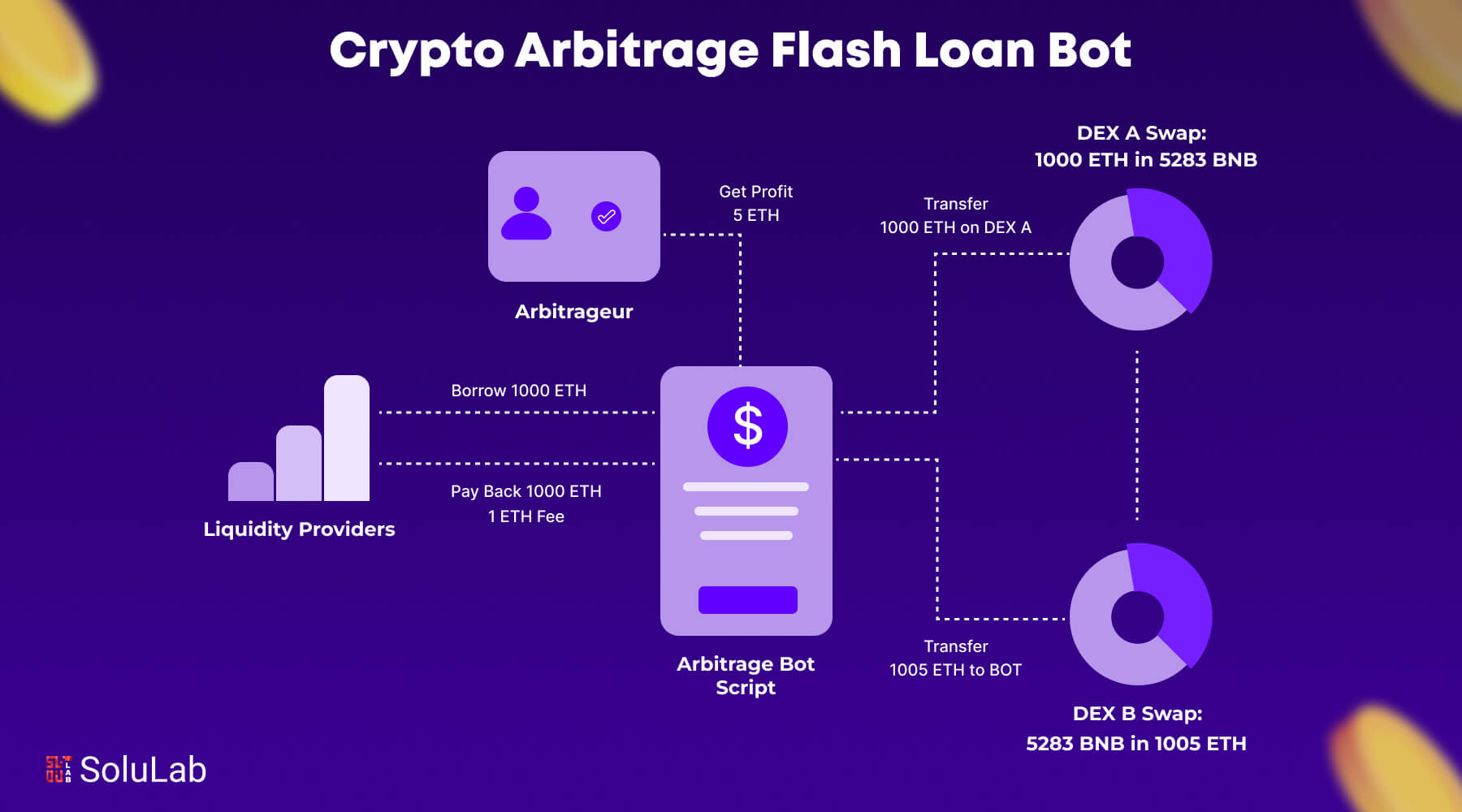
- Integrate flash loan capabilities where applicable to leverage additional liquidity and enhance arbitrage opportunities.
Performance Monitoring
- Create a detailed logging system that tracks each arbitrage opportunity, the parameters used for decision-making, transaction details, and profit metrics.
- Deploy a user-friendly dashboard or interface for real-time monitoring, strategy adjustments, and performance tracking.
- Include automated reporting of trade outcomes to continuously analyze bot efficiency and identify areas for algorithmic improvement.
5. Testing and Deployment
Pre-deployment Testing
- Utilize Ethereum testnets (such as Ropsten or Goerli) and simulated environments to run extensive testing before deploying the bot on the mainnet.
- Run simulations with historical data to validate trade logic and risk management protocols under various market conditions, ensuring the bot can handle both typical market fluctuations and extreme events.
- Use test-driven development (TDD) practices to create unit and integration tests for all critical modules, ensuring that every component functions as intended.
Deployment and Continuous Maintenance
- Begin by deploying the bot with a limited capital allocation, monitoring its real-world performance closely in the live environment.
- Implement robust feedback loops that allow for real-time adjustments to algorithm parameters and low-level system optimizations in response to observed performance.
- Schedule periodic patches and updates, including security reviews and performance optimizations, to ensure the bot remains effective in rapidly evolving market conditions.
6. User Interface and Documentation
Documentation
- Provide comprehensive documentation that includes a detailed explanation of the bot's architecture, setup instructions, and operational guidelines.
- Include developer commentary alongside the code, clear function-level comments, and high-level strategy descriptions to ensure easy future modifications and scalability.
User Dashboard
- Design an intuitive, web-based dashboard for managing and monitoring the bot’s operations.
- Integrate graphical visualizations such as trade logs, performance charts, and real-time price feeds to assist users in understanding active strategies and results.
7. Full System Architecture Outline
For clarity, use the following table as a high-level architectural overview that outlines the key components and their interactions:
| Component | Function | Technologies/Tools |
|---|---|---|
| Data Aggregation Module | Collects real-time pricing data from multiple exchanges | Web3.py, REST APIs, AMM formulas |
| Trading Algorithm | Calculates price discrepancies and determines profitable trades | Python, statistical models, machine learning |
| Smart Contract Executor | Executes trades autonomously on the Ethereum network | Solidity, MEV strategies, flash loans |
| Risk Management Unit | Implements stop-loss, circuit breakers, and error handling | Python, smart contract safeguards |
| User Interface | Provides a dashboard for monitoring traffic and performance | Web technologies (React, Angular), secure API endpoints |
| Testing and Deployment Module | Ensures robust simulation, testing, and phased deployment | Ethereum testnets, TDD frameworks, continuous integration |
Example Code Snippet
Below is an illustrative example of how you might set up a Python function to retrieve liquidity pool reserves from a decentralized exchange using Web3.py:
# /* Example: Retrieve liquidity pool reserves using Web3.py */
from web3 import Web3

# Connect to an Ethereum node (e.g., via Infura)
w3 = Web3(Web3.HTTPProvider("https://mainnet.infura.io/v3/YOUR_PROJECT_ID"))

# Define the smart contract address and ABI (simplified example)
exchange_address = "0xExch4ng3Addr355"
exchange_abi = [
    # Minimal ABI to get reserves (example)
    {"constant":True,"inputs":[],"name":"getReserves","outputs":[{"name":"reserve0","type":"uint112"},{"name":"reserve1","type":"uint112"}],"payable":False,"stateMutability":"view","type":"function"}
]

# Instantiate contract
exchange_contract = w3.eth.contract(address=exchange_address, abi=exchange_abi)

def get_pool_reserves():
    try:
        reserves = exchange_contract.functions.getReserves().call()
        reserve0 = reserves[0]
        reserve1 = reserves[1]
        return reserve0, reserve1
    except Exception as e:
        print("Error retrieving reserves:", e)
        return None

if __name__ == "__main__":
    reserves = get_pool_reserves()
    if reserves:
        print("Reserves:", reserves)
Note: Always perform thorough testing on testnets like Ropsten or Goerli before connecting the bot to the Ethereum mainnet with real funds.
Conclusion
This prompt provides a detailed blueprint for developing a highly efficient and secure crypto arbitrage bot on the Ethereum blockchain. By integrating real-time data aggregation, advanced trade execution mechanics, sophisticated risk management protocols, and a user-friendly dashboard, you can create a platform designed to profit from arbitrage opportunities while mitigating the risks inherent in high-frequency trading environments.
The guide outlines critical architectural components, technical modules, and best development practices—ensuring that even in a competitive market, the bot remains adaptive, secure, and profitable. Whether using machine learning algorithms to optimize trade timing or leveraging MEV strategies to maintain competitive edge, continuous testing and iterative improvements are the cornerstones of long-term success.
Final Thoughts
To succeed in building a profitable arbitrage bot, always keep security, speed, and precision in mind. Ensure that your trading algorithms are robust, your code is well-documented, and your deployment strategy minimizes risk. Monitor performance continuously and be prepared to adjust your strategies dynamically based on market conditions. This comprehensive approach will help you deploy a bot that not only performs well in simulation environments but can also thrive in the ever-evolving landscape of crypto trading.
References
Last updated February 17, 2025