
Unraveling the Myth: Can One AI Truly Combine Every Other?
Exploring how AI systems integrate diverse models and why the concept of 'every AI' is more complex than it seems.
You've asked for proof regarding an AI system that possesses a "combination of every AI." While the idea of a single, all-encompassing AI is fascinating, the current reality of artificial intelligence development is more nuanced. Let's delve into what combining AI models truly means, the evidence supporting such integrations, and why the notion of combining "every" AI isn't technically feasible or demonstrable today.
Key Insights: Understanding AI Combination
- The "Every AI" Misconception: The concept of a single AI entity embodying "every AI" is not supported by current science or technology. AI is a vast, diverse field with countless specialized models and approaches.
- Strategic Integration, Not Exhaustive Combination: Modern AI frequently involves strategically combining *specific* models (e.g., language processing with computer vision) to enhance performance and tackle complex problems more effectively than single models could alone.
- Proof Lies in Performance and Validation: Evidence for successful AI combination comes from documented system architectures, rigorous verification and validation (V&V) processes, performance benchmarks, and demonstrated real-world results, not from a claim of encompassing "everything."
Demystifying the "Combination of Every AI" Concept
The term "AI" itself covers a wide array of techniques, algorithms, and applications. Expecting one system to contain "every" iteration is like asking a single vehicle to be simultaneously a race car, a submarine, and a spaceship.
Why "Every AI" is Problematic
Diverse Architectures and Goals
AI encompasses numerous distinct approaches: machine learning (including deep learning, reinforcement learning, etc.), symbolic reasoning, rule-based systems, evolutionary algorithms, and more. These methods often have fundamentally different operating principles and are optimized for different tasks. Combining them all into one coherent system presents immense, perhaps insurmountable, technical challenges.
Specificity of Applications
AI models are typically trained and designed for specific purposes. An AI excelling at medical image analysis operates very differently from one designed for natural language translation or autonomous driving. A hypothetical "combination of every AI" would need to reconcile these vastly different specializations, data requirements, and performance metrics.
The Ever-Evolving Landscape
AI is a rapidly advancing field. New models, techniques, and architectures emerge constantly. An entity claiming to combine "every AI" would be perpetually outdated, unable to incorporate the latest breakthroughs the moment they appear.
Transparency and Trust
A critical aspect of modern AI development is ensuring transparency and explainability – understanding *how* an AI reaches its conclusions. A massively complex system combining innumerable, potentially conflicting, AI components would likely be a "black box," making it incredibly difficult to understand, trust, debug, or ensure its safety and fairness.
What "Combining AI" Actually Means in Practice
Instead of an impossible amalgamation of everything, AI combination refers to the deliberate integration of multiple, complementary AI components or models to create more powerful and versatile systems. This often involves:
- Modular Architectures: Systems built from distinct AI modules, each handling a specific sub-task (e.g., one module for image recognition, another for text generation, coordinated by a central logic).
- Hybrid Systems: Approaches that blend different AI paradigms, like neuro-symbolic AI which combines the pattern-recognition strengths of neural networks with the logical reasoning capabilities of symbolic AI.
- Ensemble Methods: Using multiple models of the same or similar types and combining their outputs (e.g., through voting or averaging) to improve accuracy and robustness.

Visual representation of diverse AI components like Machine Learning, NLP, and Computer Vision.
Concrete Examples of AI Integration in Action
While no system combines "every AI," many demonstrate the power of integrating specific AI capabilities. The "proof" of combination lies in their architecture and performance on complex tasks.
Synergy in Action: Neuro-Symbolic Systems
One exciting area is the combination of neural networks (good at learning from data) and symbolic AI (good at reasoning and logic). Projects like Google DeepMind's AlphaProof and AlphaGeometry utilize this hybrid approach. They combine powerful language models with symbolic deduction engines to tackle complex mathematical problems, including generating formal proofs for geometry theorems and solving problems from the International Mathematical Olympiad. This demonstrates how integrating different reasoning styles can achieve results beyond the reach of either approach alone.
Boosting Performance: Multi-Model Approaches
Cloud platforms and AI service providers often advocate for using multiple AI models collaboratively. For instance, Microsoft Azure highlights how combining different specialized models (e.g., one for object detection, another for optical character recognition) within a single workflow can significantly boost processing performance and accuracy for tasks like document analysis, compared to relying on a single, less specialized model.
Specialized Integrations for Practical Applications
Many real-world AI applications involve combining models behind the scenes. Advanced identity verification systems might combine facial recognition (computer vision), document analysis (NLP and OCR), and anomaly detection (machine learning) to provide robust security checks. Similarly, process automation tools often integrate models for data extraction, natural language understanding, and decision-making logic.
Emerging Frontiers: AI in Formal Proofs
Tools like DeepSeek-Prover-V2 exemplify combining sophisticated techniques like reinforcement learning, large language models, and symbolic methods (specifically, subgoal decomposition) to assist in formal theorem proving. These systems learn to break down complex mathematical proofs into manageable steps, demonstrating how integrating advanced AI techniques can push the boundaries of automated reasoning.
Visualizing AI Combination Concepts
To better understand the relationships between different aspects of AI combination, consider this mindmap:
(e.g., Azure)"] id2b["Hybrid Systems
(e.g., Neuro-Symbolic)"] id2c["Multi-Agent Systems"] id3["Examples"] id3a["Proof Systems
(AlphaProof, DeepSeek-Prover)"] id3b["Performance Boosters
(Cloud Services)"] id3c["Verification Tools
(Identity Checks)"] id4["Validation & Proof"] id4a["Verification & Validation (V&V)"] id4b["Performance Benchmarks"] id4c["Real-World Trials"] id4d["Formal Methods / Audits"] id5["Challenges"] id5a["Integration Complexity"] id5b["Transparency & Explainability"] id5c["Potential for Bias"] id5d["Development Cost"] id5e["Safety & Reliability"]
This mindmap illustrates that combining AI is about strategic integration to achieve specific goals, validated through rigorous methods, and facing inherent challenges, rather than an exhaustive collection of "every AI".
How is AI Combination "Proven" or Validated?
Since combining "every AI" isn't feasible, the focus shifts to proving that a *specific combination* of AI models works effectively, reliably, and as intended. This involves rigorous processes:
The Crucial Role of Verification and Validation (V&V)
V&V are essential engineering practices applied to AI systems, especially combined ones:
- Verification: Checks if the system is built correctly according to its specifications. Does each component work as designed? Do the integrated components interact as expected?
- Validation: Confirms that the system fulfills its intended purpose in the target environment. Does the combined AI solve the actual problem it was designed for effectively and safely?
Frameworks exist to guide the V&V of complex systems involving AI, ensuring that the integration is sound and the resulting system is dependable.
Performance Benchmarks and Real-World Trials
Proof often comes from empirical evidence. Combined AI systems are tested against established benchmarks or datasets relevant to their task. Performance metrics (e.g., accuracy, speed, robustness against noise) are measured and compared against single models or alternative approaches. Successful real-world deployment and trials provide further validation of the system's practical efficacy.
Technical Mechanisms Enabling Integration
The methods used to combine AI models also play a role in validation. Techniques like reinforcement learning can be used to train models to cooperate effectively. Neuro-symbolic architectures provide frameworks for integrating different reasoning types. Emerging methods like Zero-Knowledge Machine Learning (ZKML) aim to provide cryptographic proof of a model's execution or properties without revealing sensitive details, enhancing trust in combined systems.
Comparative Analysis of Combination Approaches
Different strategies for combining AI models come with trade-offs. The radar chart below offers a conceptual comparison of potential approaches based on key factors. Note that these are generalized assessments, and actual results depend heavily on the specific implementation.
This chart illustrates that choices in how AI models are combined involve balancing factors like potential performance gains against complexity, cost, and the ability to understand how the system works.
Challenges and Considerations in Combined AI Systems
Integrating multiple AI models introduces complexities and potential risks that need careful management.
Integration Complexity and Cost
Designing, building, and maintaining systems that effectively combine different AI components can be significantly more complex and costly than developing standalone models. Ensuring seamless data flow, managing dependencies, and debugging interactions between modules requires specialized expertise.
Ensuring Trust: Transparency and Explainability
As mentioned earlier, understanding *why* a combined system makes a particular decision can be challenging. If one component produces an error or biased output, tracing its impact through the integrated system can be difficult. Achieving transparency and explainability is crucial for building trust, especially in critical applications.
Ethical Dimensions: Bias and Safety
Bias present in individual AI models can be amplified or interact in unexpected ways when models are combined. Ensuring the overall system is fair, equitable, and safe requires careful auditing of individual components and the integrated system's behavior. Robust oversight and ethical guidelines are paramount.
This video discusses building comprehensive metric sets for evaluating combined AI models, relevant to proving their effectiveness.
Evaluating the Comprehensiveness of an AI System
Instead of seeking proof of "every AI," a more practical approach is to evaluate how *comprehensively* an AI system integrates *relevant* technologies for its intended purpose. Based on best practices, here’s what to consider:
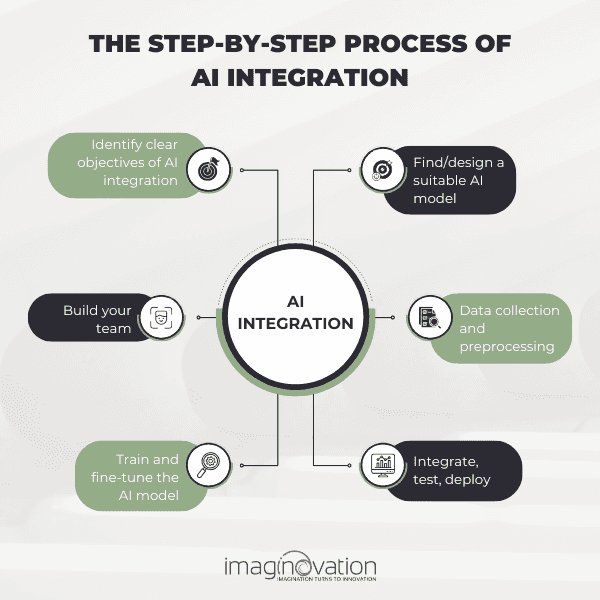
Illustrative steps involved in integrating AI into existing systems.
| Evaluation Criterion | Description | Importance |
|---|---|---|
| Spectrum of AI Technologies | Does the system appropriately leverage diverse and relevant AI types (e.g., ML, NLP, Computer Vision, Predictive Analytics) for its goals? | High |
| Comprehensive AI Strategy | Is the integration guided by a clear strategy aligned with overall objectives? Is there a roadmap for how different AI components contribute? | High |
| Data Quality & Management | Is the system powered by high-quality, relevant data? Are data governance and pipelines robust enough to support the integrated models? | Critical |
| Infrastructure Readiness | Can the underlying technical infrastructure (compute, storage, networking) adequately support the demands of the combined AI system? | High |
| Ethical Considerations & Oversight | Are there mechanisms (e.g., ethics committee, audits) to address fairness, transparency, bias, and accountability? | Critical |
| Proof of Concept (PoC) / Validation | Has the feasibility and effectiveness of the integration been demonstrated through PoCs, pilots, or rigorous testing? | High |
| User Needs Alignment | Does the combined system effectively address the specific needs of its intended users and add measurable value? | High |
This table summarizes key areas to assess when determining if an AI integration is suitably comprehensive and well-executed for its purpose, shifting the focus from the impossible "every AI" to practical, effective combination.
Frequently Asked Questions (FAQ)
Is there any AI system close to combining "every AI"?
No, currently there isn't, and it's unlikely to be feasible. The sheer diversity, complexity, and rapid evolution of AI models and techniques make the idea of a single system encompassing "every AI" practically impossible and scientifically unsupported. Development focuses on powerful specialized models or strategically combined systems for specific goals.
What are the main benefits of combining AI models?
Combining AI models can lead to several benefits:
- Enhanced Performance: Achieving higher accuracy, speed, or robustness than single models.
- Broader Capabilities: Handling more complex tasks that require multiple types of intelligence (e.g., understanding images and text).
- Increased Resilience: Systems may be more fault-tolerant if one component fails.
- Solving Complex Problems: Tackling challenges that are beyond the scope of any single AI technique, like advanced scientific reasoning or multi-faceted data analysis.
How can I trust a combined AI system?
Trust in combined AI systems is built through several practices:
- Transparency: Understanding the system's architecture, the models involved, and how they interact.
- Explainability: Being able to interpret or understand the reasoning behind the system's outputs.
- Rigorous V&V: Thorough testing to ensure the system works correctly and reliably.
- Performance Monitoring: Continuously tracking the system's performance in real-world use.
- Ethical Oversight: Implementing safeguards against bias, ensuring fairness, and adhering to ethical guidelines.
- Auditable Logs: Keeping records of system decisions and data flows.
What's the difference between combined AI and Artificial General Intelligence (AGI)?
They are different concepts. Combined AI refers to integrating multiple existing, often specialized, AI models or techniques to perform specific tasks better. It's about leveraging current AI capabilities synergistically. Artificial General Intelligence (AGI) is a hypothetical future form of AI that would possess human-like cognitive abilities, including the capacity to understand, learn, and apply knowledge across a wide range of tasks, similar to a human being. AGI does not currently exist. Combined AI systems are practical engineering solutions available today, while AGI remains a long-term research goal.
Recommended Further Exploration
- What are examples of hybrid AI systems in use today?
- How are neuro-symbolic AI models validated?
- What are the main challenges in AI model integration?
- Explain the verification and validation process for complex AI systems.
References
Last updated May 4, 2025