
Is Earth Really Shielded by a Giant Dome? Unpacking the Myths and Realities
From ancient skies to modern tech, discover the truth behind the concept of a protective dome over our planet.
Key Insights Unveiled
- Ancient Origins: The idea of a protective dome largely stems from ancient cosmology and religious texts describing the "firmament" as a solid celestial barrier.
- Scientific Reality: Modern science confirms no physical dome covers Earth; instead, our planet is protected by its multi-layered atmosphere.
- Modern Interpretations: The term "dome" is used metaphorically for advanced air defense systems and refers literally to engineered structures like geodesic or earth-sheltered homes offering localized protection.
The Firmament: A Glimpse into Ancient Skies
How Our Ancestors Viewed the Heavens
The concept of a protective dome over Earth finds its roots deep in antiquity, particularly in the ancient Near East. Cultures including the Hebrews, Akkadians, and Sumerians shared a cosmological view that included a "firmament." In Hebrew, the word is רָקִיעַ (rāqīaʿ), often translated as "firmament" or "expanse" in English Bibles.
A Solid Celestial Barrier?
In many ancient interpretations, particularly as found in the Genesis creation narrative (Genesis 1:6-8), the firmament was conceived as a vast, solid dome or vault. Its primary purpose was divinely ordained: to separate the "waters which were under the expanse from the waters which were above the expanse." This solid barrier was thought to hold back celestial waters, preventing them from flooding the world below. It was also seen as the structure within which celestial bodies – the sun, moon, and stars – were placed.
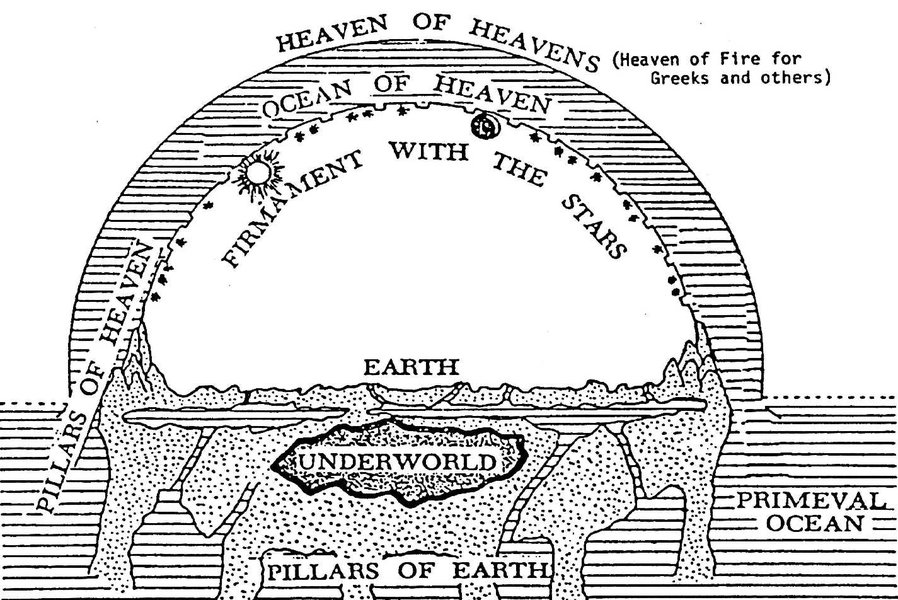
An illustration depicting the ancient Near Eastern cosmology, including a solid firmament separating the waters above from the Earth below.
Mythological Parallels
This idea wasn't unique to Hebrew thought. Sumerian mythology featured An, the god of the sky, representing the firmament separating Earth (Ki) from the heavens. In Greek mythology, the sky god Ouranos (Uranus) was sometimes envisioned as a solid dome, and in certain myths, the Titan Atlas was tasked with holding up this celestial sphere.
Interpretations: Dome or Expanse?
While older translations often imply a solid structure, modern biblical scholarship offers different perspectives. Some argue that rāqīaʿ simply means "expanse" – a vast space created by God's act of separation, not necessarily a physical, solid dome. This interpretation suggests the Genesis account focuses on God bringing order to chaos rather than providing a scientifically precise description of the cosmos. From this viewpoint, the ancient texts don't conflict with modern astronomy's understanding of the atmosphere and space.
The Scientific Verdict: No Literal Dome Found
What Really Protects Our Planet?
From the perspective of modern science, there is no physical, solid dome enclosing the Earth. Decades of space exploration, satellite observations, and astronomical study have provided overwhelming evidence against such a structure.
Earth's True Shield: The Atmosphere
Instead of a dome, Earth is enveloped by its atmosphere – a complex, multi-layered blanket of gases primarily composed of nitrogen (about 78%) and oxygen (about 21%), with trace amounts of other gases like argon, carbon dioxide, and neon. This atmosphere serves critical protective functions:
- It absorbs and scatters harmful solar radiation, particularly ultraviolet (UV) rays, thanks to the ozone layer.
- It moderates Earth's temperature, trapping heat to prevent extreme cold while also helping to distribute heat around the planet.
- It protects the surface from constant bombardment by smaller meteoroids, most of which burn up upon entry due to friction.
- It enables the weather cycles and contains the oxygen necessary for most life.
Natural and Artificial Barriers in Space
While not a solid dome, Earth's space environment does contain natural phenomena like the Van Allen radiation belts – zones of energetic charged particles trapped by Earth's magnetic field – which can pose risks to satellites and astronauts but also offer some shielding from cosmic rays. Interestingly, human activity has also created an unintended barrier. Very low frequency (VLF) radio communications, used for decades, have created a sort of bubble around Earth that pushes the Van Allen belts slightly farther away and offers some protection against high-energy particles from space. However, neither the natural Van Allen belts nor the VLF bubble constitutes a physical "dome" enclosing the planet.

An artist's depiction showing how human-generated VLF radio waves create a barrier within Earth's magnetosphere, affecting the Van Allen belts.
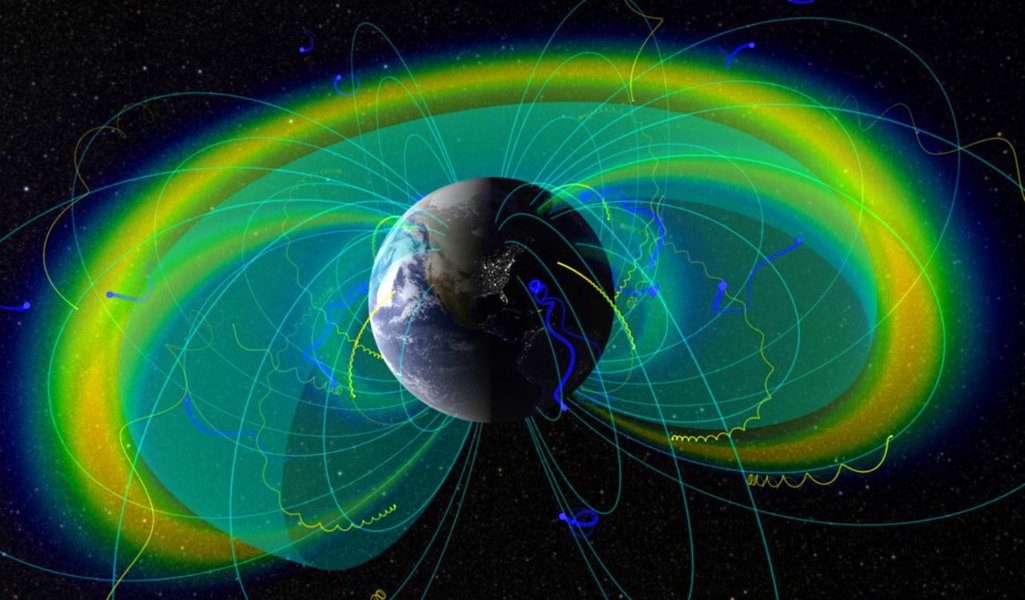
Illustration of the Van Allen Belts, natural zones of trapped radiation surrounding Earth, which act as a form of natural shielding but are not a solid barrier.
Evidence Against a Physical Dome
The absence of a physical dome is consistently verified:
- Space Exploration: Numerous spacecraft launched by NASA, ESA, Roscosmos, and other agencies have left Earth's atmosphere and traveled far into the solar system (e.g., Voyager probes, missions to Mars, Jupiter, etc.) without encountering any barrier.
- Satellite Orbits: Thousands of satellites orbit Earth at various altitudes, well beyond where any hypothetical dome would need to be, operating unimpeded.
- Human Spaceflight: Hundreds of astronauts have traveled to space and returned, including missions to the Moon and the International Space Station (ISS), passing freely through the atmosphere.
- Astronomical Observations: Images of Earth taken from space clearly show a spherical planet surrounded by an atmosphere, with no evidence of a dome-like structure.
Fact-checking organizations like Reuters have explicitly debunked modern claims, often associated with Flat Earth theories, that a literal dome or firmament covers the Earth. These claims lack any scientific basis and are contradicted by empirical evidence.
Metaphorical Domes: Modern Defense Technologies
Shielding Nations from Aerial Threats
In contemporary language, the term "dome" is often used metaphorically to describe sophisticated, large-scale air and missile defense systems. These systems don't form a physical barrier but rather a protective 'umbrella' using interconnected sensors, command centers, and interceptors.
Israel's Iron Dome
Perhaps the most famous example is Israel's Iron Dome. Developed by Rafael Advanced Defense Systems and Israel Aerospace Industries, it's designed to intercept and destroy short-range rockets, artillery shells, and mortar rounds fired from distances of 4 to 70 kilometers. It uses radar to detect incoming threats, predicts their trajectory and impact point, and launches interceptor missiles if the projectile is deemed a threat to a populated area. It's a highly effective, mobile system, but it provides localized, dynamic defense, not a constant physical shield.
The Proposed U.S. "Golden Dome"
More recently, the concept of a "Golden Dome" for the United States has entered discussions, particularly associated with proposals by figures like Donald Trump. This envisions a comprehensive, multi-layered missile defense shield protecting the U.S. homeland from various aerial threats, potentially including hypersonic missiles. It would likely involve integrating existing systems with new technologies like space-based sensors, advanced radars, and high-energy lasers. Like the Iron Dome, this is a conceptual defense network, not a literal dome.

A conceptual graphic related to the proposed "Golden Dome" missile defense system for the United States.
Tangible Domes: Engineering and Architecture
Real-World Structures Offering Protection
While a planet-encompassing dome is fictional, humans have long built dome-shaped structures for various protective purposes. Modern engineering offers innovative dome designs utilizing advanced materials and construction techniques.
Geodesic Domes
Popularized by Buckminster Fuller, geodesic domes are spherical or hemispherical structures based on a network of triangles. They are known for their inherent strength, stability, and efficient use of materials. Modern versions, often made from materials like polycarbonate or steel frames with durable coverings, offer excellent protection against wind, snow, and rain. Companies like Earth Domes and Pacific Domes manufacture these for various uses, including:
- Glamping and Housing: Providing comfortable, weather-resistant shelters.
- Greenhouses: Creating controlled environments for plants.
- Specialized Protection: Some domes are designed with materials that offer shielding against electromagnetic fields (EMF), aiming to reduce exposure to radiation from electronic devices and infrastructure.
Earth-Sheltered Domes
Another approach involves building dome structures partially or fully underground, using the earth itself as a natural insulator and protective layer. This technique, employed by systems like Terra-Dome or through methods like earthbag construction, creates highly energy-efficient buildings with excellent protection against extreme temperatures, storms, and noise.
This video showcases an example of an earth-sheltered dome home, demonstrating how modern construction techniques create protective, energy-efficient living spaces by integrating structures with the surrounding earth.
Other Protective Domes
Specialized domes serve niche protective roles, such as deployable domes made of flexible materials designed to shield spacecraft components from micrometeoroid impacts, or the large domes covering astronomical observatories to protect sensitive telescopes from the elements.

An astronomical observatory, featuring a protective dome that shields the telescope inside from weather and allows for precise sky viewing.
Comparing the "Domes": A Visual Analysis
Understanding the Different Concepts
To clarify the distinctions between the various concepts discussed, this radar chart compares them based on key attributes. The "Firmament" represents the ancient cosmological idea, the "Atmosphere" is Earth's actual protective layer, "Iron Dome" represents metaphorical defense systems, and "Geodesic Dome" represents tangible engineered structures. Scores are based on a qualitative assessment from 1 (Low/None) to 5 (High/Literal).
Mapping the Concepts: Dome Ideas Interconnected
Visualizing the Different Meanings
The idea of a "protective dome over Earth" branches into distinct categories, from ancient beliefs to modern technology. This mindmap illustrates the relationships between these concepts:
(Sumerian, Akkadian)"] id1a3["Solid barrier separating waters"] id1a4["Holds celestial bodies"] id1b["Mythological Parallels"] id1b1["Greek Mythology (Ouranos, Atlas)"] id1b2["Sumerian Mythology (An)"] id2["Scientific Perspective"] id2a["No Literal Physical Dome"] id2a1["Evidence: Space Exploration"] id2a2["Evidence: Satellite Orbits"] id2a3["Evidence: Human Spaceflight"] id2b["Earth's Actual Protection: Atmosphere"] id2b1["Composition (Nitrogen, Oxygen, etc.)"] id2b2["Functions: Filters Radiation (Ozone),
Moderates Temperature,
Blocks Meteoroids"] id2c["Natural/Artificial Phenomena (Not Domes)"] id2c1["Van Allen Belts (Natural Radiation Shield)"] id2c2["VLF Bubble (Human-Made Effect)"] id2d["Debunking Modern Misconceptions"] id2d1["Flat Earth Theories"] id3["Metaphorical Domes"] id3a["Modern Defense Systems"] id3a1["Israel's Iron Dome (Air Defense)"] id3a2["U.S. Golden Dome (Proposed Missile Defense)"] id3a3["Network of sensors & interceptors"] id4["Tangible Engineered Domes"] id4a["Geodesic Domes"] id4a1["Structural design (Triangles)"] id4a2["Uses: Housing, Glamping, Greenhouses"] id4a3["Protection: Weather, EMF Shielding"] id4b["Earth-Sheltered Domes"] id4b1["Utilizes earth for insulation/protection"] id4b2["Energy efficient"] id4b3["Examples: Terra-Dome, Earthbag"] id4c["Specialized Domes"] id4c1["Spacecraft Protection"] id4c2["Astronomical Observatories"]
Summary Table: Dome Concepts at a Glance
Comparing Key Characteristics
This table provides a quick comparison of the different types of "domes" discussed:
| Concept | Nature | Origin | Scale | Protective Function | Scientific Validity |
|---|---|---|---|---|---|
| Firmament | Solid Celestial Barrier (Belief) | Ancient Cosmology / Religious Texts | Global (Enclosing Earth) | Separate Waters, Hold Stars (Mythological) | Not scientifically supported as a physical entity |
| Atmosphere | Layer of Gases | Natural Planetary Feature | Global (Surrounding Earth) | Filters Radiation, Moderates Temp, Blocks Meteoroids | Scientifically confirmed protective layer |
| Iron Dome / Golden Dome | Metaphorical Defense Network | Modern Military Technology | Regional / National | Intercepts Rockets/Missiles | Technologically real systems (Iron Dome) or concepts (Golden Dome) |
| Engineered Domes (Geodesic, Earth-Sheltered) | Physical Structure | Human Engineering / Architecture | Local (Building Scale) | Shelter from Weather, Insulation, EMF Shielding (Specific Designs) | Real, constructed objects based on scientific/engineering principles |
Frequently Asked Questions
Quick Answers to Common Questions
Is the biblical firmament a real, physical dome?
So, Earth definitely doesn't have a literal dome covering it?
What actually protects Earth from the dangers of space?
What is the Iron Dome I hear about in the news? Is it a real dome?
Are geodesic domes or earth-sheltered homes related to the ancient firmament concept?
Recommended Further Exploration
- How does Earth's atmosphere protect us from solar radiation?
- What is the scientific evidence against the Flat Earth theory?
- Compare the Iron Dome with other missile defense systems.
- What are the benefits of living in an earth-sheltered home?
References
Last updated April 27, 2025