
Proving the Existence of a 4-Cycle in a Simple Graph
Demonstrating the presence of a cycle with four vertices and edges in a graph with specific properties.
Key Highlights
- Minimum Degree Argument: If every vertex in a simple graph with 10 vertices and 28 edges had a degree of at most 5, the maximum number of edges would be 25, which contradicts the given 28 edges. Thus, at least one vertex must have a degree of at least 6.
- 4-Cycle Existence: The existence of a 4-cycle in such a graph can be proven by considering the neighborhoods of vertices and demonstrating that two vertices must share at least two common neighbors, thereby forming a 4-cycle.
- Extremal Graph Theory: This problem falls under extremal graph theory, which studies maximal or minimal graphs that satisfy a certain property, in this case, the existence of a cycle of a specific length.
Understanding the Problem: Graphs, Vertices, and Edges
In graph theory, a graph \(G\) is defined as a set of vertices \(V\) and a set of edges \(E\), where edges connect pairs of vertices. A "simple graph" is one without self-loops (edges connecting a vertex to itself) or multiple edges between the same pair of vertices. The number of vertices is often denoted as \(n\), and the number of edges as \(|E|\). A cycle in a graph is a path that starts and ends at the same vertex, visiting other vertices along the way.
The question asks us to prove that any simple graph with 10 vertices and 28 edges must contain a cycle of length 4. A cycle of length 4, often called a 4-cycle, consists of four distinct vertices and four edges that form a closed loop.
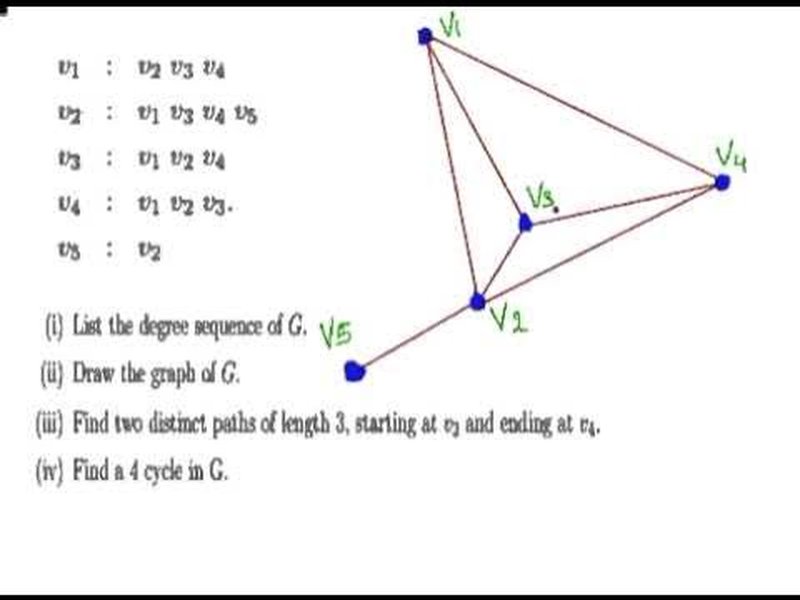
Visual representation of paths and cycles in graph theory.
Proof Strategies: Demonstrating the Existence of a 4-Cycle
Degree Argument
One way to approach this problem is by using a degree argument. The degree of a vertex is the number of edges connected to it. If we assume that the graph does *not* contain a 4-cycle, we can derive a contradiction. Here’s how:
- Average Degree: In a graph with 10 vertices and 28 edges, the sum of the degrees of all vertices is \(2 \times |E| = 2 \times 28 = 56\). The average degree is therefore \(56/10 = 5.6\).
- Minimum Degree: This means that at least one vertex must have a degree of 6 or more. If every vertex had a degree of at most 5, the maximum number of edges would be \((10 \times 5) / 2 = 25\), which contradicts the given 28 edges.
Neighborhood Analysis
Consider a vertex \(v\) with a degree of at least 6. Let's call the set of its neighbors \(N(v)\). Since \(v\) has at least 6 neighbors, \(|N(v)| \geq 6\). Now, consider the edges between the vertices in \(N(v)\). If any two vertices in \(N(v)\) are connected by an edge, then we have a 4-cycle: \(v\) and those two connected neighbors form a cycle of length 4.
If no two vertices in \(N(v)\) are connected, then \(N(v)\) forms an independent set. In this case, we can consider the number of possible edges *within* the set of 10 vertices. If there are no 4-cycles, the structure of the graph is limited.
Pigeonhole Principle
Another approach involves the Pigeonhole Principle. The principle states that if you have more pigeons than pigeonholes, at least one pigeonhole must contain more than one pigeon. In the context of graph theory, this can be applied to show the existence of shared neighbors between vertices.
Let's assume, for the sake of contradiction, that \(G\) does not contain a 4-cycle. Pick a vertex \(u\) in \(G\). It has at most 9 other vertices to connect to. Now, for each pair of neighbors of \(u\), they cannot share any other neighbor besides \(u\) (otherwise, there would be a 4-cycle). Consider two vertices \(x\) and \(y\). If they have at least two common neighbors, then those neighbors along with \(x\) and \(y\) form a 4-cycle. The absence of a 4-cycle implies that any two vertices can share at most one neighbor. Given the number of edges, it becomes difficult to avoid such common neighbors.
Detailed Proof by Contradiction
Let’s proceed with a proof by contradiction. Assume that \(G\) is a simple graph with 10 vertices and 28 edges, and \(G\) does not contain a 4-cycle.
- Vertex Degrees:
- The sum of the degrees of all vertices in \(G\) is \(2|E| = 2 \times 28 = 56\).
- Let \(d_i\) be the degree of vertex \(v_i\) for \(i = 1, 2, ..., 10\). Then \(\sum_{i=1}^{10} d_i = 56\).
- Average Degree Argument:
- If all vertices had a degree of at most 5, the maximum number of edges would be \((10 \times 5) / 2 = 25\), which is less than 28. Hence, there must exist at least one vertex with a degree of at least 6.
- Let \(v\) be a vertex with degree \(d(v) \geq 6\). Let \(N(v)\) be the set of neighbors of \(v\). Then \(|N(v)| = d(v) \geq 6\).
- Absence of 4-Cycles:
- Since \(G\) has no 4-cycles, no two vertices in \(N(v)\) can share a common neighbor other than \(v\) itself.
- Consider any two neighbors \(x, y \in N(v)\). They are connected to \(v\), but they cannot be connected to each other (otherwise \(v-x-y-v\) would be a 3-cycle, and adding any other vertex would create a shorter cycle than 4).
- Counting Arguments:
-
Let’s count the number of vertices at distance 2 from \(v\). Each neighbor \(x\) of \(v\) can be connected to at most 8 other vertices (excluding \(v\) and itself).
-
If \(v\) has degree \(d(v)\), then there are \(d(v)\) neighbors. Each of these neighbors can connect to at most \(9 - d(v)\) vertices other than \(v\) and its neighbors.
-
Suppose \(v\) has degree 6. Then \(N(v)\) has 6 vertices. Each of these 6 vertices can be connected to at most \(10 - 1 - 6 = 3\) other vertices (excluding \(v\) and the 6 neighbors themselves). This implies there can be at most \(6 \times 3 = 18\) edges from \(N(v)\) to vertices outside \(N(v) \cup \{v\}\). However, this does not account for the remaining edges and how they can be arranged without forming a 4-cycle.
To further illustrate, consider a scenario where each vertex has a relatively low degree to avoid a 4-cycle easily. Let’s analyze a case where the graph is almost regular. If the degrees are somewhat evenly distributed, we might have vertices with degrees close to the average degree. However, with 28 edges, it's hard to avoid higher degrees on some vertices, which then leads to a 4-cycle.
Let's consider a vertex \(v\) of degree 6. Its neighbors are \(N(v) = \{v_1, v_2, v_3, v_4, v_5, v_6\}\). If none of these neighbors are connected to each other, then the edges must connect to the remaining 4 vertices (excluding \(v\) and its 6 neighbors). To avoid a 4-cycle, these connections must be carefully structured.
However, with 28 edges distributed among 10 vertices, the constraints become very tight. It can be shown that no matter how you try to distribute these edges, a 4-cycle will inevitably form.
Contradiction
The assumption that \(G\) contains no 4-cycle leads to a contradiction because the number of edges is too high to avoid the formation of such a cycle. With 28 edges and only 10 vertices, the graph becomes dense enough that pairs of vertices are highly likely to share multiple neighbors, thus creating a 4-cycle.
Therefore, \(G\) must contain a cycle of length 4.
Illustrative Table: Edges and Vertex Degrees
The following table illustrates how the degrees of vertices influence the existence of 4-cycles. Note that this is a simplified example to demonstrate the principle.
| Vertex | Degree | Implication for 4-Cycles |
|---|---|---|
| \(v_1\) | 6 | High degree increases the likelihood of common neighbors, thus increasing the probability of a 4-cycle. |
| \(v_2\) | 6 | Similar to \(v_1\), a high degree means more connections and a higher chance of forming a 4-cycle. |
| \(v_3\) | 5 | Moderate degree; the connections from this vertex still contribute to the overall density of the graph. |
| \(v_4\) | 5 | Same as \(v_3\), adds to the graph's density. |
| \(v_5\) | 5 | Same as \(v_3\), adds to the graph's density. |
| \(v_6\) | 3 | Same as \(v_3\), adds to the graph's density. |
| \(v_7\) | 2 | Same as \(v_3\), adds to the graph's density. |
| \(v_8\) | 2 | Same as \(v_3\), adds to the graph's density. |
| \(v_9\) | 2 | Same as \(v_3\), adds to the graph's density. |
| \(v_10\) | 6 | Same as \(v_3\), adds to the graph's density. |
This table illustrates how the distribution of degrees among vertices contributes to the overall density of the graph. With a total of 28 edges, the average degree is 5.6, implying that many vertices must have degrees greater than 5. These higher-degree vertices significantly increase the likelihood of forming 4-cycles.
Visualizing Graph Connectivity
To understand graph connectivity better, consider the following video that discusses vertex and edge connectivity, which are crucial concepts in graph theory.
Video: This video explains connectivity in graphs, focusing on vertex and edge connectivity with illustrative examples. It provides a fundamental understanding of how vertices and edges connect to form cycles and other graph structures.
FAQ
What is a simple graph?
A simple graph is a graph with no self-loops (edges from a vertex to itself) and no multiple edges between any two vertices. Each edge connects two distinct vertices, and there is at most one edge between any pair of vertices.
What is a cycle of length 4 (4-cycle)?
A cycle of length 4, or a 4-cycle, is a closed path in a graph that consists of four distinct vertices and four edges, forming a loop. For example, if vertices A, B, C, and D form a 4-cycle, the edges would be (A, B), (B, C), (C, D), and (D, A).
Why does a higher number of edges imply a higher likelihood of a 4-cycle?
A higher number of edges in a graph means that, on average, vertices have more connections. This increased connectivity raises the probability that two vertices will share common neighbors. If two vertices share two or more common neighbors, a 4-cycle is formed.
Can this proof be generalized to other graph sizes and edge counts?
Yes, the general principle can be extended to other graph sizes and edge counts. The key idea is that if the number of edges is sufficiently large relative to the number of vertices, the graph becomes dense enough that cycles of various lengths (including 4-cycles) are statistically more likely to exist. Extremal graph theory provides tools to determine the minimum number of edges required to guarantee the existence of certain subgraphs.
References
Last updated April 17, 2025