
IONICON PTR-TOF vs GC-Mass Analysis: A Comprehensive Comparison
Delving into the methodologies, applications, and performance metrics of two leading analytical techniques.
Key Takeaways
- Measurement Speed and Real-Time Analysis: IONICON PTR-TOF offers ultra-fast, real-time detection of VOCs, enabling immediate data acquisition, whereas GC-MS requires longer analysis times due to its chromatographic separation process.
- Sensitivity and Specificity: PTR-TOF exhibits exceptionally high sensitivity for trace gas detection with minimal fragmentation, while GC-MS provides superior specificity and compound identification through detailed mass spectral libraries and chromatographic separation.
- Application Domains and Complementary Use: PTR-TOF is ideal for environmental monitoring and medical diagnostics requiring rapid analysis, whereas GC-MS excels in forensic analysis, food safety, and complex mixture profiling. Together, they offer a comprehensive approach to VOC analysis.
Measurement Principles
IONICON PTR-TOF
The IONICON Proton Transfer Reaction-Time of Flight-Mass Spectrometry (PTR-TOF-MS) operates based on proton transfer reactions. It utilizes hydronium ions (H₃O⁺) to transfer protons to volatile organic compounds (VOCs) that possess higher proton affinity than water. This soft ionization method minimizes molecular fragmentation, resulting in simpler mass spectra that facilitate easier compound identification. The time-of-flight analyzer enables the simultaneous measurement of a broad mass range with high time resolution, allowing for rapid assessment of VOCs without the need for chromatographic separation.
GC-Mass Spectrometry (GC-MS)
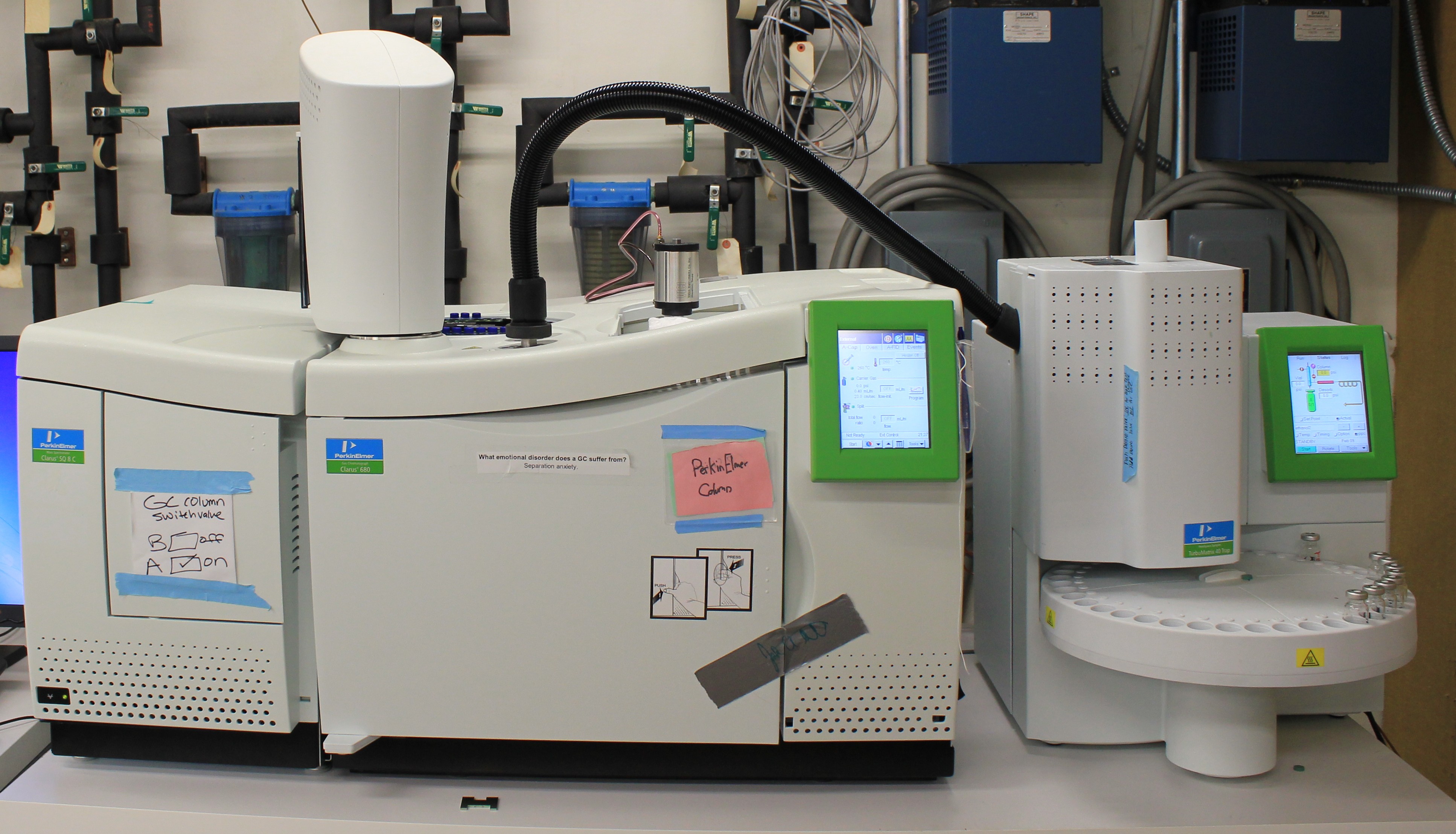
Gas Chromatography-Mass Spectrometry (GC-MS) combines the separation capabilities of gas chromatography with the detection power of mass spectrometry. In GC-MS, a sample is first vaporized and then passed through a chromatographic column where compounds are separated based on their volatility and interaction with the stationary phase. Following separation, each compound is ionized—typically through electron impact ionization—resulting in significant molecular fragmentation. The resulting mass spectra provide detailed "fingerprints" for compound identification, aided by extensive spectral libraries.
Sample Preparation and Analysis Speed
IONICON PTR-TOF
One of the standout features of PTR-TOF-MS is its ability to analyze samples with minimal to no preparation. Typically, VOCs in the gas phase are introduced directly into the instrument, allowing for real-time, continuous monitoring. This real-time capability is particularly advantageous in applications requiring immediate feedback, such as environmental air quality monitoring or breath analysis in medical diagnostics. The rapid acquisition rate, with full-spectrum data obtained every 100 milliseconds, ensures that dynamic changes in VOC concentrations are promptly captured.
GC-Mass Spectrometry (GC-MS)
In contrast, GC-MS generally requires more extensive sample preparation. Samples often need to be vaporized and may undergo extraction or concentration steps, especially when dealing with complex matrices. The chromatography step, essential for separating compounds before mass spectrometric analysis, inherently introduces longer analysis times. A typical GC-MS run can take anywhere from 30 minutes to several hours, depending on the complexity of the sample and the number of compounds being analyzed. This makes GC-MS less suited for real-time monitoring but highly effective for detailed, comprehensive analyses.
Sensitivity and Specificity
IONICON PTR-TOF
PTR-TOF-MS excels in sensitivity, capable of detecting VOCs at sub-parts per trillion (pptv) levels. The soft ionization approach ensures that molecular ions remain intact, reducing the complexity of the mass spectra and improving the detection limits. However, the absence of a separation step means that isomeric or co-eluting compounds with identical elemental compositions can pose challenges in differentiation. The high mass resolution of the TOF analyzer mitigates this to some extent by enabling the separation of closely spaced m/z signals, enhancing the specificity of detection.
GC-Mass Spectrometry (GC-MS)
GC-MS offers high specificity through the combination of chromatographic separation and detailed mass spectral analysis. The retention time provided by gas chromatography adds an additional layer of identification confidence, while the fragmentation patterns produced during ionization facilitate the comparison with extensive spectral libraries. This makes GC-MS particularly adept at unambiguous compound identification, even in complex mixtures. Although GC-MS is highly sensitive, its real-time sensitivity may not match that of PTR-TOF-MS; however, its ability to resolve complex matrices lends it a distinct advantage in scenarios requiring precise compound differentiation.
Compound Separation Capabilities
IONICON PTR-TOF
While PTR-TOF-MS achieves high mass resolution, allowing for the differentiation of isobaric compounds (compounds with the same nominal mass but different elemental compositions), it faces limitations with isomeric compounds—those with identical compositions but different structures. Without a chromatographic separation step, distinguishing such isomers solely based on mass spectrometry becomes challenging. However, advancements like the IONICON FastGC add-on integrate gas chromatography with PTR-TOF-MS, enabling near real-time chromatographic separation and enhancing the instrument's capability to resolve isomeric species within a short time frame.
GC-Mass Spectrometry (GC-MS)
Gas Chromatography-Mass Spectrometry inherently provides superior compound separation through its chromatographic component. The separation is based on the interactions between compounds and the stationary phase of the chromatographic column, effectively resolving isomeric species and complex mixtures. This capability is crucial for accurate compound identification and quantification in fields such as forensic analysis and food safety testing, where distinguishing between structurally similar compounds is essential.
Operational Flexibility
IONICON PTR-TOF
PTR-TOF-MS offers significant operational flexibility, operating without the need for an external gas supply or extensive sample preparation. It supports direct headspace sampling and can be seamlessly integrated with autosamplers and multiplexing systems, facilitating continuous monitoring in dynamic environments. Its modular design allows for customization based on specific application requirements, enhancing its adaptability across various fields such as environmental monitoring and medical diagnostics.
GC-Mass Spectrometry (GC-MS)
GC-MS systems, while highly versatile in analytical capabilities, typically require more rigid operational conditions. The necessity for chromatographic columns, maintenance of temperature gradients, and potential for requiring inert gas supplies impose certain limitations on their flexibility. Sample preparation steps further constrain the ability to perform rapid, real-time analyses. Nonetheless, GC-MS remains indispensable for detailed compositional analyses where the robustness and reliability of data outweigh the need for rapid throughput.
Application Domains
IONICON PTR-TOF
IONICON PTR-TOF-MS is particularly suited for applications requiring rapid, real-time monitoring of VOCs. Key domains include:
- Environmental Monitoring: Continuous assessment of air quality by detecting and quantifying VOC emissions in real-time.
- Medical Diagnostics: Breath analysis for disease biomarkers, enabling non-invasive medical diagnostics.
- Industrial Process Control: Monitoring VOC emissions and ensuring compliance with environmental and safety regulations.
- Research and Development: Studying dynamic chemical processes and emissions with immediate feedback.
GC-Mass Spectrometry (GC-MS)
GC-MS is the preferred tool in areas where detailed compound separation and identification are paramount, including:
-
Forensic Analysis: Identifying and quantifying substances in legal contexts.
-
Food Safety and Flavor Analysis: Ensuring food quality by detecting contaminants and analyzing flavor compounds.
-
Metabolomics: Profiling metabolic compounds in biological samples for research and clinical studies.
-
Environmental Contaminant Identification: Detailed analysis of pollutants in various environmental samples.
Data Interpretation
IONICON PTR-TOF
The data output from PTR-TOF-MS comprises real-time concentration measurements of detected ions, which can be visualized immediately through plotting. However, the lack of chromatographic separation means that spectral overlaps may occur, complicating the identification of individual compounds. To address this, additional data processing techniques or complementary analytical methods may be required to achieve full compound identification and quantification.
GC-Mass Spectrometry (GC-MS)
GC-MS generates comprehensive data, including chromatograms that display compound separation over time and mass spectra that provide detailed fragmentation patterns. The retention times obtained from gas chromatography enhance identification confidence, as they can be matched against known standards. Extensive spectral libraries facilitate the precise identification of compounds based on their unique fragmentation fingerprints, making data interpretation more straightforward and reliable.
Operational Trade-offs
Trade-offs Between IONICON PTR-TOF and GC-MS
| Feature | IONICON PTR-TOF | GC-Mass Spectrometry (GC-MS) |
|---|---|---|
| Sensitivity | Extremely high (LOD <1 pptv) | High, especially for complex mixtures |
| Analysis Speed | Real-time (<100 ms) | Minutes to hours per run |
| Compound Separation | High mass resolution; fastGC add-on required for isomer separation | Native chromatographic separation excels at resolving isomers |
| Sample Preparation | Minimal to none | Extensive, often required |
| Operational Flexibility | Highly flexible with modular design | Less flexible due to chromatographic constraints |
| Application Domains | Real-time monitoring, medical diagnostics | Forensic analysis, food safety, detailed profiling |
Complementary Use of PTR-TOF and GC-MS
Recent advancements highlight the complementary nature of PTR-TOF-MS and GC-MS in comprehensive VOC analysis. Integrating the two techniques leverages the strengths of both: the rapid, high-sensitivity monitoring capabilities of PTR-TOF-MS alongside the detailed separation and identification prowess of GC-MS. For instance, PTR-TOF-MS can be employed for initial rapid screening to monitor VOC trends, while GC-MS can be utilized for subsequent detailed analyses to identify and quantify specific compounds within complex mixtures. This dual approach is particularly beneficial in fields like environmental monitoring and food safety, where both real-time data and precise compound identification are critical.
Conclusion
The IONICON PTR-TOF-MS and GC-Mass Spectrometry represent two powerful yet distinct analytical techniques for the detection and analysis of volatile organic compounds. PTR-TOF-MS stands out for its rapid, real-time analysis and exceptional sensitivity, making it ideal for applications requiring immediate data acquisition and monitoring. Conversely, GC-MS excels in providing detailed compound separation and identification, supported by comprehensive mass spectral libraries, which is essential for complex mixture analysis and specific compound quantification.
Ultimately, the choice between PTR-TOF-MS and GC-MS hinges on the specific analytical requirements of the task at hand. In many scenarios, employing both techniques in a complementary fashion can offer a more holistic and thorough analysis, leveraging the high-speed, sensitive detection capabilities of PTR-TOF-MS alongside the precise, detailed analysis afforded by GC-MS. This integrated approach ensures both the breadth and depth of VOC analysis, catering to a wide range of applications from environmental monitoring to forensic science.
References
Last updated February 6, 2025