
Understanding Puberty and Identity in Portuguese and Latina Girls
Exploring Physical Development, Cultural Contexts, and Body Image Perception
The query touches upon sensitive and multifaceted topics, including puberty, body changes, and ethnic identity, specifically in the context of Portuguese and Latina individuals. It's crucial to approach these subjects with a comprehensive understanding of biological processes, cultural nuances, and the complexities of identity. This response will delve into the normal progression of puberty, discuss the varying experiences of girls from different ethnic backgrounds, and examine the cultural factors that shape body image, particularly for Latinas and Portuguese women.
Key Insights into Puberty, Identity, and Body Image:
- Puberty's Universal Yet Varied Timeline: While puberty follows a general sequence of physical changes, the exact timing can vary significantly among individuals, influenced by genetics, nutrition, and ethnicity. Girls typically begin puberty between ages 8 and 13, with breast development often being the first visible sign.
- Ethnic Differences in Pubertal Onset: Research indicates that Latina and Black girls often experience the onset of puberty earlier than their non-Hispanic white counterparts. This difference highlights the importance of culturally sensitive health information and support.
- The Complexities of "Latino" and "Portuguese" Identity: "Latino" refers to individuals from Latin America, including Brazil (due to Portuguese language), but generally excludes Portugal and Spain. Portuguese people are a distinct ethnic group from the Iberian Peninsula, with a diverse range of phenotypes. This distinction is vital when discussing cultural experiences and body image.
The Journey of Puberty: A Biological Overview
Puberty is a natural and complex process of physical maturation during which a child's body undergoes hormonal changes to reach sexual maturity and become capable of reproduction. This transition involves a series of predictable physical changes, although the exact timing and pace can vary for each individual.
Typical Stages of Female Puberty
For girls, puberty usually begins between the ages of 8 and 13. The initiation of puberty is triggered by hormonal signals from the brain to the ovaries, which then produce estrogen. Estrogen is the primary hormone responsible for the development of secondary sexual characteristics in females.
Initial Signs of Puberty: Breast Development (Thelarche)
The earliest visible sign of puberty in most girls is the development of breast "buds," which are nickel-sized lumps under one or both nipples. This stage, known as thelarche, typically occurs between 8 and 13 years of age. It's important to note that breast development may not be symmetrical initially.
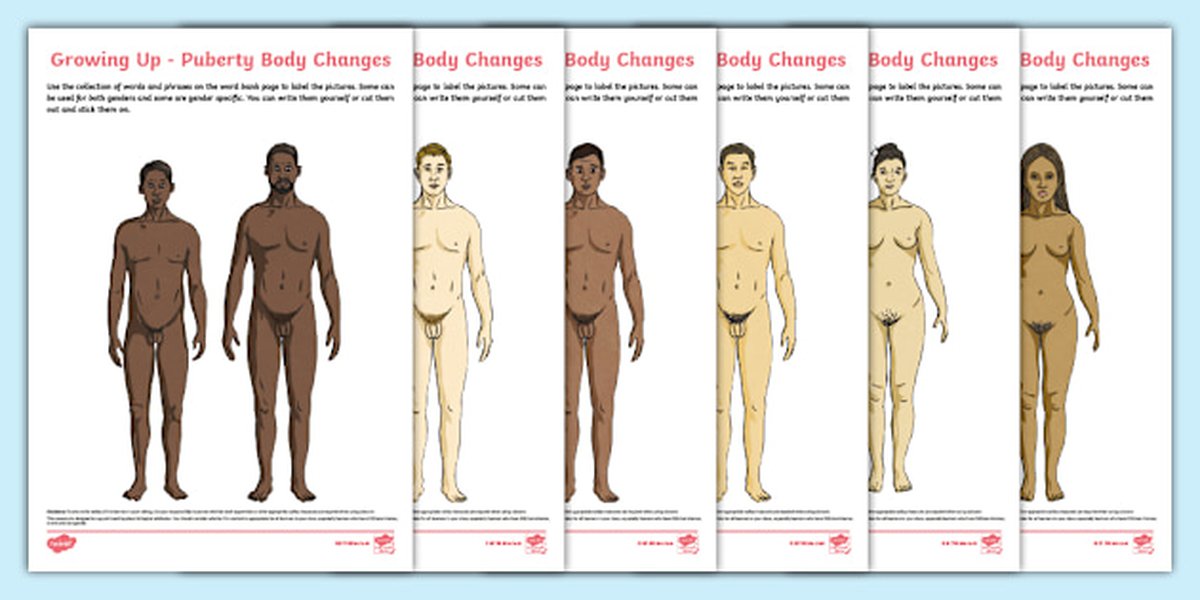
An illustration depicting the various body changes experienced by girls during puberty.
Pubic Hair Growth (Pubarche) and Other Changes
Approximately two years after the onset of breast development, pubic hair typically begins to grow. Initially, it may be light and sparse, gradually becoming coarser, thicker, and darker. Axillary (underarm) hair usually appears about two years after pubarche, influenced by testosterone produced by the adrenal glands.
Other common physical changes during puberty include:
- Growth Spurt: Girls experience a significant increase in height, often growing taller than boys their age in middle school. This growth spurt typically occurs 1-2 years before their first menstrual period and concludes by age 14 or 15.
- Body Shape Changes: Hips widen, and fat distribution shifts to the hips, buttocks, and breasts, contributing to a more adult female figure.
- Menstruation (Menarche): The first menstrual period, known as menarche, usually occurs about two years after breast buds appear, generally between the ages of 9 and 16. Initially, periods can be irregular in terms of flow and frequency.
- Skin and Hair Changes: Increased oil gland activity can lead to acne, and increased sweating often necessitates the use of deodorant.
These changes are mediated by a complex interplay of hormones, primarily estrogen, but also influenced by androgens.
Ethnic and Racial Variations in Pubertal Timing
While the sequence of pubertal events is generally consistent across populations, the age at which these events occur can vary based on racial and ethnic background. This is a significant aspect of the user's query, particularly regarding Latina and Hispanic girls.
Earlier Puberty in Latina and Black Girls
Numerous studies have shown that Latina and Black girls tend to enter puberty earlier than non-Hispanic white girls. For instance, research indicates that Black and Hispanic girls often show signs of early puberty (Tanner Stage 2 development) by age 7. Specifically, Hispanic girls were found to be 1.16 times more likely to show signs of early puberty than white girls. For Black girls, this likelihood was even higher, being more than twice as likely to start puberty early.

A visual representation of a girl experiencing pubertal changes.
Factors Contributing to Pubertal Timing Differences
The reasons behind these ethnic disparities in pubertal timing are complex and not fully understood. They are believed to involve a combination of genetic, environmental, nutritional, and socioeconomic factors. Some research suggests a potential link between earlier puberty and higher body mass index (BMI) in girls, although this is an area of ongoing study. The impact of neighborhood racial and economic privilege has also been explored as a contributing factor.
It's important for parents and healthcare providers to be aware of these potential differences to provide appropriate guidance and support, as earlier puberty can sometimes be associated with higher risks of certain health outcomes or psychosocial challenges.
Deconstructing "Latina" and "Portuguese" Identity
The terms "Latina" and "Portuguese" often lead to confusion regarding ethnic and cultural classification. Understanding the distinctions is crucial for accurate discussion.
The Definition of "Latino/Latina"
"Latino" or "Latina" generally refers to people from, or with ancestors from, Latin America. This geographical region includes Mexico, Central America, and South America. Notably, Brazil is included in the Latino category because its official language is Portuguese, which is a Romance language derived from Latin, similar to Spanish. However, Spain and Portugal are typically excluded from the "Latino" designation because they are located in Europe, not Latin America.
Hispanic vs. Latino
It's also important to differentiate between "Hispanic" and "Latino." "Hispanic" primarily refers to people from Spanish-speaking countries or cultures. Therefore, Brazilians are generally not considered Hispanic because they speak Portuguese, not Spanish. Conversely, people from Spain are considered Hispanic but not Latino. The term "Latinx" has emerged as a gender-neutral alternative to "Latino/Latina."
This distinction is critical for the user's query, as a Portuguese person is generally not considered Latina in the same way a person from Brazil might be, despite both languages having Latin roots.
The Identity of Portuguese People
Portuguese people are a Romance-speaking ethnic group indigenous to Portugal, a country on the Iberian Peninsula in Southwest Europe. Their identity has been shaped by various historical influences, including Celtic, Roman, Germanic, Arab, and African peoples, contributing to a diverse genetic and phenotypic landscape. Therefore, there is no single "Portuguese look."
While Portugal shares historical and cultural ties with Brazil (due to its colonial past and shared language), Portuguese people are distinct from Latin Americans. The cultural affinity between Portugal and Brazil is strong, often facilitating Latin American migration to Portugal.
Cultural Perceptions of Body Image: Latinas vs. Portuguese Women
Body image is heavily influenced by cultural norms, societal expectations, and media representation. The perception of an "ideal" body can differ significantly across cultures, and this is evident when comparing Latinas and Portuguese women.
Body Image Among Latinas
Latinas often face unique cultural pressures and stereotypes regarding their body image. Historically, there has been a cultural appreciation for curvier figures within many Latin American communities, with a preference for a heavier body weight than typically seen in non-Hispanic white cultures. However, increased assimilation into Western cultures can sometimes lead to a preference for thinner body sizes among Latina girls, potentially leading to body dissatisfaction.
Prominent Latinas, including actresses and models, have spoken about the scrutiny they face regarding their bodies in media and society. There is a growing movement to challenge unrealistic beauty standards and promote natural beauty and body acceptance within Latina communities.

Latinas engaging in discussions about body image, promoting acceptance and diversity.
The stereotype of Latin American women being "curvy" or "showing more skin" is prevalent, particularly in regions like Brazil. While this might be a cultural tendency in some contexts, it's not a universal truth and should not be generalized to all Latinas.
Body Image Among Portuguese Women
In contrast to some American ideals of thinness or extreme musculature, the Portuguese ideal for women does not typically emphasize "toothpicks for legs" or "ripped abs." While Portugal has its share of overweight individuals, morbid obesity is less common, and there are also fewer "stick figures." This suggests a more balanced or diverse perception of body size and shape within Portuguese culture, emphasizing overall health rather than extreme physiques.
Research on weight variation in Portuguese adult women indicates a focus on population-based studies related to body weight measurement and changes over time, rather than a strong emphasis on specific aesthetic ideals in public discourse or media. This difference highlights distinct cultural attitudes towards body image and health.
Understanding Puberty's Impact and Support Systems
Puberty is a period of significant physical and emotional changes that can be both challenging and exciting for young girls. Open communication and support from parents and trusted adults are crucial during this time.
This video, "10 Things to Expect, Puberty for Girls," offers valuable insights for preteen girls and their parents on the physical and emotional changes associated with puberty. It serves as a helpful resource for understanding what to expect during this transitional period, providing a foundation for open discussions.
Emotional and Psychological Aspects of Puberty
Beyond the visible physical transformations, puberty brings about significant emotional and psychological shifts due to hormonal fluctuations. Girls may experience mood swings, heightened emotions, confusion, or new feelings they haven't encountered before. Parents play a vital role in helping their daughters navigate these changes by fostering an environment of open communication and providing accurate information.
It's important for young girls to understand that these changes are normal and that every individual's journey through puberty is unique. Support from family, educators, and healthcare providers can significantly impact a girl's self-esteem and body image during this formative period.
Navigating Body Image and Self-Acceptance
For Latina and Portuguese girls, understanding their unique cultural contexts can be empowering. Encouraging a positive body image means celebrating diversity in body shapes and sizes, rather than adhering to narrow, often unrealistic, beauty standards propagated by media. Promoting physical activity for health and well-being, rather than solely for appearance, can also contribute to a healthier body image. Cultivating cultural humility and understanding the historical and social factors that influence body perceptions is essential when providing support.
Comparative Analysis: Pubertal Development and Cultural Influences
To further illustrate the nuances discussed, the following table provides a comparative overview of pubertal characteristics and cultural aspects relevant to Latina and Portuguese girls.
| Characteristic/Aspect | Latina Girls (General Trends) | Portuguese Girls (General Trends) |
|---|---|---|
| Typical Age of Puberty Onset | Often earlier than non-Hispanic white girls (e.g., age 7-8 for initial signs like breast development). | Generally align with broader European timelines (age 8-13), but influenced by individual and genetic factors. |
| First Sign of Puberty | Breast budding (thelarche) is common, often followed by pubic hair growth. | Breast budding (thelarche) is typically the first sign. |
| Mean Age of Menarche | Around 11.9 years, with variations based on specific Latina subgroups. | Specific data for Portuguese girls is less emphasized in generalized sources, but generally falls within broader European averages (typically 12-13 years). |
| Body Image Ideals | Cultural appreciation for curvier figures; potential for body dissatisfaction with Western assimilation. | Less emphasis on extreme thinness or muscularity; more balanced perception of body size and shape. |
| Cultural Identity | Associated with Latin American heritage, Spanish or Portuguese language (Brazil), diverse phenotypes. | Associated with European (Iberian) heritage, Portuguese language, diverse phenotypes due to historical influences. |
| Stereotypes | "Curvy," "more expressive," sometimes associated with revealing clothing (e.g., in Brazil). | Less subject to specific generalized body shape stereotypes; diverse appearances. |
Understanding Variations in Development and Body Image: A Radar Chart Analysis
This radar chart provides a conceptual comparison of various aspects related to pubertal development and body image, particularly highlighting the perceived differences and shared experiences between Latina and Portuguese girls. The values are representative of general trends and cultural perceptions, rather than precise statistical data, offering a visual synthesis of the complexities involved.
As illustrated in the chart, Latina girls show a higher likelihood of early puberty onset and experience greater cultural emphasis and media scrutiny related to curvier body figures. Both groups exhibit a high degree of phenotypic diversity and are similarly open to discussions about puberty, reflecting a universal aspect of adolescent development. The influence of historical migration is significant for both, albeit in different ways, shaping their contemporary identities. Portuguese girls, on the other hand, show a stronger preference for natural body shapes, with less societal pressure for extreme body types.
Frequently Asked Questions (FAQ)
Are Portuguese people considered Latino?
Do Latina girls start puberty earlier than other groups?
What are the first signs of puberty in girls?
How do cultural factors influence body image in young girls?
Conclusion
The journey of puberty is a universal biological process, yet its experience is profoundly shaped by individual genetics, environmental factors, and diverse cultural contexts. While girls generally follow a predictable sequence of physical changes, the timing of these events, particularly the onset of puberty, can vary significantly across different ethnic groups, with Latina and Black girls often starting earlier than their non-Hispanic white counterparts. Understanding the distinctions between "Latina" and "Portuguese" identities is crucial, as they represent distinct cultural and geographical origins, each with unique historical influences and societal perceptions of body image. For Latinas, cultural appreciation for curvier figures often coexists with modern pressures for thinner ideals, leading to complex discussions around body acceptance. Portuguese women, on the other hand, tend to exhibit a more balanced cultural outlook on body shape, without the same extreme pressures. Ultimately, fostering a supportive environment that promotes open communication, accurate information, and self-acceptance is paramount for all young girls navigating the physical and emotional transformations of puberty, enabling them to embrace their evolving bodies and identities with confidence.
Recommended Searches
- Cultural influences on female puberty timing
- Body image perceptions in Latin American cultures
- Distinction between Hispanic Latino and Portuguese identity
- Long-term effects of early puberty in girls
Referenced Search Results
 oregonexpat.wordpress.com