
Unlocking Piezoelectricity: How Stretching Transforms PVDF, Influenced by Solution and Print Parameters
Discover the intricate process of polyvinylidene fluoride (PVDF) autopoling through mechanical stress, and the critical roles of its preparation and fabrication.
Polyvinylidene fluoride (PVDF) stands out as a remarkable fluoropolymer, prized for its piezoelectric, pyroelectric, and ferroelectric properties. These characteristics make it invaluable in a wide array of applications, from sensors and actuators to energy harvesting devices and advanced filtration membranes. A key to unlocking PVDF's full piezoelectric potential lies in promoting its electroactive β-phase. "Autopoling" refers to the phenomenon where this desirable β-phase, with its aligned molecular dipoles, is induced through mechanical stretching, often eliminating the need for traditional high-voltage electrical poling. This process is not just a matter of simple mechanics; it is profoundly influenced by the initial solution parameters from which PVDF films or fibers are cast, as well as the print parameters if additive manufacturing techniques are employed.
Key Insights into PVDF Autopoling
- Mechanical Stretching is Paramount: The core of autopoling lies in uniaxially or biaxially stretching PVDF, which forces a transformation from its common non-polar α-phase to the highly polar, piezoelectric β-phase.
- Solution Chemistry Dictates Precursor Quality: The choice of solvent, polymer concentration, and solution preparation methods significantly impacts the initial crystallinity and morphology of the PVDF material, directly affecting its responsiveness to stretching.
- Print Parameters Fine-Tune for Additive Manufacturing: In 3D printing or electrospinning, parameters like extrusion temperature, print speed, and layer height can pre-align polymer chains or affect crystalline structure, influencing the efficiency of subsequent autopoling via stretching.
The Science Behind Stretching-Induced Autopoling
The piezoelectricity in PVDF is predominantly attributed to its β-crystalline phase, where the polymer chains adopt an all-trans (TTTT) conformation. This arrangement results in the fluorine and hydrogen atoms being positioned on opposite sides of the carbon backbone, leading to a net dipole moment perpendicular to the chain axis. Autopoling through stretching effectively encourages the formation and alignment of these dipoles.
Phase Transformation: From Alpha (α) to Beta (β)
When PVDF is initially processed (e.g., cast from a solution or extruded), it often crystallizes primarily in the non-polar α-phase, which has a trans-gauche-trans-gauche (TGTG') chain conformation. This phase is not piezoelectric.

Molecular structures of (a) α-phase (TGTG') and (b) β-phase (TTTT) PVDF. The β-phase is crucial for piezoelectric properties.
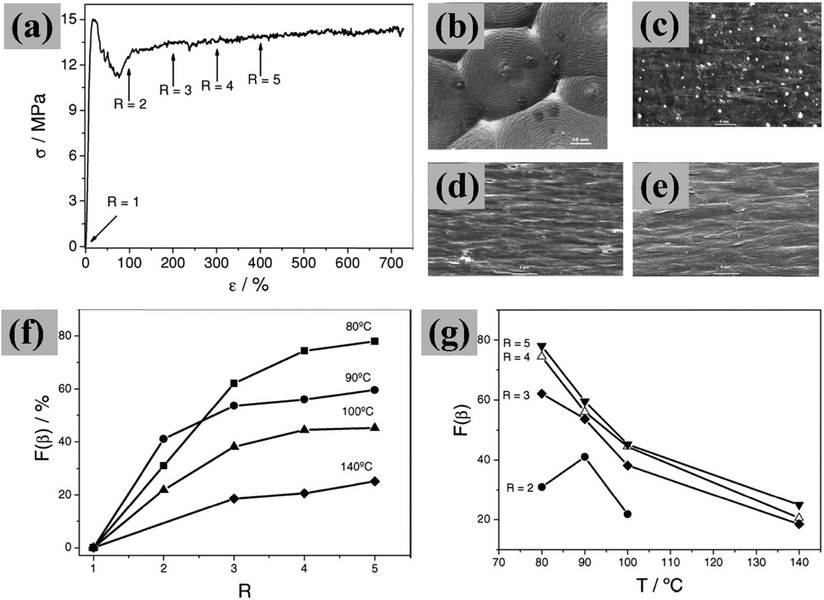
Mechanical stretching, typically at elevated temperatures, provides the necessary energy and molecular mobility for the polymer chains to uncoil and reorient. This process facilitates the transformation from the kinetically favored α-phase to the thermodynamically stable, all-trans β-phase. The degree of this transformation is critical for the resulting piezoelectric response.
Chain Alignment and Dipole Orientation
During uniaxial stretching, the PVDF molecular chains are extended and aligned along the direction of the applied stress. This alignment is crucial because it orients the C-F dipoles associated with the β-phase. As the chains align, these dipoles also tend to align, leading to a net macroscopic polarization in the material – the essence of autopoling. The material becomes spontaneously polarized without the need for an external electric field, although subsequent electrical poling can sometimes further enhance the properties.
Schematic illustration of the stretching process where PVDF chains transition from a folded α-phase to an extended β-phase, aligning dipoles.
Critical Stretching Parameters
- Stretch Ratio: Typically, a stretch ratio of 3 to 5 times the original length (300-500% elongation) is effective. Higher ratios generally lead to a greater β-phase content.
- Stretching Temperature: This is a vital parameter. Stretching is usually performed at temperatures between 70°C and 100°C. An optimal temperature, often cited around 80-87°C, maximizes chain mobility for phase transformation while avoiding material damage.
- Stretching Rate: A controlled draw rate, for example, around 50 mm/min, allows for optimal molecular alignment without introducing defects or causing premature rupture of the film.
The Pivotal Role of Solution Parameters
The journey to effective autopoling begins long before stretching, starting with the preparation of the PVDF solution. The characteristics of this solution significantly influence the morphology, crystallinity, and defect density of the cast film or electrospun fiber, which in turn dictates its response to mechanical stretching.
Solvent System Selection
The choice of solvent is critical for dissolving PVDF and achieving a homogeneous solution. Common solvents include N,N-dimethylformamide (DMF), N-methyl-2-pyrrolidone (NMP), acetone, and triethyl phosphate (TEP).
- Solvent Polarity and Volatility: These properties affect the dissolution process and the rate of solvent evaporation during film casting, influencing the resulting crystalline structure and surface morphology.
- Solvent Mixtures: Sometimes, mixtures of solvents (e.g., DMF/acetone) are used. For instance, an 8:2 DMF:acetone ratio has been shown to reduce bead formation in electrospun fibers and can promote the formation of the β-phase even before stretching due to interactions between the solvent and PVDF chains.
Polymer Concentration and Solution Viscosity
The concentration of PVDF in the solution directly impacts its viscosity. Typical concentrations range from 12 wt% to over 30 wt%.
- Chain Entanglement: Higher concentrations lead to increased viscosity and greater chain entanglement. Sufficient entanglement is necessary for effective stress transfer during stretching, promoting the α to β phase transformation.
- Processability: Viscosity must be optimized for the chosen processing method (e.g., casting, electrospinning). Too low a viscosity might result in defective films, while too high a viscosity can impede processing.
Solution Preparation and Casting Conditions
- Dissolution Temperature and Time: PVDF often requires heating (e.g., 50-60°C) and stirring for extended periods to ensure complete dissolution and a homogeneous solution.
- Film Casting and Drying: Films are typically cast onto a substrate (like glass) and then dried. Initial drying at room temperature (e.g., for 24 hours) helps prevent shrinkage, followed by drying at elevated temperatures (e.g., 70°C for several hours) to ensure complete solvent removal. These conditions affect film thickness and uniformity, which are crucial for consistent stretching.
Impact of Print Parameters in Additive Manufacturing
Additive manufacturing techniques, such as Fused Filament Fabrication (FFF) or electrospinning, offer pathways to create complex PVDF structures. The printing parameters themselves can influence the initial crystalline phase and molecular orientation, thereby affecting the subsequent autopoling process via stretching.
Fused Filament Fabrication (FFF) Parameters
- Extrusion Temperature: Typically ranging from 230°C to 260°C. Lower extrusion temperatures within this range have sometimes been associated with a higher initial β-phase content in the printed PVDF, as higher temperatures might relax chain alignments. It's crucial not to exceed 350°C to avoid toxic fume release.
- Print Bed Temperature: A heated bed (75°C to 100°C) is essential to minimize warping, improve layer adhesion, and manage shrinkage during cooling.
- Print Speed and Flow Rate: Slower print speeds often yield better quality and more precise deposition. However, some studies suggest faster extrusion rates can enhance shear forces, potentially promoting chain alignment and initial β-phase formation.
- Layer Height: Common layer heights are around 50 microns. Thin layers can contribute to better uniformity.
- In-situ Poling/Applied Voltage: While the focus here is on autopoling by stretching, some advanced 3D printing setups explore in-situ electrical poling during the printing process, which can also influence β-phase content.
- Environmental Control: Using an enclosed or heated chamber is recommended, especially for larger prints, to maintain a stable printing environment and reduce warping.
Electrospinning Parameters
For electrospun PVDF fibers, parameters like applied voltage, solution flow rate, and collector distance significantly affect fiber diameter, morphology, and the initial β-phase content, which then influences how these nanofiber mats respond to post-spinning stretching.
Visualizing Parameter Impact on Autopoling
The effectiveness of PVDF autopoling is a multifactorial outcome. The radar chart below provides a qualitative representation of how various parameters might influence key aspects of the process, such as β-phase content and overall piezoelectric performance. Higher scores indicate a stronger positive influence or critical importance.
This chart illustrates that parameters like stretch ratio and stretching temperature have a very high impact on both β-phase formation and final piezoelectric performance. Solution and print parameters, while also important, often serve to create an optimal precursor material that can then be effectively transformed by the stretching process.
Interconnected Factors in PVDF Autopoling
The following mindmap illustrates the key relationships between material properties, processing steps, and the desired outcome of autopoled PVDF with enhanced piezoelectricity.
This mindmap visually summarizes how various inputs and process controls converge to achieve autopoling in PVDF, ultimately leading to materials with significant piezoelectric capabilities suitable for advanced applications.
Consolidated Parameters for Effective PVDF Autopoling
Achieving optimal autopoling in PVDF requires careful control over a sequence of parameters. The table below summarizes typical conditions and their effects at different stages of the process.
| Parameter Stage | Parameter | Typical Value/Condition | Primary Effect |
|---|---|---|---|
| Solution Preparation | Solvent | DMF, NMP, TEP, Acetone (or mixtures) | Ensures PVDF dissolution, influences film morphology and initial phase. |
| PVDF Concentration | ~12-32 wt% | Affects solution viscosity, chain entanglement, and processability. | |
| Dissolution | Heating (e.g., 50-60°C) with stirring | Ensures homogeneous solution. | |
| Film Casting / Fiber Formation | Drying/Annealing | Room temp (e.g., 24h), then 70°C (e.g., 3-4h) | Complete solvent removal, film stabilization, influences crystallinity. |
| Film Thickness | ~10–50 µm for films | Impacts uniformity of stretching and stress distribution. | |
| Print Parameters (FFF Example) | Extrusion Temperature | 230–260°C | Affects melt flow, layer adhesion, and initial molecular orientation. Lower end may favor β-phase. |
| Bed Temperature | 75–100°C | Improves adhesion, reduces warping. | |
| Print Speed / Layer Height | Speed e.g., ~20 mm/s; Layer e.g., ~50 µm | Controls deposition quality, potential for shear-induced alignment. | |
| Mechanical Stretching | Stretch Ratio | 3–5 times original length (300-500%) | Drives α to β phase transformation and chain alignment. |
| Stretching Temperature | 70–100°C (optimal ~80-87°C) | Facilitates chain mobility for phase change, maximizes β-phase content. | |
| Stretch Rate | ~50 mm/min | Controls rate of molecular alignment, prevents defects. | |
| Post-Treatment | Thermal Annealing (Optional) | 50–120°C post-stretch | Can enhance crystallinity and stabilize β-phase domains. |
PVDF Processing and Applications in Action
Understanding the processing of PVDF, including aspects relevant to its use in additive manufacturing, provides context for how these material properties are harnessed. The following video discusses PVDF filament for 3D printing, touching upon material characteristics and printing considerations that form the basis for subsequent property enhancements like autopoling.
This video provides insights into FluorX™ PVDF filament, including its printing characteristics, which are foundational for applications requiring subsequent stretching and poling.
By carefully selecting solution components, optimizing casting or printing conditions, and precisely controlling the mechanical stretching process, PVDF materials can be engineered to exhibit significant autopoling. This leads to enhanced piezoelectric performance without the complexities of external high-voltage poling, opening doors for more efficient and versatile smart material applications.
Frequently Asked Questions (FAQ)
What is PVDF autopoling?
Why is the β-phase of PVDF important?
How does stretching temperature affect autopoling?
Can solution parameters alone induce the β-phase?
How do 3D printing parameters influence PVDF autopoling?
Conclusion
The autopoling of polyvinylidene fluoride through mechanical stretching is a sophisticated interplay of material science and process engineering. By inducing the critical transformation from the non-polar α-phase to the electroactive β-phase, and aligning the molecular dipoles, significant piezoelectric properties can be achieved without external electrical poling. The success of this process is deeply rooted in the careful control of initial solution parameters—such as solvent choice, polymer concentration, and preparation methods—and, when applicable, print parameters in additive manufacturing. These factors collectively determine the precursor material's quality and its responsiveness to the carefully controlled conditions of stretching, including temperature, ratio, and rate. Mastering these variables allows for the fabrication of high-performance PVDF components for a diverse range of advanced technological applications.
Recommended Further Exploration
- Explore a detailed comparison of different solvents and their specific impact on promoting the β-phase in PVDF during solution casting.
- Investigate the quantitative effects of varying stretch ratios and temperatures on the final piezoelectric coefficient (d33) of autopoled PVDF films.
- Learn about the influence of incorporating nanofillers (like CNTs or BaTiO3) on the autopoling behavior and piezoelectric response of PVDF composites.
- Discover advanced characterization techniques (e.g., in-situ XRD, Raman mapping) used to analyze the dynamics of phase transformation in PVDF during stretching.